Dental Code D3230: A Complete Guide to Pulpal Protection
If you have ever sat in the dentist’s chair and heard the words “deep cavity” or “close to the nerve,” you know that slight pang of anxiety. You might be wondering what happens next. Will you need a root canal? Is that tooth going to be okay?
This is where modern dentistry has some incredibly effective, minimally invasive solutions. One of the most common procedures performed to save a tooth from more serious treatment is a pulp cap. And if you are looking at your treatment plan or an insurance Explanation of Benefits (EOB), you might see it listed as Dental Code D3230.
But what does that code actually mean? Why do you need it? And most importantly, what is it going to cost?
Let’s break down everything you need to know about D3230. We will look at the procedure from the perspective of your tooth’s health, your wallet, and your peace of mind. Consider this your friendly, reliable guide to understanding one of dentistry’s most common “hero” procedures.
What is Dental Code D3230?
Let’s start with the basics. In the world of dentistry, every procedure has a specific code. These are known as CDT codes (Current Dental Terminology). They are the universal language that dentists use to communicate with insurance companies about exactly what work was performed.
Dental Code D3230 is officially defined as: Pulp cap on permanent tooth, direct (excluding final restoration).
That sounds very clinical, doesn’t it? Let’s translate that into plain English.
Imagine your tooth has a cavity. The dentist drills out the decay. Sometimes, that decay has gotten very, very deep—so deep that it almost reaches the pulp. The pulp is the soft tissue core of your tooth, containing the nerves and blood vessels. If bacteria reach the pulp, you get an infection, leading to extreme pain and the need for a root canal.
A “direct pulp cap” is a procedure designed to prevent that from happening. If the dentist removes the decay and a tiny pinpoint spot of the pulp is exposed (or is dangerously close to being exposed), they place a special medicated material directly over that spot to seal it and protect it.
Think of it like a first-aid bandage for the inside of your tooth. It soothes the nerve, encourages it to heal, and forms a protective barrier against future bacteria.
Important Note: The code specifically says “excluding final restoration.” This means the D3230 code covers only the pulp capping procedure itself. The filling, crown, or other restoration you need to rebuild the tooth afterward will be billed under separate codes.
D3230 vs. D3220: What’s the Difference?
This is where people often get confused. You might also hear about D3220. While they sound similar, they are used for different types of teeth.
-
D3220: Therapeutic pulpotomy (with removal of coronal pulp) on permanent teeth. This is a more involved procedure usually for teeth with irreversible damage, often done on baby teeth, but it has a code for permanent teeth as well.
-
D3230: Direct pulp cap on a permanent tooth. This is a less invasive procedure for a tooth that is still healthy but needs a little help healing.
To keep it simple, D3230 is specifically for permanent teeth (the ones you keep for life) when the procedure is a direct cap to seal a small exposure.
When is a Direct Pulp Cap (D3230) Necessary?
You won’t wake up one morning and realize you need a pulp cap. It is a procedure that is discovered during a restorative visit. Dentists don’t typically plan for a D3230 ahead of time; it’s a clinical decision made in the moment.
Here are the most common scenarios where D3230 comes into play:
1. The Deep Cavity Surprise
You go in for a simple filling. The X-rays showed a cavity that looked manageable. However, once the dentist starts drilling, they realize the decay runs deeper than the X-ray suggested. It’s creeping toward the nerve. To be safe and ensure the long-term health of the tooth, they perform a pulp cap before placing the filling.
2. Traumatic Injury
Have you ever fallen and chipped a tooth? If the chip is large enough to expose the inner dentin or a small part of the pulp, a direct pulp cap can be used to immediately seal the exposed area. This prevents bacteria from entering the tooth through the fresh break.
3. During Crown Preparations
Sometimes, when a dentist is shaving down a tooth to place a crown, the grinding can bring them very close to the pulp. If a small “pink spot” (the beginning of the pulp) becomes visible, they will perform a pulp cap to protect it before taking the impression for the crown.
The Step-by-Step Procedure: What to Expect
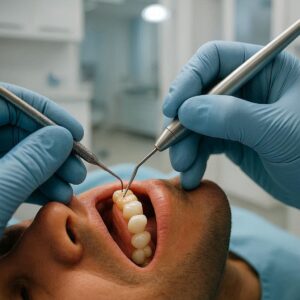
If your dentist tells you they need to perform a direct pulp cap, try not to panic. It is a routine procedure that adds only a few minutes to your appointment. Here is what happens from the moment you’re in the chair.
Step 1: Isolation with a Dental Dam
Because keeping bacteria out is the entire point of a pulp cap, the area needs to be perfectly clean and dry. Your dentist will likely place a rubber dam. This is a small sheet of latex (or non-latex) that isolates the tooth. It keeps your saliva away from the open cavity.
Step 2: Complete Decay Removal
The dentist will use a drill and other hand instruments to meticulously remove all decay and bacteria from the tooth. This is a delicate process. They have to ensure the tooth is clean while preserving as much healthy tooth structure as possible.
Step 3: Assessing the Exposure
Once the cavity is clean, the dentist looks closely. If they see a tiny speck of red (the pulp) or if the area looks extremely thin and wet, they know the pulp is very close. This is the moment they decide a pulp cap is needed.
Step 4: Placing the Medicament
This is the core of the D3230 procedure. The dentist applies a biocompatible material directly over the exposed or nearly-exposed area.
-
Calcium Hydroxide: A classic material that stimulates the formation of secondary dentin (repair tissue).
-
MTA (Mineral Trioxide Aggregate): A modern, highly effective material that provides an excellent seal and is very biocompatible.
This material soothes the nerve and encourages it to heal and create a protective layer of hard tissue over itself.
Step 5: The Base Layer
A layer of glass ionomer or another sedative material is often placed over the medicament. This acts as a cushion and provides additional insulation.
Step 6: The Final Restoration
Remember the code excludes this part. Now that the pulp is protected, the dentist will fill the rest of the tooth. This could be composite resin (tooth-colored filling), amalgam, or they might prepare the tooth for a crown if the damage was extensive.
Recovery and Success Rates
One of the best things about a direct pulp cap is the recovery. Because it is minimally invasive relative to a root canal, you shouldn’t expect major pain afterward.
What You Might Feel:
-
Mild Sensitivity: It is common to have some sensitivity to cold or pressure for a few days or even a couple of weeks. The nerve has been irritated, and it needs time to calm down.
-
Pain Management: Over-the-counter pain relievers like ibuprofen or acetaminophen are usually enough to manage any discomfort.
-
Chewing: Try to chew on the other side of your mouth until the sensitivity subsides.
How Successful Is It?
This is the million-dollar question. The success of a D3230 procedure depends on several factors:
-
The Size of the Exposure: A tiny “pinpoint” exposure has a very high success rate. A larger exposure is riskier.
-
The Health of the Pulp: Was the pulp healthy before the procedure? If it was already inflamed and infected, the cap might fail.
-
The Seal: The final filling or crown must be perfect. If bacteria leak back into the tooth, the pulp cap will fail.
Generally, success rates for direct pulp caps in permanent teeth are quite high, often cited in dental literature as being between 70% and 90% when done under ideal conditions.
Signs of Failure
Sometimes, despite the dentist’s best efforts, the pulp cap doesn’t work. If the nerve was too damaged, it may die. You should contact your dentist if you experience:
-
Spontaneous pain (pain that starts without any trigger).
-
Pain that keeps you awake at night.
-
Swelling in your gums near the tooth.
-
Extreme pain when biting down.
If this happens, the nerve is dying, and you will likely need a root canal (D3310) to save the tooth.
The Financial Aspect: Cost and Insurance for D3230
Let’s talk about money. Dental treatment can be expensive, so understanding the costs and coverage is vital.
How Much Does D3230 Cost?
The fee for the pulp cap procedure itself is separate from the filling or crown.
-
Typical Range: You can expect the fee for D3230 to range from $50 to $150 depending on your geographic location and the specific dentist’s fees.
-
It’s a Modest Fee: Compared to the cost of a root canal (which can be $800-$1,500+) plus a crown, the D3230 fee is very reasonable. It is a small investment to potentially save you from a much larger one down the road.
Insurance Coverage for D3230
Coverage varies wildly between insurance plans. Here is a realistic breakdown of what you might see:
| Coverage Scenario | What It Usually Means |
|---|---|
| Plan A: Preventive/ Basic Mix | Many plans classify pulp caps as a “basic” restorative procedure. They might cover 70% to 80% after you meet your deductible. |
| Plan B: Major Classification | Some insurance companies consider any pulp treatment (even a cap) to be a “major” procedure. They might only cover 50%, or it might fall under a separate benefit maximum. |
| Plan C: The “Wrap-In” | Because the D3230 fee is relatively low, some insurance companies won’t even pay separately for it. They “wrap” the cost of the procedure into the fee for the final filling. You might not see a separate line item payment for D3230 on your EOB, even though the dentist performed it. |
Advice: Always ask your dentist’s office to send a pre-determination of benefits to your insurance company if you are concerned about cost. They can tell you exactly what your plan will pay.
D3230 vs. Root Canal: A Critical Comparison
It is helpful to understand where D3230 fits in the spectrum of treatment. It is the least invasive option, and a root canal is the most invasive (short of extraction).
| Feature | Direct Pulp Cap (D3230) | Root Canal (Endodontic Therapy) |
|---|---|---|
| Invasiveness | Minimal. Only the decay is removed. | High. The entire nerve chamber is cleaned out. |
| Purpose | To heal and preserve the existing nerve. | To remove a dead or dying nerve. |
| Number of Visits | Usually 1 visit for the cap and filling. | Usually 1-2 visits, plus a separate visit for a crown. |
| Relative Cost | Low ($50 – $150 + filling). | High ($800 – $2,000+ including crown). |
| Tooth Structure | Maximum tooth structure is saved. | Significant tooth structure is lost. |
| Long-term Outlook | Tooth remains vital (alive). | Tooth is non-vital (dead), but functional. |
A pulp cap is a “biological” approach—it lets the tooth live. A root canal is a “mechanical” approach—it replaces the living tissue with an inert filling material. Obviously, saving the living tooth is the goal whenever possible.
Frequently Asked Questions (FAQ)
Q: Does a pulp cap hurt?
A: No, the procedure itself does not hurt because the area is numbed with local anesthetic. You might feel some vibration and pressure, but no sharp pain. After the anesthesia wears off, you may have some mild sensitivity.
Q: How long does a pulp cap last?
A: The pulp cap itself is a one-time procedure. If successful, it lasts forever because the tooth heals. The restoration on top (the filling/crown) will eventually need replacement, but the biological seal underneath should hold.
Q: Can a pulp cap fall out?
A: The medicament itself is covered by your filling. It cannot “fall out” because it is sealed under the permanent restoration. If the filling falls out, then the pulp cap is exposed and the tooth is at risk.
Q: Is D3230 for baby teeth or permanent teeth?
A: It is specifically for permanent teeth. There are different codes (such as D3222 for pulpotomy on primary teeth) for baby teeth.
Q: My dentist didn’t talk about this before the appointment. Is that normal?
A: Yes, it is very common. Because the need for a pulp cap is often discovered during the procedure, your dentist makes a clinical judgment call in the moment. A good dentist will always explain what they are doing as they work and why.
Additional Resources
For the most official and up-to-date information on dental codes and procedures, the American Dental Association (ADA) is the definitive source. They manage and publish the CDT code set that includes D3230.
[Visit the American Dental Association (ADA) Website]
(Note: As a web writer, I would link this to the ADA’s official CDT page or their patient education section.)
Conclusion
Dental Code D3230 represents a win for preventive, patient-focused dentistry. It is a simple, cost-effective, and minimally invasive procedure designed to save your natural tooth structure and keep your nerve healthy. While it adds a small step to a routine filling, its goal is to help you avoid the far more complex and expensive process of a root canal. If your dentist recommends a direct pulp cap, know that they are making a conservative choice to preserve your long-term dental health.