Coral Springs Dental Implants: The Realistic Guide to Restoring Your Smile
Losing a tooth changes everything. It changes the way you chew your morning bagel. It changes the way you smile in family photos. It changes the confidence you feel when meeting a new client for lunch on University Drive. If you live in Coral Springs and you have spent hours Googling solutions, you have likely encountered the term Coral Springs Dental Implants more times than you can count. But what does that term actually mean for your life, your schedule, and your wallet?
This is not a sales pitch. This is a comprehensive, realistic, and deeply researched guide designed to walk you through every single aspect of dental implants in this specific part of South Florida. We will discuss the titanium posts, the healing time, the honest cost breakdown, and even the traffic patterns that might affect your appointment schedule. You will find no exaggerated promises here. You will only find the clear, calm, and professional information you need to make a decision that feels right for your body and your budget.
Let’s sit down together, metaphorically speaking, and talk through the entire journey. From the initial consultation in a Coral Springs office to the day you bite into a crisp apple at the Farmer’s Market without a second thought.
Understanding the Foundation: What Is a Dental Implant?
Before we dive into the specifics of Coral Springs providers and pricing, we need to establish a baseline understanding of the technology. Many people use the word “implant” casually, but it is a specific, three-part system. It is not just a fake tooth glued in place. It is a reconstruction of the entire tooth root structure.
The Three Layers of a Modern Implant
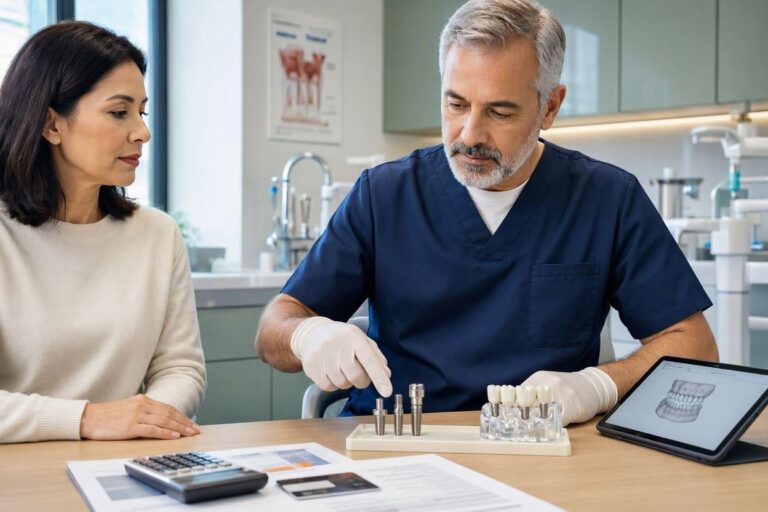
Think of a dental implant like a lamp. You have the cord that plugs into the wall (the implant post), the socket base (the abutment), and the lampshade (the crown). Here is the breakdown of those three distinct pieces:
- The Implant Fixture (The Root): This is a small screw made of biocompatible titanium. A surgeon places this screw directly into your jawbone. This is the most critical part of the process. Over a period of three to six months, your bone cells grow into the microscopic roughness of the titanium surface. This is a process called osseointegration. It essentially welds the metal to your skeleton. This is why implants feel solid and do not slip like dentures.
- The Abutment (The Connector): Once the bone has healed around the titanium root, the dentist exposes the top of the implant and attaches a small metal connector. This piece sits right at the gum line. Its job is to hold the new tooth and provide a seal to keep bacteria out.
- The Restoration (The Tooth): This is the part you actually see. Usually made of zirconia or porcelain fused to metal, this crown is custom-shaded to match the exact color of your surrounding teeth in natural Coral Springs daylight.
| Component | Material | Location | Patient Experience |
|---|---|---|---|
| Implant Post | Titanium or Zirconia | Inside Jawbone | Not visible; feels like a natural root. |
| Abutment | Titanium, Gold, or Zirconia | At Gum Level | Slight pressure when placed. |
| Crown | Porcelain or Zirconia | Above Gum Line | Looks and feels like a natural tooth. |
Important Note: While “Coral Springs Dental Implants” is the search term, understand that the implant is just the root. You will still need a crown on top. The cost and timeline must account for both parts.
Why Coral Springs Residents Choose Dental Implants Over Alternatives
You have options. You could do nothing, which is free but often leads to shifting teeth and bone loss. You could get a bridge, which requires shaving down perfectly healthy neighbor teeth. You could get a partial denture, which sits in a drawer next to the bathroom sink because it is uncomfortable. So why do so many people in Coral Springs eventually land on the decision to invest in implants?
The Battle of Long-Term Preservation
Let’s talk about bone resorption. This is a fancy term for a very simple, sad fact: your jawbone only stays thick and strong if it has tooth roots to support. When a tooth falls out, the body stops sending calcium to that area. The bone melts away, slowly, year after year. This is why people who have worn dentures for twenty years have a “sunken in” look around their mouth.
Implants are the only tooth replacement option that stops this bone loss.
Because the titanium post mimics the pressure of a natural root, it signals the body to keep the bone dense. For residents of Coral Springs who plan on aging here, preserving facial structure is not vanity. It is quality of life.
A Comparison Table for Clarity
Choosing how to replace a tooth is a personal and financial decision. Here is a realistic comparison to help you see where implants stand in the landscape of Coral Springs dentistry.
| Feature | Dental Implant | Fixed Bridge | Partial Denture (Flipper) |
|---|---|---|---|
| Impact on Adjacent Teeth | None. Stands alone. | Damaging. Neighbors must be filed down. | Minimal. But clasps can wear enamel. |
| Longevity | Lifetime. (Crown may need replacement after 15-20 yrs). | 7-15 Years. Recurrent decay under bridge common. | 3-7 Years. Fit changes as bone shrinks. |
| Maintenance | Brush and floss normally. | Must use special floss threaders. | Remove nightly; soak in cleaner. |
| Bone Preservation | Yes. Stimulates bone growth. | No. Bone still shrinks under the missing tooth. | No. Accelerates bone loss due to pressure. |
| Stability | Like a natural tooth. | Solid, but reliant on anchor teeth. | Can move, click, or fall out. |
| Average Cost in Coral Springs | $$$$ | $$ | $ |
The Psychological Lift
This is something we don’t talk about enough in technical articles. Living with a gap, or worse, a failing tooth that wiggles, changes your behavior. You stop ordering steak. You smile with your lips pressed tightly together. You avoid group photos at the Coral Springs Center for the Arts. The moment you heal from an implant procedure, that mental burden lifts. You stop thinking about your teeth and start thinking about the conversation you’re having. That is the real value.
The Coral Springs Dental Implant Experience: A Step-by-Step Timeline
You live in Coral Springs. You know about traffic on Sample Road. You know you cannot be running back and forth to the dentist every other day for six months. The process is a commitment. Let’s map out exactly what that timeline looks like in a typical Coral Springs practice, from the parking lot to the final polish.
Phase 1: The Deep Dive Consultation (Visit 1 & 2)
This is where the art meets science. You cannot get an implant by just looking in the mirror. The bone underneath your gums is a mystery until we use modern technology.
- The 3D Cone Beam CT Scan: In Coral Springs, a standard 2D x-ray is no longer sufficient for implant planning. You will sit or stand while a machine rotates around your head, taking hundreds of images. This creates a 3D model of your skull. The dentist uses this to measure exactly how much bone you have. Is the bone wide enough? Is it tall enough? Where is the nerve that runs through the lower jaw? Hitting that nerve is a serious complication, so this scan is non-negotiable.
- Digital Impressions: Gone are the days of goopy, gag-inducing putty. Many Coral Springs offices use an intraoral scanner—a small wand that takes a video of your mouth. It is fast, comfortable, and incredibly accurate.
- The Discussion of Health History: The dentist will review your medications. This is crucial. If you take bisphosphonates for osteoporosis (like Fosamax or Boniva), your risk for a rare but serious condition called osteonecrosis of the jaw goes up. If you are a smoker in Coral Springs, be honest about it. Smoking restricts blood flow to the gums and drastically lowers implant success rates. A good dentist won’t shame you; they will just give you the realistic odds.
Phase 2: Bone Grafting and Preparation (If Needed)
This is the step that surprises many Coral Springs residents. They walk in wanting an implant and walk out scheduled for a bone graft. Why? Because when you lose a tooth, the body resorbs the bone quickly. By the time you are ready for an implant, the foundation might be too thin.
| Type of Graft | Material Source | Common Use Case in Coral Springs | Healing Time |
|---|---|---|---|
| Xenograft | Bovine (Cow) Bone | Socket preservation after extraction. Very reliable. | 4-6 Months |
| Allograft | Human Donor Tissue | Building up width of a thin ridge. | 4-6 Months |
| Autograft | Your own chin or hip | Major reconstructive cases. | 4-8 Months |
| Synthetic | Lab-created Calcium Phosphates | Minor defects. | 3-5 Months |
Quotation from a Coral Springs Periodontist: “I tell my patients that the implant is the house. The bone is the land. You wouldn’t build a million-dollar home on a crumbling cliff overlooking the Everglades. Sometimes we need to bring in some fill dirt first. It adds time, but it guarantees the house stands for fifty years.”
Recovery from Bone Grafting:
You will feel like you had a tooth extracted. There will be swelling and some bruising. You will eat soft foods for a few days. Most people in Coral Springs take a Friday off for the procedure and are back at their desk (or the golf course) by Monday, albeit with a modified diet.
Phase 3: Implant Placement Surgery (The Big Day)
This is the step that causes the most anxiety, but it is often the easiest recovery of the whole journey. The surgery is performed under local anesthesia (numbing) or with sedation if you prefer.
What Actually Happens:
- Numbing is administered. You will feel pressure but zero sharp pain.
- The surgeon makes a small incision in the gum to expose the bone.
- Using a series of precise drills (guided by the 3D printed surgical guide made from your scan), the surgeon creates a channel in the bone to the exact depth and width of the planned implant.
- The titanium implant is screwed into place with a torque wrench to ensure it is stable.
- A “healing cap” or “cover screw” is placed on top, and the gum is stitched closed.
What It Feels Like After:
The first 24 hours involve some oozing and swelling. Use ice packs in 20-minute intervals. The next 3-4 days involve soreness managed by over-the-counter ibuprofen or Tylenol. You will not be able to chew on that side. You will eat a lot of soup from places around Coral Springs that offer takeout—think matzo ball soup from a local deli or smoothies from a juice bar.
Phase 4: The Waiting Game (Osseointegration)
This is the hardest part for most people: doing nothing for 3 to 6 months. The implant is under the gum, invisible, healing. There is no visible tooth yet. You wait while your bone cells lock into the titanium.
What to avoid in Coral Springs during this phase:
- Hard Chewing: Do not test the area with a chip or a nut.
- Vibrating Toothbrushes: Use a soft manual brush over the surgical site.
- Smoking/Vaping: This is the single biggest cause of early implant failure.
During this time, if the missing tooth is in the front of your smile, your Coral Springs dentist will provide you with a temporary, removable flipper or a bonded “Maryland Bridge” so you don’t have to walk around The Walk with a gap.
Phase 5: Uncovering and Abutment Placement
Once the 3D scan confirms the bone has fused to the implant, you come back for a very minor, 15-minute appointment. The surgeon makes a tiny nick in the gum to expose the top of the implant. The healing cap is removed, and the permanent abutment is screwed in. Sometimes this is done at the same time as the impression for the crown.
Phase 6: The Final Crown Delivery
This is the finish line. The lab has spent weeks crafting a custom ceramic tooth that matches the shape and translucency of your natural teeth. The dentist will try it in.
The Checklist for a Perfect Coral Springs Crown Fit:
- Color Match: Does it disappear under the bright Florida sun? If it looks too opaque or too gray, send it back.
- Bite Check: You should bite down and feel even pressure. If you tap your teeth and the implant tooth feels “high” (hitting first), ask for an adjustment. A high bite can cause the implant to fail or the screw to loosen.
- Floss Check: The floss should “snap” through the contact with the neighbor tooth, but it should glide easily once through. If the floss shreds, the contact is too tight. If you can’t get floss in, food will get trapped.
Once everything is perfect, the dentist cements the crown onto the abutment or torques a screw-retained crown into place. You walk out with a fully restored smile.
Realistic Costs for Dental Implants in Coral Springs, FL
Let’s address the elephant in the room. You have seen ads for “$999 Implants!” You have also heard horror stories of $6,000 quotes for a single tooth. Why is the pricing in Coral Springs so varied, and what number should you actually budget for?
The Truth About the “$999 Implant” Ad
That price is real, but it is incomplete. It usually refers to the surgical placement of the titanium post only. It does not include the 3D scan (often $200-$400). It does not include the abutment (often $300-$600). And it most definitely does not include the custom crown (often $1,200 – $2,000). That $999 ad is effectively the “engine” of the car, not the car itself.
A Transparent Cost Breakdown Table (Per Tooth)
Here is a realistic range of fees you can expect from a reputable, high-quality practice in the Coral Springs area. These figures assume you have adequate bone and require no grafting.
| Procedure Component | Estimated Fee Range (Coral Springs) | Insurance Behavior |
|---|---|---|
| Comprehensive Exam & 3D Cone Beam Scan | $250 – $550 | Usually applied to deductible. |
| Surgical Extraction (if tooth is present) | $200 – $500 | Covered at 50% – 80% by most plans. |
| Bone Grafting (if needed) | $400 – $1,500+ | Rarely covered. Often considered “elective.” |
| Implant Fixture Placement (Surgery) | $1,600 – $2,500 | Limited coverage. Many plans have a $1,000-$1,500 annual max. |
| Abutment & Crown (Restorative Phase) | $1,800 – $2,800 | Crown portion is covered at 50% (same as a regular crown). |
| All-in Total (Average Single Tooth) | $3,800 – $5,500 | Out-of-Pocket Expectation: $2,500 – $4,000 |
Important Note for Coral Springs Residents with Dental Insurance: Dental insurance is designed to be a maintenance plan, not a reconstruction plan. Most plans have an annual maximum benefit of $1,500 or $2,000. Even with good insurance, you will likely max out your benefits for the year on just one phase of the implant. Plan accordingly. Many Coral Springs offices offer in-house membership plans or financing through third-party lenders like CareCredit or LendingClub to smooth out the payments over 12-24 months.
Different Types of Implant Solutions Available in Coral Springs
Not everyone needs a single tooth replaced. Coral Springs has a large active adult community and many families. The implant solution for a 25-year-old who lost a front tooth in a soccer game is very different from the solution for a 75-year-old who has worn dentures for two decades.
Single Tooth Implant
- Best For: One missing tooth surrounded by healthy teeth.
- Pros: Preserves bone, looks natural, no damage to adjacent teeth.
- Cons: Cost per tooth is high; requires surgery.
Implant-Supported Bridge
- Best For: Three or four missing teeth in a row.
- The Coral Springs Approach: Instead of shaving down healthy teeth for a traditional bridge, the dentist places two implants on either end of the gap. A bridge of three teeth connects to those two implants.
- Advantage: Easier to floss under than a traditional bridge. Preserves bone at both ends of the span.
All-on-4 / Teeth in a Day (Full Arch Restoration)
This is a popular option in Coral Springs for patients who are about to lose all their teeth or who are fed up with their full denture. The concept involves placing four (or sometimes six) implants in strategic, angled positions to avoid the need for bone grafting. A full arch of acrylic or zirconia teeth is then bolted to these implants, often within 24 hours of surgery.
The All-on-4 Reality Check for Coral Springs Patients:
- Pros: You leave with teeth the same day. Cost is about 50-70% less than replacing every single tooth with an individual implant. Stability is night-and-day compared to a denture.
- Cons: The teeth are a hygienic bridge. Food gets trapped underneath. You must use a Waterpik and special floss (Superfloss) daily. The acrylic teeth can chip or stain over time. The final conversion to a stronger Zirconia bridge usually costs an additional $5,000 – $8,000 per arch six months later.
| Feature | All-on-4 (Acrylic Hybrid) | Final Zirconia Bridge |
|---|---|---|
| Material | Denture Teeth on Acrylic Base | Solid Milled Zirconia |
| Stain Resistance | Moderate (will stain from coffee) | Excellent (stain proof) |
| Wear on Opposing Teeth | Minimal | High (Zirconia is very hard) |
| Cost | Lower initial investment | Premium investment |
Implant-Retained Dentures (Snap-On Dentures)
This is the “Goldilocks” solution for many Coral Springs seniors. It involves placing two to four implants in the jaw, but instead of a fixed bridge, these implants have special attachments (Locators). Your denture snaps onto these attachments.
- Experience: The denture stays in place when you talk or laugh. It will not fall out. It will not require gobs of adhesive.
- Maintenance: You remove the denture at night to clean it and to clean the gum tissue. It is much more comfortable than a floating denture but less “permanent” feeling than an All-on-4.
Choosing the Right Professional in Coral Springs
In Coral Springs, you can find general dentists who place implants, oral surgeons, and periodontists. Who should you trust with your jawbone?
The Title vs. The Experience
- Oral Surgeon: Specializes in surgery of the mouth and jaw. They are the experts in complex extractions, impacted wisdom teeth, and managing sedation. If your case requires bone grafts from the hip or extensive jaw reconstruction, this is your specialist.
- Periodontist: Specializes in the gums and bone supporting teeth. They are the experts in treating gum disease and managing the aesthetics of the gum tissue around implants. If you want an implant in the front of your smile where the gums are visible, a periodontist is often the best choice because they are masters of soft tissue shaping.
- General Dentist with Advanced Training: Many general dentists in Coral Springs have taken hundreds of hours of continuing education in implant placement. They can handle straightforward, single-tooth cases beautifully and often at a slightly lower fee than a specialist.
Questions to Ask During Your Coral Springs Consultation
You are hiring a contractor for your body. Interview them. Here are the three questions that separate the high-volume clinics from the meticulous providers:
- “Do you use a 3D Cone Beam CT Scan for planning every case?”
- Red Flag Answer: “We can if we need to, but we usually just use a regular x-ray.”
- Green Flag Answer: “Absolutely. It’s our standard of care for safety and precision.”
- “What brand of implant do you use, and will it be easy to get replacement parts in 20 years?”
- Red Flag Answer: “We use whatever is on sale this month.”
- Green Flag Answer: “We use Straumann, Nobel Biocare, or BioHorizons. These are Swiss or US companies with long track records and guaranteed parts availability.”
- “Who will restore the implant? You or my general dentist?”
- Clarity: Some surgeons place the implant and then send you back to your family dentist for the crown. This is called the “surgical-restorative” split. It works well, but communication is key. Make sure the surgeon takes the final impression or provides the dentist with a scan body that perfectly matches the implant brand.
Maintenance and Longevity: Keeping Your Implants Forever
Congratulations. You have invested in dental implants. Now, you need to protect that investment. While the titanium post cannot get a cavity, the gum and bone surrounding it can get an infection called Peri-Implantitis.
Peri-Implantitis is the silent killer of implants. It is like gum disease for implants. Because there is no ligament cushion (PDL) like a natural tooth, bacteria can travel directly down the side of the implant and destroy the supporting bone very quickly.
The Coral Springs Implant Maintenance Protocol
To ensure your implant lasts for decades in our sunny climate, follow this home care routine:
Daily Care Checklist:
- Soft Electric Toothbrush: Use a Sonicare or Oral-B with a soft head. Do not use medium or hard bristles; they can scratch the titanium and gum tissue.
- Floss Picks with a Thin End: The floss must go under the gumline around the crown. You are trying to disrupt the biofilm where the tooth meets the gum.
- Water Flosser (Waterpik): This is non-negotiable for implant bridges (All-on-4). Use it on a low pressure setting with a special tip (Pik Pocket tip) to flush out debris from under the bridge.
Professional Care (Every 3-6 Months):
- No Metal Instruments: Ensure your Coral Springs hygienist uses plastic or titanium scalers around your implant. Metal instruments will scratch the implant surface, creating microscopic grooves for bacteria to hide.
- Radiographs: Every year, you need an x-ray to check the bone level around the implant. A healthy implant shows a tight, crisp halo of bone. If the bone level drops more than 1mm in a year, intervention is needed.
Quotation from a Coral Springs Dental Hygienist: “I tell my implant patients: ‘You spent more on this tooth than on your first car. Treat it like a Ferrari. It needs premium fuel and a detailer, not just a run through the gas station car wash.’ That means more time cleaning it, but it’s worth it.”
The Coral Springs Lifestyle Factor
Living in Coral Springs presents a unique set of variables for implant patients. We have hard water. We have an abundance of outdoor dining. We have a demographic that includes a large number of snowbirds and retirees on fixed incomes.
Snowbird Considerations
If you spend summers up north and winters in Coral Springs, timing is everything. You cannot start an implant in March and leave for six months. The healing phase requires monitoring. If you have a complication, you want your surgeon nearby.
- Ideal Plan for Snowbirds: Begin the implant process in October. This allows for the placement and the initial healing (4-5 months) while you are in Coral Springs. You can then have the final crown delivered in April before you head back north. If you need a bone graft, you might need to add 4 more months to that timeline.
Dietary Realities in South Florida
We eat differently here. Stone crabs. Cuban sandwiches from La Bamba. Chicharrones. During the healing phase (soft diet), you will miss these things. But once you are fully healed, a properly integrated implant is stronger than a natural tooth when it comes to vertical biting force. You can crack that crab claw with confidence again. Just be aware that implants have slightly less “proprioception” (feeling). You might bite down harder than you need to because the tooth doesn’t “feel” the pressure as sensitively as a natural root. It is a minor adjustment, but a real one.
Navigating Dental Anxiety in Coral Springs
If the thought of drilling into your jawbone makes you feel faint, you are in the majority. Coral Springs dental practices are well-versed in managing anxiety. You have options beyond just “toughing it out.”
Sedation Dentistry Options Available Locally
| Type of Sedation | How It Feels | Who Is It For? | Recovery Time |
|---|---|---|---|
| Nitrous Oxide (Laughing Gas) | Warm, floaty, relaxed. You hear everything but don’t care. | Mild anxiety; shorter procedures. | Immediate. You can drive yourself home. |
| Oral Conscious Sedation | Very drowsy, like a deep nap. You may not remember the procedure. | Moderate anxiety; longer surgeries. | 24 Hours. You must have a driver. |
| IV Sedation (Twilight) | You are “asleep” but breathing on your own. You will have zero memory of sounds or pressure. | Severe anxiety; surgical extractions; bone grafts. | 24 Hours. You must have a driver. |
Discuss these options during your consultation. Many patients in Coral Springs find that oral sedation makes the entire experience a non-event.
Conclusion: Your Smile, Your Schedule, Your Future
The journey to obtaining dental implants in Coral Springs is a marathon, not a sprint. It requires an investment of time for proper healing and an investment of finances for lasting quality. However, the outcome—a stable, healthy smile that preserves your facial structure and allows you to enjoy the culinary delights of South Florida—offers a return on investment that dentures and bridges simply cannot match. By understanding the realistic timeline, the honest costs, and the critical importance of selecting a skilled provider, you are now equipped to navigate this process with clarity and confidence.
Frequently Asked Questions (FAQ) About Coral Springs Dental Implants
Q: How painful is the actual implant surgery?
A: The surgery itself involves no pain because of local anesthesia. You will feel pushing and vibration, but no sharp sensations. The discomfort comes in the 48-72 hours after surgery, and it feels like a sore bruise on the jaw. Most people manage this with over-the-counter ibuprofen and ice packs.
Q: Can I get a dental implant if I have been missing a tooth for 20 years?
A: Possibly, but you will almost certainly need a bone graft. After 20 years, the jawbone has resorbed significantly. A 3D scan will determine if enough bone remains. If not, a grafting procedure can rebuild the ridge before an implant is placed. This adds 4-6 months to the total timeline.
Q: Are dental implants safe for MRI scans?
A: Yes. Dental implants are made of titanium, which is non-magnetic. They will not heat up or pull out in an MRI machine. They may cause a slight “artifact” (blurring) on the image immediately around the mouth, but they pose zero safety risk.
Q: How long does a dental implant crown last before it needs replacement?
A: The implant post itself should last a lifetime if you maintain it. The crown (the white tooth part) typically lasts between 15 and 20 years. It can chip, wear down, or the cement seal can fail, allowing bacteria in. Replacing just the crown is a simple, non-surgical procedure.
Q: Can I use my HSA or FSA for dental implants in Coral Springs?
A: Absolutely. Dental implants are a qualified medical expense. You can use your Health Savings Account (HSA) or Flexible Spending Account (FSA) debit card to pay for the entire procedure tax-free. This is a significant financial advantage for many Coral Springs employees.
Q: What if I grind my teeth at night?
A: This is crucial information for your Coral Springs dentist. Bruxism (grinding) can overload an implant and cause the screw to loosen or the porcelain to fracture. If you grind, you will need a custom-fitted night guard to protect your investment. Wear it religiously.
Additional Resource:
For unbiased, peer-reviewed information on implant materials and success rates, visit the American Academy of Implant Dentistry (AAID) website. They offer a “Find a Dentist” tool to locate credentialed implant providers and a patient education library that does not contain advertising hype.
Link: https://www.aaid.com/