Dental Implants in Aurora CO Cost:Honest Guide for 2026
If you are missing one or more teeth, you have probably heard that dental implants are the gold standard for replacement. They look natural, feel secure, and can last a lifetime. But the first question on most people’s minds is simple: how much do dental implants cost in Aurora, CO?
The short answer is that a single implant in Aurora typically costs between $3,000 and $6,000, while a full mouth reconstruction can range from $15,000 to $45,000 or more depending on the materials, procedures, and provider.
But those numbers do not tell the whole story. In this guide, we will walk through every layer of pricing, from the initial consultation to the final crown. You will learn what is included, what is extra, and how to get the best value without sacrificing safety or quality.
Let us start with the basics, then move into real numbers, payment strategies, and common pitfalls to avoid.
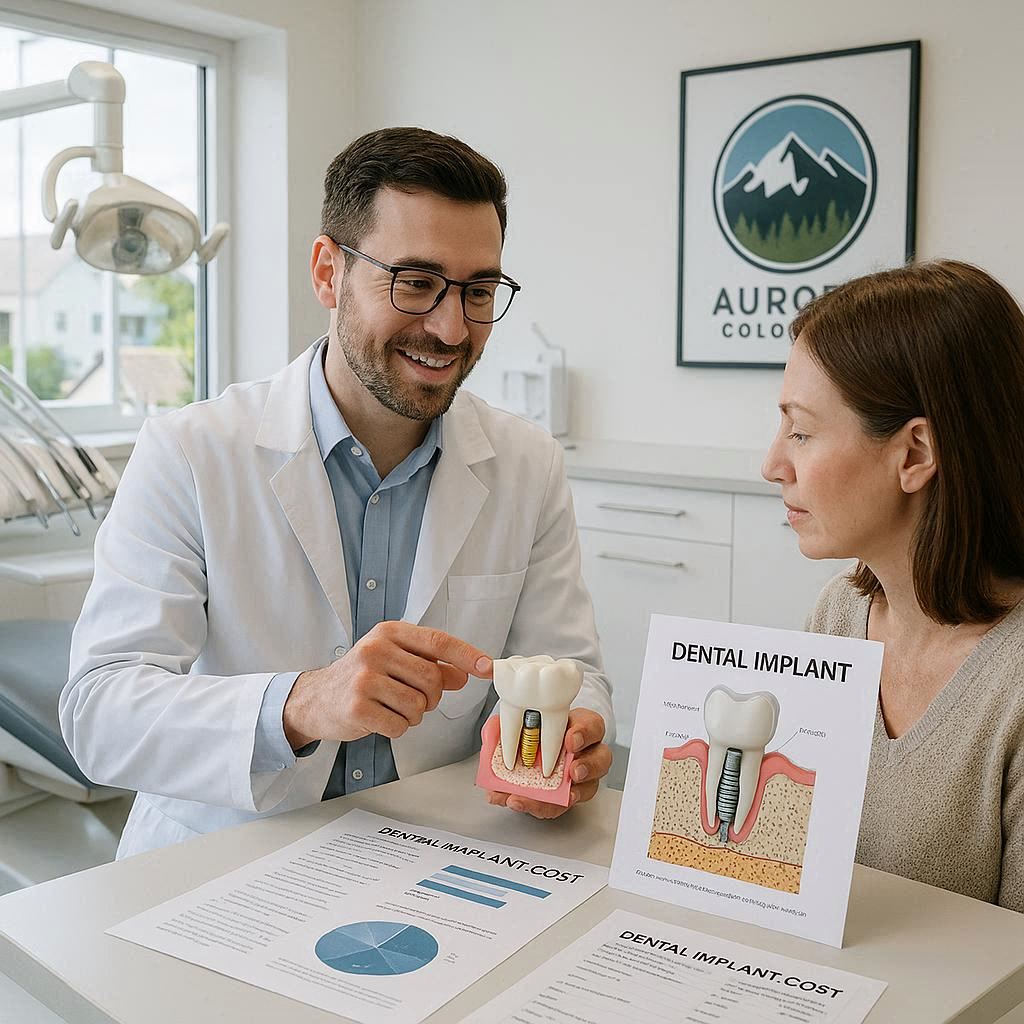
Why the Cost of Dental Implants Varies So Much in Aurora
Many people expect a simple price tag, but implant dentistry is complex. The final cost depends on several moving pieces. Understanding each one will help you compare quotes fairly and avoid surprises.
The Type of Implant Procedure You Need
Not every missing tooth situation is the same. Some patients need a single implant. Others need multiple implants to support a bridge or denture. The most expensive cases involve full arch restoration, where four to six implants support an entire upper or lower set of teeth.
Here is a quick breakdown:
- Single tooth implant – replaces one missing tooth.
- Implant-supported bridge – two implants hold three or four connected crowns.
- Overdenture – two to four implants stabilize a removable denture.
- All-on-4 or All-on-6 – four to six implants per arch support a fixed, non-removable prosthesis.
Each step up in complexity adds time, materials, and surgical skill, which increases the price.
The Materials Used for the Abutment and Crown
The implant screw itself is almost always medical-grade titanium or zirconia. Titanium is the traditional choice and has decades of proven success. Zirconia is metal-free and appeals to patients with metal sensitivities or aesthetic preferences.
The abutment (connector piece) and crown (visible tooth) also come in different materials. Porcelain fused to metal is affordable but less natural looking. Full zirconia or lithium disilicate (e.g., E-max) offers superior aesthetics but costs more.
The Need for Bone Grafting or Sinus Lifts
If you have been missing a tooth for months or years, the jawbone underneath may have shrunk. This is called bone resorption. Without enough bone height or width, the implant cannot fuse properly.
In that situation, your dentist may recommend a bone graft ($300–$800 per site) or a sinus lift ($1,500–$3,000) for upper back teeth. These procedures add both time and expense, but they are often necessary for long-term success.
The Dentist’s Training and Experience
Not all dentists place implants. Some general dentists have taken advanced courses. Others are oral surgeons or periodontists who focus exclusively on surgical placement. Specialists typically charge 15–30% more, but they also handle complex cases with lower complication rates.
Choosing the cheapest provider might save money upfront, but failed implants cost much more to repair or replace.
Average Price Breakdown for Dental Implants in Aurora, CO
To give you a realistic picture, let us look at average costs for each stage of treatment. These numbers come from dental fee surveys, patient reports, and direct clinic data in the Denver metro area, including Aurora.
Single Tooth Implant: Total Cost Range
| Component | Average Cost (Aurora, CO) |
|---|---|
| Consultation and CT scan | $150 – $350 |
| Implant placement surgery | $1,500 – $2,500 |
| Abutment | $300 – $600 |
| Custom crown | $1,200 – $2,200 |
| Total (no bone graft) | $3,150 – $5,650 |
If you need a simple bone graft, add $400–$800. If you need a sinus lift, add $1,500–$3,000.
Multiple Implants (Implant-Supported Bridge)
Replacing two or three adjacent teeth with individual implants is possible, but many dentists recommend an implant-supported bridge. Two implants hold a three-unit bridge. This costs less than three separate implants.
| Procedure | Typical Range |
|---|---|
| Two implants (surgery) | $3,000 – $5,000 |
| Abutments (two) | $600 – $1,200 |
| Three-unit bridge | $2,000 – $3,500 |
| Estimated total | $5,600 – $9,700 |
Full Arch Restoration (All-on-4 or All-on-6)
For patients missing all teeth in one jaw, full arch implants offer a fixed, non-removable solution. This is the most expensive category, but also the most transformative.
| Arch Type | Cost Range (Aurora, CO) |
|---|---|
| All-on-4 (basic materials) | $15,000 – $22,000 |
| All-on-4 (premium materials) | $23,000 – $30,000 |
| All-on-6 (more implants) | $25,000 – $38,000 |
| Both arches (full mouth) | $35,000 – $55,000 |
Important note: These prices often include the temporary prosthesis, final teeth, and all surgical guides. Always ask for a line-item estimate before signing anything.
What Is Typically NOT Included in a Dental Implant Quote
This is where many patients get frustrated. A quote might say “$3,500 for implant and crown,” but then you discover that the following services are separate.
- Tooth extraction – $200–$600 per tooth. If the damaged tooth is still present, removal is an extra step.
- Bone grafting – $300–$800 per site. Often needed but not always quoted upfront.
- CT scan – $150–$350. Essential for safe implant planning.
- Temporary tooth – $200–$500. While the implant heals, you may want a temporary flipper or bridge.
- Sedation or anesthesia – $300–$800. Local anesthesia is usually included, but IV sedation adds cost.
- Surgical guide – $200–$600. A 3D-printed guide improves accuracy.
- Final crown adjustments – sometimes included, sometimes not. Confirm this in writing.
Always ask for a complete treatment plan that lists every possible fee, including contingency costs for unexpected complications.
Does Insurance Cover Dental Implants in Aurora?
Traditional dental insurance was not designed for implants. Most plans consider them “cosmetic” or “elective,” even though missing teeth cause real functional problems. However, some coverage is available if you know where to look.
Typical Insurance Coverage Scenarios
- No coverage – Many PPO and HMO plans exclude implants entirely.
- Partial coverage – Some plans cover the crown (up to 50%) but not the implant surgery.
- Missing tooth clause – If the tooth was missing before the policy started, many plans will not cover it.
- Medical insurance crossover – If tooth loss resulted from an accident or tumor removal, your medical plan may pay part of the implant surgery.
How to Maximize Your Benefits
- Ask your dentist’s billing coordinator to submit a pre-determination to your insurer. This tells you exactly what they will pay.
- Use your remaining annual maximum (usually $1,000–$2,000) toward the crown or abutment.
- Combine dental and medical insurance if trauma is involved.
- If you have a PPO plan, stay in-network for the crown phase to save 20–40%.
Realistic expectation: Even with good insurance, you will likely pay 70–90% of the total implant cost out of pocket.
Payment Options and Financing for Aurora Residents
The good news is that you do not need to pay everything on the day of surgery. Many dental offices in Aurora offer flexible payment solutions.
In-House Membership Plans
Some local clinics provide annual membership plans for patients without insurance. For a flat yearly fee ($200–$400), you receive discounts of 10–20% on implants and major services. This is not insurance—it is a direct savings plan.
Third-Party Medical Financing
- CareCredit – The most widely accepted healthcare credit card. Offers 6, 12, or 18 months of no-interest financing if paid in full by the deadline.
- Alphaeon Credit – Similar to CareCredit, with longer terms up to 60 months (interest accrues).
- LendingClub – Fixed-rate loans specifically for dental work.
Payment Plans Directly Through the Dentist
Many independent implant specialists in Aurora allow you to split treatment into phases. For example:
- Phase 1 (extraction + graft): 30% down, balance in 30 days.
- Phase 2 (implant placement): 50% down, balance due before surgery.
- Phase 3 (crown delivery): paid in full at seating.
Never hesitate to ask about zero-interest installments over 3–6 months. Some offices offer this in-house to avoid credit checks.
How to Compare Dental Implant Costs Without Getting Confused
You will likely contact two or three offices for estimates. To compare apples to apples, use this checklist.
What to Ask Every Office Before Booking
- Is the CT scan included in the quoted price?
- Does the quote cover the final crown or just the implant?
- What type of crown material is included (e.g., PFM, zirconia, E-max)?
- Are temporary teeth part of the plan?
- Who places the implant—general dentist, periodontist, or oral surgeon?
- What happens if the implant fails? Is there a warranty or replacement policy?
- How much is the bone graft if needed during surgery?
Red Flags to Watch For
- Price significantly lower than $2,500 for a full single implant – This often means hidden fees or lower-quality materials.
- No CT scan mentioned – Placing implants without 3D imaging is risky and outdated.
- Pressure to pay in full upfront – Ethical dentists phase treatment and payments.
- No written treatment plan – Verbal quotes are not binding. Get everything in writing.
Affordable Dental Implant Options in Aurora, CO
If your budget is tight, you still have realistic paths forward. You do not have to travel abroad or accept poor quality.
Dental Schools and Training Centers
The University of Colorado School of Dental Medicine in nearby Aurora offers implant care at reduced fees. Residents perform the work under specialist supervision. Wait times can be longer, but savings often reach 30–50% compared to private practice.
Nonprofit and Sliding Scale Clinics
- Clinica Family Health – Offers some dental services on a sliding fee scale based on income. Implant availability is limited but worth asking.
- Colorado Mission of Mercy (COMOM) – Annual two-day free dental clinic. Implants are rarely provided, but extractions and diagnostics are free.
Phased Treatment
You do not need to complete everything in one month. Many patients choose to:
- Extract the tooth and place a bone graft ($500–$1,000).
- Wait 4–6 months for healing.
- Place the implant ($1,500–$2,500).
- Wait another 3–4 months.
- Add the crown ($1,200–$2,200).
Spreading these steps over 12–18 months makes payments more manageable.
Hidden Costs That Surprise Aurora Patients
Even with a clear estimate, unexpected expenses can appear. Here are the most common ones.
Failed Osseointegration
About 5% of implants fail to fuse with the bone, especially in smokers or people with uncontrolled diabetes. Replacing a failed implant means starting over, often at half price or less if the dentist offers a warranty.
Peri-Implantitis Treatment
This is an infection around the implant, similar to gum disease. Treating it early costs $300–$800. Ignoring it can lead to implant loss.
Prosthesis Remake
If you do not like the shape or color of your final crown, remaking it costs another $800–$1,500 unless you purchased a “smile guarantee.”
Always ask: “If I am unhappy with the final appearance, what is your policy for remake fees?”
How Long Do Dental Implants Last? (Value Over Time)
When you look at the upfront cost, implants seem expensive. But consider the long-term math.
| Replacement Option | Cost | Lifespan | Cost per year (10 years) |
|---|---|---|---|
| Dental implant | $4,000 | 20+ years (often lifetime) | $200 or less |
| Traditional bridge | $2,500 | 7–10 years | $250–$350 |
| Removable partial denture | $1,200 | 5–7 years | $170–$240 |
| Full denture | $1,800 | 5–8 years | $225–$360 |
Implants also prevent bone loss and keep adjacent teeth healthy. Over a lifetime, they are often the most cost-effective choice.
Frequently Asked Questions (FAQ)
1. Are dental implants painful?
Most patients report less discomfort than a tooth extraction. Local anesthesia and sedation options keep you comfortable during surgery. Afterward, over-the-counter pain relievers usually suffice for 2–3 days.
2. How long does the entire implant process take?
From extraction to final crown: typically 4–9 months. If you need bone grafting, add 3–6 months. Same-day implants (“teeth in a day”) are possible only for ideal candidates.
3. Can I get dental implants if I have gum disease?
Not immediately. Active gum disease must be treated first. Once your gums are healthy (no bleeding, pockets under 4mm), implants can be placed safely.
4. Do implants look natural?
Yes. A well-made custom crown matches the color, shape, and translucency of your natural teeth. Most people cannot tell the difference.
5. What is the success rate for dental implants?
Over 95% for lower jaw implants and 90–95% for upper jaw implants, when placed by an experienced professional and maintained with good oral hygiene.
6. Can I smoke after getting an implant?
Smoking significantly increases failure risk. Many dentists require patients to quit or reduce smoking during the healing period (4–6 months).
7. Are mini implants cheaper?
Yes. Mini implants cost 30–50% less than standard implants, but they are less durable and not recommended for high chewing force areas (molars). Use them only when standard implants are not possible.
8. Does Medicare cover dental implants in Aurora?
Original Medicare does not cover dental implants. Some Medicare Advantage plans (Part C) offer limited dental benefits, but rarely for implants. Always read the fine print.
Additional Resource
For a deeper understanding of how implant pricing works across different states and insurance plans, visit the American Academy of Implant Dentistry’s patient cost guide:
🔗 https://www.aaid.com/patients/the_cost_of_dental_implants.html
This resource includes a fee calculator, questions to ask your dentist, and a list of accredited implant specialists by zip code.
Final Thoughts: Making the Right Choice for Your Smile
The cost of dental implants in Aurora, CO, is an investment in your health, confidence, and long-term quality of life. While the upfront price may feel intimidating, understanding the breakdown—surgery, components, bone health, and follow-up care—helps you plan realistically. Do not chase the lowest number on a flyer. Instead, look for transparent pricing, experienced providers, and flexible payment options that respect your budget. Your smile is worth the right foundation, not just the right price.
Conclusion
In summary, dental implants in Aurora, CO, typically range from $3,000 to $6,000 for a single tooth, with full arch restorations reaching $15,000 to $45,000. The final cost depends on bone health, materials, specialist fees, and whether extractions or grafts are needed. By comparing detailed treatment plans, exploring financing, and prioritizing long-term value over short-term savings, you can achieve a lasting, natural-looking smile without financial surprises.