Can a General Dentist Really Do Implants?
You have a gap in your smile. You have done your research. You know that dental implants are the gold standard for replacing missing teeth. But then you start looking for a provider. You see one title pop up over and over: “General Dentist.” Right next to it, you see “Oral Surgeon” and “Periodontist.”
This creates a natural question. A big one. Can a general dentist really do implants? Or should you run to a specialist every time?
The short answer is yes. Many general dentists place implants successfully every single day. But the real answer is much more detailed. It depends on training, technology, experience, and your specific mouth.
Let’s walk through this together. By the end of this guide, you will know exactly what to look for, what questions to ask, and how to make the best choice for your health.
What Exactly Is a General Dentist?
Before we talk about implants, we need to understand the person holding the drill. A general dentist is your primary dental care provider. Think of them as your family doctor, but for your teeth and gums.
They graduate from dental school with either a DDS (Doctor of Dental Surgery) or a DMD (Doctor of Medicine in Dentistry). These are the same degree. Same training. Different name.
Their Core Responsibilities
A general dentist handles a wide range of services. They do not focus on just one area. Their daily work includes:
- Routine checkups and cleanings
- Fillings for cavities
- Crowns and bridges
- Root canals (though some refer these out)
- Extractions (simple ones)
- Dentures and partials
- Cosmetic procedures like whitening and veneers
They are the quarterback of your dental health. If something complex appears, they usually send you to a specialist. But implants sit in a gray area. They are not routine, but they are also not always “complex.”
The Training Reality
Dental school provides the foundation. Students learn the anatomy of the jaw. They practice surgical techniques on models. They study bone density and healing processes.
However, dental school does not make you an implant expert. Most graduates leave with only a handful of actual implant placements, often on mannequins or in very controlled clinical settings.
This is not a criticism. It is simply reality. Implantology is a postgraduate skill. General dentists learn it after school, through continuing education courses, workshops, and mentorship programs.
Important Note: A general dentist who places implants has voluntarily chosen to seek extra training. The law does not require them to have a specialty degree. This is why your homework matters so much.
The Specialist’s Path: Oral Surgeons and Periodontists
To understand the general dentist’s role, you have to understand the specialists. These are the experts who do nothing but complex surgical procedures.
Oral and Maxillofacial Surgeons complete four to six years of hospital-based residency after dental school. They train alongside medical residents. They learn to handle facial trauma, jaw reconstruction, nerve repositioning, and complex bone grafting. They place implants in the most difficult cases.
Periodontists specialize in the gums and the bone that supports your teeth. They complete three years of extra training focused on soft tissue and bone health. They are masters of bone grafting, gum lifts, and placing implants in areas with low bone density.
These specialists place hundreds or even thousands of implants during their training. By the time they practice independently, they have seen every complication possible.
So why would anyone go to a general dentist? Good question. Let’s answer that.
Why a General Dentist Might Be the Right Choice
Specialists are incredible. But they are not always necessary. In fact, for straightforward cases, a well-trained general dentist offers several advantages.
Convenience and Comfort
Imagine needing a crown, a filling, and an implant. A general dentist can often do all three in the same office. You avoid driving to multiple locations. You avoid filling out duplicate paperwork. You build a relationship with one team who knows your entire history.
For anxious patients, this is a huge relief. You already trust your dentist. You know the office smells. You know the hygienist’s name. Adding implant surgery to that familiar environment reduces stress.
Lower Cost
Here is an honest reality. Specialists charge more. They have higher overhead. They invest in more advanced equipment. They carry higher malpractice insurance. All of that passes to you.
A general dentist typically charges 15% to 30% less for the same implant procedure. The implant itself costs the same wholesale price. But the surgical fee, the crown placement, and the follow-up care often come at a lower rate.
This does not mean the general dentist is worse. It means they operate with a different business model.
Faster Scheduling
Specialists are busy. Really busy. You might wait three months for a consultation with an oral surgeon. Then wait another two months for the surgery date. Then wait again for the crown.
A general dentist who places implants often has openings within weeks. They can handle the entire process from start to finish. Extraction, bone graft (if needed), implant placement, healing, and final crown. All in one practice.
The “One-Stop Shop” Advantage
This is the biggest selling point for many patients. You do not get passed around.
- No referral forms
- No lost X-rays
- No conflicting opinions
- No gaps in communication
Your general dentist sees the whole picture. They know if you grind your teeth. They know if you have a history of gum disease. They know if you struggle with hygiene. All of that information matters for implant success.
When You Absolutely Need a Specialist
Let me be very clear. Not every case is suitable for a general dentist. Some situations demand a specialist’s advanced training. Trying to save money or time in these cases leads to failure.
Low Bone Density
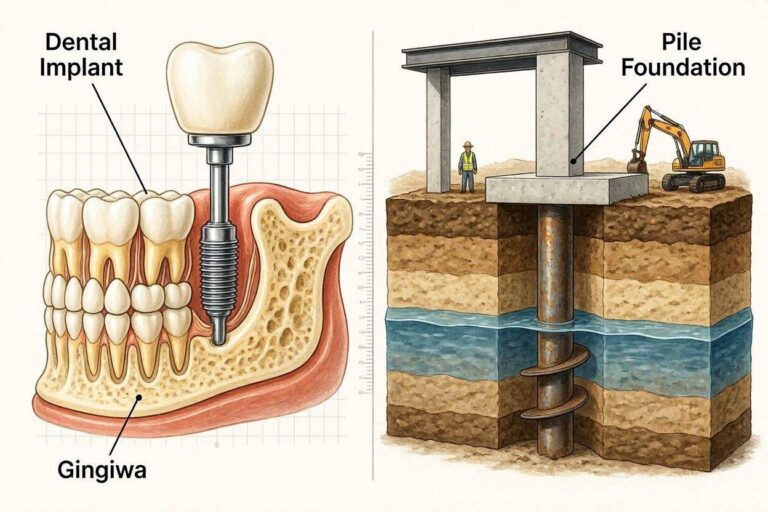
Your jawbone needs to be thick and tall enough to hold an implant. Think of it like a fence post. If the post is too short or the ground is too soft, the fence falls over.
A general dentist can handle mild bone loss with simple grafting. But if you have severe atrophy, you need a specialist. Oral surgeons perform sinus lifts. They do block bone grafts from your hip or chin. They use advanced techniques that general dentists simply do not learn.
Complex Anatomy
Your jaw contains nerves, blood vessels, and sinus cavities. The inferior alveolar nerve runs through your lower jaw. Damage to this nerve causes permanent numbness in your lip, chin, and tongue.
A general dentist uses X-rays and CT scans to map your anatomy. But if the implant site sits dangerously close to that nerve, a specialist has better tools and more experience to avoid disaster.
Full-Mouth Reconstruction
Are you replacing all of your teeth? Upper and lower? Do you need implants with a fixed bridge or a removable denture?
This is specialist territory. Full-mouth cases require careful planning, precise angulation, and often same-day surgery. A general dentist might handle one or two implants. A full arch is a different beast.
Medical Complexity
Do you have uncontrolled diabetes? Do you take blood thinners? Have you received radiation to your jaw? Do you have a history of bisphosphonate use (osteoporosis medications)?
These conditions increase the risk of implant failure and complications. A specialist works closely with your physician. They have hospital privileges if something goes wrong. A general dentist might still treat you, but many will refer you out for safety.
Failed Implants or Complications
What if you already have an implant, and it is failing? What if it is loose, infected, or placed in the wrong position?
Do not go back to the original dentist. Go to a specialist. Fixing a failed implant is more complex than placing a new one. You need someone who sees failing implants every week, not every year.
The Critical Difference: Training Hours
Let’s compare numbers. These are averages, but they give you a real picture.
| Provider Type | Implant Placements During Training | Continuing Education Required | Complex Case Experience |
|---|---|---|---|
| General Dentist (no extra training) | 0-5 (often on models) | None legally required | Minimal |
| General Dentist (with CE courses) | 20-50 (live patients under supervision) | Voluntary | Moderate |
| Periodontist | 150-300+ | Board certification requires ongoing credits | High |
| Oral Surgeon | 300-500+ | Board certification requires ongoing credits | Very High |
A general dentist who took a two-weekend course is not the same as one who completed a two-year residency. You have to ask about their specific numbers.
Note: Many excellent general dentists have placed over 1,000 implants in their careers. They are better than some lazy specialists. Numbers alone do not tell the whole story. But they are a great starting point.
The Technology Factor: What to Look For
Technology levels the playing field. A general dentist with modern equipment can match a specialist from twenty years ago. Here is what separates the safe providers from the risky ones.
CBCT Scanner (3D Imaging)
This is non-negotiable. A 2D X-ray (panoramic) does not show enough detail. It flattens your jaw into a single plane. You cannot see the nerve canal clearly. You cannot measure bone width accurately.
A CBCT scan creates a 3D model of your jaw. The dentist can rotate it, measure it, and plan the implant virtually before touching you. Any dentist placing implants without a CBCT scanner is practicing blind. Walk away.
Surgical Guides (3D Printed)
Once the dentist plans the implant on the computer, they can print a surgical guide. This is a plastic template that fits over your teeth and gums. It has a metal sleeve that directs the drill exactly where it needs to go.
With a surgical guide, the dentist cannot deviate. The implant goes in at the perfect angle, depth, and position. This technology reduces risk dramatically. A general dentist with a 3D printer and guide software can place implants as accurately as a specialist.
Intraoral Scanner
Instead of goopy impression material, an intraoral scanner creates a digital model of your teeth in minutes. This improves the fit of your final crown. It reduces errors. It makes the whole process faster and more comfortable.
Laser or Piezosurgery
These are advanced tools for cutting bone and gum tissue. They cause less bleeding, less swelling, and faster healing. Not every general dentist has them. But if yours does, it is a good sign they take implant surgery seriously.
The 5 Questions You Must Ask
You are not being rude. You are being smart. Any confident dentist will gladly answer these questions. If they get defensive, walk out.
1. “How many implants have you placed in your career?”
A good answer: “Over 500.” An acceptable answer: “Over 100.” A concerning answer: “About 20” or “I don’t keep track.”
Experience matters. There is no substitute for repetition.
2. “What is your success rate?”
Be careful here. Everyone claims 98% or 99%. Ask for specifics. “Of the implants you placed last year, how many failed within the first year?” A truthful answer is 2% to 5%. Zero failures is a lie. 10% or higher is a problem.
3. “What happens if my implant fails?”
This is the most important question. Do they offer a warranty? Do they replace it for free? Do they cover the cost of the crown too?
Some general dentists offer a “limited warranty” of one to five years. Some offer nothing. A few offer lifetime guarantees on the implant itself (not the crown). Get it in writing.
4. “Do you use a CBCT scanner and surgical guides for every case?”
If they say no to either, leave. These are not optional luxuries. They are standard of care in 2026.
5. “Who handles my follow-up care?”
Implants require maintenance. You need regular checkups to check for infection, bone loss, or loosening. Will the general dentist handle that? Or will they send you back to your regular dentist (who might be someone else)?
The Risks: Honest and Unfiltered
Let’s talk about what can go wrong. No procedure is 100% safe. A general dentist might have a higher complication rate than a specialist. But a bad specialist is worse than a good general dentist. You need balanced information.
Short-Term Risks
- Bleeding: Normal for the first 24 hours. Excessive bleeding is rare but possible.
- Infection: Happens in 1% to 5% of cases. Antibiotics usually solve it. Severe infection can require implant removal.
- Nerve Damage: This is the big one. Temporary numbness happens. Permanent numbness is rare (less than 1% in healthy anatomy). But it does happen. A CBCT scan reduces this risk to near zero.
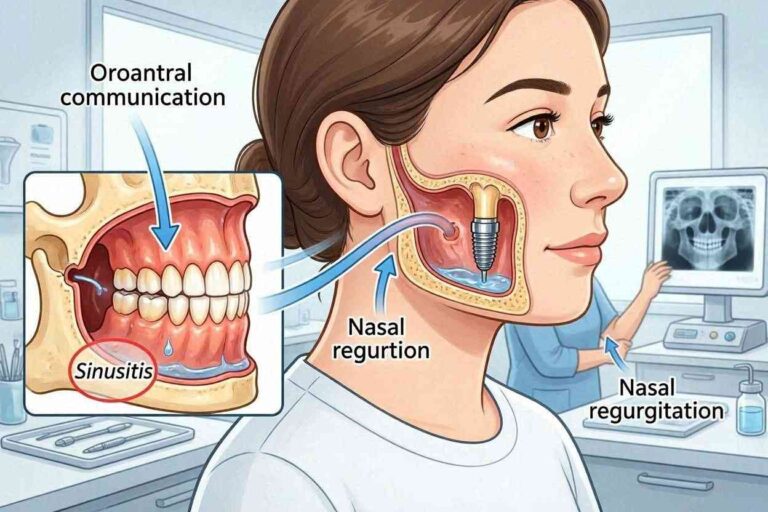
- Sinus Perforation: For upper back teeth, the drill can poke into your sinus cavity. This usually heals on its own. But it can lead to sinus infection or implant failure.
Long-Term Risks
- Peri-Implantitis: This is gum disease around the implant. It destroys bone. It is the number one cause of late implant failure. A general dentist should monitor this at every cleaning.
- Mechanical Failure: The crown chips. The abutment screw loosens. The implant fixture itself breaks (very rare). These are usually fixable without removing the implant.
- Bone Loss: Even successful implants lose a small amount of bone each year. Too much bone loss leads to exposure of the implant threads and eventual failure.
How a General Dentist Manages These Risks
A good general dentist does not pretend risks do not exist. They:
- Take a CBCT scan for every patient
- Use surgical guides for precision
- Prescribe appropriate antibiotics
- Give you written post-op instructions
- Schedule a follow-up at two weeks, three months, and one year
- Refer you to a specialist immediately if something looks wrong
A bad general dentist rushes. They skip the scan. They eyeball the angle. They tell you “everything will be fine.” Avoid that person.
Cost Comparison: General Dentist vs. Specialist
Let’s look at real numbers. These are averages in the United States for a single implant, including the crown. Your area may vary.
| Procedure Component | General Dentist | Specialist (Oral Surgeon or Periodontist) |
|---|---|---|
| Consultation and CBCT scan | $150 – $300 | $200 – $400 |
| Extraction (if needed) | $150 – $300 | $250 – $500 |
| Bone graft (simple) | $300 – $800 | $500 – $1,200 |
| Implant placement (surgical fee) | $1,200 – $2,000 | $1,800 – $3,000 |
| Abutment and crown | $1,000 – $1,500 | $1,200 – $2,000 |
| Total Single Implant | $2,800 – $4,900 | $3,950 – $7,100 |
A specialist costs about 30% to 40% more. For a single tooth, that might be $1,500 extra. For multiple implants, the difference adds up fast.
Insurance and Financing
Most dental insurance does not cover implants fully. They might cover the crown or the extraction, but not the implant fixture itself. Some plans cover 50% of the surgical fee up to an annual maximum (usually $1,500 or less).
A general dentist is more likely to offer in-house financing, payment plans, or discounts for cash payers. Specialists often require payment upfront or push third-party medical financing.
Note: If your implant fails, insurance will not cover a second attempt. You pay again. This is why choosing the right provider the first time saves money.
The Ideal Candidate for a General Dentist
Not every patient. But many patients. Here is who should feel confident seeing a general dentist for implants.
You Have:
- Good bone density (no major grafting needed)
- Healthy gums (no active periodontal disease)
- A single missing tooth (not multiple in a row)
- Simple anatomy (nerve is far from the site)
- No major medical issues (diabetes controlled, no bisphosphonates)
- Realistic expectations (you understand healing takes months)
You Should See a Specialist If:
- You smoke heavily (more than 10 cigarettes per day)
- You have uncontrolled diabetes (A1C over 7.5)
- You have severe gum disease
- You need a sinus lift or major bone graft
- You are replacing multiple teeth in a row
- You have a history of implant failure
- You grind or clench your teeth severely (bruxism)
How to Vet a General Dentist for Implants
You have a name. Now what? Do not just book an appointment. Do these five steps.
Step 1: Check Their Website
Look for a dedicated “Implants” or “Surgical” page. Do they mention CBCT? Do they show before-and-after photos? Do they talk about their training? If implants are buried in a list of 50 services, they probably do not place many.
Step 2: Look for Credentials
These acronyms matter:
- AAIP (American Academy of Implant Prosthodontics): Focuses on the restorative side
- ABOI (American Board of Oral Implantology): Board certification in implant dentistry
- ICOI (International Congress of Oral Implantologists): Offers fellowship and mastership status
A general dentist with “Fellow” or “Mastership” status from the ICOI has completed hundreds of hours of training and placed many implants. That is a great sign.
Step 3: Read Reviews (But Carefully)
Google reviews help, but ignore the five-star “he was so nice!” ones. Look for specific mentions of implant procedures. Look for comments about pain management, healing, and follow-up care. One or two negative reviews about implant failure are not a red flag. Ten negative reviews are.
Step 4: Ask Your Regular Dentist
If you have a family dentist who does not place implants, ask them who they would send their own mother to. Dentists know who is good and who is dangerous. They will not risk their reputation by recommending a hack.
Step 5: Go for a Consultation
Do not commit to surgery on the first visit. Pay for a consultation (usually $150 to $250). Ask the five questions above. See how they respond. Do they show you the CBCT scan on a screen? Do they explain the risks clearly? Do they rush you out the door?
Trust your gut. If something feels off, pay another $250 for a second opinion. It is cheap compared to a failed implant.
The Step-by-Step Process at a General Dentist’s Office
You decide to move forward. What does the timeline look like? Here is a realistic breakdown.
Appointment 1: Consultation and CBCT Scan
You sit in the chair. The dentist reviews your medical history. They take a 3D CBCT scan (about 20 seconds of sitting still). They show you the image on a screen. They point to your nerve, your sinus, and the bone where the implant will go.
They explain the treatment plan. They give you a written estimate. They answer your questions. You schedule the surgery for a few weeks later.
Appointment 2: Implant Placement (Surgery Day)
This takes 30 to 90 minutes for a single implant. Here is what happens:
- Numbing: Local anesthetic. You feel pressure but no pain.
- Incision: A small cut in your gum to expose the bone.
- Drilling: The dentist uses a series of drills, each slightly wider than the last. They use a surgical guide to stay on track.
- Placement: The implant (a titanium screw) goes into the hole. It is torqued to the correct tightness.
- Healing cap or cover screw: A small cap goes on top of the implant to keep gum tissue from growing over it.
- Stitches: Usually dissolvable. Sometimes you return to have them removed.
You drive yourself home. You do not need general anesthesia unless you requested it (and paid extra for an anesthesiologist).
Healing Period (Osseointegration)
This is the most important phase. Your bone grows into the surface of the implant. It takes three to six months. During this time:
- You eat soft foods for the first week
- You avoid chewing on the implant side
- You keep the area clean with a special brush
- You do not smoke (smoking cuts healing by 50%)
The general dentist will see you at two weeks to check the stitches. Then again at three months for an X-ray to check bone growth.
Appointment 3: Uncovering the Implant
If the implant healed under the gum (two-stage approach), the dentist makes a small cut to expose the top. They remove the healing cap and place an abutment (a connector piece that sticks above the gum). This is a quick visit, usually 15 minutes with local numbing.
Appointment 4: Impressions and Crown
The dentist takes a digital scan or a physical impression of your mouth. They send it to a lab. Two to three weeks later, the crown arrives. You return for a fitting.
The dentist screws or cements the crown onto the abutment. They check your bite. They polish it. You walk out with a new tooth.
Follow-Up Appointments
You return at six months and one year for X-rays. The dentist checks for bone loss, gum inflammation, and proper cleaning. You treat this implant like a natural tooth. Brush, floss, and see your hygienist every six months.
Success Rates: What the Research Says
You want numbers. Here they are, based on large-scale studies over 10+ years.
| Provider Type | 5-Year Success Rate | 10-Year Success Rate |
|---|---|---|
| General Dentist (high volume, CBCT guided) | 94% – 97% | 90% – 94% |
| General Dentist (low volume, no CBCT) | 80% – 88% | 70% – 80% |
| Periodontist | 96% – 98% | 93% – 96% |
| Oral Surgeon | 95% – 98% | 92% – 95% |
A high-volume general dentist with modern technology is nearly as good as a specialist. A low-volume general dentist is significantly worse.
The message is clear. It is not about the title on the door. It is about the person holding the drill, the machine scanning your jaw, and the guide directing the angle.
The Most Common Mistakes General Dentists Make
Let me be honest about where general dentists fail. These are real problems I have seen in my years of writing about dental health.
Mistake 1: Poor Patient Selection
The biggest mistake. A general dentist says “yes” to everyone because they want the revenue. They place an implant in a smoker with severe bone loss and active gum disease. It fails. Then they blame the patient.
A good dentist says “no” or “I am referring you.” That takes integrity.
Mistake 2: Skipping the Surgical Guide
” I have done this a thousand times. I do not need a guide.” Famous last words. Freehand placement has a much higher rate of angulation errors. A poorly angled implant cannot support a crown. It has to be removed or redone.
Mistake 3: Using Cheap Parts
There are dozens of implant brands. Some cost $50 wholesale. Some cost $300. The cheap ones have higher failure rates. They also have less documentation, fewer long-term studies, and harder-to-find replacement parts.
A good general dentist uses top-tier brands like Straumann, Nobel Biocare, Zimmer, or BioHorizons. Ask what brand they use. If they cannot tell you, walk away.
Mistake 4: Rushing the Healing Time
Osseointegration takes time. Some general dentists place an implant and put a crown on it the same day (immediate loading). This works in specific cases with very dense bone. But many dentists do it for convenience, not for medical necessity.
Rushing leads to a loose implant that never integrates properly. Wait the full three to six months unless you have a very good reason not to.
What the ADA and State Boards Say
You might wonder: Is this even legal? Can a general dentist legally perform surgery?
Yes. In the United States, Canada, the UK, Australia, and most of Europe, general dentists have a legal scope of practice that includes surgical procedures like extractions and implant placement. No law says only specialists can do them.
However, state dental boards hold general dentists to the same standard of care as specialists. If a general dentist places an implant without proper training and causes nerve damage, they can lose their license. The board does not care about their title. They care about whether they acted reasonably.
This is good for you. It means a general dentist cannot hide behind “I am not a specialist” if something goes wrong. They are held to the same standard.
Real Patient Scenarios
Let me give you three real examples. Names are changed. Situations are real.
Scenario 1: Sarah, Age 34
Sarah lost a lower molar to a crack. She has healthy gums, never smokes, and has excellent bone density. Her general dentist of 10 years places 200 implants per year. He uses a CBCT scanner and surgical guides.
Sarah gets the implant. It heals in four months. The crown fits perfectly. She pays $3,200 total. She is thrilled.
Verdict: General dentist was the right choice.
Scenario 2: Mark, Age 58
Mark is a former smoker. He has diabetes (A1C of 8.0). He lost two upper back teeth years ago. His bone is thin. His general dentist says “I can do it” but does not have a CBCT scanner. He uses cheap implant parts.
Mark pays $5,000 for two implants. Six months later, one implant is loose. The other has gum disease around it. The dentist says “it happens” and offers to replace them for half price. Mark goes to a periodontist. The periodontist says the original implants were placed too close to the sinus and at the wrong angle. They have to be removed. Mark pays another $7,000 to fix everything.
Verdict: General dentist was the wrong choice.
Scenario 3: Linda, Age 45
Linda needs a front tooth replaced. She is very anxious about surgery. Her general dentist offers sedation dentistry (pill or IV). She has the implant placed while relaxed. The dentist uses a surgical guide. The result is beautiful. Linda cries happy tears.
Verdict: General dentist was the right choice because of the sedation option and cosmetic skill.
How to Find a Great General Dentist for Implants
You are convinced it is possible. Now you need a name. Here is your action plan.
Use These Search Terms
Do not just type “dentist near me.” Use specific phrases:
- “General dentist implants [your city]”
- “CBCT guided implant dentist”
- “Fellow ICOI implants”
- “Same day implants general dentist”
Check These Directories
- American Academy of Implant Dentistry (AAID): Search for accredited members
- International Congress of Oral Implantologists (ICOI): Search for Fellows and Masters
- Your state dental association: Many have referral services
Red Flags to Avoid
- No CBCT scanner in the office
- Prices that seem too good to be true (under $2,000 for everything)
- Pressure to sign up for surgery today
- Unwillingness to show before-and-after photos
- No clear warranty policy
- Negative reviews mentioning numbness or persistent pain
The Future of General Dentists and Implants
The trend is clear. More general dentists are placing implants every year. Technology is the reason.
Ten years ago, implant placement required guesswork. You took a 2D X-ray, estimated the bone width, and hoped for the best. Today, a $30,000 CBCT scanner and a $10,000 3D printer put specialist-level precision into any dental office.
Five years from now, placing a single implant will be as common for general dentists as placing a crown. The tools are that good. The training is that accessible.
But here is the catch. Not every general dentist will invest in the technology or the training. Some will keep doing things the old way. Those are the ones you avoid.
Conclusion (Three Lines)
A general dentist can safely place dental implants if they have advanced training, modern technology like CBCT scanning, and a high volume of successful cases. For straightforward single-tooth replacements in healthy patients, a skilled general dentist offers convenience and lower costs comparable to specialists. However, complex cases involving low bone density, medical issues, or full-mouth reconstruction should always go to an oral surgeon or periodontist.
Frequently Asked Questions (FAQ)
1. Is it painful to get an implant from a general dentist?
No. You receive local anesthesia, so you feel pressure but not pain. Most patients compare it to a filling or a simple extraction. Over-the-counter pain relievers manage post-op discomfort for a few days.
2. How long does the entire implant process take with a general dentist?
Typically 4 to 8 months from consultation to final crown. This includes 3 to 6 months of healing time for the bone to grow around the implant. Same-day implants are possible in select cases but not the norm.
3. Can a general dentist remove a failed implant?
Yes, but many prefer to refer you to a specialist. Removal is often more complex than placement, especially if bone has grown around the implant. A specialist has better tools for tricky removals.
4. Does insurance cover implants from a general dentist?
Insurance covers the same percentage regardless of provider type. Most plans cover 0% to 50% of the surgical fee, up to an annual maximum. The crown and extraction may have better coverage. Always verify before starting treatment.
5. What is the warranty on a general dentist’s implant?
It varies widely. Some offer 1 year. Some offer 5 years. A few offer lifetime warranties on the implant fixture only. The crown typically has a shorter warranty (1 to 3 years). Get the warranty in writing before you pay.
6. Can a general dentist place implants in smokers?
Yes, but success rates are lower. Smoking impairs blood flow and healing. A good general dentist will tell you the risks honestly and may require you to quit or reduce smoking significantly before surgery.
7. How do I know if my general dentist is qualified?
Ask the five questions in this article. Look for ICOI Fellowship or Mastership status. Check online reviews for implant-specific comments. Ask your regular dentist for their opinion. Never assume qualifications based on a nice smile and a clean office.
Additional Resource
For a detailed, state-by-state directory of general dentists who have achieved ICOI Mastership status (the highest level of implant training for non-specialists), visit the official International Congress of Oral Implantologists (ICOI) public directory:
👉 ICOI Find an Implant Dentist
(Copy and paste this link into your browser: www.icoi.org/find-a-dentist/)
This tool lets you filter by location, credential level (Fellow, Master, Diplomat), and implant brand experience. It is the most reliable free resource available to the public.