Dental Implants Zirconia Vs Titanium
Making a choice about your dental health often feels like standing at a fork in the road. You want the best for your body, but the options can seem overwhelming. If you are exploring tooth replacement options, you have likely come across two leading materials: titanium and zirconia. Each has a strong following in the dental world.
This guide is here to help you understand the real differences between these two types of dental implants. We will look at how they work, how they look, how safe they are, and what you can expect in terms of cost and longevity. You will not find any confusing medical jargon here. Instead, you will get clear, honest information to help you talk with your dentist.
Understanding Dental Implants: A Quick Refresher
Before we compare zirconia and titanium, it helps to understand what a dental implant actually does. Think of it as an artificial tooth root. A small post is placed into your jawbone. Over time, your bone grows around this post. That process is called osseointegration. Once the implant is secure, your dentist places a crown on top. That crown is the part you see and chew with.
The implant itself needs to be incredibly strong and compatible with your body. For decades, one material ruled the market. Now, a newer option is giving it serious competition.
| Feature | Titanium Implant | Zirconia Implant |
|---|---|---|
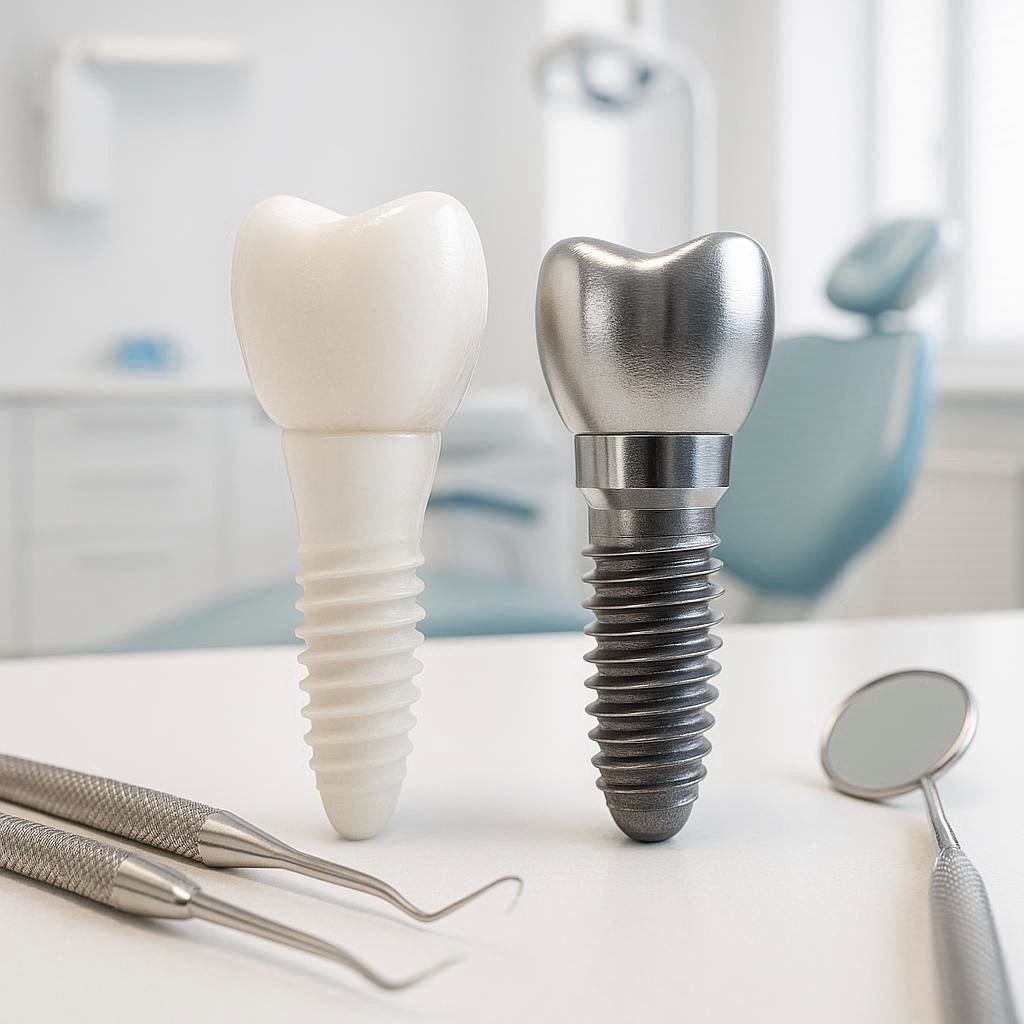
| Material | Metal alloy | Ceramic (white) |
| First Used | 1960s | Late 2000s |
| Structure | Two pieces (implant + abutment) | One piece (solid) |
| Color | Silver / Dark grey | White / Tooth-colored |
| Osseointegration | Excellent (gold standard) | Very good (growing research) |
The Champion of Metal: Titanium Implants
Titanium has a long history in medicine. Surgeons use it for hip and knee replacements as well. For dental implants, it is often called the “gold standard.” That title did not come by accident.
Why Titanium Has Been So Popular
The main secret of titanium is its surface. When placed in bone, it naturally encourages bone cells to attach and grow. This bond is incredibly strong. It has been studied and proven over many decades.
Titanium implants are also usually made of two parts. The post goes in the bone. The abutment connects to the post. A crown then attaches to the abutment. This two-piece design offers flexibility. Your dentist can adjust the angle of the abutment for the best fit.
Another benefit is the long track record. We have data on titanium implants lasting 20, 30, or even 40 years. That is a huge comfort if you want a solution you can fit and forget.
The Potential Downsides of Titanium
Titanium is not perfect for everyone. Its most obvious feature is its color. The metal is dark. If your gums are thin or recede over time, a grey line might show through at the gum line. For some people, this is a purely cosmetic problem.
A more important issue for a small group of people is metal sensitivity. True titanium allergy is rare, but it does exist. Symptoms can include chronic inflammation, rashes in the mouth, or a burning sensation. It is hard to test for, but some people simply feel better avoiding metal in their body.
Reader Note: Always tell your dentist about any known metal allergies, even if they seem mild.
The Modern Ceramic: Zirconia Implants
Zirconia (zirconium dioxide) arrived as a direct answer to the limitations of metal. It is a white ceramic. It is incredibly strong—almost as hard as diamond in some forms. Dentists first used it for crowns. Now, it is a full implant material.
The Aesthetic Advantage
The most obvious benefit of zirconia is its color. It is white. When placed correctly, it blends perfectly with your natural teeth. There is zero risk of a dark line showing through your gums. For this reason, many people with thin gum tissue or high smile lines prefer zirconia.
Zirconia is also naturally hypoallergenic. Your body is very unlikely to react to it. If you have a known metal allergy or an autoimmune condition, zirconia offers peace of mind. It is also highly resistant to corrosion. Saliva, coffee, and acids will not break it down.
The Single-Piece Design
Most zirconia implants come as a single piece. The post and the abutment are one solid unit. This has pros and cons. The pro is that there is no tiny screw to loosen over time. There is no micro-gap where bacteria can hide. This can lead to healthier gums around the implant.
Where Zirconia Has Limits
The single-piece design can also be a challenge. Because the abutment is attached at a fixed angle, placement must be absolutely perfect. If the implant is not exactly straight, your final crown will look crooked. This requires a very skilled and experienced dentist.
Zirconia is also newer. We do not have 30-year studies on it yet. The ten to fifteen-year data is very promising, but we simply do not have the same long-term history as titanium.
Head to Head: Dental Implants Zirconia Vs Titanium
Let us put these two materials side by side in a few critical categories. This will help you decide what matters most to you.
Biocompatibility and Safety
Both materials are generally very safe for the human body. Titanium is the classic standard. Zirconia is the modern alternative.
- Titanium: Works with bone excellently. Very low rejection rate (around 1-2%). However, some people report systemic symptoms they believe are related to metal.
- Zirconia: Also bonds well with bone. Zero risk of metal allergies. It is completely inert. It does not conduct electricity or temperature as much as metal.
Winner: Tie. Both are excellent. Zirconia wins for metal-sensitive patients.
Aesthetics and Appearance
This category is where zirconia shines. If your implant is in a visible area—like your front teeth—appearance matters a lot.
- Titanium: As mentioned, a grey hue can sometimes show. It is a solid material, but not a natural color.
- Zirconia: It is white. Light passes through it similarly to a natural tooth. It looks alive, not fake.
Winner: Zirconia.
Durability and Strength
Titanium has a little more flexibility. It can absorb some bite force without cracking. That is called fracture toughness. Zirconia is extremely hard, but it is also brittle. It will not bend. If you put too much force on it, it can crack like ceramic.
| Strength Factor | Titanium | Zirconia |
|---|---|---|
| Bending strength | High (bends slightly) | Very high (does not bend) |
| Fracture risk | Very low | Low (but possible if overloaded) |
| Wear on opposing teeth | Slightly more wear | Less wear (smoother) |
Winner: Titanium for back molars where you grind or clench. Zirconia for most other areas.
Osseointegration (Bone Bonding)
How well does the bone hold onto the implant?
Titanium has a rough surface that bone loves to grip. Zirconia is catching up. Modern zirconia implants have textured surfaces that mimic titanium. Studies show that zirconia integrates well, but titanium still has a slight edge in speed and strength of bone attachment.
Winner: Titanium (by a small margin).
The Surgical Experience: What To Expect
The surgery itself is similar for both types. You will receive local anesthesia. The dentist drills a precise hole in your jaw. They place the implant. Then you wait for healing.
However, there is one difference in the healing phase.
- For titanium (two-piece): The implant goes in. The gum is stitched over it. You wait 3-6 months. Then you return for a second small surgery to expose the implant and place the abutment.
- For zirconia (one-piece): The top of the implant sticks out through the gum right away. You wait 3-6 months. Then you can place the crown directly onto that top part. No second surgery is needed.
For many patients, the zirconia process feels simpler. There is no second cut. There is no screw to manage.
Cost Comparison: Is Zirconia More Expensive?
Generally speaking, zirconia implants cost more upfront. The material itself is more expensive to manufacture. The white ceramic requires more precise engineering than a metal screw.
- Titanium implant + crown: $3,000 – $5,000 per tooth on average.
- Zirconia implant + crown: $4,000 – $6,500 per tooth on average.
But remember the total picture. Because zirconia is a single piece, there is no need for a separate abutment screw. You also skip the second surgery. For some people, those savings make the price difference smaller than it first appears.
Important Note: Your dental insurance may cover titanium more readily because it is the standard. Always check your benefits before deciding.
Who Is The Ideal Candidate For Each?
It is not about which implant is “better” in a lab. It is about which implant is better for you.
Choose Titanium If:
- You need to replace a back molar (high chewing force).
- You have a history of grinding your teeth (bruxism).
- You want the longest possible track record (30+ years of data).
- Your budget is tighter.
- You have very thick gums that will hide the metal color.
Choose Zirconia If:
- The implant is for a front tooth or visible area.
- You have thin or receding gums.
- You have known metal allergies or metal sensitivities.
- You prefer a metal-free body (holistic dentistry approach).
- You want to avoid the second surgical step.
Debunking Common Myths
There is a lot of outdated information online. Let us clear up a few misunderstandings right now.
Myth 1: Zirconia is not strong enough.
Reality: Zirconia is one of the strongest ceramics used in medicine. It is stronger than your natural tooth enamel. The concern is not strength, but brittleness. It does not flex.
Myth 2: Titanium causes cancer.
Reality: There is no credible scientific evidence that pure titanium implants cause cancer. It is considered completely biocompatible by major health organizations worldwide.
Myth 3: If you have an MRI, titanium is dangerous.
Reality: Titanium is not magnetic. It is perfectly safe for MRIs. It may cause a small distortion in the image near the implant, but it will not heat up or move.
Myth 4: One-piece implants are always better.
Reality: One-piece implants (most zirconia) are simpler. But two-piece implants (titanium) allow for angled corrections. Neither is universally better.
Healing and Long-Term Care
Taking care of a zirconia or titanium implant looks very similar.
For the first week after surgery, stick to soft foods. Avoid chewing directly on the implant site. Keep the area clean with a soft brush and salt water rinses. Do not smoke. Smoking is one of the main reasons implants fail.
Long-term care is easy but important.
- Brush twice a day.
- Floss daily (use a water flosser if the implant is hard to reach).
- Visit your dentist every six months.
- Wear a night guard if you grind your teeth.
Lifespan Expectations
A well-maintained titanium implant can last a lifetime. The crown on top may need replacement after 15-20 years. Zirconia implants are expected to last just as long, but because they are newer, we will have more definitive data in the coming decade.
What Dentists Are Saying Now
The dental profession is moving toward offering both options. Many clinics now advertise “metal-free” dentistry for patients who ask for it.
Dr. Sarah Kennan, a prosthodontist from Austin, Texas, notes: “Ten years ago, I used titanium for every case. Now, I start every consultation by asking, ‘Do you have any concerns about metal in your body?’ If the answer is yes and the tooth is in the front, zirconia is my first recommendation. For the back, I still lean toward titanium for its proven fracture resistance.”
It really depends on the specific case. There is no single best answer.
Environmental and Manufacturing Differences
You might not think about how your implant is made, but there is a difference here too.
Titanium mining and processing have a significant environmental footprint. The metal is extracted using high energy.
Zirconia starts as a mineral sand. It is cleaned and processed into a white powder. The powder is then milled or pressed into shape. Some brands now use “solid” zirconia blocks to reduce waste.
Neither is perfectly “green,” but zirconia is slightly less energy-intensive to produce.
Practical Checklist Before You Decide
Here is a summary list to take to your consultation appointment.
Ask your dentist these questions:
- How many zirconia implants have you placed?
- Do you have before-and-after photos of both types?
- What happens if the zirconia implant is placed at the wrong angle?
- Which brand of implant do you use? (Not all are equal).
- What is your failure rate for each material?
Check on yourself:
- Do I clench or grind my teeth? (Yes → Titanium)
- Is the tooth in the front? (Yes → Zirconia)
- Do I have any autoimmune issues? (Yes → Zirconia)
- Is my budget strict? (Yes → Titanium)
- Do I smoke? (Both have higher risk, but titanium tolerates it slightly better)
Conclusion
Choosing between dental implants—zirconia vs titanium—is not about finding a winner. It is about finding your match. Titanium offers an unmatched long-term track record, high flexibility for back teeth, and a lower cost. Zirconia offers stunning aesthetics, a metal-free composition for sensitive individuals, and a simpler, single-piece design. Talk openly with your dentist about your lifestyle, your health history, and your smile goals. A truly informed choice is the best choice.
Frequently Asked Questions (FAQ)
1. Can I switch from titanium to zirconia later?
Yes, but it requires surgery. The old implant must be removed. The bone needs to heal for several months. Then a new zirconia implant can be placed. It is a longer process.
2. Do zirconia implants break often?
No. They break in less than 2% of cases over ten years. Most breaks happen when a patient clenches very hard without a night guard.
3. Are zirconia implants FDA approved?
Yes. Many brands of zirconia dental implants have received FDA clearance for use in the United States.
4. Which hurts less? Titanium or zirconia surgery?
The pain level is the same. Both involve drilling into bone. However, because zirconia requires only one surgery (instead of two), you have half the recovery periods.
5. Can I use an electric toothbrush on zirconia?
Yes, absolutely. Electric toothbrushes are safe for both materials. Just use a non-abrasive toothpaste to avoid scratching the zirconia surface.
6. Will insurance cover either option?
Most dental insurance plans cover the procedure of an implant, not the specific material. However, some plans may have a “metal exclusion” or a “high-altitude ceramic” upcharge. Call your provider to ask.