Dental Implants in New York: Your Complete 2026 Guide
If you are missing one or more teeth, you already know how much it can affect your daily life. Eating becomes a challenge. Smiling feels awkward. Over time, your jawbone can even start to weaken.
That is where dental implants come in.
Many people living in New York or moving to the city search for “dental implants in New York” because they want a permanent solution. Not dentures. Not bridges. Something that feels and works like natural teeth.
You have come to the right place.
This guide walks you through everything you need to know. No fluff. No fake promises. Just honest, practical information to help you make the best decision for your health and your wallet.
What Exactly Are Dental Implants?
Let us start with the basics.
A dental implant is not actually a tooth. It is a small, screw-shaped post made of titanium. A dentist surgically places this post into your jawbone. Over a few months, the bone grows around the post. This creates a super strong foundation.
Once the implant is secure, the dentist attaches an abutment (a small connector) and then a crown. The crown looks and acts like a real tooth.
In simple terms:
- Implant = the artificial root
- Abutment = the connector piece
- Crown = the visible “tooth”
Dental implants can replace a single tooth, several teeth, or even a full arch. In New York, this procedure has become very popular because people want a solution that lasts decades, not years.
Important note: Not everyone is a candidate for implants right away. Your bone density and gum health matter a lot. A good New York implant dentist will always do a full exam first.
Why Choose Dental Implants Over Other Options?
You have choices. Dentures. Bridges. Even doing nothing. So why go through surgery?
Here is a quick comparison to help you see the difference.
| Feature | Dental Implants | Traditional Bridge | Dentures |
|---|---|---|---|
| Longevity | 20+ years to lifetime | 5–15 years | 5–8 years |
| Bone preservation | Yes, prevents bone loss | No | No |
| Stability | Fixed, doesn’t move | Fixed | Can slip or click |
| Adjacent teeth affected | No | Yes, filed down | No, but can cause sore spots |
| Cleaning | Like normal teeth | Special floss needed | Requires soaking |
| Comfort | Feels natural | Can feel bulky | Often uncomfortable |
Many patients in New York choose implants because they do not want to worry about their teeth shifting when they eat an apple or laugh with friends.
The Real Cost of Dental Implants in New York
Let us talk about money. This is usually the first question people ask.
A single dental implant in New York typically costs between 3,000and6,000. That number includes the implant post, the abutment, and the crown. However, that is just the starting point.
Breakdown of typical costs in NYC
- Consultation and X-rays (CBCT scan): 150–350
- Implant post placement surgery: 1,500–3,000
- Abutment: 300–600
- Crown: 1,200–2,500
- Bone graft (if needed): 500–1,500 per site
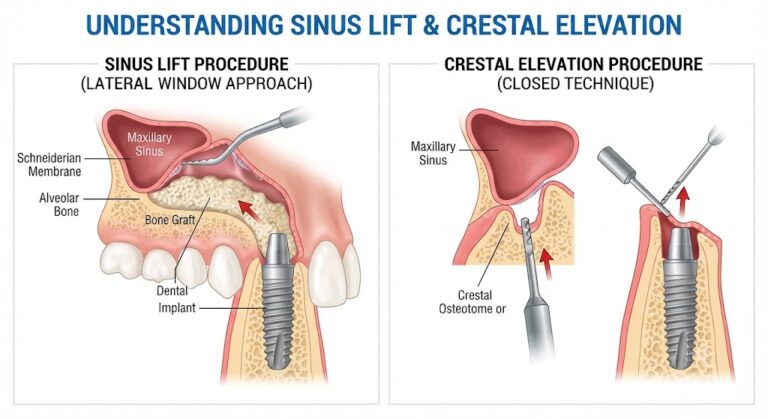
- Sinus lift (if needed): 1,500–3,000
For a full mouth reconstruction (all teeth replaced), costs can range from 25,000to60,000 per arch. In some high-end Manhattan practices, you might see prices over $80,000.
Why is New York more expensive?
New York City has higher overhead costs. Rent is expensive. Staff salaries are higher. Equipment and labs often charge premium rates. Also, the best specialists in the country work here, and their expertise comes at a price.
That said, you do not always need to go to a luxury Fifth Avenue practice to get quality care. Good, reliable implant dentists work in Queens, Brooklyn, the Bronx, and Staten Island at more reasonable rates.
Money-saving tip: Some dental schools in New York offer implant procedures at 30% to 50% less than private practices. Students work under expert supervision. The process takes longer, but the quality can be excellent.
Does Insurance Cover Dental Implants in New York?
This is a tricky area.
Most standard dental insurance plans do not cover implants. They call them “cosmetic” or “elective.” That is frustrating, but it is the reality.
However, you have options.
What some plans cover:
- The crown portion (sometimes 50%)
- Bone grafting if medically necessary
- Extractions
- Consultations and X-rays
What rarely gets covered:
- The implant post itself
- The abutment
How to maximize your coverage
- Review your plan’s “missing tooth clause.” Some plans will not cover a missing tooth that was missing before the policy started.
- Look for PPO plans. HMOs rarely cover implants. PPOs offer more flexibility.
- Use medical insurance instead. If tooth loss is due to an accident or a medical condition (like a tumor), your medical plan might pay. This is worth investigating.
- Ask about in-network discounts. Even if insurance does not pay much, in-network dentists agree to lower rates.
Some New York patients also use third-party financing like CareCredit or LendingClub. These let you pay monthly without high interest if you qualify.
How to Choose the Best Implant Dentist in New York
You have many choices. That is both a blessing and a challenge.
Here is what to look for.
Credentials matter
You want someone with advanced training. General dentists can place implants, but specialists often have better outcomes.
Look for these titles:
- Oral surgeon – Best for complex cases and bone grafting
- Periodontist – Specializes in gums and bone around teeth
- Prosthodontist – Focuses on the restoration (the crown)
Many top implant teams in New York work together. Your surgeon places the post, and your general dentist or prosthodontist makes the crown.
Questions to ask before you book
- How many implants have you placed?
- What is your success rate?
- Do you use 3D imaging (CBCT scans)?
- What brand of implants do you use? (Nobel Biocare, Straumann, and Zimmer are excellent.)
- What happens if the implant fails? Do you offer a warranty?
- Can I speak to a past patient?
Red flags to avoid
- A dentist who promises same-day implants for everyone (it is not for all cases)
- Prices that seem too good to be true (they often are)
- No pre-surgical CT scan
- Pressure to decide immediately
Advice from a real New York patient: “I interviewed three dentists before choosing one. The first rushed me. The second was vague about costs. The third spent an hour explaining everything. Go with the one who answers all your questions without getting annoyed.”
The Step-by-Step Process of Getting Implants in NYC
Knowing what happens can reduce a lot of anxiety. Here is the typical timeline.
Step 1: Initial consultation (1 hour)
The dentist examines your mouth, takes X-rays or a CBCT scan, and discusses your goals. You receive a treatment plan and a quote.
Step 2: Preparatory work (1–12 months)
If you need a bone graft or sinus lift, this happens now. Then you wait for healing. Bone grafts usually take 4 to 9 months to integrate.
Step 3: Implant placement surgery (1–2 hours per implant)
The dentist numbs the area. For most people, the procedure is not painful—just pressure and sounds. You can choose sedation if you are nervous.
Step 4: Healing and osseointegration (3–6 months)
This is the waiting period. The bone grows around the implant. You wear a temporary tooth or a flipper if needed.
Step 5: Abutment placement (30 minutes)
A small incision exposes the implant. The abutment is attached. Healing takes another 2 weeks.
Step 6: Crown placement (1 hour)
The dentist takes impressions or uses a digital scan. A lab makes your custom crown. When it is ready, the dentist screws or cements it onto the abutment.
Step 7: Follow-up visits (15 minutes each)
You return after 2 weeks, 6 months, and then yearly to check everything is healthy.
Total time from start to finish: Usually 6 to 9 months for a single implant. Complex cases can take over a year.
Pain, Recovery, and What to Expect
Let us be honest: surgery sounds scary. But most patients say the reality is much easier than they expected.
Pain levels reported by patients
- Day of surgery (with local anesthesia): No pain during. Just pressure.
- Hours 6–24: Moderate discomfort when anesthesia wears off. A 3 to 5 out of 10.
- Days 2–4: Swelling and soreness. Feels like a tough tooth extraction.
- Day 5 onward: Mild tenderness. Most people stop taking pain medication by day 3.
Recovery timeline
- First 24 hours: Rest. Ice packs on face. Soft foods only. No spitting or using straws.
- Week 1: Eat yogurt, soup, mashed potatoes. No chewing near the implant site. Brush other teeth gently.
- Weeks 2–4: Gradually add soft solids like eggs, pasta, fish.
- Month 2 onward: Most people eat normally, but avoid super hard foods (nuts, ice) until the final crown is placed.
What helps with healing
- Ibuprofen (Advil) or Tylenol as directed
- Salt water rinses after 24 hours
- Sleeping with your head elevated for the first few nights
- Avoiding smoking (huge risk for implant failure)
- Avoiding alcohol for at least 72 hours
Serious note: Smoking drastically reduces implant success. If you smoke, talk to your dentist about quitting temporarily or permanently. Many New York implant specialists will not treat active smokers because failure rates are too high.
Common Problems and How to Avoid Them
Implants have a very high success rate—over 95% in healthy people. But things can go wrong.
Implant failure signs
- The implant feels loose
- Persistent pain after the first week
- Pus or discharge around the site
- Swelling that gets worse after day 3
- The gum looks very red or blue around the implant
Why implants fail
| Cause | Approximate Frequency |
|---|---|
| Infection (peri-implantitis) | 40% |
| Failed osseointegration (bone didn’t fuse) | 30% |
| Overloading (chewing too hard too soon) | 15% |
| Patient health issues (diabetes, smoking) | 10% |
| Surgical error | 5% |
How to reduce your risk
- Choose an experienced dentist
- Follow all aftercare instructions
- Do not smoke
- Keep your diabetes under control if you have it
- Wear a night guard if you grind your teeth
- Get regular cleanings (every 6 months or more)
If an implant fails, don’t panic. Often it can be removed, the area cleaned, a bone graft added, and a new implant placed after healing.
Dental Implants in Different New York Boroughs
Where you get your implant affects price and convenience. Here is a general guide.
Manhattan
- Cost: Highest (4,500–7,000 per implant)
- Pros: World-class specialists, luxury offices, convenient locations
- Cons: Expensive, sometimes impersonal, long waits for appointments
- Best for: People with good insurance or higher budgets who want top credentials
Brooklyn
- Cost: Moderate (3,500–5,500 per implant)
- Pros: Great value, many multilingual dentists, shorter waits
- Cons: Quality varies more widely
- Best for: Families and individuals looking for balance of quality and cost
Queens
- Cost: Lower (3,000–4,800 per implant)
- Pros: Very competitive prices, excellent ethnic food nearby (always a bonus)
- Cons: Some clinics use older technology
- Best for: Budget-conscious patients willing to research carefully
The Bronx
- Cost: Most affordable (2,800–4,500 per implant)
- Pros: Lower overhead, community-focused practices
- Cons: Fewer implant specialists per capita
- Best for: Patients willing to travel from other boroughs for savings
Staten Island
- Cost: Moderate to high (3,800–5,800 per implant)
- Pros: Less crowded offices, easier parking
- Cons: Ferry/travel time for non-residents
- Best for: Staten Island locals who want convenience
Same-Day Implants: Fact or Fiction?
You have seen ads: “Teeth in a Day” or “Same-Day Implants.”
Can you really walk in with missing teeth and walk out with a full smile in one appointment?
Yes and no.
Same-day implants are possible for some people. The procedure is called immediate loading. The dentist places the implant and attaches a temporary crown on the same day.
But here is the honest truth:
- Not everyone is a candidate. You need excellent bone quality and no infection.
- The same-day crown is temporary. You will still need a permanent crown later.
- Same-day implants have slightly lower long-term success rates (around 90% vs 95%+).
- Many New York dentists over-promise this to attract patients.
If a dentist says everyone can get same-day implants, walk away. A reliable professional will first do a CBCT scan and only offer it if your bone and gums are ideal.
Dental Implants for Seniors on Medicare or Medicaid
This is a sensitive topic because many older New Yorkers need implants but have limited budgets.
Medicare (federal): Does not cover dental implants. Original Medicare does not cover most dental care at all. Some Medicare Advantage plans (Part C) offer limited dental benefits, but implants are rarely included.
Medicaid (New York State): For adults over 21, NY Medicaid covers emergency dental care and some basic services, but not implants. Exceptions exist for medically necessary cases (e.g., jaw reconstruction after cancer). For children under 21, Medicaid may cover implants in rare situations.
If you are a senior on a fixed income, do not lose hope.
Affordable alternatives in New York:
- NYU College of Dentistry – Offers reduced rates for implant procedures performed by residents
- Columbia University College of Dental Medicine – Another excellent teaching clinic
- Community health centers – Some offer sliding scale fees
- Dental tourism – Traveling to another state or country, but research carefully
How to Care for Your Dental Implants Long-Term
Once you have your implants, you want them to last. Good news: they can last 30 years or more with proper care.
But they are not invincible.
Daily care routine
- Brush twice a day with a soft toothbrush
- Floss daily using implant-friendly floss (regular floss works, but super floss or implant floss is better)
- Use a water flosser (Waterpik) to clean around the abutment
- Avoid using metal scrapers or hard picks
Professional maintenance
- See your dentist every 6 months
- Get professional cleanings that include checking the implant crown
- X-rays every 1–2 years to check bone levels
What to avoid
- Chewing ice or hard candy
- Using your teeth as tools (opening packages)
- Grinding your teeth (ask your dentist about a night guard)
A real patient from Brooklyn shared: “I have had my implant for 12 years. I treat it like my other teeth, but I am extra careful about flossing around the gumline. My dentist says the bone still looks perfect.”
Hidden Benefits of Dental Implants You Might Not Know
Most people think implants are just about looks. They are so much more.
Better nutrition
Without stable teeth, people avoid raw vegetables, nuts, and meats. They eat softer, often less healthy foods. Implants let you chew properly, which improves digestion and overall health.
Clearer speech
Dentures slip. That clicking sound is embarrassing. Implants stay put, so you speak naturally.
Slowed facial aging
When you lose teeth, your jawbone shrinks. Your lower face collapses slightly. This creates a “sunken” look. Implants keep the bone stimulated, which preserves your facial structure.
No more denture adhesives
If you have worn dentures, you know the nightmare of creams and pastes. Implants eliminate that completely.
Better self-esteem
This is not vanity. Being able to smile without hiding your mouth changes how you interact with people. Job interviews. Dates. Family photos. It all gets easier.
Financing Dental Implants in New York: Practical Strategies
You want implants. You cannot pay $6,000 today. What do you do?
Strategy 1: Dental schools
As mentioned, NYU and Columbia offer significant discounts. Wait times are longer, and appointments take more time because instructors check every step. But the savings can be 50% or more.
Strategy 2: In-house payment plans
Some New York dentists offer no-interest or low-interest payment plans directly. Ask about monthly payments over 6, 12, or 18 months. Not all practices do this, but many independent ones do.
Strategy 3: FSA or HSA
If your employer offers a Flexible Spending Account (FSA) or Health Savings Account (HSA), you can use pre-tax dollars to pay for implants. This saves you 20% to 40% depending on your tax bracket.
Strategy 4: Negotiate
Yes, you can negotiate dental prices in New York. Ask:
- “Is that your best cash price?”
- “Can you waive the consultation fee if I proceed with treatment?”
- “Do you offer discounts for paying in full upfront?”
Some practices will lower their price by 10-15% just because you asked politely.
Strategy 5: Travel to nearby lower-cost cities
New York is expensive. Consider getting your implant in Philadelphia (2 hours away), Albany, or even in New Jersey just outside NYC. Prices can be 20% to 35% lower.
Frequently Asked Questions (FAQ)
How painful is getting a dental implant?
Most patients rate the pain as less than a tooth extraction. The surgery itself is not painful because of anesthesia. Afterward, it feels like a deep bruise for a few days.
How long do dental implants last?
With good care, 20 to 30 years or more. Many patients keep their implants for life. The crown may need replacement after 10-15 years, but the implant post stays.
Can I get dental implants if I have gum disease?
Not until the gum disease is treated. Active gum disease (periodontitis) causes implant failure. Your dentist will first treat the infection and get your gums healthy.
Are dental implants safe?
Yes. Titanium implants have been used for over 50 years. Millions of people worldwide have them. Serious complications are rare (<1%) in healthy individuals.
What is the failure rate for dental implants?
Around 5% to 10% over 10 years. Failure is more common in smokers, people with uncontrolled diabetes, and those with poor oral hygiene.
Can I get a full set of implants for both top and bottom teeth?
Yes. This is called full-arch restoration or “All-on-4.” Most cases use 4 to 6 implants per arch to support a fixed bridge. It transforms lives.
How soon can I return to work?
Most people take 1 to 2 days off for a single implant. For multiple implants, 3 to 5 days. Desk jobs are fine within 48 hours. Physical jobs may need a week.
Do implants feel like real teeth?
Yes. Within a few weeks, most people cannot tell the difference. The only noticeable difference is that an implant does not have the same “spring” as a natural tooth when you bite very hard.
Additional Resources
For more reliable information, visit the American Academy of Implant Dentistry (AAID) at aaid-implant.org. This site has a “Find a Dentist” tool to locate credentialed implant specialists in New York. They also offer patient guides and videos explaining procedures in plain English.
Final Thoughts: Is Getting Dental Implants in New York Worth It?
Let us be direct.
Dental implants in New York are not cheap. They require surgery, healing time, and a commitment to good oral hygiene. You may face setbacks like bone grafts or longer healing than expected.
But for most people who get them, implants are life-changing.
You stop worrying about your teeth. You eat what you want. You smile without thinking about it. And years later, when denture wearers are on their second or third set, your implant is still solid.
If you can afford the investment or find a financing plan that works, dental implants are one of the best healthcare decisions you can make.
Take your time. Research multiple dentists. Ask hard questions. And do not let anyone pressure you into a decision.
Your smile is worth getting right.
Disclaimer: This article provides general information and does not constitute medical advice. Always consult with a licensed dental professional in New York for a personal evaluation. Prices and insurance policies change over time. Verify current costs and coverage before making financial decisions.