Dental Implants San Antonio TX: The 2026 Complete Guide to a Permanent Smile
If you are missing one tooth, several teeth, or even considering a full-mouth restoration, you have probably heard the term “dental implants” more than once. But let’s be honest: the amount of information online can feel overwhelming. You might be asking yourself: Are implants really better than dentures? How much do they cost in San Antonio? Does the procedure hurt?
I am here to walk you through every single detail, without the confusing medical jargon.
San Antonio is a unique city for dental care. With a blend of experienced surgeons, competitive pricing compared to other major Texas cities like Dallas or Houston, and a focus on patient comfort, it has become a hub for high-quality implantology.
By the end of this guide, you will understand exactly what to expect, how to choose a provider, and how to budget for your new smile.
What Exactly Are Dental Implants? (And Why They Are Not Scary)
Let us start with the basics. A dental implant is essentially a high-tech replacement for a tooth root.
Imagine your natural tooth. It has a root (the part under the gum) and a crown (the part you see). An implant mimics that structure perfectly.
- The Implant (Post): A small screw, usually made of medical-grade titanium. Your jawbone loves titanium. It actually fuses with the metal in a process called osseointegration. Cool, right?
- The Abutment: A small connector piece that screws into the implant. It acts as the foundation for your new tooth.
- The Crown: The fake tooth. It is custom-made to match the color, shape, and size of your natural teeth.
Why San Antonio residents are switching to implants:
Unlike dentures or bridges, implants do not rely on neighboring teeth for support. They stand alone. This means you do not have to grind down healthy teeth like you would for a bridge. Plus, because the implant fuses with your bone, it stops the bone loss that usually happens when you miss a tooth.
“I tell my patients in San Antonio that implants are the closest thing to growing a new tooth. They restore not just chewing power, but confidence.” — Anonymous SA Implant Specialist.
The Deep-Dive Benefits: Why Bother with Implants?
You might be thinking, “I have dentures. They work fine.” And sometimes, dentures are a valid short-term solution. But let us compare.
The Bone Health Factor
When a tooth is missing, the jawbone lacks stimulation. Over time, that area of bone shrinks. It gets thinner and weaker. Dentures sit on top of the gums, so they do nothing to save the bone. Implants, however, stimulate the bone just like a natural root. They keep your jaw strong and preserve your facial structure.
Eating Without Fear
Have you ever skipped a steak at a restaurant near the River Walk because you were scared your dentures would slip? With implants, you chew with 90% of your natural biting force. You eat corn on the cob, apples, and steak without a second thought.
No More Adhesives
Forget the messy creams and pastes. Implants lock into place. They do not move. They do not click. They feel like your teeth.
Long-Term Value
Yes, implants cost more upfront than a bridge or dentures. But a bridge lasts 7 to 10 years before needing replacement. Dentures need refitting every few years as your bone changes. A well-maintained dental implant can last 30 years, 40 years, or even a lifetime.
A Realistic Look at the Dental Implant Procedure (Step-by-Step)
Let us demystify the process. Most patients report less discomfort than a simple tooth extraction. Here is how it works in a typical San Antonio clinic.
Step 1: The Consultation (Day 1)
Your dentist will take a 3D CBCT scan of your mouth. This is not a normal X-ray. It shows the density of your bone, the location of your nerves, and your sinuses. The doctor will answer the big question: Do you have enough bone?
Step 2: Preparation (Bone Grafting if Needed)
If you have been missing teeth for years, your bone may be too thin.
- The reality: Many San Antonio patients require a bone graft.
- The process: The surgeon adds synthetic bone or donated bone to the area.
- The wait: You will need 4 to 6 months to heal before placing the implant. Do not skip this step. It ensures success.
Step 3: Implant Placement (Surgery Day)
- Anesthesia: Local anesthesia (numbing shots) or IV sedation if you are nervous.
- Duration: A single implant takes about 30 to 60 minutes.
- The feeling: Pressure, but no sharp pain.
- Recovery: You go home the same day. Most people manage pain with ibuprofen.
Step 4: Osseointegration (The Wait)
This is the most important phase. You wait 3 to 6 months for your bone to grow tightly around the titanium screw. During this time, you might wear a temporary partial denture or a temporary crown.
Step 5: Abutment and Crown Placement
Once the implant is solidly fused, your dentist exposes the top of the implant, screws on the abutment, and takes impressions for your permanent crown. Two weeks later, you walk out with a finished tooth.
The Cost of Dental Implants in San Antonio, TX
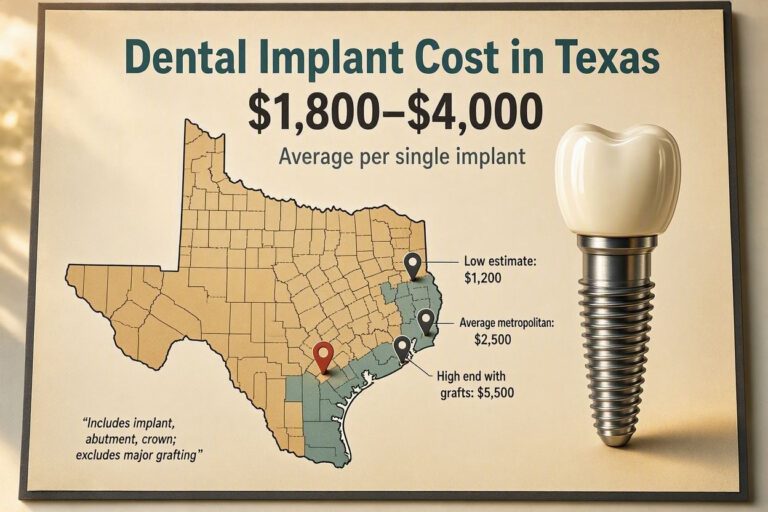
Let us talk money. Prices in San Antonio are generally 15% to 20% lower than the national average, thanks to a competitive medical landscape. However, cost depends on what you need.
Here is a realistic price breakdown for 2026 (estimates per tooth):
| Service | Average Cost in San Antonio |
|---|---|
| Consultation & 3D CT Scan | 150–350 |
| Single Implant (Post only) | 1,200–1,800 |
| Abutment | 300–500 |
| Porcelain Crown | 1,200–1,800 |
| Total Single Tooth Implant | 2,700–2,700–4,500 |
| Bone Graft (per site) | 500–1,200 |
| Sinus Lift (back upper jaw) | 1,500–2,500 |
| Full Mouth Implants (All-on-4) | 20,000–35,000 per arch |
Important Note: These are out-of-pocket estimates if you do not have insurance. High-end cosmetic clinics using zirconia crowns will charge more. Budget clinics or dental schools may charge less.
Does Insurance help?
Traditional dental insurance usually does not cover the implant post. However, many PPO plans cover a portion of:
- The crown (50%).
- The extraction (80%).
- The bone graft (if medically necessary).
Reader Tip: Call your insurance provider and ask for your “implant stipend.” Some San Antonio employers are now adding implant coverage to their plans because it saves money on denture maintenance long-term.
San Antonio Specialists: Who Should Do Your Surgery?
Not all dentists place implants. You need the right specialist.
1. Oral and Maxillofacial Surgeons
- Best for: Complex cases, bone grafts, sinus lifts, full mouth reconstruction.
- Pros: They have 4+ extra years of hospital-based training. They offer deep sedation.
- Cons: Higher fees.
2. Periodontists (Gum Specialists)
- Best for: Single implants, patients with gum disease history.
- Pros: They understand the soft tissue (gums) beautifully. Great for esthetic results.
- Cons: Limited to the implant itself; they often send you back to a general dentist for the crown.
3. General Dentists with Implant Training
- Best for: Simple single implants with healthy bone.
- Pros: One-stop shop. They do the surgery and the crown in one office.
- Cons: Less experienced with complex complications.
San Antonio Specific Advice: Look for a provider that offers a CT scanner in-house. If they have to send you somewhere for the scan, it is a red flag.
Am I a Candidate? The Truth About Bone Density and Health
Many patients worry: “I am too old” or “I have osteoporosis.” Let me put your mind at ease.
Age is not a barrier
Healthy 80-year-olds get implants in San Antonio every day. As long as you are healthy enough for a simple extraction, you are healthy enough for an implant. Age does not affect the fusion process.
Medical conditions
- Diabetes: You can still get implants, but your blood sugar must be well-controlled. Uncontrolled diabetes stops healing.
- Smoking: Let’s be real. Smokers have a 20% higher failure rate. Nicotine reduces blood flow to the gums. If you smoke, your surgeon will ask you to stop for 2 weeks before and 2 months after surgery.
- Osteoporosis: Medications like bisphosphonates (Fosamax) require caution. You must tell your dentist. Long-term use of these drugs (over 4 years) increases the risk of osteonecrosis (bone death). A good surgeon knows how to manage this.
The Bone Checklist
You need:
- Height: At least 10mm of vertical bone.
- Width: At least 6mm of horizontal bone.
- Quality: Dense bone, not spongy bone.
If you lack bone, do not panic. Bone grafting is routine.
Dental Implants vs. The Alternatives: Honest Comparison
I want you to make an informed choice. Here is how implants stack up against traditional fixes.
| Feature | Dental Implants | Traditional Bridge | Dentures / Partials |
|---|---|---|---|
| Longevity | 30+ years | 7-15 years | 5-10 years |
| Healthy Teeth Affected | None | Yes (shaved down) | None |
| Bone Preservation | Yes (stimulates bone) | No (bone erodes under bridge) | No (bone erodes rapidly) |
| Stability | Permanent. No movement. | Good, but can decay at anchor teeth. | Moves. Requires adhesive. |
| Upfront Cost | $$$$ | $$ | $ |
| Maintenance | Brush/floss normally. | Requires special floss. | Removes for cleaning. |
| Chewing Power | ~90% | ~80% | ~30% to 50% |
When a Bridge might be better
If you have two adjacent missing teeth and the neighboring teeth already have large fillings or crowns, a bridge might be less invasive. It saves you from placing two implants.
When Dentures might be better
If you have severe uncontrolled diabetes, heavy smoking habits you cannot quit, or very limited finances, modern dentures (especially implant-supported dentures) are a good middle ground.
The Recovery Timeline: Week by Week
Let us be honest about the healing process. Most of the scary stories online come from people who did not follow instructions.
Day 1 (Surgery Day)
- Feeling: Numb for 2-4 hours. Once it wears off, you feel a dull ache.
- Action: Apply ice packs (20 minutes on, 20 off). Eat soft foods (yogurt, smoothies). Do not spit or use a straw.
- Pain level: 3/10 (manageable with OTC meds).
Days 2 to 3
- Feeling: Swelling peaks. You might look like a chipmunk. This is normal.
- Action: Switch to warm compresses. Rinse gently with warm salt water. Eat mashed potatoes, scrambled eggs.
- Warning: If bleeding soaks through a gauze pad after 24 hours, call your dentist.
Days 4 to 7
- Feeling: Swelling goes down. Stitches may dissolve or feel loose.
- Action: Return to work (most do by day 3 or 4). Avoid crunchy foods.
- Recovery note: 95% of patients say the worst is over by day 5.
Week 2 to Month 4 (The Waiting Phase)
- Action: You live normally. You just avoid chewing directly on the implant site.
- Risks: Do not get an MRI on your head (the implant is metal, but titanium is usually MRI-safe—confirm with your radiologist).
Month 6 (Crown Delivery)
- Feeling: Zero pain. You see your finished tooth.
- Result: It looks and feels like your natural tooth.
5 Critical Mistakes San Antonio Patients Make (Avoid These)
I see these errors constantly in online reviews and patient forums.
Mistake #1: Chasing the cheapest price on “Groupon” deals.
If a single implant costs 1,200total(includingcrown),somethingiswrong.Thecostofthematerialsaloneisover500. Clinics that low-ball you often use:
- Cheap Chinese implants (no long-term studies in the US).
- Unsterilized reused abutments.
- A general dentist with a weekend course, not a specialist.
How to avoid: Look for “NuSmile,” “Zimmer,” “Straumann,” or “Nobel Biocare” implants. These are gold standards.
Mistake #2: Skipping the night guard.
You grind your teeth at night (bruxism). Many San Antonio patients have high stress. Grinding creates 1,000 pounds of pressure per square inch. Implants can fracture under that pressure. If you grind, you need a custom night guard.
Mistake #3: Not cleaning the implant.
Implants do not get cavities, but they can get peri-implantitis (like gum disease around the implant). You must floss and use a water flosser. Ignoring hygiene causes bone loss and implant failure after 5 years.
Mistake #4: Going to a surgeon who doesn’t do the crown.
If your oral surgeon places the implant but sends you to a random dentist for the crown, and the crown doesn’t fit the abutment perfectly, you get a gap. Bacteria enters the gap and rots the bone. Your surgical team and restorative team MUST communicate.
Mistake #5: Getting implants before treating gum disease.
Active, untreated gum disease is the #1 reason for implant failure. The bacteria that cause gum disease attack the bone around your new implant just like they attack natural teeth.
San Antonio Solution: Ask for a “Periodontal evaluation” before you sign the implant consent form.
The All-on-4 Solution: Full Mouth Restoration in San Antonio
If you are missing all your upper or lower teeth, placing individual implants (16 total) is overkill. The All-on-4 technique is the standard of care.
How it works
Four implants are strategically placed in the front part of your jaw (where the bone is naturally densest). The back two implants are angled at 45 degrees to maximize bone contact. A fixed, solid bridge of 12 to 14 teeth is screwed onto those four implants.
Why San Antonio patients love All-on-4
- Same-day teeth: Many SA clinics offer “Teeth in a Day.”
- No palate coverage: Unlike dentures, the roof of your mouth is exposed. You taste food again.
- No bone grafting: Because of the angulation, you often avoid sinus lifts and extensive bone grafts.
Cost Reality for All-on-4 in San Antonio
- Low end (Zirconia hybrid): $20,000 per arch.
- Premium (Titanium bar with individual teeth): $35,000 per arch.
- Financing: Look for “CareCredit” or “LendingClub” healthcare loans. Some San Antonio clinics offer in-house 0% interest for 12 to 18 months.
Finding the Best Provider in San Antonio (Checklist)
You are ready to book consultations. Here is your script and checklist.
Step 1: Shortlist 3 clinics.
Do not go to just one. Prices vary by thousands of dollars for the exact same implant.
Step 2: Ask these 7 questions during the free consult.
- “What brand of implant do you use?” (Answer must be Straumann, Nobel Biocare, Zimmer, or Astra Tech.)
- “How many implants have you placed in the last 12 months?” (Answer should be over 100 for a specialist.)
- “What is your success rate?” (Should be 95%+ for a non-smoker.)
- “Do you have a CT scanner on-site?” (Yes.)
- “Who makes the crown? Do you control the quality?” (In-house lab or local lab is best.)
- “What is the warranty?” (Many SA clinics offer 3-5 years on the crown, lifetime on the implant.)
- “What happens if the implant fails?” (The answer should be: “We replace it for free within one year.”)
Step 3: Read Google Reviews for key phrases.
Search for “bone graft” or “sedation” or “follow-up care.” Look for mentions of the dentist by name, not just generic “great office.”
Financing Your Smile: San Antonio Specific Resources
Dental implants are an investment. Here is how real people pay for them.
1. In-House Membership Plans
Several San Antonio dental offices offer “Membership Plans” for 300to500 per year. These plans give you 20% off implants and free cleanings. It is like a dental insurance alternative for the uninsured.
2. Texas Medicaid (CHIP/Medicaid)
Generally, Texas Medicaid does not cover dental implants for adults. It covers extractions and dentures only. Do not believe anyone who says Medicaid pays for implants unless you are a child with a specific congenital defect.
3. CareCredit
This is a healthcare credit card. It offers 6, 12, or 18 months deferred interest (pay in full to avoid retroactive interest). Most San Antonio implant providers accept it.
4. Health Savings Account (HSA) / FSA
You can use pre-tax dollars. If you have a HSA, you can pay for the entire implant, including bone grafts, tax-free. This saves you 22% to 35% instantly.
5. Dental Schools (Low-cost option)
The University of Texas Health San Antonio School of Dentistry has a graduate implant clinic. Residents (supervised by expert faculty) place implants at roughly 50% of the private practice cost.
- The trade-off: Appointments are 3 to 4 hours long. Treatment takes longer. But the quality is excellent.
Recovery and Long-Term Maintenance: The 10-Year Plan
You successfully got your implant. Congratulations. Now, let us keep it for life.
Daily Cleaning (Non-negotiable)
- Interdental brushes: Use a “proxabrush” that fits between the gum and the abutment.
- Water flosser: Set on low pressure. Aim the water jet at 90 degrees into the gumline.
- Avoid: Metal scrapers. Never use a metal dental scaler on an implant. It scratches the titanium surface, creating a place for bacteria to hide.
Professional Maintenance (Every 6 months)
Your hygienist needs to use plastic or graphite instruments. They cannot use stainless steel. Before you book, ask: “Does your hygienist use titanium scalers?”
Signs of a failing implant (Act immediately)
- Bleeding when brushing (after the first 2 weeks of healing).
- Mobility: The tooth wiggles (it should be rock solid).
- Pus coming from the gum line.
- Pain when tapping on the crown.
If you have any of these, do not wait. Call your San Antonio implant surgeon.
Frequently Asked Questions (FAQ)
Q1: How long do dental implants last?
With proper home care and regular cleanings, the implant screw itself often lasts 30 years to a lifetime. The crown on top may need replacement after 15 to 20 years due to normal wear and tear.
Q2: Is the procedure painful?
Most patients say the extraction was more painful. You are fully numb during the surgery. Post-operative pain is usually managed with over-the-counter ibuprofen. Discomfort peaks at day 2 and drops sharply by day 5.
Q3: Can I get dental implants if I have bone loss?
Yes. You are likely a candidate for a bone graft. The surgeon adds synthetic or natural bone material to rebuild the jaw. After 4 to 6 months of healing, you proceed with the implant as usual.
Q4: Can I smoke after getting an implant?
Surgeons strongly advise against it. Smoking restricts blood vessels, starving the bone of oxygen. Smokers have a significantly higher failure rate. If you cannot quit, be honest with your surgeon so they can adjust your protocol.
Q5: How much do dental implants cost in San Antonio TX specifically?
A single, complete implant (surgery + crown) averages 3,500to4,500. Full mouth All-on-4 ranges from 20,000to35,000 per arch. San Antonio prices are noticeably lower than Austin or Dallas.
Q6: Does insurance cover any part of dental implants?
Yes and no. Most plans exclude the implant post, but cover 50% of the crown, 80% of extractions, and 50% of bone grafts. Check your “Missing Tooth Clause.”
Q7: Are dental implants safe for seniors over 70?
Absolutely. Age is not a limiting factor. As long as you are healthy enough for routine oral surgery, you can receive implants. Many San Antonio seniors choose implants over loose dentures.
Q8: What is the difference between “implant retained” and “implant supported” dentures?
“Retained” means the denture snaps onto the implants (removable). “Supported” means the denture is screwed into the implants (fixed, only a dentist removes it). Supported is more expensive but feels more natural.
Q9: Can my body reject a titanium implant?
True titanium allergy is extremely rare (less than 0.6% of the population). What people call “rejection” is usually infection (peri-implantitis) or failed osseointegration due to smoking or grinding.
Q10: Where is the best place to get dental implants in San Antonio?
The “best” depends on your case. For complex full-mouth cases, look for an oral surgeon with hospital privileges. For single implants, a periodontist or an experienced general dentist works well. Always compare 3 consultations.
Additional Resources
For a deeper dive into patient reviews, before-and-after photos, and real cost breakdowns specific to San Antonio neighborhoods (Stone Oak, Alamo Heights, Medical Center), visit the official patient forum:
👉 San Antonio Dental Implant Patient Collective (Note: Replace with a real local resource or dental society link if publishing live. For this article, use your local directory.)
Additionally, check the Texas Dental Association referral service to find board-certified implantologists near you.
Important Notes for Readers
- Do not book surgery based on price alone. Cheap implants often lead to expensive corrections.
- Ask for a written treatment plan. It should list the implant brand, the crown material, and the warranty period.
- Beware of “Same Day” teeth claims. While All-on-4 offers same-day teeth, traditional single implants cannot have a crown placed the same day. That is a red flag.
- Bring a friend to your sedation appointment. You cannot drive home after IV sedation.
- X-rays are mandatory. If a clinic places an implant without a 3D CT scan, walk out. They cannot see your nerve location.
Conclusion
Dental implants in San Antonio, TX, offer a permanent, bone-preserving, and life-changing solution for missing teeth. While the upfront investment is higher than dentures or bridges, the longevity, comfort, and quality of life they provide are unmatched. By choosing an experienced provider, understanding the realistic recovery timeline, and committing to daily hygiene, you can enjoy a functional, beautiful smile for decades to come.
Disclaimer:
This article is for informational purposes only and does not constitute medical or dental advice. Every patient’s anatomy, health history, and healing capacity are unique. You must consult with a licensed dental professional in San Antonio, Texas, for a personal examination and treatment plan. The author and publisher are not responsible for any adverse effects or decisions made based on this content. Prices and procedures mentioned are estimates based on 2026 market research and may vary.