Magnetic Implants for Dentures
Do you remember the first time you tried to eat corn on the cob with traditional dentures? Or the anxiety of laughing at a party, worried your teeth might slip? You are not alone.
For millions of people, dentures are a lifesaver. But they also come with a frustrating list of compromises: adhesives, sore spots, and a constant fear of movement.
Enter magnetic implants for dentures.
This technology sounds like science fiction, but it has been quietly helping people for decades. It uses tiny magnets to lock your denture firmly onto implants in your jawbone.
In this guide, we will walk through everything you need to know. We will cover how it works, who it is for, the real costs, and the honest downsides. No complicated medical jargon. Just clear, helpful information to help you decide if magnetic dentures are your next step.
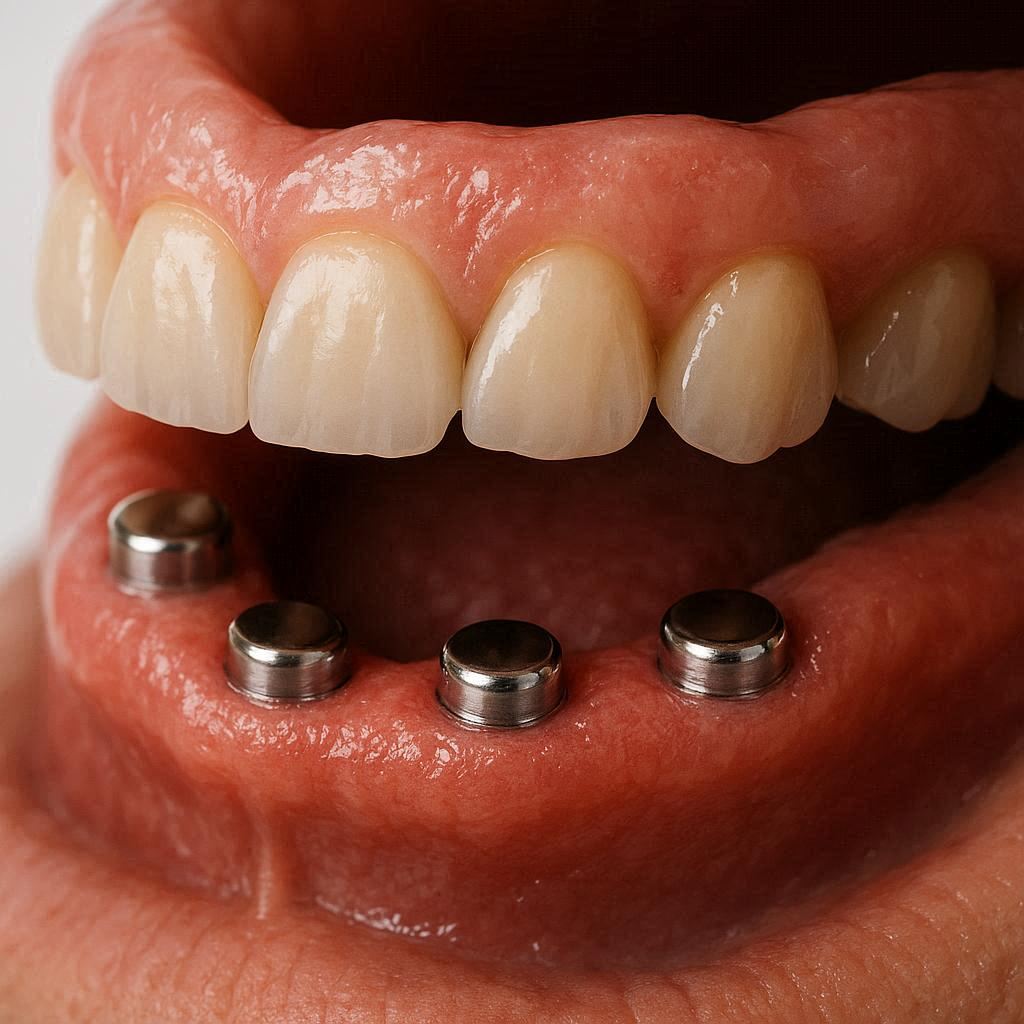
What Are Magnetic Implants for Dentures? (A Simple Explanation)
Let us break this down in plain English.
A traditional denture sits on your gums. It relies on suction, adhesive cream, or simply gravity to stay in place. That works fine for some people. But for others, it is like trying to keep a hat on during a hurricane.
A magnetic implant system changes the rules.
The Two Main Parts
Think of it like a refrigerator magnet, but inside your mouth.
- The Implant: A small, screw-like post made of titanium. A dentist surgically places this into your jawbone. Over a few months, the bone grows around it (a process called osseointegration). Inside this implant, or attached to it, is a small magnet or a magnetic metal alloy.
- The Denture Magnet: Your removable denture gets a matching magnetic attachment embedded in its base. When you put your denture in, the two magnets snap together.
The result? Your denture clicks firmly into place. It stays secure when you chew, talk, or yawn. Yet, you can still remove it for cleaning at night.
Not Just One System
It is important to know that “magnetic implants” is a family name. There are a few different designs:
- Root Magnets: The magnet sits inside the implant post itself.
- Bar and Magnet: A metal bar connects two or more implants. The denture has magnets that clip onto this bar.
- Keepers: A small magnetic “keeper” is attached to the implant. The denture has the opposite magnet.
Important Note: Early magnetic dentures (from the 1980s and 90s) had problems. Magnets would corrode or lose strength. Modern systems use rare-earth magnets like Neodymium or Samarium Cobalt. These are coated in stainless steel or titanium. They are safe, strong, and resistant to mouth fluids.
How Do They Differ from Other Implant Dentures?
You might have heard of “snap-on dentures” or “locator attachments.” Magnetic systems are a different animal.
Here is a quick comparison table to show you the difference.
| Feature | Magnetic Implants | Locator (Ball/Socket) Implants | Fixed Implant Bridges |
|---|---|---|---|
| Removable? | Yes (easy removal) | Yes (snaps on/off) | No (only dentist removes) |
| Moving Parts | None (magnetic force) | Plastic inserts (wear out) | None |
| Noise | Silent | Can click over time | Silent |
| Ease of Cleaning | Very easy | Moderate | Difficult (needs flossing under) |
| Long-term Wear | Magnets degrade slowly | Inserts need yearly replacement | Very durable |
| Best For | Low to moderate force | General use | Maximum stability |
| Cost | $$ | $$$ | $$$$$ |
The “No-Moving-Parts” Advantage
This is the biggest selling point of magnetic systems.
Ball and socket attachments have tiny plastic rings that create the friction to hold the denture. Those rings wear out. You need to go back to the dentist every 6 to 12 months to get new ones.
With magnets, there are no rings. There is no friction. The force is invisible. The magnets will lose a tiny bit of strength over 5 to 10 years, but they do not break down mechanically.
Who Is a Good Candidate for Magnetic Dentures?
Magnetic implants are not for everyone. And a responsible dentist will tell you that upfront.
You are likely a good candidate if you answer “yes” to most of these questions:
- Do you have trouble keeping your lower denture in place? (Lower dentures are notoriously harder to secure than uppers).
- Are you tired of using sticky adhesives that taste bad and leave residue?
- Do you have enough jawbone density to support small implants? (If not, you might need a bone graft).
- Are you a non-smoker? (Smoking dramatically lowers implant success rates).
- Do you have healthy gums (no active gum disease)?
- Are you looking for a removable solution? (Do you want to take your denture out at night?).
Who Should Avoid Magnetic Implants?
Honesty is important here. Magnetic dentures are wonderful, but they are not a miracle cure.
- People who grind their teeth (bruxism): Extreme force can break magnets or cause bone loss.
- Patients with severe bone loss: If your jaw is too thin, you may need traditional large-diameter implants instead.
- People allergic to nickel or rare earth metals: Although rare, some people react to the metal alloys. Titanium is usually hypoallergenic, but the magnet coating may vary.
- Those expecting to eat hard foods (nuts, bones, ice): While magnets hold well, they are not as strong as fixed, screw-retained bridges.
A quote from a prosthodontist we spoke to: “I love magnetic implants for the elderly or for patients with arthritis. They are so much easier to handle than fiddly clips or snaps. But I warn all my patients: you will still have some denture movement. It is not as rigid as a fixed bridge.”
The Step-by-Step Procedure: What to Expect
The journey from loose dentures to magnetic retention takes time. Patience is your best friend here.
Step 1: The Consultation (1 hour)
Your dentist will take x-rays (usually a 3D CBCT scan). This shows the exact amount of bone you have. They will check your existing denture fit and discuss your budget.
Step 2: Implant Placement Surgery (1-2 hours)
This is done under local anesthetic (numbing shots). You will be awake, but you will not feel pain.
- The dentist makes small incisions in your gum.
- They drill pilot holes into the jawbone.
- The titanium implant screws are placed into these holes.
- The magnet (or magnetic keeper) is either inserted immediately or later.
Number of implants needed:
- Lower denture: Usually 2 to 4 implants.
- Upper denture: Usually 4 to 6 implants (the upper jaw has less dense bone).
Step 3: Healing Period (3 to 6 months)
This is the waiting game. The bone must grow around the implant to lock it in place. During this time, you will wear your old denture (with a soft liner to protect the healing implants).
Step 4: Uncovery and Magnet Attachment (30 minutes)
Once healed, the dentist uncovers the top of the implant. They attach the final magnet or the metal plate that will attract the denture magnet.
Step 5: Denture Conversion (1-2 hours)
Your existing denture is sent to a dental lab. The technician drills holes in the exact spots that line up with your mouth magnets. They place the opposing magnets into your denture base and seal them with acrylic.
Step 6: Delivery and Fitting (1 hour)
You put the denture in. Click. That satisfying sound means it worked. The dentist will check the bite pressure and make small adjustments.
Step 7: Home Care Instructions
You are ready to go home. You will practice inserting and removing the denture yourself.
The Honest Pros and Cons (Realistic Expectations)
Let us get real. No dental solution is perfect. Here is the unvarnished truth about magnetic implants for dentures.
The Advantages (Why Patients Love Them)
- No Adhesives: You can finally throw away those messy creams and powders.
- Increased Chewing Power: Studies show magnetic dentures can increase biting force by up to 300% compared to conventional dentures.
- Improved Speech: No more clicking sounds. No more dentures floating up when you say words with “S” or “F”.
- Preservation of Bone: Because implants stimulate the jawbone (like natural tooth roots), you slow down the bone loss that normally happens with regular dentures.
- Easy Hygiene: You take the whole denture out. Brush the denture. Brush the implants (like cleaning a tiny button in your mouth). Done.
- Comfort: No sore spots caused by the denture rocking back and forth.
The Disadvantages (The Real Downsides)
- Cost is High: This is not a cheap fix. We will talk numbers soon.
- Surgery Required: You cannot avoid it. You need two small surgeries (implant placement and uncovering).
- Healing Time: 3 to 6 months is a long time to wait.
- Magnets Can Degrade: After 5 to 10 years, the magnetic force may drop by 20-30%. The magnets might need replacement.
- Not for Heavy Biting: You cannot bite into a whole apple or chew taffy. The magnets could dislodge or break.
- Metal Sensitivity: A small percentage of people experience a metallic taste or allergic reaction.
- Potential for Rust: Although rare with modern coatings, if the coating chips, the rare-earth magnet inside can corrode.
Cost Breakdown: How Much Do Magnetic Dentures Cost?
Money talk can be uncomfortable, but it is necessary.
The total cost varies wildly based on:
- Where you live (New York City vs rural Alabama).
- How many implants you need.
- Whether you need bone grafting.
- Your dentist’s experience.
General Price Ranges (USD)
| Service | Low Estimate | High Estimate |
|---|---|---|
| 2 Implants (Lower Jaw) | $3,000 | $6,000 |
| 4 Implants (Lower Jaw) | $5,000 | $10,000 |
| Full Upper Magnets (6 implants) | $8,000 | $15,000 |
| Bone Grafting (if needed) | $1,000 | $3,000 |
| New Denture Fabrication | $1,500 | $4,000 |
| Magnet Replacement (5-10 years) | $500 | $1,500 |
Total average out-of-pocket: For a lower magnetic implant denture with 2 implants, expect to pay between 4,500and4,500and8,000.
Does Insurance Cover It?
- Dental Insurance: Usually, no. Most plans call this “major restorative” and cover 0% to 50% of the implant cost, often with a low annual cap ($1,500).
- Medical Insurance: Possibly, if you lost teeth due to an accident or cancer surgery.
- Medicare: Original Medicare does not cover dental implants. Some Medicare Advantage plans have limited dental benefits.
Pro Tip: Ask your dentist about payment plans (CareCredit, LendingClub, or in-house financing). Many offices offer 12-24 month interest-free financing.
Maintenance and Long-Term Care
The good news? Magnetic dentures are low maintenance. The bad news? “Low” does not mean “zero.”
Daily Care Routine (5 minutes)
- Morning insertion: Rinse the denture and magnets with water. Insert. Listen for the click.
- After eating: Rinse your mouth with water to remove food debris around the implant magnets.
- Nighttime removal: Never sleep with your denture in. Remove it gently by prying from the back edge.
- Clean the denture: Use a soft brush and mild soap or denture cleaner. Avoid abrasive toothpaste (it scratches the acrylic and magnets).
- Clean the implants: Use a small brush (interdental brush) to clean around the magnet heads in your mouth.
- Soak overnight: Keep the denture in water or a mild cleaning solution.
What to Avoid
- Whitening toothpaste: It contains peroxide that can damage magnetic coatings.
- Metal utensils: Do not scrape your denture with a metal fork or spoon. It can scratch the magnet surface.
- Ultrasonic cleaners: The vibrations can weaken the magnet bond over time.
- Hard foods: Nuts, popcorn kernels, ice, and hard candy are enemies.
When Do Magnets Fail?
Magnets do not “die” suddenly. They fade slowly.
Signs your magnets need replacement:
- Your denture feels looser than it used to.
- You hear a slight rattle when you chew.
- The denture rotates slightly on the implants.
- You see rust or discoloration around the magnet.
Most patients need new magnets every 5 to 8 years. The procedure is simple: the dentist pries the old magnet out of your denture and glues a new one in. It takes 15 minutes.
Magnetic Implants vs. Traditional Dentures vs. Mini Implants
Sometimes the choice is overwhelming. Let us simplify.
Scenario 1: The Active Grandparent
- Traditional dentures: Frustrating. They slip during pickleball.
- Mini implants (small diameter): Good, but less stable than standard magnets.
- Magnetic implants: Excellent. Secure enough for sports, easy to clean.
Scenario 2: The Patient with Arthritis
- Traditional dentures: Very hard to manage (using adhesives requires squeezing tubes).
- Magnetic implants: Ideal. Just push the denture into place. No squeezing, no twisting.
- Locator attachments: Difficult (small plastic inserts require dexterity).
Scenario 3: The Patient with Severe Bone Loss
- Traditional dentures: Only option without surgery.
- Magnetic implants: Impossible without bone grafting.
- Zygomatic implants: Alternative for upper jaw, but very expensive and invasive.
Practical Checklist: Which is Right for You?
| Your Priority | Best Choice |
|---|---|
| Lowest cost | Traditional dentures |
| Easiest to remove/insert | Magnetic implants |
| Most stable (no movement at all) | Fixed screw-retained bridge |
| Best for immediate results | Traditional dentures (no healing) |
| Best for long-term bone health | Magnetic implants |
| Best for heavy chewing | Fixed bridge |
Frequently Asked Questions (FAQ)
1. Do magnetic implants hurt?
The surgery itself is numb. After the anesthesia wears off, you will have soreness for 3-5 days, like a tooth extraction. Most patients manage with over-the-counter ibuprofen.
2. Can I sleep with my magnetic denture in?
No. You should never sleep with any removable denture. You need to give your gums and bone time to recover. Sleeping with dentures increases your risk of fungal infections (stomatitis) and bone loss.
3. How strong is the magnetic hold?
A single modern denture magnet has about 300-600 grams of pull force. With two magnets, that is over a kilogram of force. It is enough to lift a can of soup. But a hard sideways bite (like chewing gum) can break the seal.
4. Will the magnets affect my brain or health?
No. The magnetic field is extremely localized (a few millimeters). It is thousands of times weaker than an MRI machine. There is zero evidence that dental magnets affect brain function, sleep, or general health.
5. Can I have an MRI if I have magnetic implants?
It depends. Most modern magnetic dentures use “non-ferromagnetic” alloys (Samarium Cobalt) that are MRI-safe up to 1.5 Tesla. However, older magnets (Neodymium) are dangerous. Always tell your radiologist. You may need to remove the denture (not the implant) before the MRI.
6. My dentures are already loose. Can I add magnets to my old denture?
Yes, in most cases. As long as you are willing to get the implants placed, a dental lab can retrofit your existing denture. However, a new denture is often recommended for the best fit.
7. How long does the whole process take?
From the first x-ray to eating steak with your new magnets? Plan on 4 to 8 months. The bone healing is the longest part and cannot be rushed.
8. Do food particles get stuck under the magnets?
Sometimes, yes. You will need to rinse after meals. A water flosser (Waterpik) on a low setting is excellent for cleaning around implant magnets.
Real Patient Stories (Anonymous, but Realistic)
Mary, 68 (Florida):
“I had a lower denture for 12 years. It never fit. I tried three different relines. The magnets changed my life. I can eat a hamburger in public. The only downside was the cost. I saved for two years. Worth it.”
Robert, 72 (Texas):
“My dentist talked me into it. I regret it. Not because of the magnets, but because I didn’t have enough bone. One of the implants failed after 18 months. Now I have a magnetic denture on one side and a loose one on the other. Get a second opinion before you start.”
Linda, 59 (Oregon):
“I have MS and my hands shake. I could not manage the little snap-in inserts on my old implant denture. The magnets are so easy. I just push. Click. Done. I tell everyone with dexterity issues to ask for magnets.”
Conclusion (Summary in Three Lines)
Magnetic implants for dentures offer a reliable, adhesive-free solution for people struggling with loose lower dentures. While the upfront cost and healing time are significant, the benefits of improved chewing, speech, and confidence are life-changing for the right candidate. Always consult an experienced prosthodontist to check your bone density and discuss realistic expectations before committing to surgery.
Additional Resource
For a deeper dive into scientific studies on magnetic denture retention, visit the National Library of Medicine’s database (PubMed) and search for “magnetic retention overdenture.” You can also find patient forums and cost comparison tools at the American College of Prosthodontists (gotoapro.org).
Disclaimer
This article is for informational purposes only and does not constitute medical or dental advice. You should not use this information to diagnose or treat a dental health problem without consulting a qualified professional. Every patient is different. The costs and success rates mentioned are averages and may not reflect your specific situation. Always seek the advice of a licensed dentist with any questions you have regarding a medical condition or treatment.