The Real Price of a Smile: A Candid Guide to Comparing Denture Costs Across Providers
Losing teeth is not just a physical change. It reshapes how you eat, how you speak, how you laugh in public, and how you see yourself in the mirror every morning. The decision to get dentures is deeply personal, often coming at a time when you are already navigating other health challenges or financial constraints. But then comes the practical side: the cost. Not a single number on a poster, but a dizzying range of figures that seems to swing wildly from one provider to the next. One clinic quotes you $600 for a full arch. Another, across town, asks for $8,000. You are left wondering if you are comparing the same thing at all, or if the cheaper option is a trap waiting to spring hidden fees on you months later.
This guide exists to cut through that confusion. We will walk through every corner of the denture cost landscape without fluff, without artificial optimism, and without pushing you toward the most expensive option under the guise of quality. You will learn exactly what drives prices up or down, how different provider models operate, what questions to ask before you sign anything, and how to spot a fair deal from a mile away. The goal is not to tell you what to buy. The goal is to make sure that when you do spend your money, you know exactly what you are paying for and why.
Understanding Why Denture Costs Vary So Dramatically
Before we compare providers, we need to understand the product itself. A denture is not a commodity like a gallon of milk or a pair of generic shoelaces. It sits at the intersection of medical device, cosmetic prosthesis, and personal service. That intersection naturally creates enormous price variation.
The Materials That Shape the Price Tag
The base of a denture typically starts with acrylic. But not all acrylic is created equal. Economy dentures often use a heat-cured acrylic that is perfectly functional but may feel slightly bulkier in the mouth. Premium options move toward high-impact acrylics that resist fracture better, or flexible thermoplastics like Valplast that offer a slimmer profile and a more natural gum appearance. Then there is the matter of the teeth themselves.
Standard acrylic teeth cost pennies per tooth to manufacture. They get the job done. They allow you to chew and smile. But they wear down faster against natural teeth or opposing dentures, and their color stability is limited. Over time, they can look chalky or flat. Mid-range options introduce composite resin teeth with better wear characteristics and more subtle color layering. At the top end, you find porcelain teeth or high-grade composite teeth from manufacturers like Ivoclar or Dentsply. Porcelain offers a translucency that mimics natural enamel beautifully and resists staining for decades. It also costs the lab significantly more, and it can be more brittle if dropped on a tile floor. The choice of tooth material alone can swing the cost of a single arch by several hundred dollars.
The Invisible Labor: Craftsmanship and Chair Time
You do not just pay for materials. You pay for hours of human skill. A denture that costs $500 probably involved a single impression, a stock mold selection, and a quick turnaround at a high-volume lab where one technician processes dozens of cases a day. A denture that costs $4,000 may have involved a custom tray impression, multiple try-in appointments, a facebow transfer to align the teeth with your jaw joint, and hours of meticulous hand-layering of acrylic to simulate realistic gum tissue.
The dentist or prosthodontist who charges more is often charging for time you do not see: the time spent adjusting the occlusion under a microscope, calling the lab to discuss your specific midline, re-pouring a model because the first one had a tiny bubble near a critical margin. That time is invisible in the final product, but you feel it when the denture stays in place without adhesive and does not pinch after a four-hour dinner.
The Business Model Behind the Price
No dental office operates as a charity, and the business structure directly affects your final bill. A solo private practitioner in a small office with one chair has high overhead relative to patient volume. Every procedure must carry enough margin to cover rent, staff, insurance, lab bills, and a living wage for the dentist. Corporate chains flip this model. They centralize labs, negotiate bulk material pricing, streamline procedures, and often pay dentists on a production basis. Their cost structure allows lower sticker prices, but the trade-off often appears in time—shorter appointments, fewer adjustments, and a standardized product that may not account for your unique facial anatomy.
Understanding this does not make one model bad and the other good. It simply explains the gap. Once you understand the gap, you can decide which side of it you want to be on for your specific situation.
“The bitterness of poor quality remains long after the sweetness of low price is forgotten.” This old industry saying does not mean cheap dentures are always poor quality. It means that if you choose primarily on price, you must accept the risk of paying for it later in discomfort or early replacement.
A Clear Look at National Cost Ranges
Talking about cost without numbers is pointless. Let us anchor this conversation in the real figures patients across the country encounter in 2026. These ranges reflect the full spectrum, from rural economy clinics to urban prosthodontic specialty practices.
Economy Dentures: $300 to $1,000 per Arch
These are the dentures you see advertised on roadside billboards and in coupon mailers. They serve a genuine need. For someone with no insurance, limited income, and a mouth that has been without teeth for years, a $399 full upper denture can be life-changing.
What you typically get in this range: a standard acrylic base, basic acrylic teeth, one or two appointments, and a limited warranty that may only cover breakage for a few months. The fit relies heavily on the existing ridge of your jawbone. If you have significant bone loss, these dentures may feel loose from day one. The aesthetics are functional but not nuanced—teeth tend to be a single shade, positioned in a standard arch form that may or may not complement your facial structure.
Economy dentures work best for patients who have worn dentures before, have a well-preserved ridge, and have realistic expectations about comfort and appearance. They work poorly for first-time denture wearers with high aesthetic demands or anyone with a complex bite relationship.
Mid-Range Dentures: $1,200 to $3,500 per Arch
This bracket covers most private general dentists. You step into a more personalized process here. The dentist takes a primary impression, sends it to a local lab for a custom tray, takes a secondary impression for precision, and works with the lab on tooth selection. You typically get a wax try-in appointment where you can see the teeth set in wax before they process the final acrylic. This try-in is your moment to approve the shade, the shape, the midline, and how much tooth shows when your lips are at rest.
Mid-range dentures often use higher-grade acrylic teeth with layered color and some individualized characterizations—maybe a slight rotation of a lateral incisor, a tiny gap, or subtle staining at the gumline. The warranty tends to extend for one to three years against fracture. Adjustments for sore spots are usually included for the first several months.
This category fits most patients well. It balances cost and customization. The key variable here is the skill of the dentist and the quality of the local lab they use. A skilled dentist sending work to an average lab will produce a better result than an average dentist sending work to a great lab, because the clinical steps—the impressions, the bite registration, the try-in evaluation—determine the foundation.
Premium Dentures: $4,000 to $8,500 per Arch
This is prosthodontist territory. Prosthodontists are dentists who completed an additional three years of specialty training in tooth replacement and oral rehabilitation. They treat the most complex cases: patients who have lost significant jawbone, patients who have undergone cancer surgery, patients whose previous dentures have failed repeatedly.
A premium denture process might span six to eight weeks and involve five or more appointments. The prosthodontist may use a facebow, a device that records the spatial relationship of your upper jaw to your jaw joint, so the lab can mount your case on an articulator that mimics your exact chewing movements. They may take a Gothic arch tracing to record your bite without you having to bite into wax, which can be inaccurate if your ridges are unstable.
The lab tech hand-layers each tooth, often using multiple shades of acrylic to replicate the translucency gradient you see in natural enamel. The gum work might include tiny blood vessel simulation using fine acrylic fibers. Porcelain teeth are common at this level, set in a high-impact acrylic base with a processed soft liner.
The warranty at this level often runs five years or longer. But the real value proposition is comfort and function. A premium denture, well made, should stay in place with minimal adhesive, distribute chewing forces evenly, and support your lips and cheeks in a way that looks natural in photographs.
Immediate Dentures: An Added Layer of Cost
Immediate dentures deserve special mention because they flip the timeline. You have your remaining teeth extracted and the denture placed the same day. This means you never walk around toothless, but it also means the denture is fabricated before the extractions occur, based on an educated guess of what the healed ridge will look like.
Inevitably, the bone resorbs and the gum shrinks over the next six to twelve months. An immediate denture will feel loose during that period. You will need a temporary reline, which costs $200 to $500, to fill the gap between the denture base and the shrinking tissue. Eventually, the denture requires a permanent reline or a complete replacement within a year or two.
The cost for immediate dentures typically adds $300 to $800 per arch over the cost of a conventional denture, simply because the lab process is more complex and the appointments more urgent. Many patients do not budget for the reline and replacement costs that follow. If you are considering an immediate denture, factor in at least one soft reline and the strong likelihood of needing a new definitive denture within 12 to 18 months.
Comparing Providers: Where the Price Differences Really Live
Now we get to the heart of the matter. The same denture materials, ordered through different types of providers, can cost vastly different amounts. Understanding the incentives and limitations of each provider type will help you shop intelligently.
Private General Dentist
A private general dentist is the traditional route. This is the office in your neighborhood, often with the dentist’s name on the door, where you might also get your cleanings and fillings. The dentist knows you, or at least has your chart in front of them with years of history.
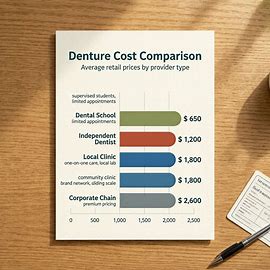
Cost Range for Full Upper and Lower Set: $2,500 to $7,000
The pricing here reflects a mix of local lab costs, the dentist’s experience with denture cases, and the overhead of a small practice. General dentists who do a lot of denture work tend to be faster and more efficient, which can translate to lower chair time costs. Those who do one or two cases a month may take longer, order more remakes, and build that risk into their pricing.
The relationship factor matters. If something hurts, you can call the office and get an adjustment appointment within a day or two. The dentist has a reputational incentive to make you happy because you are a long-term patient. That said, general dentists vary widely in their denture skills. Dentistry school teaches the fundamentals of removable prosthodontics, but it does not make everyone an expert. If your general dentist refers complex cases to a prosthodontist, that is a good sign—they know their limits.
Note: Ask a private dentist how many denture cases they complete per month. The answer will tell you more than the price will.
Prosthodontist
A prosthodontist is a specialist. They see the failures, the tough cases, the patients whom other dentists have given up on. Their entire practice revolves around replacing missing teeth.
Cost Range for Full Upper and Lower Set: $6,000 to $16,000
The premium is unmistakable. What you buy here is the certainty that your case will be handled with the highest level of technical rigor. Prosthodontists own the kind of equipment—facebows, semi-adjustable articulators, pressure-indicating paste systems—that general dentists may not find economical to invest in for a handful of denture cases per year.
They also tend to work with elite dental labs that charge significantly more. The lab fee for a premium set of dentures from a high-end lab can exceed $2,000 per arch just for the fabrication, before the dentist adds any chair time. The prosthodontist then layers on their diagnostic wax-up, their multiple try-in appointments, and their meticulous adjustments.
Prosthodontists are not the right choice for everyone. If you have a straightforward case, plenty of bone, and modest expectations, paying prosthodontist fees is like hiring a Formula 1 engineer to tune your sedan. But if you have been through multiple failed dentures, have severe bone loss, or need a denture that interacts with dental implants, the specialist fee often pays for itself in avoided remakes and misery.
Corporate Dental Chains
Names like Aspen Dental, Affordable Dentures, and ClearChoice (which focuses on implants) operate on a high-volume, standardized model. Their advertising budgets are enormous, and their pricing is designed to get you in the door.
Cost Range for Full Upper and Lower Set: $600 to $3,000
The lower end of their pricing is genuine. You can walk out of an Affordable Dentures practice with a new set of economy dentures for under $700. The catch, and this is where the industry draws criticism, is that the initial low price often does not include the services needed to make those dentures successful. Extractions, for example, are frequently billed separately at rates that can add up quickly. A $99-per-tooth extraction fee on a full arch can add $1,400 to your bill before you even get to the denture.
Corporate chains also rely heavily on in-house labs that standardize production. This standardization reduces lab costs dramatically but limits customization. The dentist’s job is to move efficiently through a protocol. You get less face time, fewer try-in opportunities, and a product that is designed to satisfy the median patient rather than your specific facial geometry.
The warranties at these chains are often quite good on paper—some offer seven-year warranties against breakage. However, patients sometimes report difficulty getting adjustments scheduled promptly, and the initial denture may require multiple trips back to get the fit acceptable. If you live far from the chain’s location, the travel cost and time can erode the initial savings.
Note: If you choose a chain, go in with a written treatment plan that details every single fee. Do not accept verbal estimates. Ask specifically about extraction costs, reline costs, and adjustment visit fees.
Dental Schools
University dental schools and teaching hospitals offer a unique value proposition. Students, supervised closely by licensed faculty dentists who are often prosthodontists, perform the work. The appointments run long—expect three to four hours for what a private office does in one—but the cost savings are substantial.
Cost Range for Full Upper and Lower Set: $800 to $3,000
Dental school clinics typically charge 50% to 70% less than private practices. The materials and labs they use are often high-quality because the educational mission encourages teaching with proper materials. The trade-off is time and scheduling. You may wait weeks for an initial appointment, and the treatment can stretch over several months because students must get each step checked by faculty.
For retirees with time and patience, dental schools can be an exceptional deal. The faculty overseeing your case are often leading experts in removable prosthodontics, and students are eager to do meticulous work because their grades depend on it. The lab fees at dental schools tend to be heavily subsidized, passing further savings to you.
Denturists (Where Permitted)
In some states—Arizona, Colorado, Idaho, Maine, Montana, Oregon, and Washington—denturists are licensed professionals who fabricate and fit dentures directly, without a dentist’s involvement. They are trained specifically in removable prosthetics and often operate their own labs on-site.
Cost Range for Full Upper and Lower Set: $1,000 to $4,000
Denturists offer an attractive middle ground. They eliminate the dentist markup while retaining the craftsmanship focus. Because they make the denture themselves, they can adjust and personalize it immediately without waiting for a lab turnaround. The chair-side reline, the occlusion tweak, the pressure spot relief—all happen in real time.
The limitation is scope. A denturist cannot diagnose oral disease, cannot perform extractions, and cannot place implants. They must refer you to a dentist or oral surgeon for any surgical needs. If your mouth is healthy, you need no extractions, and you simply need dentures to replace existing ones, a denturist often provides the best value in terms of fit and aesthetics per dollar spent.
Important: Check your state’s regulations. In states without denturist licensure, only a dentist can legally provide dentures. Traveling to a denturist state may be an option if you factor in gas, lodging, and follow-up visits.
Comparative Cost Table: Provider Types at a Glance
| Provider Type | Single Arch (Range) | Full Set (Upper & Lower) | Typical Inclusions | Best For |
|---|---|---|---|---|
| Economy Clinic / Chain | $300 – $1,000 | $600 – $2,000 | Basic acrylic, limited shade options, short warranty | Budget-conscious patients, spare denture needs |
| Mid-Range General Dentist | $1,200 – $3,500 | $2,500 – $7,000 | Custom tray, wax try-in, 1-3 year warranty | Most patients seeking good balance of cost and fit |
| Denturist (where legal) | $500 – $2,000 | $1,000 – $4,000 | On-site lab, personalized shading, direct adjustments | Patients with healthy mouths, no extractions needed |
| Dental School | $400 – $1,500 | $800 – $3,000 | High-quality materials, extensive faculty oversight | Patients with time flexibility, complex cases |
| Premium General Dentist | $3,500 – $5,000 | $6,000 – $10,000 | Premium teeth, detailed characterization, extended warranty | Patients wanting high aesthetics, durable materials |
| Prosthodontist | $4,000 – $8,500 | $8,000 – $16,000 | Full diagnostic workup, facebow, premium lab, long warranty | Complex cases, implant-supported, previous failures |
The Hidden Costs No One Puts on the Brochure
A denture’s sticker price tells only part of the story. Ignoring the adjunctive costs is the single most common budgeting mistake patients make. Let us unpack these quiet budget-eaters.
Extractions: The Necessary Precursor
If you still have teeth that need to come out, extraction costs layer onto the denture quote. Simple extractions of teeth that are already loose from periodontal disease might cost $75 to $150 per tooth. Surgical extractions of broken-down molars, teeth with curved roots, or impacted teeth can run $250 to $600 per tooth. A full-mouth extraction case can easily add $1,500 to $4,000 to your total.
Bone grafting after extraction is another silent line item. When a tooth comes out, the surrounding bone resorbs, sometimes leaving a sharp, thin ridge unsuitable for denture stability. A socket preservation graft at the time of extraction can cost $200 to $600 per site. Some dentists recommend grafting routinely; others reserve it for strategic areas like the front of the upper jaw where bone loss is most visible.
Relines: The Fit Keepers
Your mouth changes. The bone under a denture slowly remodels, and the soft tissue compresses differently over time. A denture that fit perfectly on delivery day may wobble noticeably 18 months later. A reline adds material to the tissue side of the denture to restore a snug fit.
A soft reline, using a pliable silicone-based material, costs $200 to $500 and lasts a year or two. It is particularly helpful for patients with thin, tender gum tissue. A hard reline, using acrylic, costs $400 to $800 and feels more like the original denture base. Most patients with an immediate denture need at least one soft reline during the first year of healing, followed by a hard reline when the ridge stabilizes.
Budget for a reline every two to five years, depending on how fast your bone changes. If you are a new denture wearer, budget for one within the first 12 months.
Adjustments and Repairs
Sore spots develop. The denture base rubs against a prominent bony point, and within days you have an ulcer. Adjustments involve the dentist using an acrylic bur to relieve the pressure point inside the denture. Most private dentists include a certain number of adjustment visits in the initial fee for a defined period, often three to six months. Corporate chains may limit free adjustments to a specific number, after which a per-visit fee applies—commonly $50 to $100.
Repairs are a different animal. Dropping a denture on a bathroom floor cracks an acrylic base with stunning regularity. A simple fracture repair runs $100 to $300. Adding a tooth to an existing denture after losing one to wear or further extraction costs $100 to $200 per tooth. Denture teeth do not always bond perfectly to a repair, so a repaired denture is slightly more vulnerable to future breaks.
Adhesives and Cleaners: The Monthly Drip
A tube of denture adhesive costs $6 to $12 and lasts a couple of weeks with daily use. Over a decade, adhesive costs can exceed $2,000. Many patients use adhesive as a crutch for a poorly fitting denture. A properly fabricated denture should require minimal to no adhesive for upper arches, which gain stability from suction against the palate. Lower dentures are trickier because the tongue and floor of the mouth constantly displace them; some adhesive use is common even with excellent fit.
Denture cleaning tablets, brushes, and soaking solutions add another $5 to $15 per month. These are non-negotiable. Poor denture hygiene leads to fungal infections like candidiasis, which can be painful and costly to treat.
Geographic Price Variation: Why Your Zip Code Matters
A denture in Manhattan costs more than the same denture in rural Mississippi. This is not a conspiracy. Rent, staff wages, lab shipping, and local market competition shape dental fees as surely as they shape restaurant prices.
Urban vs. Rural Pricing
In major metropolitan areas—New York, Los Angeles, San Francisco, Boston—overhead is punishing. A dental office in a downtown medical building might pay $50 per square foot per month in rent. Staff expect wages commensurate with the cost of living. Lab technicians who can afford to live near a big city charge more for their work. The result: mid-range dentures in a city center often start $500 to $1,000 higher per arch than the same quality in a suburban or rural setting.
Rural areas present a different dynamic. Overhead is lower, but patient volume is also lower. Some rural dentists keep prices moderate to retain the community’s loyalty. Others, particularly those with no competition within a 50-mile radius, may price at or above urban levels because patients have no alternative. The sweet spot for affordable private dentistry often lies in medium-sized cities and suburbs where multiple practices compete.
Regional Trends
The southern United States tends to have lower average denture costs, driven in part by lower overhead and the presence of many economy-focused chains. The Northeast and West Coast rank as the most expensive regions. The Midwest falls in the middle, with pockets of very affordable care near dental school hubs like Iowa City, Indianapolis, and Ann Arbor.
Traveling for dentures is a real strategy. Some patients fly from New York to a denturist in Maine or from California to a dental school in Arizona. The math can work if you need extensive work, but you must account for travel, lodging, and the critical need for follow-up adjustments close to home. A denture made in another state that requires an adjustment you cannot get locally turns a bargain into a burden.
Insurance and Payment: What Actually Reduces Your Out-of-Pocket
Dental insurance for dentures operates differently than medical insurance. The days of generous coverage are mostly behind us. Understanding the mechanics helps you set realistic expectations.
How Dental Insurance Typically Handles Dentures
Most dental PPO plans place dentures in the “major services” category, alongside crowns and bridges. The annual maximum—the total the insurance will pay for all dental work in a year—typically ranges from $1,000 to $2,500. That maximum has not budged significantly in decades, even as dental fees have risen.
Coverage for dentures usually works as a percentage: 50% of the allowed amount, up to the annual maximum. If your plan has a $1,500 maximum and you have already used $800 on fillings and a crown earlier in the year, only $700 remains for dentures. The plan pays half of the allowed amount, which may be lower than the dentist’s actual fee. You pay the rest.
A typical insurance contribution for a full upper and lower denture set is $500 to $1,200, leaving you with a substantial balance regardless. Some plans impose a missing tooth clause: if the tooth was missing before the policy started, they will not cover its replacement. Read your policy’s fine print carefully, or ask your dentist’s insurance coordinator to verify benefits before you commit.
Discount Dental Plans
Unlike insurance, discount plans charge an annual membership fee—usually $100 to $200—and provide a card that entitles you to reduced fees at participating dentists. The discount on dentures typically ranges from 20% to 50% off the provider’s usual fee. There are no annual maximums, no waiting periods, and no exclusions for pre-existing conditions.
Discount plans can be genuinely useful for denture patients, especially if you need work that exceeds a traditional insurance maximum. The catch is network: you must use a participating dentist, and the quality of those dentists varies. Check the list of providers near you before buying the plan.
In-House Membership Plans
A growing number of private practices offer their own membership plans, bypassing insurance companies entirely. You pay a monthly or annual fee to the practice and receive a defined set of preventive care plus a discount on restorative work, including dentures. Typical discounts run 15% to 30%. These plans often eliminate waiting periods and annual maximums, and the money stays local.
Financing Options
CareCredit and similar healthcare credit cards offer promotional financing—often 6 to 18 months of zero interest—on dental work if you pay the balance within the promotional period. The risk is the deferred interest clause: if you miss a payment or fail to pay the full balance by the deadline, interest accrues retroactively from day one at a high rate. These cards work for disciplined borrowers. For others, they can be a trap. Personal loans from credit unions or online lenders sometimes offer lower APRs than CareCredit’s standard rate, with simpler terms.
Implant-Supported Dentures: A Different Cost Universe
We must address implants because the conversation about dentures increasingly turns to them. An implant-supported overdenture uses two to four dental implants surgically placed in the jawbone to anchor the denture. The denture snaps onto the implants, eliminating much of the wobble and lift that plagues conventional lower dentures.
The cost jump is seismic. A single implant, including the surgical placement, the abutment, and the attachment housing in the denture, can cost $1,500 to $3,500. A two-implant lower overdenture might cost $6,000 to $12,000 total, including the denture itself. A four-implant upper overdenture can reach $15,000 to $25,000.
The comparison across providers shifts when implants enter the picture. Some corporate chains now offer fixed prices for implant overdentures—for example, a “snap-in” denture package for $10,000 to $15,000 per arch—that simplifies budgeting but may use fewer implants or less expensive implant systems. Prosthodontists and oral surgeons charge more per implant but often use premium implant brands with decades of research behind them and provide more careful planning, including 3D cone-beam CT imaging to map nerve locations and bone density.
Implant-supported dentures are not the right answer for everyone. They require adequate bone volume, good general health, meticulous hygiene, and a willingness to undergo surgery. But for patients who have struggled with lower dentures for years, the improvement in quality of life can be profound enough to justify the cost.
How to Evaluate a Provider: Questions That Reveal Everything
You cannot judge quality by the furniture in the waiting room or the friendliness of the front desk. You must ask specific, sometimes uncomfortable, questions. Good providers welcome these questions. Defensive providers reveal themselves.
Questions About the Process
Start with the workflow. Ask: “Can you walk me through exactly how many appointments my case will need, and what happens at each one?” A quality denture process involves at least four to five appointments: initial exam and impressions, final impressions with custom trays, bite registration, wax try-in, and delivery. If the answer is “we can have you in and out in two visits,” understand that they are cutting steps. Sometimes those steps are expendable for a straightforward case. Often they are not.
Ask: “Will I have a wax try-in where I can see the teeth before they finish the denture?” If the answer is no, walk away. The wax try-in is your only opportunity to change the shade, the shape, the position of the teeth, or the amount of gum showing. Without it, you are gambling.
Questions About the Lab
Ask: “Which dental lab do you use, and how long have you worked with them?” The relationship between dentist and lab is the invisible thread that determines your result. A lab that the dentist has partnered with for years understands the dentist’s preferences and standards. A lab chosen purely on low bid will deliver accordingly.
Ask if the lab is local or out of state. Local labs allow the dentist to send you for a custom shade match in person. Out-of-state labs, often used by corporate chains, work entirely from impressions and photos. They can produce fine work, but the margin for miscommunication widens.
Questions About Problems
Ask: “What happens if I hate the denture? What is your remake policy?” Every dentist has faced this scenario. A good remake policy gives you a clear, no-surprise path: a certain number of adjustments, and if the fit or aesthetics still fall short within a defined period, a remake at no or reduced lab cost. Get this policy in writing.
Ask: “What is your adjustment policy after delivery? How many adjustment visits are included, and for how long?” The answer tells you whether the provider views the delivery as the end of the relationship or the beginning of one.
Denture Adhesive Dependency: A Sign Worth Heeding
A properly made upper denture should stay in place most of the time without adhesive. The physics of the palate—a relatively flat, broad surface—allow for a suction seal when the borders of the denture extend correctly into the vestibule and post-dam area. If your upper denture requires heavy adhesive paste just to stay up during a conversation, the denture is not fitting correctly. Full stop.
Lower dentures are more challenging. The tongue, the mobile floor of the mouth, and the narrow ridge conspire against stability. A small amount of adhesive on a lower denture is not a sign of failure. But if you cannot chew a soft piece of bread without the denture lifting, the fit or the bite registration needs correction.
Denture adhesive overuse has real consequences. Zinc-containing adhesives, used in large quantities over years, have been linked to neurological damage from zinc toxicity. Most major brands now offer zinc-free formulations, but the risk exists with chronic overuse. More practically, adhesive masks the fit problems that should prompt a reline or a remake. It allows a bad denture to continue being a bad denture, while you slowly adapt to a level of discomfort that is not normal.
The Aging Denture: When to Replace, Not Repair
Dentures do not last forever. The teeth wear down, changing your bite and the vertical dimension of your face. The acrylic absorbs odors and stains over time, regardless of how diligently you clean it. The base may develop microscopic cracks that harbor bacteria.
Most clinicians recommend replacing dentures every five to eight years, though well-made premium dentures can last a decade or more with excellent care and regular relines. Waiting too long has functional consequences. Worn teeth reduce chewing efficiency and can cause the corners of the mouth to crack (angular cheilitis) as the bite collapses. The chin appears closer to the nose, the lips thin, and the face ages prematurely.
Consider the cost-per-year rather than the upfront cost. A $4,000 set of dentures that lasts eight years costs $500 per year, or about $1.37 per day. A $800 set that fails in three years and leaves you miserable costs about $267 per year—cheaper on paper, but far more expensive in comfort and dignity.
Key Questions to Ask Any Provider Before Committing
- How many full denture cases do you personally complete per month?
- May I see before-and-after photos of your own patients (not stock images)?
- Does your quote include the wax try-in step?
- What specific brand and type of teeth are included in this quote?
- What is your policy on remakes if the denture does not meet expectations?
- How many adjustment visits are included, and for how long after delivery?
- Is the lab local, and may I speak with them about shade matching if needed?
- Are extractions, relines, and repairs priced separately or included?
- What is the warranty period, and what exactly does it cover?
- Do you offer an in-house payment plan or membership discount?
Strategies to Reduce Your Denture Costs Without Sacrificing Quality
Saving money does not require settling for a bad product. It requires strategy.
Time your treatment across two calendar years. If your insurance has a $1,500 annual maximum, starting extractions and impressions in December allows you to use this year’s maximum, then deliver the denture in January and use next year’s maximum. This simple calendar shift can double your insurance contribution.
Get a treatment plan in writing and shop it around. Take the written plan, which should detail every procedure code, and call three other providers. Ask for a fee schedule for those same codes. Price transparency is improving in dentistry, and many offices will quote over the phone for removable prosthetics.
Consider a dental school if one is within driving distance. The time cost is high, but the financial savings and quality oversight often make it the best value in dentistry.
Ask about a “spare denture” discount. Some dentists will fabricate a second set of dentures at a significantly reduced fee while making the first set, because the lab setup work is already done. Having a spare set brings peace of mind and effectively halves the per-set cost.
Negotiate, respectfully. Private practices have some pricing flexibility, especially if you are paying cash, doing multiple arches at once, or committing to additional work. Corporate chains have less flexibility on their advertised specials but may negotiate on the ancillary services like extractions or relines.
Realistic Expectations: What Good Dentures Feel Like
New denture wearers often arrive with misconceptions born of television makeover shows and optimistic advertising. Let us set the record straight.
Good dentures feel foreign at first. Your brain needs time to remap the new landscape of your mouth. Saliva production increases temporarily. Speech requires practice—reading aloud to yourself accelerates this adaptation. The lower denture will always be less stable than the upper. You will chew with roughly 20% to 25% of the force you had with natural teeth. Foods like steak, raw carrots, and crusty bread require cutting into small pieces and chewing deliberately.
But a good denture should not cause constant pain. It should not make you dread meals. It should not require you to excuse yourself from social situations to apply more adhesive. It should not prevent you from smiling fully. If it does, the denture—or the denture process—has failed, and you have every right to demand correction.
A Note on Overseas Dental Tourism
Dental tourism to Mexico, Costa Rica, Thailand, and other destinations offers denture prices that seem impossibly low: $300 to $800 per arch, often including extractions. The math can appear irresistible, but the risks merit clear-eyed assessment.
Quality varies wildly overseas, just as it does at home. Some international clinics rival or exceed American standards, using modern materials and employing prosthodontists trained in the United States or Europe. Others cut corners that will not be visible until months later, when the acrylic warps or the bite collapses.
The deeper issue is continuity of care. A denture made in Costa Rica that needs adjustment two weeks after you return home becomes a problem. Your local dentist may be reluctant to adjust a denture they did not fabricate, or they may charge full fees for the adjustments. In the worst case, the denture fails entirely, and you end up paying for a new one locally, erasing the initial savings.
If you pursue dental tourism, research the clinic exhaustively. Look for American Dental Association-recognized continuing education credentials. Ask for patient references you can call. Stay long enough for the delivery and at least one follow-up adjustment visit. Build the travel and lodging costs into your comparison, and have a backup plan for local care if things go wrong.
The Emotional Side of the Denture Decision
We would be remiss to discuss costs without acknowledging the emotional weight of this purchase. Dentures are not like a new appliance or a set of tires. They sit at the intersection of health, identity, and self-image. Many patients grieve the loss of their natural teeth, even when those teeth were failing and painful. The denture represents a kind of bodily change that feels invasive and permanent.
Choosing a provider who listens, who does not rush, and who treats your case as worthy of their best effort matters in ways that do not appear on a balance sheet. The cheapest provider in town might be perfectly capable of making a functional denture, but if the experience leaves you feeling like a number on a production board, the savings come at a cost you may not want to pay.
Conversely, the most expensive provider who spends hours with you but delivers a denture that does not fit is not a better choice simply because they were kind. Kindness and competence are not the same thing, though ideally you find both.
Building Your Personal Cost Comparison
At this point, you have the framework. Now build your own comparison. Create a simple spreadsheet or paper chart. For each provider you consult, record:
- The quoted fee for a full upper and lower denture
- The specific materials included (acrylic type, tooth brand and line)
- The number of appointments in the quoted process
- Whether a wax try-in is included
- Whether extractions are included or separate
- The cost of a soft reline and a hard reline at that office
- The adjustment policy timeline
- The warranty terms in writing
- Your gut feeling about the communication quality
This record will keep you grounded when the marketing and the emotion swirl. It will reveal the gaps between quotes that initially looked similar. It will guide you to the choice that best fits your circumstances, not the choice someone else’s advertising budget pushes you toward.
Resource Guide
For further research, visit the American College of Prosthodontists at gotoapro.org. Their patient education section explains the difference between general dentists and prosthodontists, offers a “Find a Prosthodontist” tool, and covers the basics of denture care without commercial bias.
The National Association of Dental Laboratories (NADL) website provides insight into the laboratory side of denture fabrication. Understanding what goes on in the lab helps you appreciate why materials and craftsmanship matter.
Your state’s dental board website can verify a dentist’s or denturist’s license status and any disciplinary history. This is public information, and checking it is free and prudent.
Frequently Asked Questions
How much should I realistically budget for a full set of dentures?
Budget $3,000 to $7,000 for a conventional full set from a private general dentist, including the wax try-in and a reasonable adjustment period. This range covers most mid-range cases with decent materials and adequate chair time.
Why do some dentures cost $600 and others cost $8,000?
The gap reflects differences in materials (basic acrylic teeth versus layered premium composites or porcelain), the number of appointments and try-ins, the skill and specialty training of the provider, and the quality of the dental lab. The $600 denture involves fewer steps and standardized production; the $8,000 denture involves extensive customization and specialist oversight.
Are corporate chain dentures bad quality?
Not necessarily. They can provide functional dentures at a price many patients could not otherwise afford. The trade-offs typically include fewer customization steps, less face time with the dentist, and standardized aesthetics. They work best for patients with straightforward anatomy and modest expectations.
Does dental insurance cover dentures?
Most plans cover them as a major service at around 50% of the allowed amount, subject to an annual maximum that typically runs between $1,000 and $2,500. Many patients find their insurance covers only a fraction of the total cost.
How do I know if a provider is quoting me a fair price?
Collect at least three written quotes for the same procedure codes. Ask each provider to itemize what is included. A price significantly below the local average usually signals omitted steps or materials; a price significantly above should come with a clear explanation of what that premium buys.
What is the single most important question to ask before committing?
Ask whether the process includes a wax try-in appointment. If the answer is no, the process is cutting a step that is essential for verifying the fit, bite, and appearance of the final denture. This single question often separates quality-focused providers from volume-focused ones.
Can I negotiate denture prices?
In private practice, yes—especially if you are paying cash, doing multiple arches, or bundling extractions. Corporate chains tend to have less flexibility on advertised specials but may negotiate on ancillary fees like relines.
Conclusion
Comparing denture costs across providers is not about finding the lowest number. It is about understanding what that number includes, what it excludes, and whether the provider behind it will still be available to you when the denture needs adjustment six months from now. The work of gathering quotes, asking uncomfortable questions, and checking credentials pays off in a denture that lets you eat, speak, and smile without constant anxiety.
The market offers genuine options for every budget. Economy clinics serve a vital role. General dentists handle the majority of cases well. Prosthodontists catch the hardest cases. The key is matching your specific circumstances—your remaining bone, your aesthetic needs, your insurance, your patience for appointments—to the provider model that fits. Do the homework, trust your direct observations more than the advertisements, and remember that a fair price is one that buys you both function and dignity.
Disclaimer: This article provides general information for educational purposes. It is not a substitute for a clinical examination by a licensed dental professional. Costs cited represent typical ranges at the time of writing and vary by location, individual case complexity, and market conditions. Always request a written treatment plan and itemized quote before beginning any dental treatment. No information in this article constitutes medical or financial advice.