What Does It Mean When a Dental Implant Wiggles?
You are eating dinner, and suddenly you feel something you were never supposed to feel. A subtle movement. A slight give. You press your tongue against your dental implant crown, and your stomach drops. It wiggles. A wave of panic washes over you. Implants are supposed to be rock-solid, fused to the bone. So what does this mean? Is it failing? Will it fall out?
Let us start with the most important fact: a healthy, successfully integrated dental implant never moves. Zero mobility is the absolute standard. If you detect any wiggle, any wobble, any sensation of movement at all, something is wrong. The question is what exactly is wrong, and how urgently you need to act.
This guide will walk you through every possible cause of a wiggling implant. We will distinguish between a loose crown, a loose abutment, and the most serious scenario, a failed implant fixture. You will learn what to do immediately, what not to do, and what your dentist will likely recommend. Knowledge is your antidote to panic.
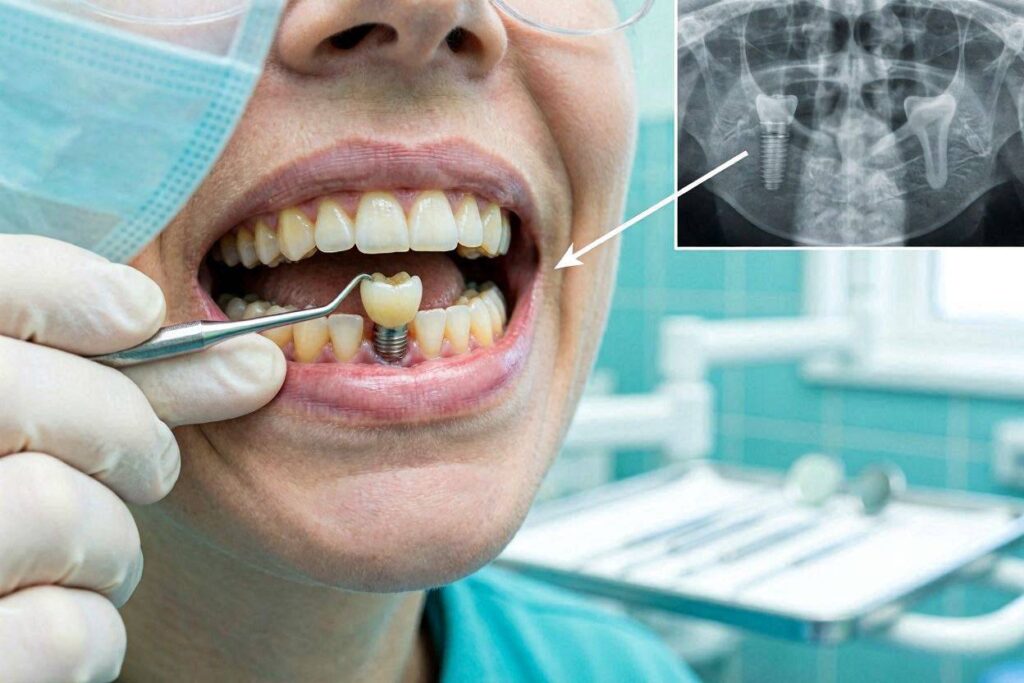
The Zero-Mobility Standard: What Normal Feels Like
Before we explore what is wrong, we must define what is right. A natural tooth has a minuscule amount of physiological mobility. It is suspended in the bone by the periodontal ligament, a cushion of fibers that allows a barely perceptible movement of about 25 to 100 microns. If you push on a natural tooth with your fingers, you might sense a slight springiness.
A successful dental implant is fundamentally different. It is ankylosed, meaning fused directly to the bone with no ligament. There is no give. No shock absorption. No micron of movement. When you tap on a healthy implant, it emits a high-pitched, crystalline ringing sound. A failing implant gives a dull, muffled thud. When you push on a healthy implant, it feels like pushing on a granite countertop. Absolute rigidity.
If you feel movement, you are not feeling a normal ligament. You are feeling a mechanical failure of some component, or a biological failure of the bone-implant interface.
The Three Possible Sources of the Wiggle
When you sense movement, the problem can originate at one of three levels. Distinguishing between them is critical.
- The Crown (Prosthetic Level): The visible tooth moves, but the implant fixture deep in the bone is solid. The problem is with the crown itself or the cement that holds it.
- The Abutment (Connector Level): The crown and the abutment post move together as a unit. The abutment screw that connects the abutment to the implant fixture has loosened or fractured.
- The Implant Fixture (Bone Level): The entire assembly, including the metal post in the bone, moves. This is a failed implant. Osseointegration has been lost.
Let us examine each level in detail.
Level 1: The Loose Crown or Cement Failure
This is the least serious and most easily fixable scenario. If your crown was cemented onto the abutment, the dental cement can break down over time. Saliva, chewing forces, and micro-leakage slowly dissolve the cement seal. Eventually, the crown becomes a loose cap sitting on a solid post.
Signs That Point to a Crown Problem
- You feel movement of the crown itself, but if you look closely, the metal abutment post underneath seems stationary.
- There is no bleeding, no pain, and no bad taste. The gums look healthy.
- The crown may actually come off completely in your hand. Do not be alarmed. This is a common minor complication.
What You Should Do
Save the crown. Place it in a small container or plastic bag. Call your dentist. Do not attempt to superglue it back on yourself. Household glues are toxic and will damage the crown and abutment irreparably.
The dentist will simply clean the abutment and the inside of the crown, then recement it with fresh dental cement. If the crown has a defect, a new crown might be needed. But the implant itself is perfectly fine.
Level 2: The Loose Abutment Screw
This is the most common cause of a wiggling implant restoration. The abutment screw, that tiny titanium fastener we discussed in the previous article, has lost its preload. It has started to back out.
Why Do Abutment Screws Loosen?
- Inadequate initial torque: The dentist may not have tightened it to the manufacturer’s exact specifications.
- Settling effect: After initial placement, microscopic roughness on the mating surfaces flattens out, causing a loss of preload within the first few weeks.
- Overload: Heavy clenching or grinding transmits shockwaves that can vibrate the screw loose.
- Poor fit: If the crown does not seat perfectly passively, every bite creates a bending moment on the screw.
Signs That Point to an Abutment Screw Problem
- The entire crown-and-abutment unit wiggles together. You cannot separate them visually.
- You might have a screw-retained crown, and you can actually see the access hole filling has fallen out, exposing the loose screw underneath.
- There may be a faint clicking sound when you bite.
- Sometimes a bad taste or smell comes from the micro-gap, as bacteria and fluids seep in.
What You Should Do
Call your dentist immediately. Do not wait. A loose screw that is subjected to further chewing will eventually fracture. A broken screw is a much more complex and costly problem.
The dentist will unscrew the loose assembly, inspect all components for damage, clean and disinfect the internal connection of the implant, and retighten the screw to the specified torque value. If the screw has been loose for a while, the threads may be worn and the screw is replaced. If the abutment is damaged, a new abutment is fabricated. The fix is usually quick and non-surgical.
“A loose abutment screw is like a loose lug nut on a car wheel. If you address it immediately, you simply tighten it. If you ignore it, the studs break, and you lose the wheel.” — A fitting analogy for the urgency of this common complication.
Level 3: The Failed Implant Fixture (Loss of Osseointegration)
This is the scenario every patient fears. The implant fixture, the metal post that was surgically placed in the jawbone, is mobile. The bone that once embraced it has been destroyed or never formed properly. The implant is failing.
How Does a Fused Implant Become Loose?
- Peri-implantitis: Chronic bacterial infection causes progressive bone loss around the implant. As the bone recedes, less implant surface is anchored. Eventually, the bone loss reaches a critical point where the remaining bone cannot support the load, and the implant becomes mobile.
- Failed Osseointegration: The implant never fused to begin with. A fibrous scar tissue capsule formed instead of a bone-implant union. This is an early failure, often detected at the uncovering stage or shortly after crown placement.
- Trauma or Overload: Excessive force from bruxism, a bad bite, or an accident can fracture the thin bone around the implant, causing sudden mobility.
Signs That Point to a Fixture Failure
- The entire implant, including the metal post, moves visibly. You may be able to rock it back and forth.
- Movement is often accompanied by signs of infection: pus, swelling, bleeding, and a bad taste.
- The implant may feel slightly raised or different in its position.
- On an X-ray, the dentist sees a dark halo of bone loss completely surrounding the implant, a radiolucency that traces the entire outline of the implant.
- Tapping the implant produces a dull, low-pitched sound.
What You Should Do
This is an urgent situation. If the implant is truly mobile, it has already failed. No amount of antibiotics or wishful thinking can make bone grow back into an implant surface that is moving. Micromotion prevents any bone cell from attaching.
The failed implant must be removed. The good news? This is usually a simple, low-trauma procedure. Because the bone attachment is already gone, the implant often unscrews with minimal force. The site is thoroughly cleaned and debrided. A bone graft is often packed into the socket to preserve the ridge for a future implant.
After a healing period of three to six months, the site can often be re-implanted with a high success rate. A failed implant is a setback, not the end of the road.
The Diagnostic Process: How Your Dentist Figures It Out
When you present with a “wiggling implant,” the dentist will perform a systematic evaluation.
- Visual Inspection and History: They will ask when you first noticed the movement, and whether there was any trauma or pain.
- Mobility Testing: Using two instrument handles, they will try to rock the crown. This helps determine if the mobility is at the cement level, the abutment level, or the fixture level. They may use a torque wrench on a screw-retained crown to test the screw directly.
- Percussion Testing: Tapping the implant with a mirror handle. A clear, high ring suggests good osseointegration. A dull thud suggests a problem.
- Radiographic Examination: A periapical X-ray is essential. It shows the bone-to-implant interface. The dentist looks for a dark radiolucent line around the implant, saucer-shaped bone loss, or complete bone loss. A CBCT may be taken for a three-dimensional view of the bone defect.
- Probing: Using a plastic periodontal probe, the dentist measures the gum sulcus depth around the implant. Deep pockets and bleeding on probing are signs of peri-implantitis.
What NOT to Do If Your Implant Wiggles
Your actions in the hours and days after discovering movement can make the difference between a minor fix and a catastrophic failure.
- Do not keep chewing on it. Every bite on a loose implant transmits destructive forces to the fragile bone interface or risks fracturing the screw. Switch to a soft diet and chew exclusively on the other side.
- Do not wiggle it with your tongue or fingers to “test” it. This is a hard habit to break, but every movement you induce makes the situation worse.
- Do not ignore it, hoping it will “tighten up.” It will not. Loose components never get tighter on their own.
- Do not apply household adhesives. We said it before, but it bears repeating. No superglue, no denture adhesive, no temporary cement from the drugstore.
- Do not postpone the dental visit. Time is bone. If a screw is loose, early tightening prevents fracture. If peri-implantitis is starting, early treatment can arrest bone loss.
Prevention: Keeping Your Implants Rock-Solid
Most causes of wiggle are preventable. Here is a summary of the preventive measures that keep your implants immobile.
| Complication | Prevention Strategy |
|---|---|
| Crown Cement Failure | Use high-quality resin cements; replace restorations with evidence of cement washout. |
| Abutment Screw Loosening | Precise torque control; use of torque wrenches; occlusal guards for bruxers. |
| Implant Fixture Failure | Meticulous oral hygiene; regular professional maintenance; smoking cessation; bite management. |
| Overload | Night guard for bruxism; occlusal adjustment to eliminate heavy contacts. |
Your daily home care, as outlined in our article on cleaning dental implants, is your best defense. Your six-month professional check-ups, with probing and torque testing, catch problems before you ever feel a wiggle.
Conclusion
A wiggling dental implant is an urgent warning sign that demands immediate professional attention. The movement can originate from a simple crown cement failure, a loose abutment screw, or the serious failure of osseointegration at the bone level. By understanding the different levels of mobility, acting quickly, and avoiding harmful behaviors like chewing on the loose implant, you can turn a potentially catastrophic failure into a manageable, fixable complication. Early diagnosis is the key to saving your implant.
FAQ
1. Can a loose implant heal itself or tighten back up?
No. A loose implant will never spontaneously become stable again. If the abutment screw is loose, it must be physically retightened. If the implant fixture has failed, it must be removed. There is no biological mechanism for a mobile implant to re-integrate with the bone.
2. How urgent is a slightly wiggly implant?
It is very urgent. You should call your dentist immediately and be seen within a day or two. A slightly loose screw that could be fixed in five minutes can turn into a broken screw requiring hours of complex surgery if you continue to chew on it.
3. Is it normal for an implant to have a tiny bit of give, like a natural tooth?
No. A natural tooth has a periodontal ligament that allows a minuscule, imperceptible amount of spring. A healthy implant is fused directly to the bone and should have absolutely zero mobility. Any detectable movement is abnormal.
4. If my implant is failing, will I need another bone graft?
Often, yes. After the failed implant is removed, the socket is thoroughly cleaned, and a bone graft is placed to regenerate the bone that was lost. This prepares the site for a possible new implant after several months of healing. The graft helps preserve the ridge dimensions.
Additional Resource
For more information on implant complications and their management, visit the American College of Prosthodontists: https://www.gotoapro.org/