
Will Dental Implants Decrease in Price? Market Forces and Future Affordability
A patient postpones treatment, hoping that next year dental implants will cost less. Another reads about new technology and assumes prices must be dropping. The question of whether dental implants will decrease in price reflects a common hope: that innovation and competition will make this life-changing treatment more affordable over time.
This guide examines the economic, technological, and market forces that influence dental implant pricing. We analyze whether deflation in implant costs is realistic, what components of the total fee might become less expensive, what forces push prices higher, and what the likely price trajectory looks like over the next decade. This analysis provides patients and industry participants with a clear, evidence-based perspective.
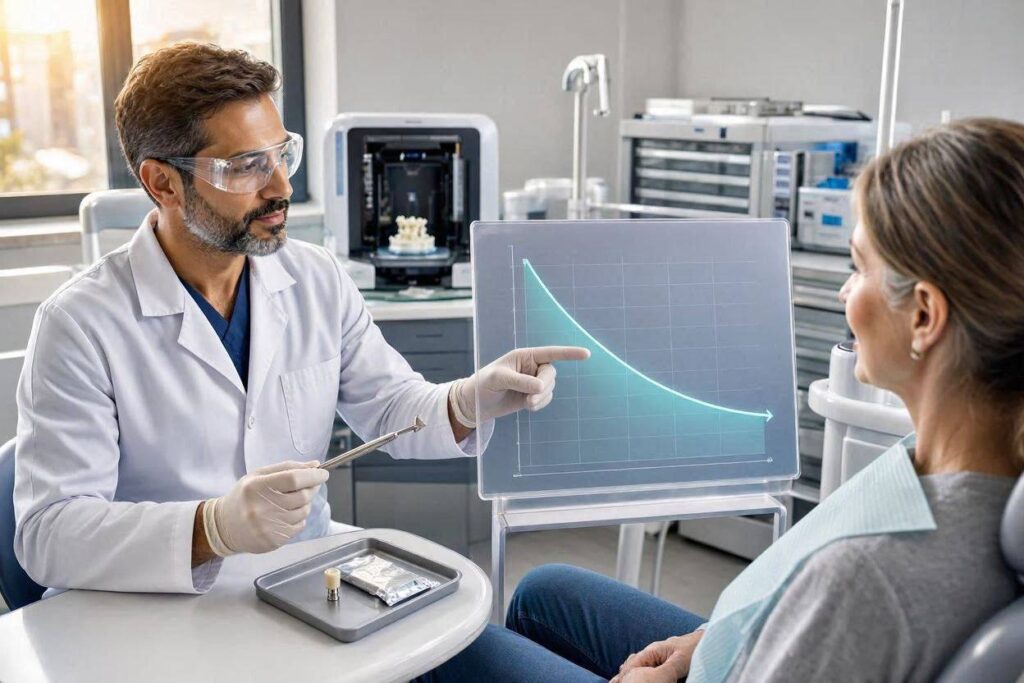
Understanding Why Prices Are High
The possibility of price decreases depends on what makes implants expensive now.
The Components of Implant Cost
A dental implant procedure is not a single product with a single price. It is a bundle of components and services. The implant fixture is a precision medical device. The surgical placement is a skilled procedure. The abutment and crown are custom-fabricated restorations. Diagnostic imaging, surgical guides, and follow-up care are integral to the treatment. Each of these components has its own cost structure and its own susceptibility to price pressure.
The Professional Service Component
Unlike a manufactured product, a significant portion of the implant fee compensates for professional time, judgment, and skill. The surgeon who places the implant spent years in training. The restorative dentist who designs and delivers the crown brings expertise in occlusion, esthetics, and biomaterials. These professional services are subject to different economic forces than manufactured goods.
The Overhead Component
Dental practices operate with substantial fixed costs: rent, utilities, equipment, sterilization, staff salaries, benefits, insurance, and compliance. These costs tend to rise over time, not fall. They create a floor beneath which fees cannot drop without rendering the practice unviable.
Where Price Decreases Could Occur
Certain components of the implant treatment cost are more amenable to reduction.
The Implant Fixture
The implant fixture is the most commodity-like component. Manufacturing efficiencies, increased competition, and the entry of value-segment manufacturers from emerging economies have the potential to reduce fixture costs. The expiration of patents on established implant systems allows generic equivalents. Major manufacturers face pressure from lower-cost competitors. The fixture cost, which might represent 15 to 25 percent of the total treatment fee, is the component most likely to see price decreases over time.
Laboratory and Prosthetic Costs
Digital dentistry is transforming the dental laboratory industry. Intraoral scanners eliminate physical impressions. CAD/CAM milling and 3D printing automate the fabrication of abutments, crowns, and surgical guides. These technologies reduce labor time and material waste. As digital workflows become more widespread and the capital equipment becomes more affordable, the laboratory portion of the implant cost may decrease.
However, this decrease is partially offset by the demand for higher esthetics. Patients want restorations that are indistinguishable from natural teeth. This requires skilled technicians and premium materials, even in a digital workflow. The cost of a high-end esthetic crown is unlikely to drop to the level of a basic functional crown.
Diagnostic Imaging
Cone-beam CT scans have become more affordable as the technology has proliferated. What once required a hospital radiology department and cost over a thousand dollars can now be done in a dental office for a few hundred dollars. Further decreases in imaging cost are possible but will have a marginal effect on the total treatment cost.
Where Price Decreases Are Unlikely
Other components resist downward pressure.
Surgical and Restorative Professional Fees
The fees for the surgeon and the restoring dentist are unlikely to decrease significantly. These fees reflect the cost of education, the value of clinical judgment, the time required for the procedure, and the liability assumed. The cost of dental education continues to rise. The cost of living increases annually. Malpractice insurance premiums do not decrease. Professional fees track these underlying costs.
Practice Overhead
Rent, staff wages, and regulatory compliance costs rise over time. The cost of sterilization, personal protective equipment, and infection control increased substantially during and after the COVID-19 pandemic. These overhead costs are passed on to patients.
Bone Grafting and Adjunctive Procedures
The cost of bone graft materials, barrier membranes, and biologic agents is determined by the medical device and pharmaceutical industries. These products are subject to regulatory requirements and manufacturer pricing strategies. They are not likely to become significantly cheaper. The surgical time required for grafting is also subject to the same professional fee dynamics.
The Role of Insurance and Third-Party Payment
The effective cost to the patient can decrease even if the provider’s fee does not.
Expanding Insurance Coverage
If more dental insurance plans cover implants, or if annual maximums increase, the patient’s out-of-pocket cost decreases. This is a reduction in the effective price, even if the nominal fee stays the same. The trend toward greater implant coverage is slow but positive.
Government Programs
Medicaid coverage for adult dental implants varies by state and is generally limited. Expansion of public insurance coverage for implants would dramatically reduce the effective cost for eligible populations. This is a policy decision, not a market outcome, and it is subject to political and budgetary forces.
Employer-Sponsored Plans
As employers compete for talent, some are enhancing dental benefits to include implant coverage. This trend could accelerate if implants become an expected part of comprehensive health benefits.
The Disruptive Innovation Hypothesis
Could a new business model dramatically lower implant costs?
The DSO and Corporate Dentistry Effect
Dental service organizations are consolidating dental practices and applying economies of scale to purchasing, laboratory services, and marketing. DSO-affiliated practices may negotiate lower implant fixture costs through bulk purchasing. They may operate in-house laboratories that reduce prosthetic costs. Some DSOs market implant treatment at lower price points than traditional private practices. This model could exert downward pressure on prices in competitive markets.
The Direct-to-Consumer Threat
Direct-to-consumer orthodontics disrupted the traditional braces market. Could a similar model emerge for dental implants? A company could create a streamlined, technology-driven implant process with fewer visits, centralized laboratories, and standardized protocols, all at a lower price point. The surgical nature of implant placement makes this more challenging than orthodontics, but not impossible. If such a model emerged and gained regulatory acceptance, it could meaningfully reduce implant costs.
The Overseas Laboratory Arbitrage
Some practices send digital impressions to laboratories in countries with lower labor costs for the fabrication of abutments and crowns. This reduces the laboratory cost component. The quality of work from some overseas laboratories is excellent, while others are unreliable. The practice that masters this supply chain can offer lower prosthetic fees.
Table: Price Trajectory Forecast by Component
| Cost Component | Likely Price Trajectory (5-10 Years) | Rationale |
|---|---|---|
| Implant fixture | Slight to moderate decrease | Generic competition, manufacturing efficiency |
| Abutment and crown (standard) | Slight decrease | Digital workflow efficiencies |
| Abutment and crown (premium esthetic) | Stable to slight increase | Skilled labor intensive, material costs |
| Surgical fee | Stable to slight increase | Education costs, overhead, liability |
| Restorative fee | Stable | Professional service, overhead |
| CB-CT imaging | Slight decrease | Technology proliferation |
| Bone graft materials | Stable | Medical device pricing, regulation |
| Practice overhead allocation | Slight increase | Staffing, rent, compliance costs |
The Global Perspective
Comparing U.S. prices to those in other developed countries illuminates structural differences.
Why Implants Cost Less in Some Countries
In countries with lower labor costs, less expensive dental education, lower malpractice costs, and different regulatory environments, dental implants are significantly less expensive. The implant fixture itself is a globally traded product with similar manufacturing costs. The price differential is almost entirely in the professional services, laboratory costs, and overhead. U.S. implant costs are high primarily because the U.S. healthcare economic environment is high-cost.
Can the U.S. Adopt These Lower Costs?
Fundamental reduction in U.S. implant costs to the level seen in, say, Spain or South Korea would require changes in the cost of dental education, the malpractice environment, and the healthcare regulatory framework. These are systemic issues unlikely to change significantly in the foreseeable future.
What Patients Should Do Now
Waiting for implant prices to drop significantly may not be the best strategy.
The Cost of Waiting
Bone resorption continues after tooth loss. The longer a patient waits, the more bone is lost, and the more likely bone grafting becomes necessary. The cost of waiting can exceed any hoped-for price decrease. A patient who waits five years for prices to drop may find that they now need a sinus lift and ridge augmentation that they would not have needed earlier, more than offsetting any decrease in the implant fee.
Financing Instead of Waiting
For patients who cannot afford the upfront cost, financing offers immediate access with manageable monthly payments. Third-party healthcare financing, in-house payment plans, and health savings accounts are all tools that bridge the gap between cost and affordability. Rather than waiting for a price decrease that may not come, financing allows treatment now at current prices.
Seeking Value, Not Just Low Price
The lowest-priced implant is not necessarily the best value. A well-placed, premium-brand implant with a high-quality crown may last decades. A poorly placed, generic implant with a substandard crown may fail and require costly replacement. Patients should seek value: the best outcome for a fair price, not the lowest price possible.
Conclusion
Dental implant prices are unlikely to decrease significantly in nominal terms over the next decade. The forces that could reduce certain component costs, such as generic implant competition and digital workflow efficiencies, are offset by rising practice overhead, professional education costs, and the demand for premium esthetic outcomes. The most realistic scenario is continued moderate inflation in implant fees, with gradually improving access through insurance coverage and financing options. Rather than waiting for a price decrease, patients are better served by addressing tooth loss promptly, using available financing tools, and seeking treatment that delivers long-term value.
Frequently Asked Questions
Will 3D printing make dental implants cheaper?
3D printing is used for surgical guides and some provisional restorations. The implant fixture itself is not 3D printed for clinical use. 3D printing reduces some laboratory costs but is unlikely to dramatically lower the total implant treatment fee.
Are dental implant prices dropping due to competition?
Competition from value implant manufacturers has moderated fixture costs, but the total treatment fee is dominated by professional services and overhead, which are not dropping.
Should I wait for dental implant prices to go down?
Probably not. The cost of waiting in terms of bone loss and potential need for grafting often outweighs any modest price decrease that might occur. Financing makes treatment accessible now at current prices.
Do dental implants cost less today than ten years ago?
In nominal dollars, no. Implant fees have risen modestly, tracking healthcare inflation. In real terms, the cost has been relatively stable.
Will dental insurance ever fully cover implants?
Full coverage is unlikely in the near term. However, coverage is expanding slowly. More plans offer some implant benefit, though annual maximums remain low relative to the total cost.
Additional Resources
American Dental Association – Health Policy Institute
https://www.ada.org/resources/research/health-policy-institute
Data and analysis on dental economics, fee trends, and the financial aspects of dental care delivery in the United States.


