How To Clean Hybrid Dental Implants: A Definitive Maintenance Guide
A hybrid dental implant prosthesis, often called a fixed-detachable or an All-on-X bridge, is a transformative solution that replaces an entire arch of missing teeth. It is a marvel of engineering that combines the security of dental implants with the beauty of a full set of fixed teeth. But this complex, high-value restoration comes with a non-negotiable responsibility: a meticulous, specialized daily hygiene regimen. A hybrid prosthesis is not cleaned like natural teeth or a traditional denture. Its unique design, which features a small gap between the acrylic or zirconia bridge and the gum tissue, creates specific niches where food debris and bacterial biofilm can accumulate. The consequence of inadequate cleaning is not a simple cavity; it is peri-implantitis, a destructive infection that can silently dissolve the bone supporting your implants and lead to the catastrophic loss of your entire investment. This guide provides a step-by-step, clinically proven protocol for cleaning your hybrid dental implants and protecting your smile for decades.
Understanding the Anatomy You Are Cleaning
You cannot effectively clean a structure you do not understand. A hybrid implant bridge is fundamentally different from your natural teeth. It is a single, horseshoe-shaped prosthesis that is screwed into four to eight dental implants. It does not cover the roof of your mouth like a traditional denture. Beneath the smooth, pink acrylic that mimics your gums, and the white teeth, there is a critical space. There is a small, intentional gap, often just one to two millimeters, between the underside of the prosthesis and your actual gum tissue.
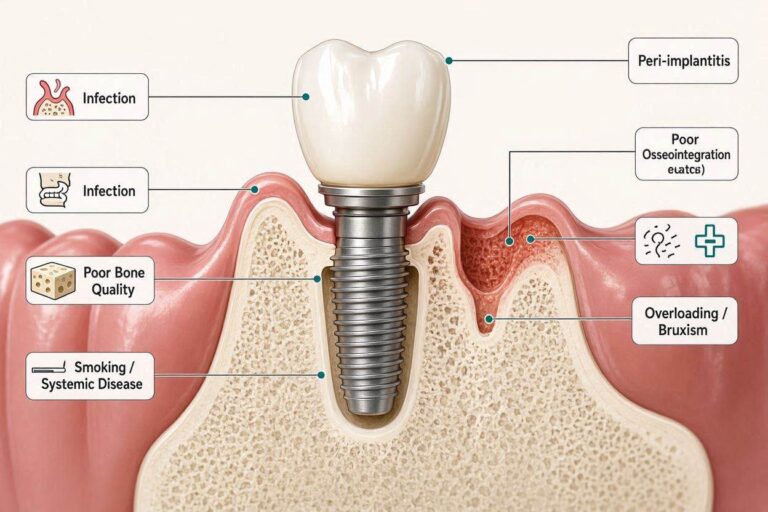
This space, the intaglio surface of the bridge, is the hygiene zone. It exists to allow you to pass cleaning aids underneath the bridge. It is a calm-water area where food particles, particularly soft, sticky foods like bread and pasta, can pack and stagnate. Saliva-borne proteins form a pellicle layer on the titanium and acrylic, which bacteria rapidly colonize into a sticky biofilm, the dental implant equivalent of plaque. If this biofilm is not mechanically disrupted daily, it matures, calcifies into a hardened, rough calculus, and triggers an inflammatory response in the surrounding gum. The bacteria in the biofilm produce toxins that cause the gum to become red, swollen, and bleed easily, a condition called peri-implant mucositis. This is the precursor to peri-implantitis, where the inflammation extends to the bone, causing irreversible bone resorption. Your daily cleaning is not cosmetic; it is an active, biological war against bone loss.
The Critical Distinction: Cleaning Around Natural Teeth vs. Implants
A fundamental conceptual shift is required. The attachment mechanism that holds a natural tooth in the bone is the periodontal ligament (PDL). This ligament is a network of collagen fibers that inserts into the tooth root on one side and the bone on the other. It is a resilient, vascular, shock-absorbing suspension system. A dental implant has no PDL. It is fused directly to the bone, a rigid, calcified union. This difference has profound hygiene implications.
A natural tooth is defended by a cuff of gum tissue with fibers that insert perpendicularly into the root surface, creating a strong, active barrier. The gum tissue around an implant has fibers that run parallel to the implant surface, a much weaker, more passive seal. This peri-implant seal is more easily breached by bacterial toxins. Therefore, an implant is less forgiving of biofilm accumulation than a natural tooth. Your cleaning effort must be more thorough, not less. You are compensating for a weaker biologic defense with superior mechanical disruption of the plaque.
“I tell my hybrid prosthesis patients that they are now the owners of a high-performance vehicle, and high-performance vehicles require precise, scheduled maintenance. They don’t just get run through a car wash. You have to get under the hood, into the nooks and crannies, every single day. The people who embrace this ritual keep their implants for life. The ones who don’t, well, I see them back with bleeding, painful gums and crumbling bone.” — A Certified Dental Implant Hygienist
The Essential Daily Cleaning Arsenal for Your Hybrid Bridge
Your bathroom countertop must now be equipped with a specific set of tools designed for this unique task. A generic toothbrush is not enough. You need a layered system of mechanical plaque disruption. This is not an upsell of dental products; these are FDA-cleared medical devices for maintaining a prosthetic device in a biologic environment.
- The Water Flosser (Oral Irrigator): This is arguably your most important tool. A countertop water flosser with a specialized tip, often called a “Plaque Seeker” or a soft rubber-tipped irrigator, delivers a pulsating stream of water that creates a hydraulic flush. It blasts food debris and loosely adherent plaque from the intaglio surface of the bridge, the gumline, and around the individual implant abutments. The pulsatile action also stimulates the gum tissue, increasing circulation. This should be done with warm water and, for many patients, a non-alcoholic antibacterial mouthwash diluted in the reservoir.
- The Power Toothbrush: A sonic or oscillating-rotating electric toothbrush is vastly superior to a manual brush for this task. Sonic brushes create a secondary fluid dynamic action, where the vibrations agitate the water and saliva mixture, creating microbubbles that can disrupt biofilm slightly beyond the reach of the bristles. Use it on the pink acrylic gums and the teeth of the bridge, but understand that it cannot reach under the bridge. That is the water flosser’s job.
- Superfloss or Implant-Specific Floss: This is a specialized floss with three components: a stiff, threader end, a soft, spongy, tubular middle section, and a short section of regular floss. The stiff end is passed under the bridge, from the cheek side to the tongue side. The spongy, fuzzy section is then pulled back and forth in a shoeshine motion under the full width of the bridge, mechanically scrubbing the entire intaglio surface. This is a manual, targeted scrub that the water flosser’s hydraulic action supplements, but does not replace.
- Proxabrush or Interdental Brush: A small, cone-shaped brush on a thin wire, used to clean the vertical spaces between the individual implant abutments where they emerge from the gum. The correct size is the largest brush that fits snugly but without forcing. A plastic-coated wire is essential to avoid scratching the titanium or zirconia abutment surface.
- Non-Alcoholic, Non-Abrasive Mouthwash: A therapeutic rinse containing cetylpyridinium chloride or stabilized chlorine dioxide can reduce the bacterial load. Avoid alcohol, which can dry out the gum tissue and potentially degrade the acrylic over years of use. Avoid abrasive “whitening” rinses.
Your Step-by-Step, Clinically Proven Evening Routine
Your nighttime oral hygiene ritual, performed just before bed when salivary flow decreases and bacteria proliferate, is your most critical defense. This is a multi-step process that should take no less than five minutes.
- Water Flosser First (The Power Wash): Fill the reservoir with warm water. Using the specialized rubber tip, aim the stream at the junction where the pink acrylic meets your gums. Trace the entire gumline, both on the cheek side and the tongue side. Pause at the space between each tooth to flush out debris. Then, tilt the tip horizontally and direct the stream into the space under the bridge. You are creating a high-pressure, directed wash of the intaglio surface. Do this for a full 90 seconds.
- Interdental Brushing (The Vertical Scrub): Select your appropriately sized Proxabrush. Insert it vertically into the embrasure space between the implant abutments. Scrub in and out several times. You are cleaning the round, cylindrical surfaces of the abutments that your other tools cannot contour around.
- Superfloss (The Underside Scrub): Take a strand of Superfloss. Pass the stiffened end under the most posterior part of the bridge and pull it through. Grip the spongy section and perform the shoeshine motion, methodically moving from the back to the front of the bridge, scrubbing the entire length of the underside. The spongy floss should physically contact the pink acrylic. If it glides through with no resistance, you are not engaging the surface effectively.
- Power Brushing (The Polishing Step): Apply a small amount of non-abrasive denture paste or gel to your electric toothbrush. Brush all surfaces of the teeth and the pink acrylic gums. Pay special attention to the gum line, holding the brush at a 45-degree angle to gently massage the tissue. Do not use regular toothpaste, as many contain silica abrasives that can microscopically scratch and dull the polished surface of the acrylic and zirconia over time.
- Final Rinse: Swish vigorously with your non-alcoholic antimicrobial mouthwash for 60 seconds. This reduces the remaining planktonic bacteria and leaves the tissues feeling clean.
Important Note: Rubbing alcohol, boiling water, and household bleach have no place in cleaning your hybrid prosthesis. These harsh chemicals can craze and crack the acrylic, leading to premature failure and a costly replacement of the entire bridge, a procedure that can cost several thousand dollars.
Professional Maintenance: The Critical Role of Your Implant Hygienist
Your at-home care is essential, but it is incomplete without a professional partner. You must see a qualified implant dental hygienist at least every six months, and for many patients, a three or four-month recall interval is more appropriate. This appointment is fundamentally different from a traditional dental cleaning. Your hybrid bridge is typically not removed at these maintenance visits unless the dentist has specifically designed it to be retrievable and plans to do so annually. Attempting to forcibly remove a fixed hybrid can damage the multi-unit abutments.
Instead, the implant hygienist will perform a thorough evaluation. They will probe gently around each implant abutment with a flexible plastic or titanium probe to measure the depth of the gum cuff and check for bleeding, the cardinal sign of peri-implant mucositis. They will use specialized non-metal instruments, such as titanium, plastic, or PEEK (polyether ether ketone) scalers, to carefully debride any hardened calculus deposits from the implant surfaces and the underside of the bridge. Using a traditional stainless steel scaler on a titanium implant is a critical error; it will deeply scratch and gouge the surface, creating a rough, microscopic “jungle gym” for bacteria to adhere to, paradoxically accelerating the disease process. Your hygienist will also evaluate the stability of the prosthesis and may take a panoramic X-ray to screen for bone loss. This professional partnership is the standard of care. A dentist who places a hybrid prosthesis without a structured hygiene maintenance program is providing incomplete care.
Essential Tools and Brushing Agents: What to Avoid
The material science of your hybrid bridge dictates a specific “do not use” list. A hybrid prosthesis is typically fabricated from a high-strength acrylic (PMMA) or a monolithic zirconia, often bonded to a titanium framework. These materials are durable but susceptible to specific chemical and mechanical insults.
Abrasive toothpaste, particularly those marketed for “whitening” or “tartar control,” often contain hydrated silica, calcium carbonate, or baking soda. These abrasive particles will act like fine-grit sandpaper on the polished surfaces of the acrylic, creating micro-scratches. Over time, the glossy pink gums and shiny teeth will become dull, matte, and more plaque-retentive. Treat your hybrid bridge like a high-end pair of eyeglasses; you only use the specific, approved cleaning solution. An ultrasonic cleaner with an approved solution, used daily, can be an excellent addition for cleaning a removable full denture, but a fixed hybrid is cleaned in the mouth using the mechanical tools described.
The following table provides a quick reference guide to your hygiene toolkit.
| Tool | Purpose | Frequency | Key Caution |
|---|---|---|---|
| Water Flosser | Hydraulic flush of underside and gumline | At least daily (evening) | Use low-medium pressure; avoid the highest setting directly on gums |
| Superfloss | Mechanical scrub of the intaglio (under) surface | Daily (evening) | Use gentle shoeshine motion; do not snap the floss against the gum |
| Proxabrush | Clean vertical spaces between abutments | Daily (evening) | Use plastic-coated wire only; ensure it fits without forcing |
| Electric Toothbrush | Polish teeth, pink acrylic, and gumline | Twice daily | Use non-abrasive gel, not gritty whitening toothpaste |
| PEEK/Titanium Scalers | Professional removal of hardened calculus | Every 3-6 months by a hygienist | Never accept stainless steel instruments on your implants |
Conclusion
Cleaning a hybrid dental implant bridge is a disciplined, layered ritual that must become a permanent part of your daily life. It requires a water flosser to hydraulically flush the intaglio surface, Superfloss to mechanically scrub the underside of the bridge, interdental brushes to clean the vertical abutment spaces, and a non-abrasive gel on an electric toothbrush to polish the exterior. The goal is the uncompromising daily disruption of bacterial biofilm before it can calcify and trigger the destructive cascade of peri-implantitis that leads to bone loss. This home care must be paired with a three-to-six-month professional maintenance visit with a hygienist who uses specialized non-metal instruments, because your implant has no periodontal ligament and depends entirely on mechanical cleaning to maintain its vulnerable gum seal.
Frequently Asked Questions (FAQ)
Q: Can I remove my hybrid bridge to clean it at home?
A: No. A hybrid prosthesis is fixed. It is screwed into the implants and can only be removed by a dentist using special tools. Attempting to remove it yourself could damage the abutments or the bridge, and cause severe pain. It is designed to be cleaned in the mouth.
Q: Why do my gums bleed when I clean around my hybrid bridge?
A: Healthy peri-implant gum tissue does not bleed. Bleeding upon gentle probing, brushing, or water flossing is the definitive clinical sign of peri-implant mucositis, an active bacterial infection in the gum cuff. It indicates your current hygiene protocol is not adequately disrupting the biofilm in that specific bleeding area. Increase your focus on that site, and schedule a professional evaluation.
Q: Can I use a Waterpik if I have a hybrid bridge?
A: Yes, a water flosser is strongly recommended and is arguably the single most effective tool for the daily maintenance of a full-arch hybrid prosthesis. Use a specialized rubber tip on a low-to-medium pressure setting to safely and effectively flush the intaglio surface.
Q: How often does my hybrid bridge need to be professionally removed and cleaned?
A: This varies by clinical protocol. Many dentists will remove and thoroughly clean the prosthesis, replace the abutment screws, and re-torque the bridge at an annual maintenance visit. However, this is a clinical decision based on your home care effectiveness and the health of your tissues. Some patients with impeccable hygiene may only need this done every two to three years.
Additional Resource:
For more information on the prevention and management of peri-implant diseases, the American Academy of Periodontology provides evidence-based patient resources: Peri-Implant Diseases – AAP.