What Causes Dental Implants To Loosen?
The promise of a dental implant is one of permanence. The titanium post, fused to the jawbone through osseointegration, is designed to be a lifelong anchor for a replacement tooth. So when a patient feels even the slightest movement in what is supposed to be a rock-solid restoration, it triggers a wave of alarm. A loose dental implant is a definitive signal that something has gone wrong. It is never normal. Understanding what causes an implant to loosen is critical, because the cause determines whether the situation is a minor, fixable mechanical problem or a catastrophic biological failure that threatens the entire investment. This guide provides a comprehensive, clinical breakdown of the two fundamentally different types of implant mobility, the specific causes of each, and the evidence-based path back to stability.
The Critical Distinction: A Loose Implant vs. A Loose Abutment or Crown
The very first diagnostic step is to identify what, precisely, is loose. The term “loose implant” is used generically by patients, but clinically, there are two completely separate problems with vastly different prognoses. The first, and far less serious, scenario is a loose abutment screw or a loose crown. The implant body itself, the titanium post in the bone, is still perfectly rigid and osseointegrated. The component that connects the crown to the implant, or the crown itself, has simply come unscrewed or de-cemented. This is a mechanical complication, not a biological failure. The implant is healthy. The solution is typically a simple, non-surgical retightening of the screw or re-cementation of the crown, often completed in a single short appointment.
The second, and grave, scenario is a mobile implant body. The titanium post itself is moving within the bone. This is a biological failure of osseointegration. The bone has not fused to the implant surface, or the fusion that once existed has been destroyed. A mobile implant is a failed implant. It cannot be “tightened.” It must be surgically removed, the site must be debrided and grafted, and after a healing period, a new implant may be placed. The tactile sensation is different. A loose screw may produce a slight wobble of the crown. A mobile implant produces a dull, deeper sensation of the entire post moving in the bone, often accompanied by pain or a bad taste from the infection. Only a dentist can make this definitive diagnosis, using an instrument to test the crown and a radiograph to see the bone-implant interface.
Mechanical Failure: The Loose Abutment or Crown
By far, the more common reason a dental implant restoration feels loose is a mechanical failure of the connection. This is not the implant failing; it is the hardware that holds the tooth onto the implant. The most frequent cause is abutment screw loosening. The abutment is the small connector that screws into the implant body. The crown is then cemented or screwed onto the abutment. The tiny screw that holds the abutment in place can, over time, lose its preload, the precise clamping force that keeps it tight.
Abutment screw loosening is often a gradual process driven by micro-movement under cyclic loading. Every time you chew, you apply off-axis forces to the implant crown. These lateral forces create tiny rocking motions that can cause the screw threads to back out, fraction by fraction. This is more common in single-tooth implants, particularly molars that bear heavy chewing loads, and in cases where the implant position is not perfectly aligned with the direction of the biting force. An ill-fitting crown that places a lateral, rather than axial, load on the implant is a major risk factor. Another mechanical cause is crown de-cementation. If the crown was cemented onto the abutment, the cement layer can fail, causing the crown to feel loose while the abutment remains firmly attached. This is a straightforward fix but must be addressed promptly to prevent bacterial infiltration.
Biological Failure: The Failed Osseointegration
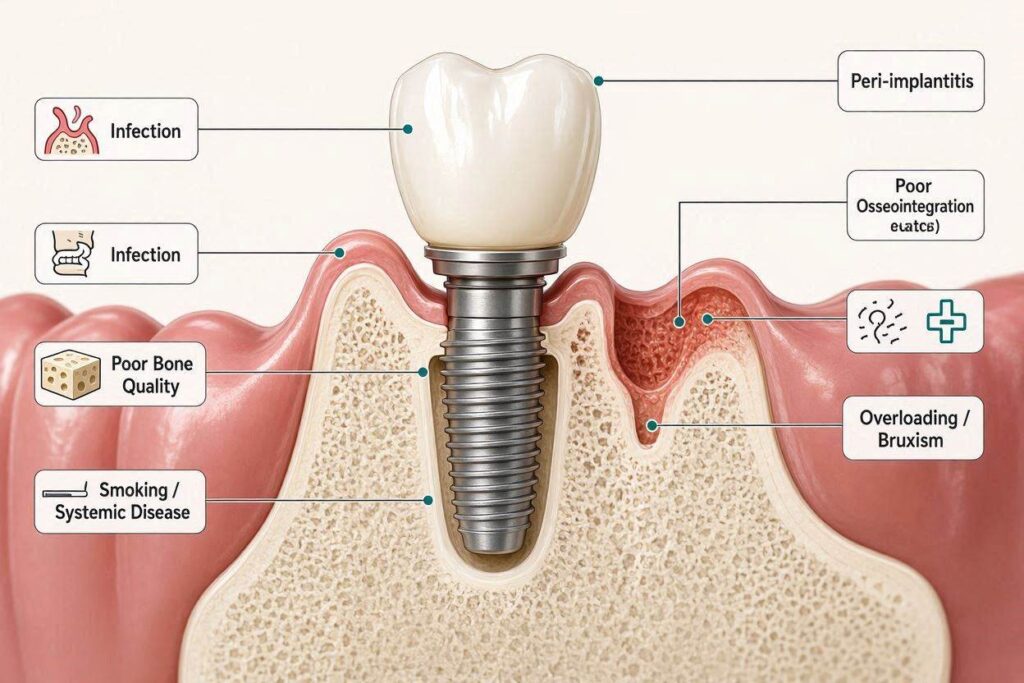
A truly loose implant, where the titanium body is mobile, is a biological failure. The reasons for this failure fall into two temporal categories: early failure and late failure. Early failure occurs before the implant is restored with a crown, during the three-to-six-month healing period. The implant fails to osseointegrate. The bone never forms a rigid, direct contact with the implant surface. Instead, a fibrous capsule of scar tissue encases the implant. This is often a silent process. The patient may not feel pain, but the implant simply does not become rigid. The causes of early failure include surgical trauma to the bone (overheating the bone during drilling), bacterial contamination of the implant site during surgery, a systemic condition of the patient that impairs healing (such as uncontrolled diabetes), or excessive micromotion during the healing period due to a poorly fitting temporary restoration or the patient chewing on the site.
Late failure, which occurs after the implant has successfully osseointegrated and been in function for years, is almost always a result of peri-implantitis. This is a plaque-induced, progressive inflammatory disease that affects the tissues around an osseointegrated implant. It begins as peri-implant mucositis, a reversible inflammation of the gum, and if left untreated, extends to the bone, causing progressive, irreversible bone loss. The implant loses its bony support, crater by crater, until the remaining bone is insufficient to hold it rigidly. The implant becomes mobile only in the end stage of this disease. Another cause of late failure is occlusal overload. If the patient is a heavy grinder or clencher (bruxer), and these parafunctional forces are not managed with a nightguard, the constant, excessive force can exceed the adaptive capacity of the bone, causing microfractures at the bone-implant interface and eventual failure. A fractured implant body, where the titanium itself breaks, is a rare but catastrophic mechanical cause of late failure, usually occurring at the level of the first thread or the connection with the abutment.
“In my practice, the vast majority of what patients describe as a loose implant is a loose screw. I can usually fix it in ten minutes with a torque wrench and a new screw. But the look of relief on their face when I tell them their implant is healthy is profound. That said, every loose screw is a warning sign. Something caused that screw to loosen, and I have to analyze the bite and the crown to find that cause, or it will happen again.” — An Implant Prosthodontist
The Mechanics of Screw Loosening: Torque, Preload, and Occlusion
To truly understand the most common cause of a “loose implant” sensation, one must appreciate the physics of the screw joint. When a dentist tightens an abutment screw, they apply a specific torque, typically 25 to 35 Newton-centimeters (Ncm), using a calibrated torque wrench. This torque generates a clamping force called preload. The preload pulls the abutment into the implant body, creating a friction-lock at the conical connection. The screw itself is under tension, like a tiny, stretched spring. The integrity of this joint depends on the preload being greater than the separating forces applied by chewing.
If the preload is lost, the screw loosens. This can happen if the original torque was insufficient, if there was debris or saliva on the threads at the time of placement, or if the implant and abutment are from different manufacturers, creating a micron-level mismatch. The most common destructive force is off-axis loading. An implant crown with a steep, angled chewing surface can act like a wedge, applying lateral forces that pry the abutment apart from the implant. This is why a well-designed implant crown is critical. It must have a shallow, forgiving occlusion that directs forces vertically down the long axis of the implant. When a screw loosens repeatedly, the dentist must diagnose the occlusal cause and may need to remake the crown with a better design.
Diagnosing the Cause: The Role of the Radiograph and Clinical Exam
When you present with a loose-feeling implant, the dentist’s diagnostic process is methodical. The first step is a tactile test. The dentist will grasp the crown with their fingers or an instrument and attempt to move it. A loose crown or abutment will have a slight, springy give. A truly mobile implant, a failed osseointegration, will have a dull, sinking, spongy movement, and is often tender to percussion. This is a deeply unsettling sensation for both patient and dentist.
The second, and definitive, step is a periapical radiograph. This is a high-resolution, small X-ray of the implant. The dentist will scrutinize the bone-to-implant contact. A healthy implant shows bone hugging the threads tightly, with no dark spaces. A failing implant with peri-implantitis will show a saucer-shaped, dark radiolucency around the neck of the implant, indicating cratered bone loss. A failed osseointegration shows a complete dark halo surrounding the entire implant body. The radiograph will also reveal a fractured implant, seen as a clear separation of the implant body, or a loose abutment, seen as a small gap between the abutment and the implant platform. The treatment path is entirely dependent on this radiograph. No dentist should ever attempt to “just tighten” a loose-feeling implant without first taking an X-ray to rule out a catastrophic biological failure.
Important Note: If your implant feels loose, stop chewing on it immediately. Switch to a soft diet. Call your dentist and explain the symptom. Do not attempt to tighten it yourself, as you can strip the internal threads of the implant, turning a simple fix into a major surgical explantation. An implant is a precision medical device, not a household screw.
The table below summarizes the differential diagnosis.
| Symptom | Possible Diagnosis | Likely Cause | Prognosis |
|---|---|---|---|
| Crown moves slightly, no pain | De-cemented crown or loose abutment screw | Loss of cement bond or loss of screw preload | Excellent; simple re-cementation or screw retorquing |
| Implant feels “springy” with a clicking sensation | Loose abutment screw | Micro-movement under occlusal forces | Good; screw replaced and tightened; may require occlusal adjustment |
| Implant moves deeply, dull sensation, may have pus or pain | Failed osseointegration or severe peri-implantitis | Bone loss; infection; overload | Poor; implant must be removed |
| Sudden mobility with a sharp pain, implant may be tilted | Fractured implant body | Material fatigue; heavy occlusal overload | Terminal; implant must be surgically retrieved |
The Prevention of Implant Loosening: A Shared Responsibility
Preventing a loose implant is a shared contract between the surgical team, the restorative dentist, and the patient. The surgeon must place the implant using an atraumatic technique, ensuring the bone is not overheated during drilling. The restorative dentist must design a crown with a passive fit and a centric occlusion that does not create destructive lateral forces. The use of a custom abutment rather than a stock prefabricated abutment allows for a more precise emergence profile and a better seal.
The patient’s role is the lifelong disruption of bacterial biofilm around the implant. This requires daily, meticulous use of floss, an interdental brush, or a water flosser around the implant crown. A patient who grinds or clenches their teeth must wear a custom-fabricated, hard acrylic nightguard. This guard does not just protect the teeth; it dissipates the destructive parafunctional forces that cause screw loosening and bone loss. Regular professional maintenance, ideally every six months but sometimes every three months for patients with a history of periodontitis, is mandatory. At these visits, the hygienist will probe the gum cuff, check the occlusion, and torque-check the screw if indicated. This maintenance schedule is the insurance policy on your investment.
Conclusion
A loose dental implant sensation is most commonly caused by a mechanically loose abutment screw or a de-cemented crown, which are both repairable, non-surgical complications of the prosthetic hardware, not the implant body itself. When the titanium implant body is truly loose and mobile, it signals a terminal biological failure—either a failure of initial osseointegration or a destruction of the bone by peri-implantitis or catastrophic overload. The diagnosis is made by a clinical examination of mobility and a periapical radiograph showing the bone-implant interface, and the prognosis ranges from a simple, immediate fix to the necessity of surgical removal and a complete restart.
Frequently Asked Questions (FAQ)
Q: Can a loose implant be saved?
A: If the looseness is due to a loose screw or crown, yes, it is easily saved. If the implant body itself is mobile due to bone loss, it cannot be saved and must be removed. However, peri-implantitis caught before the implant becomes mobile can sometimes be treated surgically to arrest the bone loss and keep the implant.
Q: How long does an implant abutment screw last?
A: An abutment screw that is properly torqued and protected from excessive occlusal forces should last indefinitely. However, it is a mechanical component with a fatigue life, and in a patient with heavy bite forces, it may need to be replaced after many years.
Q: Is it normal for an implant to have a slight give?
A: No. A successfully osseointegrated dental implant is ankylosed, meaning it is fused to the bone. There should be absolutely zero movement, no matter how slight. Natural teeth have a slight, physiologic mobility because of the periodontal ligament; implants do not. Any movement is a red flag.
Q: Can an X-ray always show a loose implant?
A: It can show a loose abutment screw as a gap at the connection, and it can show the bone loss around a failing implant. However, a loose crown that is simply de-cemented may not show on an X-ray. The clinical exam is the primary diagnostic tool for cement failure.
Additional Resource:
For further information on the prevention of peri-implant disease, the American Academy of Periodontology has a dedicated patient resource page: AAP Peri-Implant Diseases.