Are Implant Dentures A Scam?
Losing teeth changes your life. It affects how you eat, how you speak, and how you feel when you look in the mirror. For many years, the only solution was a traditional denture resting on the gums. Today, dental technology offers something different: implant dentures.
But with every new medical advancement comes skepticism. You may have seen advertisements promising “permanent teeth in a day” or heard stories about costs spiraling out of control. This leads to a critical question. Are implant dentures a scam? Are they a legitimate medical treatment, or just a way for dentists to make money?
The short answer is no. Implant dentures are a scientifically proven, medically sound procedure that has restored confidence and function for millions of people. However, the industry is not perfect. There are pitfalls, hidden costs, and situations where a patient might feel misled.
This guide will break down the reality of implant dentures. We will look at the cost, the procedure, the marketing hype, and the genuine benefits. Our goal is to give you the honest truth so you can make an informed decision.
Understanding the Basics: What Are Implant Dentures?
To understand if you are being scammed, you must first understand what you are buying. We need to distinguish between “fake” products and “complex” products.
A scam implies deception. Implant dentures are not a fake product. They are physical devices manufactured from medical-grade materials. However, the way they are sold can sometimes be misleading.
Defining the Technology
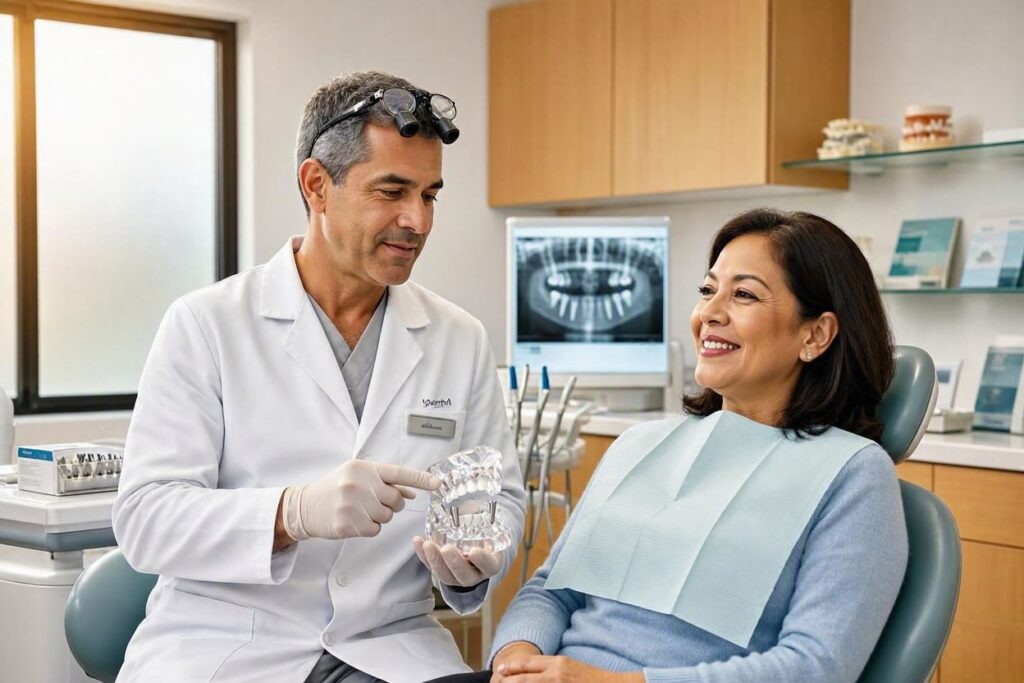
An implant denture (often called an overdenture or a hybrid prosthesis) consists of two main parts:
- The Implants: These are small posts, usually made of titanium or zirconia, which are surgically placed into your jawbone.
- The Denture: This is the set of prosthetic teeth attached to those posts.
Unlike a traditional denture that sits on your gums and relies on suction or adhesive, an implant denture snaps onto the posts. This provides stability.
Key Distinction:
- Traditional Denture: Removable, rests on tissue, often slips.
- Implant-Retained Denture: Removable, snaps onto implants, very stable but may still have some movement.
- Implant-Supported Denture (Fixed): Often called “All-on-4” or “All-on-6.” This is screwed into the implants and can only be removed by a dentist. It feels most like natural teeth.
The Science Behind Osseointegration
The magic of dental implants lies in a biological process called osseointegration. This is not a marketing buzzword; it is a well-documented medical phenomenon.
When titanium is placed into living bone, the bone cells grow directly onto the surface of the titanium. They fuse. This creates an anchor that is as strong, if not stronger, than a natural tooth root.
If implant dentures were a scam, this biological reaction would not happen. The success rate of this fusion is over 95% in healthy patients. This statistic is backed by decades of peer-reviewed studies. The human body accepts these materials.
The “Scam” Perceptions: Where Skepticism Comes From
If the technology works, why do so many people search for “Are implant dentures a scam?” There are several reasons. Most of them relate to marketing, sales tactics, and cost confusion rather than the physical product itself.
1. The “Bait and Switch” Pricing
This is the biggest source of anger and suspicion. You see an advertisement for “$999 Implant Dentures!” or “Teeth in a Day for $9,999!” You visit the clinic, only to find out that the final bill is $25,000.
Is this a scam? In many cases, it is a marketing strategy called “unbundling.”
How the Bait and Switch Works:
- The Ad: Shows the price for the lowest possible option (e.g., a single implant or a denture with one implant).
- The Consultation: The dentist discovers you need bone grafts, extractions, or a different type of material.
- The Reality: The $999 price only covered the implant screw, not the crown, the surgery, the anesthesia, or the denture itself.
The Verdict: The low price was technically true but realistically unattainable for most patients. It is misleading, but it is not necessarily illegal. It is aggressive sales.
2. High-Pressure Sales Tactics
Some corporate dental chains treat patients like customers. They have sales quotas. If you visit one of these offices, you might meet with a “Treatment Coordinator” whose job is to close the deal before you leave.
They may use phrases like:
- “This discount expires tomorrow.”
- “If you don’t do this now, your jawbone will melt away.”
- “We can finance this for a low monthly payment” (without explaining the high-interest rate).
When a medical decision feels like a timeshare presentation, it feels like a scam.
3. Misunderstanding the Maintenance Costs
You might pay $20,000 for your new teeth and think you are done. Then, five years later, a screw breaks, or the denture wears down. You discover that the “permanent” teeth require maintenance that costs thousands more.
Again, this isn’t a scam, but a failure of communication. Implant dentures are appliances. Like a car, they require upkeep. A good dentist will explain this upfront.
The Honest Pros and Cons
To determine if something is “worth it,” you need to look at the good and the bad honestly. We will not hide the negatives here.
The Benefits (Why It Is Not a Scam)
The benefits of implant dentures are overwhelmingly positive for the right candidate.
1. Bone Preservation
When you lose teeth, your jawbone begins to resorb (shrink). This is why long-term denture wearers often have a “sunken” look in the lower half of their face. Implants stimulate the bone, tricking the body into thinking the tooth is still there. This preserves your facial structure.
2. No More Sore Gums
Traditional dentures rub against the gums. This causes friction, sores, and pain. Implant dentures are supported by the bone, not the soft tissue. This is perhaps the most significant quality-of-life improvement.
3. Psychological Relief
People with loose dentures often stop going out to eat. They avoid social situations out of fear that their teeth will slip when they laugh or talk. Implant dentures restore that confidence. You can eat an apple or a steak. You can sneeze without holding your mouth.
4. Improved Nutrition
Chewing is the first step in digestion. If you cannot chew, you tend to swallow larger pieces of food, or you limit your diet to soft, processed foods. Patients with implant dentures can eat raw vegetables and meats, leading to better overall health.
The Drawbacks (Why It Feels Risky)
It would be unfair to claim this is a perfect procedure. There are real risks and downsides.
1. The Cost
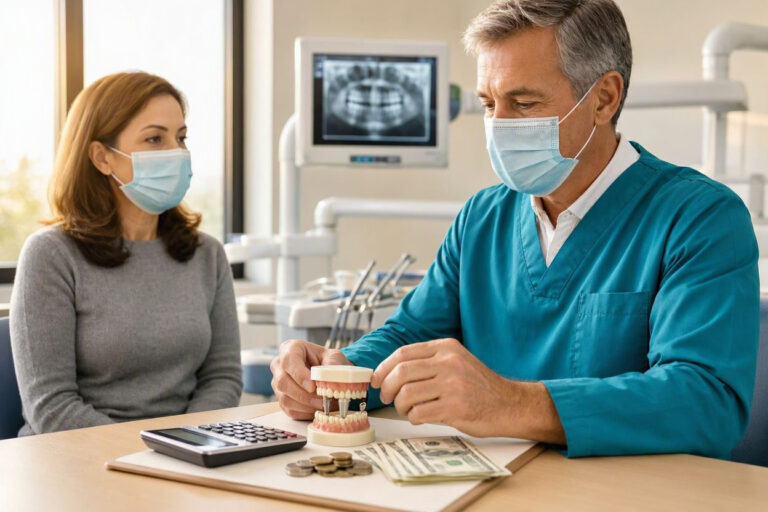
This is the elephant in the room. Implant dentures are expensive. A full mouth restoration can cost between $15,000 and $50,000 per arch (top or bottom). This is a significant investment for most people.
2. The Surgery
This is a surgical procedure. It involves cutting into the gum and drilling into the bone. There are risks of infection, nerve damage, and sinus problems (for upper implants). The recovery can be weeks or months long.
3. Time Commitment
While “Teeth in a Day” exists, the full process from start to finish (including healing) can take 4 to 12 months. You may have to walk around without teeth for a period, or with a temporary denture that still moves.
4. It Can Fail
Although rare, implants can fail. Smokers, diabetics, and people with poor oral hygiene have a higher failure rate. If the bone does not fuse to the implant, it must be removed and the process restarted. This is painful and costly.
Who Is Trying to Trick You? Red Flags to Watch For
To protect yourself, you need to know the red flags. If you encounter these situations, you are likely dealing with a practice that prioritizes money over your health.
Red Flag 1: The “Free Consultation” Trap
While many good dentists offer free consultations, be wary of the “free” exam that is just a vehicle for a high-pressure sales pitch. If the dentist spends more time talking about financing options than looking at your bone density, be careful.
Red Flag 2: No Bone Scan (CBCT)
Modern implantology requires a 3D scan (Cone Beam Computed Tomography). This allows the dentist to see your nerves, sinuses, and bone density.
- The Scam: A dentist who says they can do implants without a 3D scan is guessing. Guesswork in surgery is dangerous. They may be cutting costs, but they are risking your safety.
Red Flag 3: Offering “One Size Fits All”
If a clinic offers “All-on-4 for everyone!” walk away. Some patients need 4 implants; some need 6 or 8. If you have thin bone, the “All-on-4” technique might be riskier than a bone graft with more implants. Your anatomy dictates the treatment, not the marketing brochure.
Red Flag 4: Guaranteeing Perfection
No ethical doctor can guarantee a 100% success rate. If a provider promises that “nothing will ever go wrong” or “you will never have any problems,” they are lying. Medicine is not that predictable.
The Comparison: Traditional Dentures vs. Implant Dentures
To see if the price is justified, let’s compare the two options side-by-side.
| Feature | Traditional Dentures | Implant Dentures (Snap-On / Fixed) |
|---|---|---|
| Initial Cost | Low ($1,000 – $3,000) | High ($15,000 – $50,000) |
| Stability | Low. Moves when eating or speaking. | High. Secured to jawbone. |
| Bone Health | Accelerates bone loss. | Prevents bone loss. |
| Taste | Covers the roof of the mouth (upper). | Often open palate (hybrid). Food tastes better. |
| Maintenance | Needs relining as bone shrinks. | Needs professional cleaning/checking. |
| Longevity | Replaced every 5-8 years. | Implants can last 25+ years (prosthesis 10-15 years). |
| Confidence | Often negative impact. | High impact. |
Important Note: While the upfront cost of implant dentures is higher, the long-term cost can sometimes equalize when you factor in adhesives, relines, and replacement of traditional dentures. However, the quality of life difference is the main selling point.
Are There Actual “Scam” Products?
While the concept is legitimate, there are specific products and materials you should avoid because they are dangerous or substandard.
The “Mini Implant” Debate
Mini implants are much thinner than conventional implants.
- The Legit Use: They can be good for stabilizing a loose lower denture when there is severe bone loss.
- The Scam Use: Some clinics market them as a cheaper substitute for full-size implants to support a fixed bridge. Mini implants are not designed to hold the constant chewing force of a full set of teeth. They break. If a dentist offers to use “mini” implants for a full fixed bridge to save you money, this is a red flag for future failure.
“Cheap” Implant Brands
There are hundreds of implant manufacturers. The top brands (Straumann, Nobel Biocare, Zimmer Biomet, etc.) have decades of research behind them. They cost more.
There are also “generic” or “clone” implants imported from countries with less strict quality control. While some are fine, others use inferior titanium alloys. Ask your dentist: “What brand of implant are you using, and why?” If they refuse to tell you, that is a problem. You have a right to know what is going into your body.
Dental Tourism Horror Stories
People often fly to Mexico, Costa Rica, or Turkey to get implants for a fraction of the cost. Is this a scam? Not inherently. There are excellent doctors abroad.
However, there is a risk. If a complication occurs, your local dentist may not want to fix someone else’s failed work. You may have to fly back to the foreign country for repairs, or pay a local dentist a premium to fix the mess. The “deal” can evaporate quickly.
The Financial Reality: Why Is It So Expensive?
It helps to understand where your money goes. You are not just paying for a “screw.”
- The Surgical Skill: You are paying for the dentist’s training. An oral surgeon or prosthodontist has spent years learning to avoid nerves and place implants correctly. This expertise costs money.
- The Lab Work: The denture (the teeth part) is usually made by a master ceramist or a digital lab. This is art. The materials (acrylic, zirconia, titanium bar) are expensive.
- The Overhead: Dental offices have high overhead. Sterilization equipment, 3D scanners, staff salaries, and rent.
- The Materials: As mentioned, the implant screws themselves are precision medical devices.
How to Save Money Without Getting Scammed:
- Dental Schools: Teaching universities offer implants at reduced rates. You are treated by students under the supervision of experts. It takes longer, but the quality is high and the price is often 50% cheaper.
- Ask for Phased Treatment: Do the bottom arch first (the one that matters most for stability), and save up for the top.
- In-House Payment Plans: Many honest dentists offer payment plans that do not go through predatory third-party lenders.
The Verdict
Are implant dentures a scam?
No. They are a remarkable medical advancement that allows people to live normal lives after tooth loss. They prevent bone deterioration and restore function.
However, the industry surrounding them can be predatory. The high cost creates an environment where aggressive marketing and “discount” clinics thrive. The biggest risk is not that the implants won’t work; it is that you will be overcharged, sold a substandard product, or rushed into surgery by a salesperson rather than a doctor.
To ensure you are not a victim, you must do your research. Choose a dentist based on credentials, not on the price in a newspaper ad. Understand the total cost. Understand the maintenance.
If you do that, you will likely find that implant dentures are one of the best investments you can make in your health and happiness.
Frequently Asked Questions
Q: Can my body reject dental implants?
A: True “rejection” (like an organ transplant) is rare because titanium is biocompatible. However, the bone can fail to heal around the implant. This is called failure to osseointegrate. This happens in about 5% of cases, usually due to smoking, infection, or poor bone quality.
Q: How long does the pain last after implant surgery?
A: The severe pain usually lasts 2-3 days and is managed with over-the-counter or prescription painkillers. After that, there is typically soreness and swelling for about a week. You can usually return to work within 1-2 days.
Q: Are implant dentures removable?
A: It depends on what you buy. “Snap-on” dentures (overdentures) are removable by you for cleaning. “Fixed” dentures (hybrids) are screwed in permanently and can only be removed by a dentist for maintenance.
Q: Can I be turned down for implant dentures?
A: Yes. If you have uncontrolled diabetes, heavy smoking habits, or have taken certain bone medications (bisphosphonates), you may not be a good candidate because the risk of failure is too high.
Q: Is there an age limit for dental implants?
A: No. The primary factor is health, not age. A healthy 85-year-old can get implants, while a sick 40-year-old might not be able to. Bone density is more important than birthdate.
Additional Resource:
For peer-reviewed information on implant safety and materials, you can visit the American Academy of Implant Dentistry: https://www.aaid.com/