Kaiser Dental Insurance Costs How Much?
Navigating the world of dental insurance can feel like learning a new language. There are premiums, deductibles, copays, and maximums to decipher. If you are looking for coverage, you have likely come across Kaiser Permanente. Known primarily for its medical insurance and integrated healthcare model, Kaiser also offers dental plans.
However, the way Kaiser structures its dental insurance can be confusing. The costs are not always a simple “one-price-fits-all” scenario. The amount you pay depends on your location, whether you get insurance through an employer or buy it yourself, and the level of coverage you choose. This guide will break down the costs associated with Kaiser Permanente dental insurance, explain the different plan types, and help you determine if it is the right financial choice for you.
Understanding the Kaiser Permanente Model
Kaiser Permanente is an HMO (Health Maintenance Organization). This means you must use doctors and facilities within the Kaiser Permanente network to receive coverage (except for emergencies). This is different from a PPO (Preferred Provider Organization), where you can typically visit any dentist and receive some level of reimbursement.
Kaiser offers its dental plans in specific states where it operates, including California, Oregon, Washington, Colorado, Georgia, Hawaii, Maryland, and Virginia. The costs and plan options vary significantly by region.
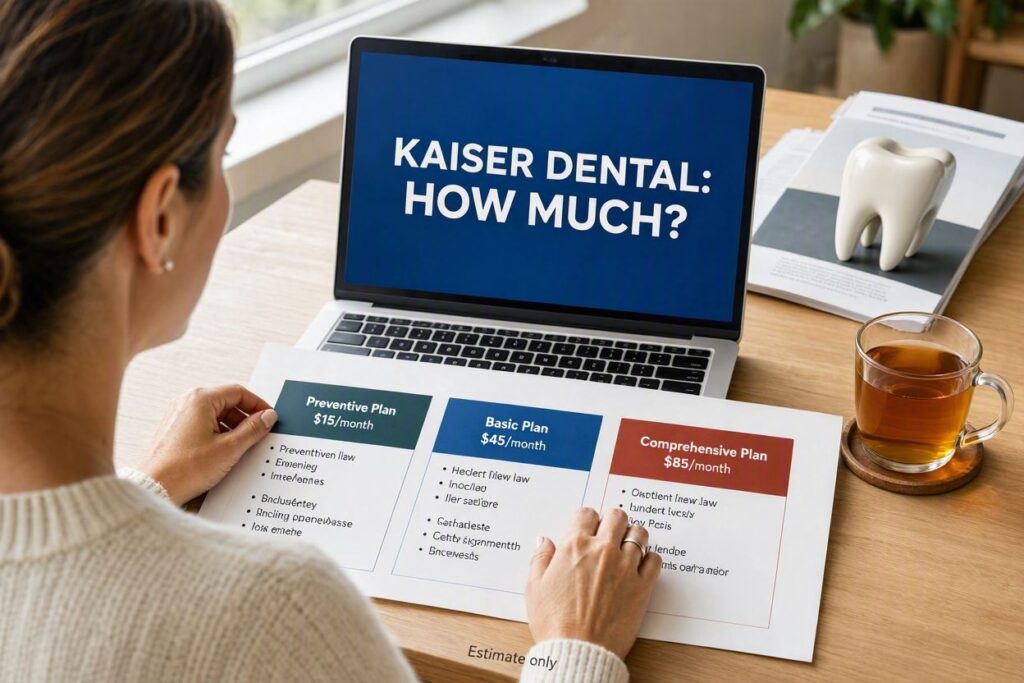
How Much Does a Kaiser Dental Plan Cost Per Month?
The monthly premium is the amount you pay just to have the insurance active. This cost is influenced by your employment status.
1. Through an Employer (Group Plans)
The majority of people get Kaiser dental insurance through their job. In this scenario, the cost is often subsidized by the employer.
- Employee-Only Coverage: You might pay anywhere from $0 to $50 per month for a basic plan. Employers often cover the premium for the employee but charge extra for dependents.
- Family Coverage: Adding a spouse and children might increase your out-of-pocket premium to $50 to $150 per month.
Note: These are estimates. The cost depends entirely on the contract your employer has negotiated with Kaiser.
2. Individual and Family Plans (Self-Purchased)
If you are buying insurance on your own (not through an employer), the cost is higher because there is no employer subsidy.
- Basic Coverage: Plans can start as low as $20 to $40 per month for a single adult.
- Comprehensive Coverage: More robust plans with lower deductibles and higher annual maximums can cost $50 to $100+ per month for a single adult.
- Family Plans: Can range from $80 to $200+ per month.
3. Medicare Advantage (Kaiser Senior Advantage)
If you are over 65, Kaiser offers Medicare Advantage plans that often include dental benefits as an added perk.
- Cost: The dental portion is often bundled into the overall Medicare plan premium, which can range from $0 to $100+ per month depending on your specific Medicare plan.
The Costs Beyond the Premium: Deductibles and Copays
With Kaiser dental insurance, paying your monthly premium does not mean your dental care is free. You must understand the out-of-pocket structure.
The Deductible
This is the amount you must pay for dental services before the insurance company starts contributing.
- Typical Individual Deductible: $25 to $100 per year.
- Typical Family Deductible: $75 to $300 per year.
- Tip: Many Kaiser plans waive the deductible for preventive services like cleanings.
The Copays (Your Share of the Bill)
Kaiser dental plans usually use a fixed “copay” system rather than a percentage system. This makes it easy to budget.
- Preventive (Cleanings, Exams, X-rays): Often $0 to $20.
- Basic (Fillings, Simple Extractions): Often $30 to $100 per procedure.
- Major (Crowns, Bridges, Dentures): Often $200 to $600 per procedure, or coinsurance (like 50%) up to a maximum.
The Annual Maximum
This is the total amount the insurance company will pay for your dental work in a single year.
- Kaiser Basic Plans: Often have a lower annual maximum (e.g., $1,000).
- Kaiser Premium Plans: Can have higher maximums (e.g., $2,000 or $2,500).
- Once you hit this limit, you pay for everything out of pocket for the rest of the year.
A Cost Comparison Table for Kaiser Dental Plans
To understand the financial value, let’s look at a hypothetical year of coverage for a single adult.
| Cost Factor | Basic Plan (Lower Premium) | Premium Plan (Higher Premium) |
|---|---|---|
| Monthly Premium | $25 | $60 |
| Annual Premium | $300 | $720 |
| Deductible | $50 | $25 |
| Cleaning (2x/year) | $10 each ($20 total) | $0 |
| Filling (1 needed) | $60 | $30 |
| Annual Maximum | $1,000 | $2,000 |
| Total Out-of-Pocket (Premiums + Care) | $430 | $775 |
The Analysis:
In this scenario, the Basic Plan costs you $345 less over the year. If you only need cleanings and one filling, the Basic Plan is the winner. However, if you need a crown ($800) or two fillings, the Basic Plan’s $1,000 maximum might run out quickly, leaving you to pay the difference. The Premium Plan provides more headroom.
Is Kaiser Dental Insurance Worth the Cost?
Whether Kaiser is “worth it” depends on your dental health needs.
When Kaiser is a Great Deal:
- You need orthodontics: Many Kaiser plans in certain states (like California) offer generous orthodontic benefits for children and adults, sometimes covering a flat fee (like $1,500-$2,000) for braces, which is rare in individual plans.
- You prefer a copay system: If you hate calculating percentages, knowing “a filling is $50” is very appealing.
- You are already a Kaiser member: You value the integration of your dental and medical records.
When Kaiser Might Be Frustrating:
- You need a specialist: As an HMO, you must get a referral to see an oral surgeon or periodontist. This adds a step.
- The network is small: Compared to a large PPO network like Delta Dental or Cigna, the number of dentists available can be limited. You have fewer choices.
- You have a high dental risk: If you have a history of needing lots of crowns or periodontal work, the annual maximum limits might leave you with high out-of-pocket costs despite having insurance.
Important Note for Consumers: “Kaiser is unique because it is an integrated system. The quality of care is generally standardized and high, but the member must understand they are buying into a system. It is not the right fit for someone who wants to go to a specific independent dentist down the street.” – Dr. Sheila Harris, DDS, independent healthcare consultant.
Kaiser HMO vs. PPO Options
Some regions offer a “Kaiser Permanente Dental PPO” option. This functions like a traditional PPO. You pay a higher premium, but you can visit any dentist in the PPO network (or out-of-network for a higher cost).
- HMO (Standard): Lower premiums, fixed copays, small network.
- PPO: Higher premiums, deductible + coinsurance (e.g., 80/20), large network.
If you choose the Kaiser PPO, the costs align more closely with traditional dental insurance: you pay 20% of the cost for fillings and 50% for crowns, up to an annual maximum.
How to Keep Your Kaiser Dental Costs Low
- Stay In-Network: This is non-negotiable with Kaiser. Going out-of-network in an HMO usually means zero coverage (unless it is an emergency).
- Use Preventive Care: Go to your cleanings. Catching a cavity early means a $50 filling. Ignoring it means a $400 crown.
- Use the Copay System to Your Advantage: If you have a big treatment plan, ask your dentist if you can split the work over two calendar years to maximize your annual maximum benefits.
- Check for Government Subsidies: If you are buying an individual plan through the state exchange (like Covered California), you might qualify for subsidies that lower your monthly premium cost.
Conclusion
The cost of Kaiser dental insurance varies widely, with monthly premiums ranging from $20 to $100+ for individuals depending on the plan level and whether it is employer-sponsored. While the HMO structure offers predictable copays and often includes good orthodontic coverage, the restricted network and annual maximums require careful consideration. It offers the best value for those who value integration and predictability over flexibility.
Frequently Asked Questions (FAQ)
1. Can I use Kaiser Dental at any dentist?
If you have the Kaiser HMO plan, you must use a dentist at a Kaiser Permanente dental office. If you have the Kaiser PPO plan, you can see any dentist in their PPO network, but you will pay more if you go out-of-network.
2. Does Kaiser medical cover dental?
Generally, no. Dental and medical are separate insurance products. However, Kaiser Medicare Advantage plans often bundle a basic dental plan into the medical coverage.
3. Does Kaiser dental have a waiting period?
For individual plans, there might be waiting periods for major services (like crowns). For employer-based groups, waiting periods are often waived.
4. Can I cancel Kaiser dental anytime?
If you have an individual plan, you can usually cancel at the end of the month. If you have it through your employer, you can only change it during “Open Enrollment” or if you have a “Qualifying Life Event” (like getting married or having a baby).
5. Is Kaiser Dental available in all 50 states?
No. Kaiser Permanente only operates in specific regions (mainly the West Coast, Colorado, Georgia, and the Mid-Atlantic). If you live outside their service area, you cannot buy a Kaiser dental plan.
Additional Resource
To see the specific plans and rates available in your ZIP code, visit the official Kaiser Permanente dental website: https://kp.org/dental