ADA Code for Abutment Supported Implant Crown: A Complete Billing Guide
- On
- InDENTAL CODE
Navigating the world of dental insurance coding can sometimes feel like trying to solve a puzzle where the pieces keep changing shape. When it comes to implant restorations, things get even more complex. If you are a dentist, a dental hygienist, or a front office coordinator, you know that one wrong code can mean the difference between a paid claim and a frustrating denial.
The terminology surrounding the “ada code for abutment supported implant crown” is often misunderstood. Is it a crown? Is it an abutment? Or is it a combination of several procedures?
In this guide, we are going to break down everything you need to know about coding for implant crowns supported by abutments. We will look at the specific codes, the common mistakes to avoid, and how to structure your treatment plans to ensure clarity for both the patient and the insurance carrier. By the end of this article, you will feel confident in your ability to document and code these complex restorations accurately.
$ADA Code for Abutment Supported Implant Crown
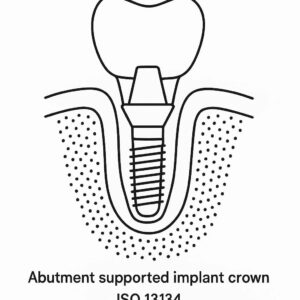
Table of Contents
ToggleUnderstanding the Anatomy of an Implant Restoration
Before we dive into the numbers, it helps to have a clear picture of what we are actually billing for. An implant restoration is rarely a single unit. It is a system made up of different components, and the ADA (American Dental Association) has created specific codes to reflect these distinct parts.
The Three Main Components
When we look at a single-tooth implant restoration, we are typically dealing with three separate pieces:
-
The Implant Fixture: The screw that goes into the bone.
-
The Abutment: The connector piece that sits on top of the implant.
-
The Crown: The visible, artificial tooth.
Insurance companies treat these as separate line items. This is the primary source of confusion. Many people assume there is one “magic” code for the entire process, but in reality, we combine codes to represent the full restoration.
The Primary ADA Codes for Abutment Supported Crowns
When we talk specifically about an abutment supported implant crown, we are usually referring to the restoration of a single implant that has already been placed (or is being placed). The ADA Code set offers specific codes depending on how the crown attaches to the abutment and who fabricated the components.
Here are the key codes you need to know.
D6057: Custom Abutment
This is arguably one of the most important codes in implant billing.
-
What it is: D6057 is used for a custom fabricated abutment. This means the abutment is not a stock, prefabricated part. It is typically milled or cast to fit the specific contours of the patient’s gingiva and the specific implant platform.
-
When to use it: You use this code when the dentist takes an impression of the implant fixture, and a dental laboratory fabricates a custom piece to support the final crown.
-
Why it matters: Insurance companies often prefer (or require) that the abutment be billed separately from the crown. Using D6057 helps delineate the lab work involved in creating the supportive structure.
D6062: Abutment Supported Crown – Prefabricated
This code covers the crown itself, but it specifies the type of support.
-
What it is: D6062 is used for a crown that is cemented or screwed onto a prefabricated (stock) abutment.
-
When to use it: If the dentist uses a standard titanium or zirconia abutment that comes straight from the implant manufacturer’s box (with no customization), the crown placed on top falls under this code.
D6065: Implant Supported Crown – Custom Abutment
This code is the partner to D6057.
-
What it is: D6065 is used for a crown that is cemented or screwed onto a custom fabricated abutment.
-
When to use it: When you have billed D6057 for the custom abutment, you will bill D6065 for the crown that goes on top of it. This is the most common combination for high-aesthetic cases where gingival contours are irregular.
D6066: Implant Supported Crown – Retained by Abutment (Screw Retained)
This code is used for a screw-retained crown where the screw goes through the crown and directly into the abutment (or implant), with no cement.
-
What it is: A crown that is fabricated as a single unit with a screw hole.
-
When to use it: This is often used when retrievability is a priority. If the crown is screwed directly to the abutment (or the implant), D6066 is the appropriate code.
D6067: Implant Supported Crown – Retained by Abutment (Cemented)
This is essentially the crown portion when it is cemented to an abutment (either custom or prefabricated).
-
Note: There is some overlap here. Often, if you are using a prefabricated abutment (D6062), the crown is cemented. If you are using a custom abutment (D6065), the crown is also usually cemented. However, D6067 is a specific code for the crown portion when it is cemented to a standard abutment.
How to Combine Codes: The “Build” Method
To avoid denials, you must visualize the restoration as a house. You have the foundation (implant), the support beams (abutment), and the roof (crown).
If you are restoring an existing implant that is already osseointegrated, your claim should typically look like this:
| Procedure | ADA Code | Description |
|---|---|---|
| Custom Support | D6057 | Custom abutment (fabricated by lab) |
| Final Restoration | D6065 | Crown supported by custom abutment |
Or, if using stock/prefabricated parts:
| Procedure | ADA Code | Description |
|---|---|---|
| Stock Support | (Included) | Often the abutment cost is bundled into the crown code here |
| Final Restoration | D6062 | Crown supported by prefabricated abutment |
Important Note: Some insurance plans bundle the abutment and the crown. They may have a policy that states the “abutment supported crown” (D6062) is a comprehensive code that includes the stock abutment. If you bill a custom abutment (D6057) separately, you must ensure the patient’s policy allows for this “unbundling.” Always verify benefits before starting treatment.
Common Billing Scenarios and How to Handle Them
Let’s look at a few real-world scenarios. In a busy dental practice, you will encounter different situations depending on when the implant was placed and by whom.
Scenario 1: The Implant Was Placed by a Surgeon (Different Tax ID)
This is the most common scenario in general dentistry. A periodontist or oral surgeon places the implant fixture (usually billed under D6010 or D6011). The patient returns to the general dentist for the restoration.
-
What to bill: You will bill for the restorative phase only.
-
D6057 (Custom abutment)
-
D6065 (Crown)
-
-
Documentation: You must include a narrative explaining that the implant fixture was placed by a separate provider. Include the surgeon’s name and the date of placement. This justifies why you are not billing the surgical code.
Scenario 2: The Implant and Restoration Are Done “In House”
If the same dentist places the implant and restores it, you need to be careful about timing and staging. You cannot bill for the crown on the same day as the implant placement (unless it is an immediate loading case with specific documentation).
-
Staging:
-
Visit 1 (Surgery): D6010 (Implant placement)
-
*Visit 2 (Uncovery/Healing Abutment):* D6011 (Second stage surgery) or D6056 (Prefabricated abutment)
-
Visit 3 (Restoration): D6057 + D6065
-
Scenario 3: The “Screw Retained” Preference
More dentists are moving toward screw-retained crowns because they are easier to repair if something breaks.
-
What to bill: D6066.
-
Context: This code often includes the abutment portion in the eyes of some insurance carriers. When billing D6066, you are usually not billing a separate D6057, because the abutment is integrated into the crown design (one piece). However, if a custom abutment is used under a screw-retained crown (a two-piece screw-retained design), you may still bill D6057 and D6066. Check the specific plan.
The Role of “Alternative Benefits”
As a writer focused on realistic information, I have to address a hard truth: many dental insurance plans do not cover implant restorations well. Some plans exclude them entirely. Others offer an “alternative benefit.”
What is an alternative benefit?
If a plan does not cover an implant crown (D6062/D6065), they may downgrade the benefit to the cost of a traditional porcelain-fused-to-metal (PFM) bridge (D6750 or D6740). This is legal based on the insurance contract.
When this happens, the patient is responsible for the difference.
-
Example: The implant crown costs $2,000. The plan covers a traditional bridge at $1,200 (after their usual co-insurance). The plan pays $1,200. The patient owes the remaining $800 plus any deductible.
You must communicate this clearly to the patient before starting the case. It is better to have an honest conversation upfront than to have an angry patient with a surprise bill later.
Documentation: Your Best Defense Against Denials
Insurance companies rely heavily on narratives and radiographs. If you want to get paid for the ada code for abutment supported implant crown, you cannot just send a generic form. You need to build a case.
Essential Elements of a Strong Narrative
-
Tooth Number: Specify the site.
-
Existing Implant: State whether the implant is existing or placed same day.
-
Medical Necessity: Explain why the patient needs this. Usually, “missing tooth structure” or “tooth is non-restorable” suffices if it is replacing a missing tooth.
-
Abutment Justification: If you are billing for a D6057 (custom abutment), you must justify why a stock abutment was insufficient.
-
Good justification: “Due to the angulation of the implant and the need for ideal emergence profile in the aesthetic zone, a custom-milled abutment was required to achieve proper contour and fit.”
-
-
Implant Manufacturer: Some plans require knowing the system used (e.g., Nobel Biocare, Straumann, Zimmer).
Radiographs
Never submit a claim for an implant crown without a radiograph showing the abutment seating on the implant. A periapical X-ray (PA) is usually sufficient. This proves:
-
The implant is present.
-
The abutment is seated correctly.
-
There are no interferences.
Differences Between HMO, PPO, and Fee-for-Service
The “ada code for abutment supported implant crown” is the same set of numbers regardless of the plan type, but the reimbursement changes drastically.
| Plan Type | Reimbursement Reality | Patient Responsibility |
|---|---|---|
| PPO | Usually covers 50% of the “allowable amount.” Often downgrades to bridge (alternative benefit). | High. Often 50% of the total fee plus any lab fees not covered. |
| HMO/DMO | Often excludes implants entirely. If they do cover, it is a fixed copay (e.g., $300 for crown) but may not cover the abutment. | Moderate to High. The patient pays the copay plus the difference for “uncovered” components (the abutment). |
| Fee-for-Service | No network restrictions. The plan pays based on the patient’s out-of-network benefits. | Variable. The patient pays the total fee, and insurance reimburses them directly (or the office) based on their specific plan. |
Pro Tip: For HMO plans, always get a pre-treatment estimate (predetermination). In many cases, the implant crown is a “non-covered service,” meaning the patient must pay the office fee in full.
Navigating Medicare and Implant Crowns
For our readers treating patients over 65, a note on Medicare is essential.
Original Medicare (Part A and B) does not cover dental implants or implant crowns.
However, there is a nuance. If the implant is part of a procedure deemed “medically necessary” (such as reconstruction following the removal of a tumor or due to trauma), there may be coverage under Medicare Part A (hospital) if the procedure is done in a hospital setting. For the vast majority of standard implant crowns in a private practice setting, Medicare will deny the claim. Patients with Medicare Advantage (Part C) plans may have dental riders, but those vary wildly by state and carrier.
The Future of Implant Coding: Digital Dentistry
We are seeing a shift in the industry. As digital dentistry (intraoral scanning, CAD/CAM milling) becomes the standard, the distinction between “custom” and “prefabricated” is blurring.
Currently, D6057 is still the appropriate code for a digitally designed and milled custom abutment. Even though the process is digital, it is still “custom” because it is fabricated specifically for that patient’s anatomy.
However, stay tuned to ADA updates. Every few years, the Code Maintenance Committee reviews the CDT codes. There is ongoing discussion about creating more specific codes for digitally fabricated prostheses to differentiate them from analog (physical impression) workflows. For now, we work within the existing framework.
Conclusion
The “ada code for abutment supported implant crown” is not just a single number on a billing sheet. It is a combination of CDT codes—primarily D6057, D6062, D6065, and D6066—that tell the story of the restoration. By understanding the difference between custom and prefabricated abutments, mastering the art of the insurance narrative, and preparing patients for the reality of “alternative benefits,” you can streamline your billing process and minimize claim rejections.
Accurate coding protects your practice’s revenue and builds trust with your patients by ensuring they understand the investment they are making in their long-term oral health. When in doubt, remember the three pillars: document the components separately, justify the custom work, and always verify benefits before seating the final crown.
Frequently Asked Questions (FAQ)
Q1: What is the difference between D6062 and D6065?
A: D6062 is used for a crown placed on a prefabricated (stock) abutment. D6065 is used for a crown placed on a custom abutment. The main difference is whether the abutment was fabricated specifically for that patient (custom) or used straight out of the manufacturer’s packaging (prefabricated).
Q2: Can I bill D6057 (custom abutment) and the crown on the same day?
A: Yes, you can. In the CDT codebook, these are separate procedures. However, if you are placing the custom abutment and the final crown on the same day (a same-day delivery), you must ensure your documentation clearly shows that the abutment was fabricated prior to the appointment. Most insurance companies accept these codes on the same date of service.
Q3: Why did my insurance deny the D6057 but pay the D6065?
A: Many insurance plans consider the abutment (especially custom abutments) to be an “integral part” of the crown. They may bundle the reimbursement for the abutment into the crown code. If they deny D6057, it is often because the plan has a policy that the “crown code” includes the abutment support. You can appeal if the patient’s contract does not specifically exclude custom abutments, but this is a common denial reason.
Q4: Is there a separate code for the healing abutment?
A: Yes. The healing abutment (the temporary cap placed during the uncovering phase) is coded as D6056 (Prefabricated abutment). This is distinct from the custom abutment (D6057) used for the final crown.
Q5: What if the implant crown needs to be repaired?
A: If the crown is recemented, you use D6090 (Recement implant supported crown). If the screw is loose or needs replacement, you use D6091 (Replacement of screw for implant supported crown). If the crown is broken and needs to be replaced entirely, you typically rebill the case as a replacement, but you must include the original placement dates and a narrative explaining the fracture.
Additional Resources
For those looking to dive deeper into the nuances of dental coding and implant billing, the following resources are invaluable:
-
American Dental Association (ADA) CDT Codebook: This is the definitive guide. The “CDT 2024: Current Dental Terminology” (or the most current year) provides the official descriptors and guidelines for every code discussed in this article.
-
Dental Coding Organizations: Organizations like the American Academy of Dental Office Managers (AADOM) and the Association of Dental Implant Auxiliaries (ADIA) offer specific courses on implant billing that go beyond the codebook to teach insurance negotiation strategies.
-
Insurance Verification Services: If your practice handles a high volume of implants, consider using a verification service that specializes in complex restorative benefits. They can help you determine if a patient’s plan covers D6057 or if they bundle it into the crown fee before you start the case.
Disclaimer: This article is intended for educational and informational purposes only. Dental coding rules vary by region and insurance carrier. Always consult the current CDT manual and verify benefits directly with the patient’s specific insurance plan before treatment.

dentalecostsmile
Newsletter Updates
Enter your email address below and subscribe to our newsletter