The Definitive Guide to the ADA Code for Band and Loop Space Maintainer
When a primary tooth is lost prematurely, the clock starts ticking for the pediatric dentist or general practitioner. The adjacent teeth naturally drift into the empty space, potentially leading to a host of orthodontic problems down the line. This is where the trusty space maintainer comes into play.
Among the various types, the band and loop space maintainer is a classic, reliable workhorse in pediatric dentistry. It’s a fixed appliance designed to hold the space for a permanent successor until it is ready to erupt.
But for dental professionals, the clinical work is only half the battle. The other half? Ensuring that the procedure is correctly documented and accurately billed using the right Current Dental Terminology (CDT) code, commonly referred to as the ADA code.
In this comprehensive guide, we will dissect everything you need to know about the ADA code for band and loop space maintainers. We will move beyond just the code number to explore clinical scenarios, documentation best practices, and the “why” behind the billing choices to ensure your claims are processed smoothly and accurately.
Understanding the Band and Loop Space Maintainer
Before we dive into the code, let’s ensure we are on the same page regarding the appliance itself.
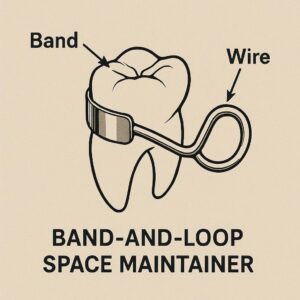
A band and loop space maintainer is a fixed, unilateral appliance. It consists of two primary components:
-
The Band: A pre-formed or custom-fitted stainless steel band that is cemented onto a tooth. This tooth acts as the anchor. Typically, the anchor tooth is the primary first molar or primary second molar adjacent to the extraction site.
-
The Loop: A stainless steel wire, usually 0.036 inches or 0.040 inches in diameter, that is soldered or welded to the band. This loop extends across the edentulous space (the gap where the tooth was lost) and contacts the tooth on the opposite side of the space. The loop does not rest on the gingiva; it sits passively in the embrasure.
The goal is simple: to prevent the mesial (forward) drift of the permanent first molar or the distal (backward) drift of the anterior teeth, ensuring there is enough space for the permanent tooth to erupt into its correct position.
When is a Band and Loop Indicated?
This appliance isn’t for every space, but it excels in specific scenarios:
-
Unilateral space maintenance: When a space is needed on only one side of the arch.
-
Premature loss of a primary first or second molar: This is the most common indication.
-
When a healthy abutment tooth is available: The band requires a tooth that is structurally sound enough to hold a band and withstand the forces of mastication.
Important Note: A band and loop is not indicated for bilateral space loss, when the permanent successor is ready to erupt imminently, or when there is severe crowding where space maintenance alone is insufficient.
The Correct ADA Code: D1516 vs. D1517
This is the heart of the matter. When you are ready to bill for a band and loop space maintainer, you will look at the CDT codes under the “Fixed Partial Denture Remnants” or “Space Maintenance” sections.
The two codes you need to know are D1516 and D1517.
| ADA (CDT) Code | Description | Key Clinical Application |
|---|---|---|
| D1516 | Space maintainer – fixed – unilateral | This is the code for a band and loop space maintainer. It is used when the appliance is placed on one side of the arch (maxillary or mandibular) and maintains a single edentulous space. |
| D1517 | Space maintainer – fixed – bilateral | This code is used for a lower lingual arch or a transpalatal arch. These appliances are used when spaces are needed on both sides of the same arch, and they span across the midline. |
So, to be direct: The ADA code for a standard band and loop space maintainer is D1516.
It is crucial to use the correct code. Submitting D1517 for a simple unilateral case is a quick way to trigger a denial from the insurance carrier. The codes are distinct because the complexity, materials, and chair time for a unilateral appliance versus a bilateral one are significantly different.
The Components of Billing: D1516 in Detail
When you submit a claim with code D1516, you are billing for a specific procedure. However, it is rarely just one code. A complete and accurate claim often involves several related codes to cover the entire patient experience.
The Primary Code: D1516
This code covers the fabrication, fitting, and cementation of the appliance. According to the CDT manual, this includes the impression, the laboratory work (or in-house fabrication), the try-in, and the final cementation.
Think of D1516 as the “global” code for the appliance delivery.
Associated Procedure Codes
Often, the initial appointment for a space maintainer is a separate visit from the extraction. Here is how the timeline typically breaks down:
| Appointment Type | ADA Code | Description |
|---|---|---|
| Extraction of Primary Tooth | D7140 | Extraction, erupted tooth or exposed root. If the extraction is surgical, you might use D7210. |
| Space Maintainer Evaluation & Impression | D1516 | This code is used on the day the impression is taken for the space maintainer. |
| Space Maintainer Delivery | D1516 | This code is also used on the day the appliance is cemented. Wait, can you use the same code twice? |
A Note on Multiple Dates of Service with D1516
This is a common point of confusion. The procedure D1516 is often considered a single procedure with multiple appointments. The correct way to handle this is:
-
Option 1 (Most Common): Bill D1516 on the date of delivery (cementation). The impression, fabrication, and cementation are all part of the global service.
-
Option 2 (Accurate Tracking): Some practices and insurance plans prefer to see the procedure as a single-line item on the date of service when the work was completed. If your office tracks lab fees separately or wants to show the full scope, you can bill D1516 on the date of the delivery.
Never bill D1516 twice for the same appliance. If you take the impression on one day and deliver it a week later, you should only submit the claim once, typically on the date of delivery.
Additional Codes: What About the Band?
A question that often pops up is: “Can I bill for the band separately?”
The short answer is no.
The band is an integral part of the appliance. The code D1516 includes the cost and application of the band. There is a separate code, D2930 (prefabricated stainless steel crown – primary tooth), which is for a crown, not a band used for a space maintainer. Do not use crown codes for space maintainer components.
Step-by-Step Clinical Workflow and Documentation
To ensure your claim is airtight, your clinical notes must tell the story that matches the code. Insurance companies deny claims based on a lack of documentation more often than they deny them for clinical necessity.
Here is a workflow that supports proper use of D1516.
Step 1: Diagnosis and Treatment Planning
Your chart notes must justify the need for the appliance. Document the following:
-
The primary tooth that was lost or is scheduled for extraction.
-
The date of the extraction or the planned extraction date.
-
The presence of the permanent successor (confirmed by radiograph) and an estimate of its eruption time.
-
The clinical assessment of space loss risk (e.g., “Mesial drift of the permanent first molar noted on radiograph”).
Step 2: The Impression Appointment
When you bring the patient in to take the impressions, your note should state:
-
“Patient presented for space maintainer fabrication.”
-
“Alginate impressions were taken of the maxillary/mandibular arch.”
-
“Bite registration was obtained.”
-
“Shade selection for the band was recorded.”
-
“Prescription sent to dental lab.” (Or “Case fabricated in-house by Dr. X.”)
Step 3: The Delivery Appointment
This is the day you submit the claim. Your note must be detailed.
-
“Patient presented for delivery of band and loop space maintainer (D1516).”
-
“Appliance was tried in. Fit was verified. Occlusion was checked.”
-
“The band was cemented with [brand name] glass ionomer cement.”
-
“Excess cement was removed. Floss was passed through the contacts.”
-
“Oral hygiene instructions were reviewed with the parent.”
-
“Patient and parent advised to avoid sticky and hard foods.”
-
“Recall appointment scheduled for 6 months to monitor fit and oral hygiene.”
Step 4: The “What If” – The Breakage Appointment
Space maintainers break. If you need to repair a band and loop, do not use D1516 again. The code for repair is:
-
D1555 – Removal of fixed space maintainer (if it needs to be removed and remade)
-
D1553 – Recement or re-bond of space maintainer (if the band came loose but the appliance is intact)
If the appliance is severely damaged and needs to be completely remade, you would use D1516 again, but your notes must clearly explain why the original appliance failed (e.g., “Appliance fractured at the solder joint. Old appliance removed. New impression taken for fabrication of new band and loop.”)
Realistic Fee Structure and Insurance Considerations
Let’s be realistic about the financial side. The fee for D1516 varies wildly based on geography, whether the practice is a pediatric specialty office, and the lab fees involved.
Here is a realistic breakdown of the factors influencing the fee:
| Factor | Impact on Fee | Notes |
|---|---|---|
| Lab Fee | Increases fee | If you outsource to a lab, your fee must cover the lab cost plus your time. In-house fabrication can lower overhead but increases chair time. |
| Geography | High variation | Urban and suburban areas typically have higher fees than rural areas. |
| Specialist vs. Generalist | Specialist fees are often 15-25% higher | This reflects the complexity of behavior management and the niche expertise. |
| Insurance Contract | Can severely limit fee | If you are in-network, your fee is dictated by the contracted rate. Many plans pay around 50-80% of the procedure fee, leaving a patient portion. |
Common Insurance Scenarios
-
Medical Necessity: Most dental insurance plans cover space maintainers under the premise that they are a “medically necessary” preventive procedure. However, some plans have a missing tooth clause or an age limit. Always verify benefits.
-
Waiting Periods: Many plans have a 6 or 12-month waiting period for major services. While D1516 is not a “major” service like a crown, some plans categorize it under “orthodontics” or “other services” which may have a waiting period.
-
Frequency Limitations: Most plans will only pay for a space maintainer once per quadrant per lifetime for a given edentulous space. If you have to remake it due to breakage, you will likely need to appeal or write off the fee if it is a non-covered service.
Common Pitfalls and How to Avoid Them
Even experienced billers can make mistakes. Here are the most common pitfalls with the band and loop ADA code.
1. Using the Wrong Code (D1517 for a Unilateral Case)
As mentioned, this is the number one error. Double-check your claim before submitting. If you have a single band and a single loop, it is D1516.
2. Billing for the Band Separately
Avoid using codes like D2930 (crown) or D2990 (resin crown) for the band. The band is not a crown; it is a component of the appliance. The CDT manual is explicit that the fabrication of the band is part of the space maintainer procedure.
3. Inadequate Diagnostic Documentation
If your chart notes simply say “Band and loop placed,” you are at risk for a post-payment audit. The insurer may ask, “Why was this necessary?” Your notes should always include:
-
The tooth number of the missing tooth.
-
The date of extraction or loss.
-
The clinical rationale (e.g., “To prevent mesial drift of tooth #K to preserve space for tooth #20”).
4. Ignoring the “Mutilation Factor”
If the abutment tooth (the tooth you are banding) is heavily restored or carious, a band and loop may not be appropriate. If you place a band on a tooth that later needs a crown, the space maintainer must be removed and remade. This can lead to patient dissatisfaction and additional non-covered costs. Always confirm the abutment tooth is healthy.
5. Cementation Issues
Using the wrong cement can lead to a loose band, which is a common cause of “recall” failures. If the band comes loose within the first year, many patients expect a free recementation. Your financial policy should clearly define warranty periods for appliances.
Writing an Airtight Narrative for D1516
In the modern dental office, your clinical narrative is your best defense against a denied claim. Let’s look at a sample note that justifies the use of D1516.
Patient: John Doe, age 7
Date: October 15, 2024Chief Complaint: “My son’s tooth fell out yesterday, and we want to make sure the space stays open.”
Clinical Findings:
Tooth #K (primary second molar) is missing. Parent reports the tooth exfoliated on 10/14/24.
Radiographic evaluation (BWX) reveals the permanent successor, tooth #20, is present but has not yet begun to erupt. The permanent first molar (#19) is fully erupted.
Clinical examination reveals no active space loss at this time. However, due to the mesial drift potential of tooth #19, a space maintainer is indicated.
Abutment tooth #J (primary first molar) is sound, caries-free, and has adequate supragingival structure for band placement.
Procedure:
D1516 – Space maintainer, fixed, unilateral, mandibular left.
Alginate impressions of the mandibular arch were obtained. Bite registration was taken.
A prefabricated stainless steel band was selected for tooth #J. The case was sent to ABC Dental Lab for fabrication of a band and loop space maintainer.
Patient tolerated the procedure well. Post-operative instructions reviewed.
Next Appointment: Scheduled for 10/22/24 for delivery of the appliance.
Beyond the Code: Patient and Parent Education
A crucial part of your role as a dental professional is to set expectations. The best-coded claim in the world won’t matter if the patient’s parent is unhappy because the appliance failed due to poor home care.
Here are key points to discuss with parents:
-
Hygiene is Critical: Plaque accumulation around the band can lead to decalcification and caries on the abutment tooth. This is the most common long-term complication.
-
Tip: Suggest a proxabrush (interdental brush) to clean around the band.
-
-
Dietary Restrictions: Sticky foods like caramel, taffy, and gum can pull the appliance loose. Hard foods like ice and hard candy can break the solder joint.
-
Flossing: Flossing is different with a band and loop. Parents must use a floss threader to floss under the loop and between the abutment tooth and the adjacent teeth.
-
Regular Recall: A space maintainer is not a “set it and forget it” appliance. It must be checked every 6 months to ensure it is still passive and not impeding the eruption of the permanent tooth.
The Removal of the Appliance (D1556)
One final piece of the puzzle is removal. You have done your job, and the permanent tooth is now ready to erupt. How do you bill for the removal?
The code is D1556 – Removal of fixed space maintainer.
This is a separate procedure from the placement. It involves carefully cutting the solder joint or band to remove the appliance without traumatizing the adjacent teeth or the erupting permanent tooth.
This code is often overlooked. Make sure to bill for this procedure when the appliance has served its purpose.
Conclusion
Navigating the ADA code for a band and loop space maintainer is about more than just knowing that D1516 is the correct code. It requires a holistic understanding of the clinical rationale, the documentation requirements, and the insurance nuances that surround this essential pediatric procedure.
By combining precise coding with thorough clinical notes and clear patient communication, you ensure that your practice is paid correctly for the valuable service you provide, while also delivering the best possible orthodontic foundation for your young patients.
Frequently Asked Questions (FAQ)
1. What is the exact ADA code for a band and loop space maintainer?
The exact ADA (CDT) code is D1516. This code is defined as “Space maintainer – fixed – unilateral.”
2. Can I use D1516 for a lower lingual arch?
No. A lower lingual arch (LLA) is a bilateral appliance. The correct code for an LLA or a transpalatal arch is D1517 (Space maintainer – fixed – bilateral).
3. What do I do if the band on the space maintainer comes loose?
If the appliance is intact but the band is loose, you would use code D1553 (Recement or re-bond of space maintainer). If the appliance is broken, you may need to use D1555 (Removal of fixed space maintainer) and then a new D1516 if it needs to be remade.
4. Is a space maintainer covered by medical insurance?
Typically, no. Space maintainers are almost exclusively a dental insurance benefit. They are covered under most dental plans as a preventive service, but you should always verify the patient’s specific plan details.
5. At what age is a band and loop space maintainer typically used?
This appliance is most commonly used in children between the ages of 5 and 10, when primary molars are lost prematurely and the permanent successors are not yet ready to erupt.
6. How long does a band and loop space maintainer stay in place?
The appliance remains in place until the permanent successor is ready to erupt, which can be anywhere from 6 months to 2-3 years, depending on the child’s dental development. It is critical to monitor the appliance with regular recall visits.