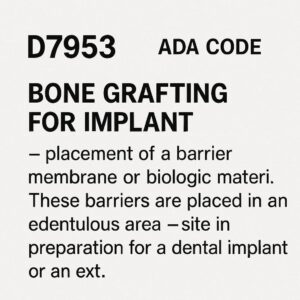
ADA Code for Bone Grafting for Implant
If you are planning to get a dental implant, you have probably heard about bone grafting. It sounds a little scary at first. But in reality, it is a very common procedure. Many people do not have enough natural jawbone to support an implant. So, a graft helps create a solid foundation.
But then comes the tricky part: the paperwork. You look at your treatment plan or insurance form and see strange codes. What is the correct ADA code for bone grafting for implant? Does insurance cover it? Why are there different codes for different situations?
Do not worry. This guide will walk you through everything. We will keep it simple, clear, and honest. You will learn exactly what each code means, when a dentist uses it, and how much you might expect to pay. Let us dive in.
What Is Bone Grafting for a Dental Implant?
Before we talk about codes, let us understand the procedure itself. A dental implant is a small titanium post that acts like a tooth root. It needs to sit inside healthy, thick bone. But after tooth loss, the bone shrinks. This is called resorption.
A bone graft adds new bone material to the weak area. The material can come from:
-
Your own body (autogenous)
-
A human donor (allograft)
-
An animal source like cow bone (xenograft)
-
A synthetic lab-made material (alloplast)
The graft heals over several months. Once it fuses with your existing bone, the surgeon can place the implant.
Why Do You Need a Specific Code for This?
Dentists use the Current Dental Terminology (CDT) code set. The American Dental Association (ADA) updates these codes every year. Each code represents a specific service. If a dentist uses the wrong code, your insurance may deny the claim. Or you might get billed for something you did not receive.
So, using the right ADA code for bone grafting for implant protects both the dentist and the patient. It ensures clarity and fair payment.
The Main ADA Codes for Bone Grafting Around Implants
There is not just one single code. The ADA separates bone grafting codes based on two things:
-
When the graft is done (before implant placement or at the same time)
-
Where the graft material comes from
Here are the most common codes you will see.
D4266 – Bone Graft for Socket Preservation
This code applies when a tooth is extracted, and the dentist places a graft directly into the empty socket. The goal is to prevent bone loss immediately after extraction. This is often done even if you are not getting an implant right away.
-
When: At the time of tooth removal
-
Why: To keep the ridge width and height
-
Implant relation: Prepares the site for a future implant (usually 4-6 months later)
D4267 – Bone Graft for Ridge Augmentation (Not Including Socket Preservation)
This code is for a larger defect. Imagine a missing tooth that has been gone for years. The bone has collapsed. The dentist needs to rebuild the ridge shape. This is not a fresh socket. It is a healed area that needs more volume.
-
When: Months or years after tooth loss
-
Why: To create enough bone for an implant
-
Implant relation: Performed before implant placement
D7951 – Sinus Lift with Bone Graft (for Posterior Maxilla)
The upper back jaw (maxilla) sits right below the sinus cavity. When bone is thin there, the surgeon lifts the sinus membrane and places graft material underneath. This is called a sinus augmentation or sinus lift.
-
When: Before or at the time of implant placement in the upper back area
-
Why: To gain vertical bone height
-
Implant relation: Essential for implants in the premolar and molar region of the upper jaw
D7950 – Bone Graft for Ridge Augmentation (Major)
This is a broader code. It covers more complex grafting. For example, a large onlay block graft or a major reconstruction of the jawbone. D7950 is often used when the defect is extensive and requires significant bone volume.
-
When: Before implant placement in severely atrophic ridges
-
Why: To restore basic jaw anatomy
-
Implant relation: Usually followed by a second grafting procedure or direct implant placement after healing
Important note for readers: Do not confuse D7950 with D4267. D4267 is for smaller, localized ridge defects. D7950 is for major, often multiple-tooth defects.
Comparative Table: ADA Codes for Bone Grafting for Implant
| ADA Code | Procedure Name | Typical Timing | Best For | Implant Stage |
|---|---|---|---|---|
| D4266 | Socket preservation | At extraction | Fresh socket | Future implant |
| D4267 | Ridge augmentation (localized) | Healed ridge (months after extraction) | Small to moderate defect | Before implant |
| D7951 | Sinus lift (direct or indirect) | Upper molar/premolar area | Low sinus floor | Before or with implant |
| D7950 | Major ridge augmentation | Severely deficient jaw | Large onlay or block graft | Before implant |
| D4263 | Bone replacement graft – first site | Any ridge site | Per site, per area | Varies |
*Note: D4263 and D4264 are older codes sometimes still used. Most modern claims use D4266, D4267, or D7951 for implant-related grafting.*
When Is the Graft Done at the Same Time as the Implant?
This is a common question. Can the dentist place the bone graft and the implant in one visit? The answer is: sometimes.
If the bone defect is small, the surgeon can place the implant first. Then, they pack graft material around the exposed threads. This is called a simultaneous approach.
In this case, the correct ADA code for bone grafting for implant depends on the area:
-
D4266 – if the graft fills a small gap around a new implant in a fresh site
-
D7951 – if the sinus lift is done and the implant is placed the same day (direct sinus lift)
However, if the defect is large, the surgeon will do the graft first. Then, you wait 4 to 9 months for healing. After that, a second surgery places the implant. That means two separate codes: one for the graft and later one for the implant (D6010).
Realistic advice: Most implant surgeons prefer staged grafting for large defects. Simultaneous grafting works only when the implant has at least 50% of its surface in natural bone.
Understanding Insurance Coverage for Bone Grafting
Let us be honest. Dental insurance often does not cover bone grafting fully. Some plans consider it “major restorative.” Others call it “surgical preparatory.”
Here is what you need to know.
Medical Insurance May Pay
If bone loss happened due to trauma, tumor removal, or congenital deformity, your medical insurance might cover the graft. The dentist would then bill using medical CPT codes, not ADA codes. But for routine tooth loss, dental insurance is the primary payer.
Typical Coverage Limits
-
Socket preservation (D4266): Many plans cover 50% to 80% after deductible
-
Ridge augmentation (D4267): Often covered at 50%
-
Sinus lift (D7951): Less commonly covered; often considered “implant-related” and excluded
-
Major graft (D7950): Rarely covered by standard dental insurance
How to Avoid Surprise Bills
Always ask your dentist’s office for a pre-treatment estimate. They will send the proposed ADA code for bone grafting for implant to your insurance company. The insurance will reply with exactly what they will pay. You are not obligated to proceed if the coverage is too low.
Quotation from a billing expert:
“The single biggest mistake I see is using D4266 for a ridge that healed years ago. That code is for the day of extraction only. Using it later is insurance fraud. Always use the correct ADA code for bone grafting for implant based on the clinical situation.” — Carla M., dental billing specialist, 18 years experience.
Step-by-Step: What to Expect During Bone Grafting for an Implant
Let us walk through a typical case. This will help you understand which code applies at each step.
Step 1: Consultation and Imaging
Your dentist takes a CBCT (3D X-ray). They measure your bone height and width. If the bone is too thin, they recommend grafting.
Step 2: Choosing the Right Code
Based on the defect, the dentist decides:
-
Small missing area after extraction months ago → D4267
-
Fresh extraction today → D4266
-
Low sinus floor in upper back → D7951
Step 3: The Graft Procedure (Local Anesthesia)
-
The dentist makes a small cut in your gum.
-
They place the graft material (putty, granules, or block).
-
They cover it with a membrane (sometimes billed separately with code D4268).
-
They close with stitches.
Step 4: Healing Period
You wait 4 to 9 months. During this time, the graft turns into your own bone.
Step 5: Implant Placement
After healing, the dentist places the implant. This is billed with D6010 (surgical placement of implant body).
Step 6: Final Crown
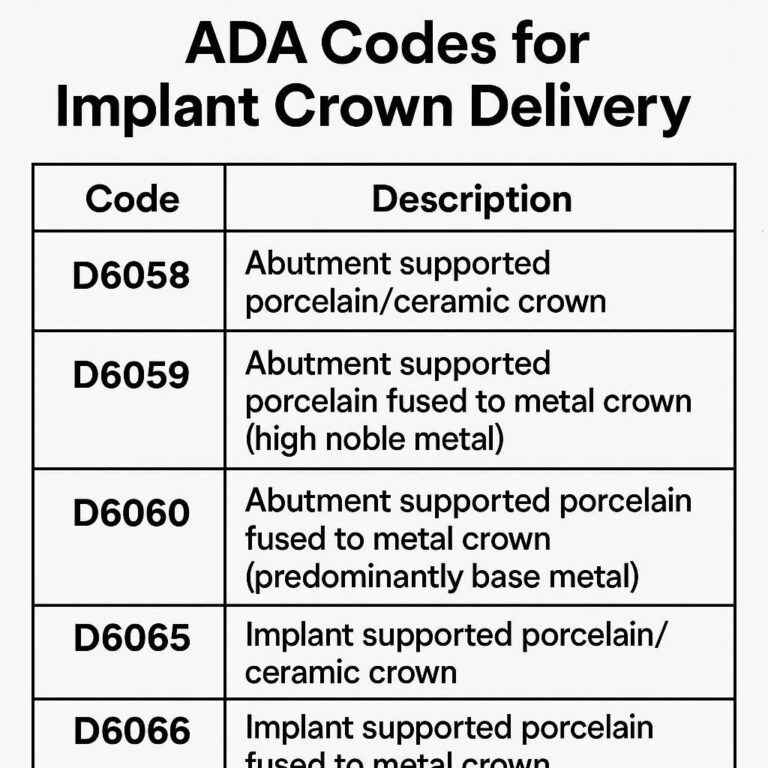
After another 3-6 months, you get your crown (D6057 or D6060 for custom abutment and crown).
Helpful List: Factors That Affect Which ADA Code Is Used
The correct code depends on these clinical details:
-
Timing: Is the tooth extracted today, last month, or 5 years ago?
-
Location: Front tooth, premolar, or molar? Upper or lower?
-
Defect size: Small gap (one tooth) or large area (three teeth)?
-
Sinus involvement: Is the sinus floor too low?
-
Prior grafts: Has this area been grafted before?
-
Implant placement: Same day or delayed?
Pro tip: Always ask your dentist to write down the code on your treatment plan. Then, you can call your insurance to verify coverage before the procedure.
Common Billing Mistakes and How to Avoid Them
Even great dentists make coding errors. Here are the most frequent problems.
Mistake #1: Using D4266 for a Healed Ridge
A healed ridge (no tooth removed recently) cannot use socket preservation code. That is incorrect. The correct ADA code for bone grafting for implant in this case is D4267 or D7950.
Mistake #2: Not Separating Sinus Lift from Ridge Graft
Some dentists bill a sinus lift as D4267. That is wrong. The sinus requires a specific code: D7951. Mixing them up can trigger an insurance audit.
Mistake #3: Billing for Graft Material Separately
The graft material cost is included in the procedure code. You cannot bill a separate code for “bone putty” or “membrane” unless you use D4268 (guided tissue regeneration membrane). And even then, many plans bundle it.
Mistake #4: Upcoding
Upcoding means billing a more expensive code than the work performed. For example, billing D7950 (major graft) for a tiny 3mm defect that only needs D4267. This is fraudulent.
Cost Ranges for Bone Grafting (Without Insurance)
Let us talk money. Prices vary by city, dentist, and graft material. But here are honest, realistic ranges in the United States.
| ADA Code | Typical Cost (per site) | Includes |
|---|---|---|
| D4266 | $300 – $800 | Socket graft only |
| D4267 | $600 – $1,500 | Localized ridge augmentation |
| D7951 | $1,500 – $3,000 | Sinus lift with graft material |
| D7950 | $2,000 – $4,500+ | Major block graft or extensive reconstruction |
These costs do not include the implant (D6010: $1,500 to $3,000) or the crown ($1,000 to $3,000). A full case with graft, implant, and crown often totals $4,000 to $9,000 per tooth.
Note: Some dental schools and nonprofit clinics offer reduced fees. You can save 30% to 50% by being a patient at a dental school.
Does Medicare or Medicaid Cover Bone Grafting for Implants?
Medicare (for patients 65+)
Original Medicare does not cover dental implants or bone grafting for implants. However, if the bone grafting is part of jaw reconstruction due to accident or disease (like oral cancer), Medicare Part A (hospital) may cover the surgical portion. But the implant itself is almost never covered.
Medicaid (state-dependent)
Some states cover bone grafting and implants for adults. Others cover nothing. You must check your specific state’s dental benefits. For example, California’s Denti-Cal covers implants only in very limited cases (cleft palate, trauma). Most states do not cover elective implant grafting.
How to Read Your Dental Claim Form
When your dentist submits a claim, you will see boxes like this:
-
Box 32: ADA Code (e.g., D4267)
-
Box 33: Tooth number or area (e.g., #3 for upper right first molar)
-
Box 34: Description (e.g., “ridge augmentation, localized”)
-
Box 35: Fee charged
If you see a code that does not match what your dentist explained, ask. You have the right to a clear explanation.
Alternatives to Bone Grafting for Implants
Grafting is not your only option. Depending on your case, you might consider:
-
Short implants – For low bone height (D6010 with shorter post)
-
Narrow diameter implants – For thin bone (less than 4mm wide)
-
Zygomatic implants – For severe upper jaw atrophy (no graft, but very complex)
-
No implant – A bridge or partial denture instead
Each alternative has pros and cons. Grafting is often the most predictable long-term solution. But it is not the only path.
Helpful List: Questions to Ask Your Dentist Before Bone Grafting
Before you agree to any procedure, ask these questions. Write down the answers.
-
Which ADA code for bone grafting for implant will you use, and why?
-
Is the graft done at the same time as the implant or separately?
-
What material will you use (human, animal, synthetic)?
-
How long is the healing time?
-
What happens if the graft fails?
-
Can you provide a pre-treatment estimate for my insurance?
-
What is the total out-of-pocket cost for graft, implant, and crown?
-
Do you offer any payment plans or third-party financing (CareCredit, LendingClub)?
What the Research Says About Bone Grafting Success
You want honest information. So here it is. Bone grafting for implants has a high success rate. Systematic reviews show:
-
Socket preservation (D4266): 95%+ success when followed by implant placement
-
Ridge augmentation (D4267): 90-95% success for defects up to 5mm
-
Sinus lift (D7951): 92-98% implant survival after 5 years
Failure happens. It is rare but possible. Reasons include infection, smoking, uncontrolled diabetes, or poor blood supply. If a graft fails, you may need a second graft (different code: D4268 for membrane or D7952 for a repeat sinus lift).
Conclusion (Summarized in Three Lines)
Choosing the correct ADA code for bone grafting for implant depends on timing, location, and defect size—use D4266 for fresh sockets, D4267 for healed localized ridges, and D7951 for sinus lifts. Understanding these codes helps you verify insurance coverage, avoid billing errors, and plan your budget realistically. Always ask for a pre-treatment estimate and a clear explanation of which code applies to your unique situation.
Frequently Asked Questions (FAQ)
1. What is the most common ADA code for bone grafting for implant?
The most common are D4266 (socket preservation at extraction) and D4267 (ridge augmentation on a healed site). For the upper back jaw, D7951 (sinus lift) is very common.
2. Can a dentist bill bone grafting and implant placement on the same day with two codes?
Yes. If the graft is small and placed simultaneously with the implant, you will see D6010 (implant) plus one graft code (D4266, D4267, or D7951). The insurance may reduce payment for the graft, arguing it is “inclusive.”
3. Does insurance always deny D7951 (sinus lift)?
Not always, but often. Many plans exclude sinus lifts because they consider them “implant preparatory.” However, some PPO plans cover sinus lifts at 50% after a waiting period. Always check your specific policy.
4. Is there a separate code for the bone graft material itself?
No. The material is part of the procedure code. You should not see a separate line item for “bone putty” or “xenograft granules.” If you do, ask why.
5. What is the difference between D4267 and D7950?
D4267 is for localized defects (one to two teeth, moderate volume). D7950 is for major defects (three or more teeth, block grafts, extensive reconstruction). Think of D7950 as “heavy duty.”
6. Can I get a bone graft without an implant later?
Yes. Some people get a graft to preserve bone for a future implant they cannot afford yet. Others graft simply to prevent collapse of the jaw ridge. The code remains the same regardless of whether you eventually get an implant.
7. How do I know if my dentist used the correct code?
Ask to see the ADA code on your treatment plan. Then ask: “Does this code match the exact procedure you described?” If you are unsure, you can call the ADA at 312-440-2500 or visit their CDT code inquiry page (see additional resource below).
8. What happens if the graft fails and I need a second one?
The dentist will likely use the same code again (D4267 or D7951). Some insurance plans have a “90-day global period” during which a repeat graft is not separately billable. After 90 days, they may pay again.
Additional Resource
For the official and most up-to-date list of CDT codes (including all bone grafting codes for implants), visit the American Dental Association’s Code Maintenance Committee page:
🔗 https://www.ada.org/en/publications/cdt/ada-code-maintenance-committee
You can also search for “CDT 2025 bone grafting codes” for the latest revisions. Codes are updated every year on January 1st.