The Complete Guide to Understanding the ADA Code for Gingivoplasty
Navigating the world of dental procedure codes can often feel like learning a new language. For dental professionals, accurate coding is not just about paperwork; it is the backbone of a healthy practice. It ensures proper reimbursement, maintains compliance with insurance providers, and creates a clear record of patient care.
Among the myriad of procedures that require precise coding, gingivoplasty stands out as a common yet often misunderstood treatment. Whether you are a seasoned dentist, a practice manager, or a dental student, understanding the specific Current Dental Terminology (CDT) code for this procedure is essential.
In this guide, we will demystify the ADA code for gingivoplasty. We will explore what the procedure
entails, the correct codes to use, how to differentiate it from similar surgeries, and best practices for documentation. Our goal is to provide you with a reliable, realistic resource that helps you code with confidence and clarity.
What is Gingivoplasty? Defining the Procedure
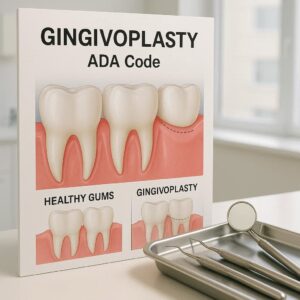
Before diving into the numbers and letters of the code, it is vital to understand the procedure itself. Gingivoplasty is a surgical procedure performed on the gums (gingiva). Its primary goal is to reshape the gum tissue to create more natural, functional, and aesthetically pleasing contours.
Think of it as sculpting. While a gingivectomy involves removing gum tissue to reduce pocket depth (often to treat periodontal disease), a gingivoplasty is focused on recontouring existing tissue. The gums might be healthy, but their shape could be irregular due to genetics, trauma, or as a result of previous periodontal treatment.
Common Reasons for Gingivoplasty
Patients might require a gingivoplasty for several reasons:
-
Aesthetic Concerns: A “gummy smile” where excess gum tissue covers too much of the tooth crown.
-
Functional Issues: Irregular gum contours that trap food and plaque, making oral hygiene difficult for the patient.
-
Pre-Prosthetic Preparation: Reshaping gum tissue to prepare the mouth for a crown, bridge, or denture, ensuring a proper fit.
-
Post-Disease Recontouring: After successful periodontal therapy, the gums may heal with uneven contours that need smoothing.
The Importance of Using the Correct ADA Code
In the dental field, precision matters—not just clinically, but administratively. The American Dental Association (ADA) develops and maintains the CDT (Current Dental Terminology) code set. These codes are the universal language used to communicate with dental insurance companies.
Using the correct ADA code for gingivoplasty is critical for several reasons:
-
Accurate Reimbursement: Insurance companies use codes to determine if a procedure is covered and how much they will pay. An incorrect code can lead to claim denials or reduced payments.
-
Legal and Regulatory Compliance: Proper coding is a requirement for compliance with healthcare regulations and insurance contracts.
-
Patient Trust: When a claim is processed smoothly, it builds trust. Conversely, denied claims due to coding errors can lead to frustrated patients and awkward conversations about unexpected bills.
-
Practice Analytics: Accurate coding helps you track which procedures are most common in your practice, aiding in business planning and inventory management.
The Specific ADA Code for Gingivoplasty
So, what is the code you need to know? In the CDT manual, gingivoplasty is specifically coded as:
D4212: Gingivectomy or Gingivoplasty – Four or More Contiguous Teeth or Tooth Bounded Spaces Per Quadrant
This is the primary code you will use. Let’s break down exactly what this description means, as the details are crucial for correct application.
-
Gingivectomy or Gingivoplasty: The code covers both procedures. This is because they are often performed together or are difficult to distinguish in a post-operative assessment. Both involve the surgical removal or reshaping of gum tissue.
-
Four or More Contiguous Teeth: This specifies the minimum extent of the procedure. “Contiguous” means touching or adjacent. You are reshaping the gums around at least four teeth that are next to each other.
-
Tooth Bounded Spaces: This refers to edentulous areas (spaces where teeth are missing) that are bordered by teeth. If you are reshaping gum tissue in an area where a tooth is missing, but it sits between two other teeth, that space counts toward the “four or more” requirement.
-
Per Quadrant: This is a key billing unit. The mouth is divided into four quadrants: upper right, upper left, lower right, and lower left. Code D4212 is billed per quadrant.
When to Use D4212
You would use this code when the procedure involves surgically reshaping the gingiva to restore normal contour. This could involve the use of a scalpel, lasers, or electrosurgery. The focus is on recontouring existing tissue, not necessarily on eliminating deep periodontal pockets (though that may be a secondary effect).
Important Note: D4212 is typically considered a surgical procedure. Pre-authorization with the patient’s insurance provider is highly recommended to confirm coverage and avoid surprises for both you and your patient.
Gingivoplasty vs. Other Procedures: A Comparative Guide
One of the biggest sources of coding errors is confusing gingivoplasty with other, similar periodontal procedures. To help you navigate this, here is a detailed comparison table.
| Procedure & Code | Primary Goal | Typical Indication | Key Differences |
|---|---|---|---|
| Gingivoplasty (D4212) | To reshape healthy gum tissue. | Gummy smile, uneven contours, pre-prosthetic preparation. | Focuses on aesthetics and function, not necessarily disease elimination. |
| Gingivectomy (D4212) | To remove diseased or excess gum tissue. | To eliminate suprabony pockets, reduce gum overgrowth. | Often performed to treat a condition (like drug-induced hyperplasia). Shares the same code. |
| Gingival Curettage (D4231) | To remove the soft tissue lining of a periodontal pocket. | As a standalone procedure to promote healing in a pocket. | Does not involve reshaping the external surface of the gum. It is debridement within the pocket. |
| Osseous Surgery (D4261) | To reshape the underlying bone supporting the teeth. | To correct moderate to deep bone defects caused by periodontitis. | This is a more involved surgery. It often includes a gingivoplasty, but the primary focus is on the bone. |
| Crown Lengthening (D4249) | To expose more tooth structure by removing gum and bone. | To prepare a tooth for a crown when there is not enough tooth above the gum line. | This is a specific restorative procedure. It is localized to one tooth, whereas D4212 covers a contiguous area. |
Making the Right Call
The decision often comes down to the “why.”
-
If the goal is to fix a “gummy smile” for a patient with healthy gums and bone, the code is D4212.
-
If the goal is to reshape the bone to save a tooth with severe decay below the gum line, the code is likely D4249 (Crown Lengthening).
-
If the goal is to remove deep pockets and reshape the underlying bone due to bone loss from periodontitis, the code is likely D4261 (Osseous Surgery).
Documentation: Your Best Friend in Coding
Using the correct code is only half the battle. Your clinical documentation must tell the same story that the code implies. If an auditor or insurance company reviews the patient’s chart, the notes must justify the procedure.
Here is a checklist of what to include in your documentation when performing a gingivoplasty:
-
Diagnosis: What is the specific reason for the procedure? (e.g., “Patient presents with excessive gingival display and uneven gingival margins on teeth #6-11.”)
-
Medical Necessity: If the procedure is not purely cosmetic, explain the functional need. (e.g., “Irregular gingival contours are creating food traps, leading to localized inflammation and difficulty with oral hygiene.”)
-
Procedure Details:
-
Specific code used (D4212).
-
Quadrant(s) treated (e.g., “Quadrant 2”).
-
Technique used (Scalpel, laser, electrosurgery).
-
Description of the tissue removed or reshaped.
-
-
Pre-Operative Status: Include photographs, periodontal charting, and study models if available. Visual evidence is powerful.
-
Informed Consent: Ensure the patient has signed a consent form that specifically mentions “gingivoplasty” and explains the risks, benefits, and alternatives.
Step-by-Step: What to Expect During a Gingivoplasty
Understanding the clinical steps can also help with coding. Here is a general overview of how a gingivoplasty is typically performed. This helps clarify why it is classified as a surgical procedure.
-
Assessment and Marking: The dentist evaluates the gum contours and may mark the tissue with a surgical pen to guide the incisions.
-
Anesthesia: Local anesthesia is administered to ensure the patient is comfortable and feels no pain.
-
Incision and Reshaping: Using a scalpel, a laser, or an electrosurgical unit, the dentist carefully trims and recontours the gum tissue to the desired shape. Lasers are popular for this procedure because they often cause less bleeding.
-
Tissue Smoothing: The edges of the remaining tissue are smoothed to create a natural, tapered appearance.
-
Post-Operative Care: A periodontal dressing (a putty-like bandage) may be placed over the area to protect it during initial healing. The patient is given specific instructions for care, including pain management, diet, and oral hygiene.
Optimizing Reimbursement for D4212
Getting the code right is the first step toward getting paid. Here are some practical tips to ensure your claims for gingivoplasty are processed smoothly.
1. Master the Narrative
The D4212 code description is quite specific (“four or more contiguous teeth”). Your claim form and any attached narratives must clearly reflect this. If you performed the procedure on three teeth, D4212 is not the correct code. You may need to look at alternative codes or bill it differently.
2. Understand the Patient’s Policy
Not all dental insurance plans cover gingivoplasty. If the procedure is purely for cosmetic reasons (like treating a gummy smile), it is often a plan exclusion. However, if there is a functional component—such as tissue overgrowth hindering oral hygiene—it may be covered. Always verify benefits before the procedure.
3. Use Diagnostic Codes (ICD-10) Effectively
CDT codes (like D4212) tell the insurer what you did. ICD-10 diagnosis codes tell them why you did it. Pairing the correct codes is essential.
-
For a cosmetic gummy smile, you might use M26.89 (Other specified dentofacial anomalies).
-
For tissue overgrowth caused by medication, you might use K06.1 (Gingival enlargement).
-
For irregular contours after periodontal therapy, you might use K05.5 (Other periodontal diseases).
The diagnosis code must support the medical necessity of the procedure.
4. Submit Clear Documentation
When in doubt, attach a brief narrative and clinical photos (with patient consent) to the claim. This can preemptively answer an insurer’s questions and speed up the approval process. A picture of uneven, plaque-trapping gum contours is worth a thousand words in a claims adjustment office.
A Friendly Reminder: Insurance policies vary wildly. What is covered by one provider may be excluded by another. Always check the specific plan details.
The Future of Periodontal Coding
The world of dental coding is not static. The ADA updates the CDT code set every two years, with new codes added and old ones revised. It is your responsibility as a professional to stay current.
We are seeing a trend toward more specific codes that differentiate between procedures performed with traditional scalpels versus lasers. While D4212 currently covers both methods, future iterations of the CDT manual could introduce separate codes for laser-based gingivoplasty, reflecting the different technology and skill sets involved.
Make it a habit to check for the latest CDT manual updates annually. Your local dental society or the ADA’s official website are the best resources for this information.
Frequently Asked Questions (FAQ)
Q1: Can I use D4212 for a single tooth?
Generally, no. The code explicitly states “four or more contiguous teeth or tooth bounded spaces per quadrant.” If you are reshaping the gum around a single tooth, the procedure is likely being done for a specific restorative reason, and you should investigate codes like D4249 (crown lengthening—surgical) or a single-tooth gingivectomy code, though D4212 is specifically for the contiguous group.
Q2: What is the difference between D4210 and D4212?
This is a common point of confusion. D4210 is for “Gingivectomy or gingivoplasty – four or more contiguous teeth or tooth bounded spaces per quadrant (Includes [the procedure])”. Wait, that sounds the same! Actually, the distinction has been clarified in recent CDT manuals. The key difference historically was that D4210 included root planing, while D4212 did not. However, in current CDT coding, D4212 is the primary code for both procedures. It’s critical to use the most current CDT manual. The old D4210 is no longer the standard code for this procedure. Always default to D4212.
Q3: Is gingivoplasty considered cosmetic or medical?
It can be both. If the procedure is done solely to enhance the appearance of a “gummy smile,” it is cosmetic. If it is done to remove tissue that is interfering with chewing, causing recurrent inflammation, or necessary for the placement of a prosthetic device (like a crown), it is considered medically necessary. This distinction is critical for insurance coverage.
Q4: Will my insurance cover a gingivoplasty?
Coverage depends entirely on your specific plan. Some plans cover medically necessary periodontal surgery. Others exclude any surgery related to the gums. The best course of action is for your dental office to perform a “predetermination of benefits” before the procedure. This involves sending the code (D4212) and supporting documentation to your insurer to get a written estimate of what they will pay.
Additional Resources
To ensure you are always using the most up-to-date and accurate information, please refer to the official source:
-
American Dental Association (ADA) CDT Code Book: Link to ADA Store for the latest CDT manual (This link leads to the official ADA page where you can purchase the current code set).
Conclusion
Mastering the ADA code for gingivoplasty (D4212) is more than just memorizing a number. It requires a solid understanding of the procedure itself, a keen eye for detail when differentiating it from similar treatments, and a commitment to thorough documentation. By accurately using D4212 for the reshaping of gum tissue on four or more contiguous teeth, you protect your practice’s financial health, ensure compliance, and provide clarity for your patients. Remember, precise coding is the final, crucial step in a successfully delivered dental procedure.