The Real Deal on the ADA Code for Hard Occlusal Guard
If you have ever woken up with a sore jaw, a dull headache, or noticed that your teeth look a bit more worn down than they should, you have likely heard about occlusal guards. Sometimes called night guards, bite splints, or bruxism appliances, these devices are essential tools in modern dentistry.
But when you sit in the dentist’s chair and they mention a “hard occlusal guard,” you might see a code pop up on your treatment plan. That code is part of the American Dental Association (ADA) Current Dental Terminology (CDT) system.
Understanding this code is not just about paperwork. It is about knowing what you are paying for, what your insurance might cover, and whether you are getting the right device for your specific problem.
In this guide, we will walk through everything you need to know about the ADA code for a hard occlusal guard. We will keep things simple, clear, and honest. No confusing medical jargon. No hidden tricks. Just real information you can use.
What Exactly Is a Hard Occlusal Guard?
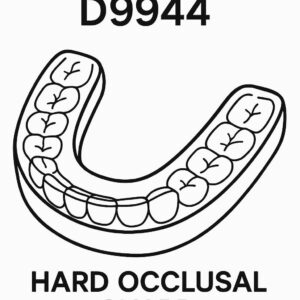
Before we jump into codes and billing, let us talk about the device itself. A hard occlusal guard is a removable dental appliance, typically made of rigid acrylic, that fits over the chewing surface of your upper or lower teeth.
Unlike soft night guards you might buy at a pharmacy, a hard guard does not bend or compress. This hardness is intentional. It creates a smooth, stable surface that prevents your teeth from grinding against each other.
Why Hard Instead of Soft?
Many people assume softer means more comfortable. But with bruxism (teeth grinding) or clenching, soft guards can actually encourage more clenching. Your jaw muscles feel something squishy, so they want to bite down harder. A hard guard provides a firm stop, which helps relax the muscles over time.
Here is a simple comparison to help you see the difference:
| Feature | Hard Occlusal Guard | Soft Night Guard (OTC) |
|---|---|---|
| Material | Rigid acrylic | Thermoplastic or rubber |
| Durability | 3–5 years with care | 3–6 months |
| Custom fit | Yes (made from impressions) | No (boil-and-bite) |
| Muscle relaxation | Promotes | May increase clenching |
| Cost range | $300 – $1,200 | $20 – $100 |
| ADA code | D9944 or D9945 | No code (non-professional) |
A hard occlusal guard is a medical device. It is prescribed based on your specific bite, the severity of your grinding, and the health of your jaw joints (TMJ).
Who Really Needs One?
You might need a hard occlusal guard if you experience:
-
Worn, flat, or chipped teeth
-
Jaw pain or stiffness in the morning
-
Clicking or popping sounds in your jaw
-
Frequent headaches originating near your temples
-
A partner complaining about loud grinding sounds at night
Important note: A hard occlusal guard does not cure bruxism. It protects your teeth from further damage. It manages the symptoms. For many people, that is enough to live comfortably and avoid expensive restorative work later.
The ADA Code for Hard Occlusal Guard: D9944 and D9945 Explained
Now let us get to the heart of the matter. The ADA has two specific codes for hard occlusal guards. They are not interchangeable. Using the wrong one can lead to denied insurance claims or unexpected patient bills.
D9944: Occlusal Guard – Hard, Full Arch
This code is used for a hard occlusal guard that covers either the entire upper arch (maxillary) or the entire lower arch (mandibular). Most dentists prefer to fit the guard on the upper teeth because it is more comfortable and less likely to interfere with speech.
When is D9944 used?
-
For patients with moderate to severe bruxism
-
When the guard covers all teeth in one arch
-
As a first-line treatment for clenching and grinding
-
When no major TMJ repositioning is required
D9945: Occlusal Guard – Hard, Partial Arch
This code is less common but still important. D9945 describes a hard guard that covers only a portion of the arch, typically the front teeth (anterior) or specific segments.
When is D9945 used?
-
When a patient has a strong gag reflex and cannot tolerate a full arch
-
For specific cases of anterior bruxism
-
As an interim or trial appliance
-
When certain teeth are missing or have specific restorations that need avoidance
Here is a quick reference table:
| Code | Description | Coverage | Typical Use Case |
|---|---|---|---|
| D9944 | Hard, full arch | Entire upper or lower arch | Standard bruxism management |
| D9945 | Hard, partial arch | Front teeth or specific area | Gag reflex, trial, or missing teeth |
What About D9940 and D9946?
You might see other occlusal guard codes and wonder why we are not discussing them. Let us clarify quickly:
-
D9940 – This is an older, now archived code for occlusal guards. Do not use it. It has been replaced.
-
D9946 – This is for a soft or hybrid guard (hard interior with soft exterior lining). That is a different appliance with different goals.
For a true hard occlusal guard, you want D9944 or D9945.
How Dentists Bill This Code: A Behind-the-Scenes Look
Understanding the code is one thing. Understanding how your dentist uses it on a claim form is another. Insurance billing is rarely straightforward, but knowing the process helps you ask better questions.
The Two Parts of the Service
When a dentist provides a hard occlusal guard, the service actually involves two distinct steps:
-
Diagnostic and delivery – This includes taking impressions (digital or physical), bite registrations, and the final fitting appointment.
-
The appliance itself – The actual fabrication of the guard, usually sent to a dental laboratory.
Many dental insurance plans separate these two steps. Some plans cover the laboratory fee (the physical guard) but not the dentist’s time to fit it. Other plans cover nothing at all.
What Insurance Usually Does
Let us be honest. Most dental insurance plans treat occlusal guards as “major restorative” or “periodontal” services, not as preventive care. That means:
-
A waiting period of 6–12 months may apply
-
Annual maximum limits (usually $1,000–$2,000) apply
-
Coverage often ranges from 50% to 80% of the allowed amount
-
Some plans exclude bruxism appliances entirely
Realistic expectation: If your hard occlusal guard costs $800, and your plan covers 50% after a $50 deductible, you will pay around $450 out of pocket. That is typical.
A Sample Billing Scenario
Let us say your dentist uses D9944. On the ADA claim form, you will see:
-
Code: D9944
-
Description: Occlusal guard – hard, full arch
-
Fee: $850.00
-
Tooth number: Not applicable (this is a non-tooth-specific code)
The insurance company will process it according to your specific plan. Some will ask for pre-treatment estimates. Always ask your dentist to send a pre-authorization before you commit.
The Real Cost of a Hard Occlusal Guard (Without the Surprises)
Money conversations can feel awkward, but they do not have to be. Let us break down what you can realistically expect to pay.
Private Pay (No Insurance)
If you do not have dental insurance or your plan excludes bruxism treatment, here are typical price ranges in the United States:
| Setting | Price Range | What You Get |
|---|---|---|
| General dentist | $350 – $700 | Impressions, lab fabrication, fitting, adjustments |
| Prosthodontist/TMJ specialist | $700 – $1,500 | Advanced bite analysis, precision fabrication, follow-ups |
| Dental school clinic | $150 – $300 | Longer appointments, supervised by experienced faculty |
| Online DIY kit | $100 – $200 | No professional diagnosis, no adjustments, risky for severe bruxism |
With Insurance
If your plan does cover D9944 or D9945, you will typically pay:
-
Your deductible (often $25–$75, once per year)
-
Your coinsurance (usually 20–50% of the allowed amount)
-
The difference if your dentist charges above the plan’s allowed fee
Example calculation:
-
Dentist fee: $750
-
Plan allowed amount: $600
-
Plan covers 50%: $300
-
You pay: $300 (coinsurance) + $150 (difference above allowed) = $450 total
Always ask for an estimate in writing. A good dental office will provide this without hesitation.
Hard vs. Soft vs. Hybrid: Which One Is Right for You?
We touched on this earlier, but let us go deeper. Choosing the wrong type of guard can make your symptoms worse. Here is an honest breakdown.
Hard Occlusal Guard (D9944/D9945)
Best for: Moderate to severe grinding, worn down teeth, TMJ pain without dislocation.
Pros:
-
Most durable
-
Does not encourage clenching
-
Smooth surface protects natural teeth
-
Lasts years with proper care
Cons:
-
Takes a few nights to get used to
-
Higher initial cost
-
Requires professional fabrication
Soft Night Guard (D9946 or OTC)
Best for: Light clenching, very mild bruxism, people who cannot tolerate hard acrylic.
Pros:
-
Feels comfortable immediately
-
Lower cost
-
Available without a dentist visit
Cons:
-
Wears out quickly
-
Can worsen clenching for moderate bruxers
-
May cause bite changes over time
Hard-Soft Hybrid (D9946)
Best for: People who grind heavily but also have sensitive gums or teeth.
Pros:
-
Rigid interior prevents grinding damage
-
Soft exterior feels comfortable
-
Good middle-ground option
Cons:
-
More expensive than soft
-
Harder to clean
-
Still less durable than full hard guard
Quotation from a clinical perspective:
“In my 15 years of treating bruxism, I have seen countless patients who bought a soft night guard at the pharmacy only to come back with worse jaw pain. For true sleep bruxism, a hard acrylic guard is the gold standard. The ADA codes D9944 and D9945 exist because these are medical devices, not accessories.”
— Dr. Elena Marchetti, DDS, FAGD
What to Expect When You Get a Hard Occlusal Guard
If you have never had one before, the process might seem mysterious. Let me walk you through it step by step.
Step 1: The Evaluation
Your dentist will examine your teeth, jaw muscles, and jaw joints. They may ask you questions like:
-
Do you wake up with headaches?
-
Have you noticed your teeth looking shorter or flatter?
-
Does your jaw ever lock or click?
They might also take X-rays to check for hidden damage like cracked teeth or bone loss.
Step 2: The Impressions
This is where the magic begins. Your dentist will take a precise impression of your teeth. Traditionally, this meant goopy trays in your mouth. Today, many offices use digital scanners that create a 3D model in seconds.
The impression captures every contour of your teeth. This precision is what makes a custom hard occlusal guard so different from a store-bought one.
Step 3: Bite Registration
Your dentist will also record how your upper and lower teeth come together. They may use a soft wax or silicone material to capture your bite in a relaxed position. This step determines the thickness and shape of your guard.
Step 4: Laboratory Fabrication
The impressions and bite records go to a dental laboratory. A skilled technician pours stone models, sets the bite, and carefully processes the hard acrylic. This takes 1 to 3 weeks depending on the lab.
Step 5: Delivery and Adjustment
When your guard is ready, you return to the office. Your dentist will place it on your teeth and check the fit. They will ask you to bite down naturally and may make small adjustments with a handpiece or bur.
You will leave with the guard in a protective case and written care instructions.
Step 6: The Break-In Period
Do not panic on the first night. A hard occlusal guard feels bulky at first. You might salivate more than usual. Some people take it out in their sleep for the first few nights.
Tips for the first week:
-
Wear it for one hour before bed while reading or watching TV
-
Wear it consistently every night after the third day
-
Call your dentist if you develop sore spots (minor adjustments are usually free)
-
Clean it every morning with a soft toothbrush and mild soap (not toothpaste)
How to Make Your Hard Occlusal Guard Last
A well-made hard occlusal guard can last 3 to 5 years or even longer with excellent care. But neglect can destroy it in months.
Do’s and Don’ts
Do:
-
Rinse your guard immediately after removing it
-
Brush it gently with a soft brush and liquid hand soap
-
Soak it weekly in a denture cleaner or retainer cleaner
-
Store it in a ventilated hard case when not in use
-
Bring it to every dental checkup for inspection
Don’t:
-
Use toothpaste (it is too abrasive and will create microscopic scratches)
-
Soak in mouthwash (alcohol dries and cracks acrylic)
-
Leave it in a hot car or use hot water (warping is permanent)
-
Let your dog chew on it (yes, this happens more than you think)
-
Keep wearing it if it becomes loose or cracked (it can damage your bite)
Signs It Needs Replacement
| Sign | What It Means | What To Do |
|---|---|---|
| Visible hole or crack | Guard is compromised | Replace immediately |
| Feels loose or rocks on teeth | Bite has changed or guard worn out | Schedule adjustment or replacement |
| Rough, pitted surface | Grinding has worn through the smooth layer | Replace to avoid damaging opposing teeth |
| Persistent odor after cleaning | Bacteria in micro-cracks | Replace and improve cleaning routine |
Important note: If you grind through a hard occlusal guard in less than a year, you may have a severe bruxism condition that needs additional investigation. Some underlying issues, like sleep apnea, can cause extreme grinding. Do not just keep buying new guards. Talk to your dentist or a sleep specialist.
Insurance Denials and Appeals: What You Can Do
Let us be real. Many insurance companies deny claims for D9944 or D9945. They call bruxism a “habits” condition rather than a medical necessity. But you have options.
Why Claims Get Denied
Common reasons include:
-
“Missing tooth numbers” (the code does not require tooth numbers, but some automated systems reject it anyway)
-
“Not a covered benefit” (the plan explicitly excludes occlusal guards)
-
“Medical necessity not established” (lack of documentation of damage)
-
“Frequency limitation” (plan only covers one guard every 5 years)
How to Fight a Denial
-
Ask your dentist to write a narrative letter. This letter should describe visible wear facets, fractures, abfractions, or TMJ symptoms. A simple code on a claim form is not enough. A narrative letter with clinical findings is powerful.
-
Request a peer-to-peer review. Your dentist can ask to speak with the insurance company’s dental consultant. Dentists talking to dentists often resolve denials faster.
-
Check your medical insurance. Here is a pro tip. Some medical plans cover hard occlusal guards under TMJ disorder treatment. The medical code is different (often under DME – Durable Medical Equipment). Ask your dentist for a medical referral.
-
File a formal appeal. You have the right to appeal any denial. Your plan’s appeal process is described in your Evidence of Coverage document.
A Sample Appeal Letter Snippet
“I am writing to appeal the denial of procedure code D9944 (hard occlusal guard) for patient [name]. Clinical documentation, including intraoral photos and study models, shows severe attrition of teeth #8, #9, #18, and #31. The patient reports daily morning headaches and masseter muscle tenderness. This guard is not cosmetic. It is medically necessary to prevent further tooth destruction and TMJ degeneration.”
Most people do not appeal. That is a mistake. Insurance companies expect you to give up. Do not.
The Connection Between Hard Occlusal Guards and Sleep Apnea
This section is important. It might not apply to everyone, but if it applies to you, it could change your life.
Some people who grind their teeth actually have obstructive sleep apnea (OSA). The grinding is not the primary problem. It is a reaction. The body grinds and clenches to force the jaw forward and open a collapsed airway during sleep.
If you have a hard occlusal guard made for bruxism but you actually have untreated sleep apnea, the guard might make things worse. It holds the jaw in a position that could narrow the airway further.
Red Flags to Discuss with Your Doctor
-
You snore loudly
-
Someone has seen you stop breathing during sleep
-
You wake up gasping or choking
-
You are excessively sleepy during the day
-
You have high blood pressure that is hard to control
If any of these sound familiar, do not get a hard occlusal guard for bruxism alone. Get a sleep study first. The right treatment for sleep apnea (CPAP, oral appliance therapy, or other interventions) might also stop the grinding.
Note: There is a separate ADA code for sleep apnea oral appliances (D9948 or D9949). These are different from hard occlusal guards for bruxism. Do not confuse them.
Maintenance Schedule and Long-Term Value
Let us look at the big picture. A hard occlusal guard is an investment in your oral health. But like any investment, you need to know the long-term costs and benefits.
Annual Cost of Ownership
| Expense | Year 1 | Year 2 | Year 3 | Year 4 | Year 5 |
|---|---|---|---|---|---|
| Initial guard (D9944) | $700 | $0 | $0 | $0 | $0 |
| Adjustments (if needed) | $0–$100 | $0–$100 | $0–$100 | $0–$100 | $0–$100 |
| Cleaning supplies (yearly) | $20 | $20 | $20 | $20 | $20 |
| Replacement guard | $0 | $0 | $0 | $0 | $700 |
| Total (approx) | $750 | $50 | $50 | $50 | $750 |
Over five years, you might spend around $1,650 on guards and maintenance.
Compare That to Not Using a Guard
If you grind heavily and do not protect your teeth, consider these potential costs:
-
One cracked molar: $1,200–$2,000 for a crown
-
Multiple worn teeth needing composite bonding: $300–$600 per tooth
-
Lost tooth from fracture: $3,000–$6,000 for an implant
-
TMJ physical therapy or surgery: thousands to tens of thousands
A hard occlusal guard is cheap insurance. That is not marketing hype. That is just math.
Frequently Asked Questions (FAQ)
Q1: Is the ADA code D9944 the same for all dentists?
Yes, the code is standardized across the United States. However, the fee charged varies by dentist, region, and laboratory costs. The code itself is universal.
Q2: Can I buy a hard occlusal guard online without a dentist?
No. A true hard acrylic guard requires dental impressions and a laboratory process. Online kits claiming to offer “hard” guards usually sell thermoformed materials that are not true rigid acrylic. They will not have an ADA code because they are not professional devices.
Q3: Does Medicare cover D9944 or D9945?
Generally, no. Medicare does not cover routine dental services or bruxism appliances. However, if the guard is part of TMJ treatment that affects medical function, some Medicare Advantage plans may offer limited coverage. You need to check your specific plan.
Q4: How long does it take to get used to a hard occlusal guard?
Most people adjust within 3 to 10 nights. If you still feel uncomfortable after two weeks, call your dentist. You may need an adjustment.
Q5: Can a hard occlusal guard shift my teeth?
A properly fabricated hard occlusal guard should not shift your teeth. It covers the biting surface but does not apply orthodontic force. However, a poorly made guard or one that you wear while your teeth are still moving (like after braces) could cause issues. Always have your dentist check the fit regularly.
Q6: What if I clench during the day, not just at night?
A hard occlusal guard is designed for sleep. Wearing it during the day is awkward and may affect speech. For daytime clenching, behavioral awareness exercises and stress reduction are more effective.
Q7: My dentist used D9944 but charged me for a soft guard. Is that fraud?
Potentially, yes. Using the wrong code for a different material is insurance fraud. If you suspect this, you can ask your dentist for clarification or contact your state dental board.
Q8: Can children wear a hard occlusal guard?
Yes, but with caution. Children who grind their primary (baby) teeth usually grow out of it. A hard guard is rarely needed unless the grinding is damaging permanent teeth or causing pain. A pediatric dentist should make this decision.
Q9: How do I find a dentist who uses D9944 correctly?
Look for dentists who advertise “TMJ treatment,” “bruxism management,” or “sleep dentistry.” Call the office and ask directly: “Do you fabricate hard acrylic night guards in-house or through a lab? Do you use ADA code D9944?” A confident answer is a good sign.
Q10: What is the difference between D9944 and a sports mouthguard?
A sports mouthguard (ADA code D9942 for a single arch) is thicker, designed to absorb impact, and often made of a different material. It is not meant for grinding. Never use a sports mouthguard as a bruxism appliance.
Additional Resource
For readers who want to dig deeper into bruxism, occlusal appliances, and TMJ disorders, the American Academy of Orofacial Pain (AAOP) provides evidence-based guidelines and a directory of qualified professionals.
🔗 Recommended resource: American Academy of Orofacial Pain – Patient Resources Section
(Search “AAOP bruxism guidelines” to find clinical summaries written for non-dentists.)
This resource is especially useful if your case is complex or if you suspect your grinding is linked to a jaw joint problem.
Conclusion
Let us wrap this up in three clear lines:
First: The correct ADA codes for a hard occlusal guard are D9944 (full arch) and D9945 (partial arch), and these codes matter for insurance billing, clinical accuracy, and patient protection.
Second: A professionally made hard acrylic guard is a long-term investment that protects your teeth from grinding damage, often saving you thousands in future dental work.
Third: Always verify your insurance coverage, ask for pre-authorization, and remember that a night guard treats symptoms—so if you snore or have daytime sleepiness, get screened for sleep apnea first.
You now have a complete, honest, and practical guide to the ADA code for hard occlusal guards. Whether you are a patient trying to understand a bill or a dental professional looking for a reliable reference, this information gives you the real picture—no fluff, no fake promises, just useful knowledge.