ada code for pontic porcelain crown bridge
If you have ever looked at a dental insurance statement, you know the feeling. It is a long list of numbers, strange abbreviations, and amounts that do not seem to match. You see words like “pontic,” “porcelain crown,” and “bridge.” But what do those codes actually mean?
You are not alone.
Many patients feel confused when they read their dental claim forms. The good news is that understanding these codes is easier than it sounds. Once you learn a few basic rules, you can read your treatment plan with confidence.
This guide focuses on one specific area: the ADA codes for a pontic, a porcelain crown, and a dental bridge. We will look at each code one by one. We will explain what the dentist does for each procedure. And we will show you how to spot errors on your bill.
Let us start with the basics.
What Are ADA Dental Codes?
The American Dental Association (ADA) publishes a book called the Current Dental Terminology (CDT). This book lists every dental procedure with a unique five-character code. The code usually starts with a letter (like D) followed by four numbers.
Insurance companies use these codes to decide what they will pay. Dentists use them to describe your treatment. If the code is wrong, your claim gets denied. If the code is missing, the insurance company will not pay anything.
That is why codes matter so much.
Important note: The ADA updates the CDT code set every year. Small changes happen often. Always check the current year’s code set if you are a dental professional. Patients should know that codes from older treatment plans may no longer be valid.
Understanding the Main Components: Pontic, Crown, and Bridge
Before we look at the codes, we need to understand three words.
-
Crown: A cap that covers a damaged tooth. It restores the tooth’s shape, size, and strength.
-
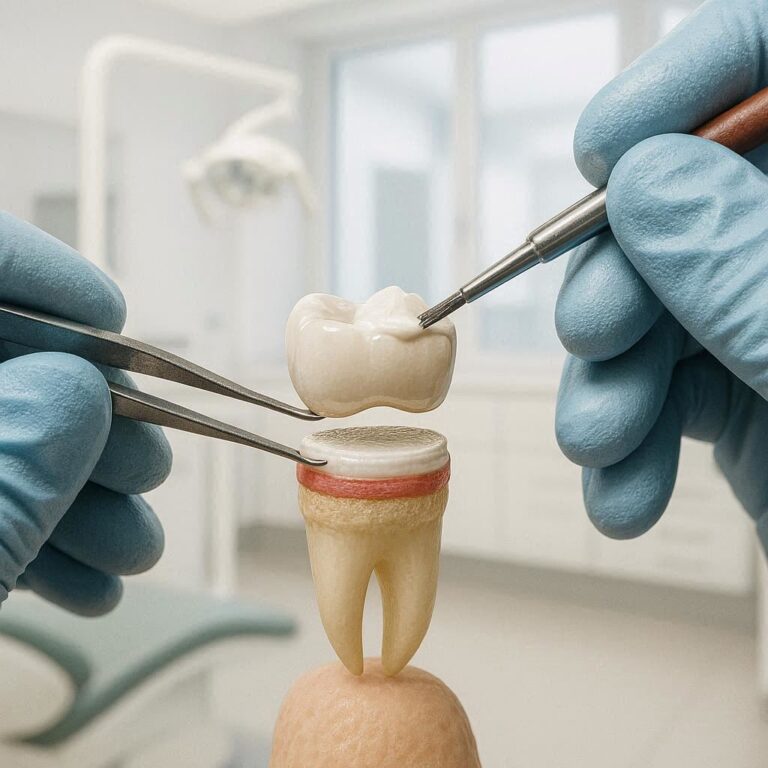
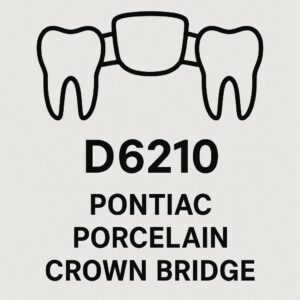
Pontic: An artificial tooth that replaces a missing natural tooth. It is part of a bridge.
-
Bridge: A dental restoration that replaces one or more missing teeth. It uses crowns on the teeth next to the gap (abutments) and a pontic in the middle.
A porcelain crown is a crown made from dental ceramic. It looks very natural. Many patients choose porcelain for front teeth because it matches the color of their other teeth.
Now, let us look at the specific codes you will see on a treatment plan for a porcelain crown bridge with a pontic.
The Primary ADA Code for a Pontic Porcelain Crown Bridge
There is no single ADA code for a “pontic porcelain crown bridge.” Instead, the dentist bills each part of the bridge separately. The most common code for the pontic itself is:
D6245 – Pontic, porcelain/ceramic, per pontic
This code covers a pontic made entirely of porcelain or ceramic material. It is the correct code for a single false tooth in a bridge when that tooth is made from high-quality dental ceramic.
When does a dentist use D6245?
A dentist uses D6245 when:
-
You have a missing tooth that needs replacement.
-
The abutment teeth (the teeth on each side) are getting crowns.
-
The pontic is made from porcelain or ceramic.
-
The pontic is part of a fixed bridge (not removable).
What is included in D6245?
The fee for D6245 usually includes:
-
Shaping the area where the pontic will sit.
-
Taking impressions for the lab.
-
Creating the porcelain pontic.
-
Adjusting the pontic for fit and bite.
-
Cementing the pontic as part of the full bridge.
The code does not include the crowns on the abutment teeth. Those are separate codes.
Related ADA Codes You Will See on the Same Treatment Plan
A bridge never comes alone. When you see D6245 on a claim form, you will almost always see other codes next to it. Here are the most common ones.
D2740 – Crown, porcelain/ceramic substrate
This is the code for a porcelain crown on a natural tooth. If your bridge uses two abutment teeth (one on each side of the gap), the dentist will bill D2740 for each of those teeth.
Example:
Missing tooth #19 (lower left first molar). Abutments are teeth #18 and #20.
The claim form would show:
-
D2740 – Tooth #18
-
D6245 – Pontic for tooth #19
-
D2740 – Tooth #20
D2750 – Crown, porcelain fused to high noble metal
Some dentists prefer a metal base under the porcelain. This makes the crown stronger. The code for that is D2750. It is less aesthetic than D2740 but very durable.
D2752 – Crown, porcelain fused to noble metal
Similar to D2750, but the metal is noble (like gold or platinum alloys). This is a common choice for back teeth.
D2799 – Provisional crown (temporary)
While you wait for the permanent bridge, the dentist places a temporary bridge. The code for that is D2799. It is billed separately.
Complete Table of ADA Codes for a Porcelain Bridge with Pontic
Here is a clear table showing the most relevant codes for a pontic porcelain crown bridge. Use this as a quick reference.
| ADA Code | Procedure Description | When It Is Used |
|---|---|---|
| D6245 | Pontic, porcelain/ceramic, per pontic | For each false tooth made of porcelain in a bridge |
| D2740 | Crown, porcelain/ceramic substrate | For each abutment tooth receiving a full porcelain crown |
| D2750 | Crown, porcelain fused to high noble metal | For abutment teeth when metal reinforcement is needed |
| D2752 | Crown, porcelain fused to noble metal | Alternative to D2750 with different metal type |
| D2799 | Provisional crown (temporary bridge) | While the permanent bridge is being made in a lab |
| D2950 | Core buildup, including any pins | When an abutment tooth has too little structure left |
| D2960 | Labial veneer (porcelain) | Rarely for bridges; usually for single teeth |
| D6930 | Recement or rebond fixed partial denture | If the bridge comes loose and needs reattachment |
| D6999 | Unspecified fixed partial denture procedure | Only used when no other code fits (rare) |
Important note for patients: Do not be surprised if you see multiple D6245 codes on one claim. If you are missing two teeth in a row, the bridge will have two pontics. The dentist bills D6245 for each pontic.
How a Pontic Porcelain Crown Bridge Treatment Is Built (Step by Step)
Understanding the steps helps you understand the codes. Here is how a typical bridge treatment works.
Step 1: Examination and treatment plan
The dentist examines your mouth. They take X-rays. They decide which teeth will be the abutments. They write down the planned codes. You receive a treatment plan with estimated costs.
Step 2: Abutment tooth preparation
The dentist numbs your mouth. They reduce the size of the abutment teeth so crowns can fit over them. This is part of the crown code (D2740, D2750, etc.). There is no separate code for tooth reduction.
Step 3: Impressions and temporary bridge
The dentist takes a mold of your mouth. They place a temporary bridge (D2799). You wear this for two to three weeks.
Step 4: Lab fabrication
A dental lab makes the permanent bridge. The lab creates the porcelain crowns for the abutments and the porcelain pontic(s). The lab bill is not on your insurance claim. Your dentist’s fee covers it.
Step 5: Try-in and cementation
You return to the dentist. They remove the temporary bridge. They try in the permanent bridge. They check the fit and your bite. Then they cement the bridge permanently. The cementation is included in the crown and pontic codes.
Billing Scenarios: Real Examples of ADA Codes for Pontic and Crown Work
Let us look at three real-world examples. These show how the codes appear on an actual dental claim form.
Scenario 1: Missing one front tooth (tooth #8)
Abutments: teeth #7 and #9
Material: Full porcelain (high aesthetic)
Claim lines:
-
D2740 – Tooth #7 (porcelain crown)
-
D6245 – Pontic tooth #8 (porcelain pontic)
-
D2740 – Tooth #9 (porcelain crown)
Scenario 2: Missing two back teeth (teeth #30 and #31)
Abutments: teeth #29 and #32 (if #32 exists; otherwise a cantilever bridge)
Material: Porcelain fused to noble metal (stronger for back teeth)
Claim lines:
-
D2752 – Tooth #29
-
D6245 – Pontic tooth #30
-
D6245 – Pontic tooth #31
-
D2752 – Tooth #32
Scenario 3: Existing bridge that needs repair
The bridge is still in place, but one side came loose.
Claim line:
-
D6930 – Recement fixed partial denture
Note: D6930 is much cheaper than a new bridge. Always ask your dentist if recementing is possible before replacing the whole bridge.
Common Mistakes Patients Make When Reading These Codes
It is easy to get confused. Here are the most common mistakes I see on dental claim forms.
Mistake 1: Thinking D6245 includes the crowns
No. D6245 is only for the artificial tooth (pontic). The crowns on the natural teeth are separate codes. If you see only D6245 and no crown codes, the claim is incomplete.
Mistake 2: Confusing D2740 and D6245
D2740 is for a crown on a natural tooth. D6245 is for a pontic (no natural tooth under it). They are not interchangeable.
Mistake 3: Expecting one code for the whole bridge
A bridge is a combination of multiple codes. You will always see at least three codes for a simple three-unit bridge (two crowns + one pontic).
Mistake 4: Ignoring the temporary bridge code
Many patients do not see D2799 on their treatment plan and think the dentist forgot. But some dentists include the temporary in the total fee without listing it separately. Always ask: “Is the temporary bridge included in the quoted fee?”
Why Material Matters for Pontic Codes
The ADA codes change depending on the material. Here is a quick guide.
| Material | Pontic Code | Crown Code | Best For |
|---|---|---|---|
| Full porcelain/ceramic | D6245 | D2740 | Front teeth, best aesthetics |
| Porcelain fused to high noble metal | D6248 (note: different code) | D2750 | Back teeth, high strength |
| Porcelain fused to noble metal | D6249 | D2752 | Back teeth, good strength |
| Porcelain fused to base metal | D6250 | D2751 | Budget option, less biocompatible |
| All metal (gold) | D6252 | D2790 | Back teeth, very durable |
Important note for readers: The ADA has specific pontic codes for different materials. D6245 is specifically for full porcelain/ceramic. If your pontic has metal inside, the code changes to D6248, D6249, or D6250. Always verify the material with your dentist before assuming the code is correct.
How to Check if Your Dental Claim Has the Right ADA Code
You do not need to be an expert. Just follow these five steps.
-
Look for separate crown codes for each abutment tooth. If you have two abutments, you should see two crown codes.
-
Find the pontic code (D6245 or similar) for each missing tooth.
-
Check that the tooth numbers match your mouth. If you are missing tooth #14 but the claim shows D6245 for tooth #13, there is an error.
-
See if a temporary code (D2799) is listed. If not, ask if it is included in another fee.
-
Compare the total fee to the dentist’s original estimate. If they match, the codes are probably correct.
What If the ADA Code Is Wrong? (Patient Rights)
Mistakes happen. A front desk person might enter the wrong number. A dentist might use an old code. If you see an error, here is what you can do.
-
Politely ask the dentist’s billing coordinator to review the codes. Say: “I noticed the code for my pontic is D6248, but my treatment plan says all-porcelain. Should it be D6245?”
-
Request a corrected claim. If the code was truly wrong, the dental office can submit a new claim to your insurance.
-
Do not pay until the codes are corrected. If you pay first, getting a refund is much harder.
Frequently Asked Questions (FAQ)
1. Is there a single ADA code for a full bridge with a pontic and crowns?
No. A bridge is always billed as separate codes for each crown and each pontic. There is no single “bridge code.”
2. What is the difference between D6245 and D6248?
D6245 is for a pontic made entirely of porcelain/ceramic. D6248 is for a pontic made of porcelain fused to a high noble metal core. One is metal-free; the other has metal inside.
3. Does insurance always cover D6245?
It depends on your plan. Many plans cover 50% of the cost for a pontic. Some cover only metal pontics. Call your insurance company before treatment to ask: “Do you cover D6245 for a missing front tooth?”
4. Can I use D6245 for a removable partial denture?
No. D6245 is only for fixed bridges (non-removable). Removable partial dentures have their own codes (like D5211).
5. My bridge has three pontics. Will the dentist bill D6245 three times?
Yes. Each pontic gets its own line with D6245 (or the appropriate material code). Three missing teeth = three pontic codes.
6. What is the code for a pontic repair?
There is no specific code for repairing a broken pontic. Usually, the dentist bills D6999 (unspecified procedure) or recommends a new bridge (new D6245).
7. Why does my claim show D2740 for a tooth that already has a crown?
If an abutment tooth already has a crown, the dentist may need to remove the old crown and make a new one. That is still billed as D2740. It is not a “discount” code for existing crowns.
8. How long does a D6245 pontic last?
With good oral hygiene, a porcelain pontic can last 10 to 15 years. Some last longer. The most common reason for failure is decay under the abutment crowns, not the pontic itself.
Additional Resource for Readers
For the most current ADA dental codes, visit the official American Dental Association CDT page:
🔗 https://www.ada.org/en/publications/cdt
You can also download a free summary of common codes from the ADA. Always use the official source. Do not rely on third-party websites that may have outdated information.
Conclusion
Understanding the ADA code for a pontic porcelain crown bridge is not about memorizing numbers. It is about knowing what to look for on your treatment plan. Remember these three key points:
-
A bridge is billed as multiple codes: crowns for the abutment teeth (like D2740) plus a pontic code for each missing tooth (like D6245).
-
Material matters: D6245 is for full porcelain pontics. If metal is inside, the code changes.
-
Always compare the codes on your claim to the treatment plan you agreed to. If something looks wrong, ask before you pay.
You are now equipped to read your dental claim form with confidence. No more confusion. No more surprise bills. Just clear, honest understanding between you and your dentist.