ADA Code for Pulpotomy: Coding, Billing, and Clinical Application
If you have ever found yourself staring at a dental claim form, wondering why a simple “baby tooth root canal” seems to have a complicated language all its own, you are not alone. Navigating the world of dental procedure codes can feel like learning a new dialect. Among the most common yet frequently misunderstood codes is the one for a pulpotomy.
For parents, understanding what is happening inside their child’s mouth is important. For dental professionals, accurate coding is the backbone of a healthy practice. Using the correct ADA code for pulpotomy ensures that claims are paid promptly, patients understand their treatment, and the clinical record remains accurate.
In this guide, we will explore everything you need to know about the pulpotomy procedure and its specific codes. We will look at why this code matters, how it differs from similar procedures, and what you need to do to ensure your documentation is bulletproof. Whether you are a dental student, a seasoned hygienist, a practice manager, or a curious parent, this article will serve as your go-to resource.
What Is a Pulpotomy? Understanding the Procedure
Before we dive into the numbers and billing nuances, it helps to have a clear picture of what a pulpotomy actually is. In simple terms, a pulpotomy is a dental procedure performed primarily on primary (baby) teeth. It is often called a “baby root canal,” but that description is not entirely accurate.
When a deep cavity reaches the pulp of a tooth—the soft tissue inside that contains nerves and blood vessels—it causes pain and infection. In a permanent tooth, a root canal (pulpectomy) removes the entire pulp. In a primary tooth, however, dentists often perform a pulpotomy. This involves removing only the infected portion of the pulp from the crown (the top part of the tooth), leaving the healthy pulp in the roots intact.
Why Perform a Pulpotomy?
The goal of a pulpotomy is simple: to save a baby tooth. While primary teeth are temporary, they serve crucial roles. They hold space for permanent teeth, aid in proper chewing and nutrition, and contribute to speech development. Premature loss of a primary tooth can lead to alignment issues that require orthodontic treatment later.
A pulpotomy allows the tooth to remain functional until it is ready to fall out naturally. The procedure typically involves:
-
Removing the decay
-
Excising the coronal pulp (the pulp in the top of the tooth)
-
Placing a medicated dressing to soothe the remaining nerve tissue
-
Sealing the tooth with a crown (usually a stainless steel crown)
The Clinical Flow: What Happens During the Appointment
Understanding the clinical steps helps clarify why specific codes are used. Here is a typical sequence:
-
Diagnosis: The dentist takes an X-ray to confirm that the decay has not spread to the furcation area (the area between the roots) and that the roots are still healthy.
-
Anesthesia: The area is numbed to ensure the child is comfortable.
-
Isolation: A rubber dam is placed to keep the tooth dry and free from saliva.
-
Removal of Decay: The dentist removes all decayed tooth structure.
-
Pulpotomy: The roof of the pulp chamber is opened, and the infected coronal pulp is removed.
-
Hemostasis: Bleeding is controlled. If bleeding is excessive and cannot be stopped, the tooth may not be a candidate for a pulpotomy.
-
Medication: A medicament like formocresol, ferric sulfate, or mineral trioxide aggregate (MTA) is placed to treat the remaining pulp.
-
Restoration: The tooth is restored, usually with a stainless steel crown to prevent fracture.
The Correct ADA Code for Pulpotomy
Now, let’s address the central question: what is the proper code to use?
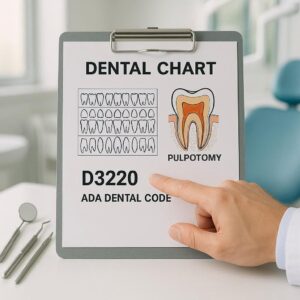
In the Current Dental Terminology (CDT) code set, maintained by the American Dental Association (ADA), the primary code for a pulpotomy is D3220.
D3220: Therapeutic Pulpotomy
The official descriptor for D3220 is: Therapeutic pulpotomy (excluding final restoration) – removal of pulp coronal to the apex of the root.
This code is used specifically for primary teeth. It covers the removal of the infected pulp tissue from the crown portion of the tooth. Importantly, this code does not include the final restoration (the crown or filling). The final restoration must be billed separately.
When to use D3220:
-
For a primary tooth where the infection is confined to the coronal pulp.
-
When hemostasis is achieved, and the radicular pulp (the pulp in the root) is healthy.
-
As a vital pulp therapy to maintain the tooth until exfoliation.
D3221: Pulpal Debridement
There is a second code that is often confused with the pulpotomy code: D3221.
The official descriptor for D3221 is: Pulpal debridement, primary and permanent teeth.
This code is an emergency code. It is used when the dentist opens the tooth to remove necrotic (dead) tissue or to relieve pain, but they do not complete the full pulpotomy or root canal procedure. It is often used as a palliative (pain-relieving) treatment until a definitive procedure can be scheduled.
Key difference:
-
D3220 is a definitive, therapeutic procedure meant to save the tooth.
-
D3221 is a temporary, emergency procedure to relieve pain.
If a dentist performs a pulpotomy in one appointment and places a permanent crown in another, D3220 is the correct choice. If they open the tooth to let an abscess drain and place a sedative dressing, D3221 is more appropriate.
Comparison Table: D3220 vs. D3221
| Feature | D3220 (Therapeutic Pulpotomy) | D3221 (Pulpal Debridement) |
|---|---|---|
| Tooth Type | Primarily primary teeth | Primary or permanent teeth |
| Purpose | Definitive treatment to save the tooth | Emergency palliative treatment |
| Procedure | Removal of coronal pulp, medicament placement | Removal of debris/necrotic tissue for drainage |
| Restoration | Billed separately (usually crown) | Often followed by a sedative filling |
| Outcome | Long-term retention of tooth | Temporary relief; requires follow-up |
Pulpotomy vs. Pulpectomy: A Critical Distinction
One of the most common mistakes in dental coding occurs when a pulpectomy is confused with a pulpotomy. While they sound similar, the codes and procedures are vastly different.
A pulpectomy (code D3222) involves the complete removal of the pulp from both the crown and the roots. This is the true “baby root canal.” After the pulp is removed, the canals are often filled with a resorbable material. This code is used when the infection has spread to the root pulp or when a pulpotomy has failed.
If you bill D3220 but your clinical notes describe removing pulp from the roots and filling the canals, the insurance company will likely deny the claim or request records. When the audit comes, the mismatch between the code and the narrative will flag the claim.
How to avoid the mix-up:
-
Remember that “potomy” means to make an incision or cut (removing the top).
-
“Ectomy” means to remove entirely.
-
Ensure your clinical notes specify whether the procedure was limited to the coronal pulp or extended into the radicular canals.
Billing and Reimbursement: What to Expect
From a practice management perspective, understanding the nuances of the ADA code for pulpotomy is essential for financial health. Here are the key factors that influence reimbursement.
Medical vs. Dental Insurance
While pulpotomies are almost always billed to dental insurance, there are rare cases where medical insurance may be involved. If the pulpotomy is performed due to trauma (e.g., a fall that fractured a tooth) and the patient has medical coverage for dental accidents, it may be billable to medical. However, this is the exception, not the rule. Most pediatric dental offices stick strictly to dental plans.
Pricing Factors
The cost of a pulpotomy (D3220) varies widely based on geographic location, the specialty of the provider (pediatric dentist vs. general dentist), and the type of restoration used.
Here is a general estimate of costs in the United States without insurance:
-
D3220 (Pulpotomy) alone: $100 – $250
-
Stainless Steel Crown (D2930): $200 – $400
-
Total Pulpotomy with Crown: $300 – $650
Note: These are estimates. In urban areas or specialist practices, the total may be higher. In rural clinics or community health centers, it may be lower.
Insurance Coverage
Most dental insurance plans cover pulpotomies on primary teeth. However, there are nuances to watch for:
-
Frequency Limitations: Some plans only allow one pulpotomy per tooth per lifetime. Since a baby tooth only gets one, this is usually fine, but it prevents re-treatment if the first one fails.
-
Crown Coverage: Even if the pulpotomy (D3220) is covered, some insurance plans downgrade the crown. They may only pay for a composite filling on a primary molar, even though a stainless steel crown is the standard of care.
-
Separate Surfaces: If you are billing a pulpotomy and a crown, ensure you are not also billing for a “buccal” or “lingual” buildup unless it is truly separate and documented.
Important Note for Patients: If your insurance denies the crown because they say a “filling” would suffice, talk to your dentist. A tooth that has undergone a pulpotomy is brittle and prone to fracture. A crown is rarely just a preference; it is often a medical necessity to prevent tooth failure.
Documentation: How to Support Your Code
In the world of coding, the clinical narrative is just as important as the code itself. A common reason for claim denial is insufficient documentation. When you use D3220, your chart notes should tell a story that matches the code.
Key Elements for a Solid Clinical Note
-
Diagnosis: Include the tooth number and the diagnosis (e.g., “Deep caries with reversible pulpitis, tooth #K”).
-
X-ray Evidence: Note that the radiograph shows no furcation involvement or internal resorption.
-
Anesthesia: Record the type and amount used.
-
Rubber Dam: Note that isolation was achieved with a rubber dam.
-
Hemostasis: This is critical. A pulpotomy requires that bleeding from the amputation site stops within a reasonable time (usually 5 minutes). If bleeding persists, it indicates that the radicular pulp is also infected, and a pulpectomy (D3222) is needed.
-
Medicament: Document the material used (e.g., “Ferric sulfate applied with cotton pellet pressure”).
-
Restoration: Even though the restoration is billed separately, note that the tooth was restored with a stainless steel crown.
A Sample Clinical Note
*”Tooth #S was isolated with rubber dam. Caries removed. Pulp chamber opened. Coronal pulp amputated with sterile bur. Hemostasis achieved with ferric sulfate. Radiopaque base placed. Tooth prepared and restored with pre-veneered stainless steel crown (D2932). Post-op X-ray taken to verify fit.”*
This note justifies D3220. If the note said, “Pulp extirpated, canals filled with Vitapex,” that would justify D3222 instead.
Common Coding Pitfalls and How to Avoid Them
Even experienced billers sometimes stumble. Here are the most frequent errors associated with the ADA code for pulpotomy and how to steer clear of them.
1. Bundling Issues
Some dentists mistakenly think the pulpotomy is “part of” the crown. It is not. D3220 is a separate service. However, be careful not to bill for pulp therapy that is included in another code. For example, if you are billing a root canal (D3330) on a permanent tooth, you cannot also bill a pulpotomy on the same tooth on the same day, as the root canal encompasses the pulp removal.
2. Age Limitations
While D3220 is designed for primary teeth, there is technically no age limit on the code. However, using it on a permanent tooth is rare. If you perform a pulpotomy on a permanent tooth (often as an emergency procedure to relieve pain before a full root canal), it is usually better to use D3221 (pulpal debridement) or D3330 (root canal) depending on the completion of the treatment.
3. Overlapping Codes with Same-Day Services
If a patient comes in for an emergency, and you perform a pulpal debridement (D3221) and then schedule them for a pulpotomy the next week, ensure the documentation clearly separates the two visits. Billing a pulpotomy on the same day as a debridement on the same tooth is a red flag for auditors.
4. Modifier Confusion
When a pulpotomy is performed on a tooth, and the crown is placed on a different date, modifiers become important. If the procedures cross calendar years or benefit periods, you may need to use a modifier like -58 (Staged or related procedure or service by the same physician during the postoperative period) to indicate the crown is part of the planned treatment.
Best Practices for Pediatric Dental Coding
Since pulpotomies are predominantly performed on children, coding for pediatric patients requires an extra layer of care. The dynamic is different from adult dentistry. Parents are often anxious, and insurance plans for children (like Medicaid or CHIP) have specific rules.
Medicaid and CHIP Considerations
For practices that accept state insurance, coding accuracy is non-negotiable. Medicaid programs often have strict frequency limitations and require specific documentation to be kept on file.
-
Prior Authorization: Some state Medicaid programs require prior authorization for stainless steel crowns following pulpotomies.
-
X-rays: Always attach the pre-operative and post-operative X-rays to the claim if required.
-
Sedation: If the child required sedation (e.g., nitrous oxide D9230 or conscious sedation D9248) to complete the pulpotomy due to anxiety or behavior, that is a separate billable service. However, ensure the sedation is medically necessary and documented as such.
Communicating with Parents
From a practice management perspective, coding is not just about insurance. It is about patient (parent) relations. Surprise bills are the leading cause of negative online reviews. Before performing a pulpotomy, it is wise to provide a treatment plan that clearly shows:
-
D3220 – Pulpotomy: $X
-
D2930 – Stainless Steel Crown: $Y
-
D9230 – Nitrous Oxide (if used): $Z
Explain to the parent that the pulpotomy saves the tooth, but the crown protects it. Transparency builds trust.
The Role of New Materials and Techniques
Dentistry is constantly evolving, and while the ADA code D3220 remains the same, the materials used under that code have changed significantly. This does not affect the code selection, but it affects the clinical outcome and narrative.
Formocresol vs. Ferric Sulfate vs. MTA
-
Formocresol: The historical gold standard. It is effective but contains formaldehyde, which has led to concerns in recent years. Some practices have moved away from it.
-
Ferric Sulfate: A popular alternative that controls bleeding and promotes healing without the chemical concerns of formocresol. It is hemostatic (stops bleeding) and acts as a less toxic fixative.
-
MTA (Mineral Trioxide Aggregate): This is a newer, biocompatible material that promotes hard tissue formation. It is often considered the “best” option from a biological standpoint but is more expensive and technique-sensitive.
Why this matters for coding: The code does not change based on the material. Whether you use ferric sulfate or MTA, it is still D3220. However, if you are using MTA, you may need to document that the material was used as a pulp dressing, which may require a different setting time or technique.
Frequently Asked Questions (FAQ)
1. Is a pulpotomy the same as a root canal?
No. A pulpotomy removes only the pulp in the crown of the tooth. A root canal (pulpectomy) removes the pulp from both the crown and the roots.
2. Can a permanent tooth have a pulpotomy?
Yes, but it is usually a temporary measure. On a permanent tooth, a pulpotomy is often an emergency procedure to relieve pain until a full root canal (D3330) can be performed. In this case, code D3221 (pulpal debridement) may be more appropriate if the treatment is not completed.
3. Why does my dentist charge for a crown separately?
The ADA code D3220 specifically excludes the final restoration. The pulpotomy addresses the infection in the nerve. The crown is necessary to protect the weakened tooth structure and prevent it from breaking. Because they are separate procedures, they are billed separately.
4. What happens if the pulpotomy fails?
Sometimes, a pulpotomy may fail due to persistent infection or internal resorption. If this happens, the dentist may need to perform a pulpectomy (D3222) or extract the tooth. This is why follow-up X-rays are essential.
5. Does insurance always cover pulpotomies?
Most dental insurance plans cover pulpotomies on primary teeth as a basic service. However, coverage varies. Some plans may have waiting periods, or they may only cover the procedure at 50% after a deductible.
Conclusion
Navigating the world of dental codes does not have to be overwhelming. The ADA code for pulpotomy—D3220—is a specific tool designed to accurately represent a specific procedure: the removal of coronal pulp in a primary tooth to maintain its natural function until exfoliation.
Understanding the distinction between D3220 and D3221 (pulpal debridement) or D3222 (pulpectomy) is crucial for accurate billing and legal compliance. For dental professionals, meticulous documentation, clear communication with insurance companies, and transparent patient discussions are the keys to a successful practice. For patients, knowing the difference helps you advocate for the best care for your child and understand your financial responsibility.
Whether you are sitting in the dentist’s chair or reviewing a claim in the back office, clarity on this code ensures that everyone is on the same page: saving smiles, one tooth at a time.
Additional Resources
For more detailed information on current dental terminology and coding guidelines, the American Dental Association (ADA) maintains the most up-to-date CDT code set.
Visit the ADA Center for Professional Success