ADA Code for Scaling and Root Planing
- On
- InDENTAL CODE
If your dentist has recently told you that you need a “deep cleaning,” you might have left the appointment feeling a little confused. You brush twice a day, you floss (most of the time), so why is a regular cleaning not enough?
The answer usually lies in the health of your gums. When a standard prophylaxis (a routine cleaning) isn’t sufficient, dentists turn to a more intensive procedure known as Scaling and Root Planing (SRP). In the world of dental billing and insurance, this procedure is identified by a specific set of codes maintained by the American Dental Association (ADA).
Understanding these codes isn’t just about satisfying curiosity. It is about being an informed patient. It helps you understand your treatment plan, verify your insurance benefits, and ensure you are receiving the appropriate care for your specific condition.
In this guide, we will break down everything you need to know about the ADA codes for scaling and root planing. We’ll look at what the procedure entails, why the codes matter, how they differ from routine cleanings, and what you can expect in terms of cost and insurance coverage. Let’s demystify the process together.
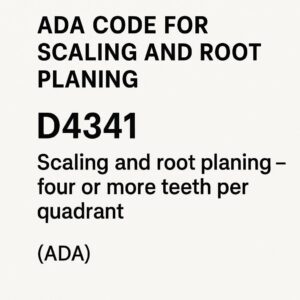
Table of Contents
ToggleWhat Exactly Are Scaling and Root Planing?
Before we dive into the codes themselves, it is important to understand the procedure they represent. Scaling and root planing is often referred to as a “deep cleaning,” but this term doesn’t quite capture the complexity of the treatment.
The Difference Between a Regular Cleaning and a Deep Cleaning
A routine cleaning, known as a prophylaxis (D1110), focuses on the surfaces of your teeth above the gum line. The hygienist removes plaque and tartar from the crowns of your teeth—the parts you can see when you smile.
Scaling and root planing, however, is a therapeutic procedure. It is designed to treat active gum disease, also known as periodontal disease. This procedure goes beneath the gum line to clean the root surfaces of your teeth.
-
Scaling: This is the process of removing plaque, calculus (tartar), and bacterial toxins from the surfaces of the tooth and the root. The hygienist uses specialized hand instruments or ultrasonic devices to access deep pockets between the tooth and gum.
-
Root Planing: This step involves smoothing the root surfaces. By smoothing the roots, we make it harder for bacteria to adhere to them in the future. It also helps the gum tissue heal and reattach to the tooth structure, reducing the depth of the periodontal pockets.
Why Is It Necessary?
When gum disease progresses, the bone and tissue supporting your teeth begin to break down. This creates “pockets”—spaces between the tooth and gum that are deeper than the healthy range of 1 to 3 millimeters. If these pockets are left untreated, the infection can lead to bone loss, gum recession, and eventually tooth loss.
Scaling and root planing is the first line of defense. It is a non-surgical procedure that aims to halt the progression of the disease and restore gum health.
The ADA Code System: A Brief Overview
The American Dental Association (ADA) maintains the Current Dental Terminology (CDT) code set. This is a standardized set of codes that dentists use to communicate with insurance companies and document patient records.
These codes are updated annually to reflect changes in dental technology and procedures. For patients, these codes are the key to understanding exactly what your dentist is billing for. When you look at a treatment plan or an insurance claim, you won’t see “deep cleaning.” Instead, you will see a combination of letters and numbers, like D4341 or D4342.
Using the correct code is crucial. It ensures that your insurance company correctly identifies the service provided and applies the appropriate benefits. If the wrong code is used, your claim could be denied, or you could be billed incorrectly.
The Primary ADA Codes for Scaling and Root Planing
When it comes to scaling and root planing, there are two main codes that you will encounter: D4341 and D4342. While they describe similar procedures, they are used in different clinical scenarios. Understanding the difference between these two is the most important part of navigating your periodontal treatment plan.
D4341: Periodontal Scaling and Root Planing – Four or More Teeth per Quadrant
This is the most commonly used code for treating moderate to advanced periodontal disease. The key factor here is the extent of the disease.
When a dentist uses D4341, it means that in a specific quadrant of your mouth (the mouth is divided into four quadrants: upper right, upper left, lower right, lower left), there are four or more teeth requiring deep cleaning.
When is D4341 used?
-
The patient has periodontal pockets measuring 5 millimeters or deeper.
-
There is significant radiographic evidence of bone loss.
-
There is heavy calculus (tartar) buildup below the gum line.
-
The quadrant is generalized, meaning most teeth in that section are affected.
Because this code represents a more extensive disease state, it typically commands a higher fee than D4342, reflecting the increased time, complexity, and skill required to treat the area.
D4342: Periodontal Scaling and Root Planing – One to Three Teeth per Quadrant
This code is used when the periodontal disease is localized rather than generalized. It indicates that in a specific quadrant, only one, two, or three teeth require the deep cleaning procedure.
When is D4342 used?
-
The patient has isolated areas of gum disease.
-
Only a few teeth in a quadrant show pocket depths of 5 millimeters or more.
-
The rest of the teeth in that quadrant are healthy or only require a routine cleaning.
It is important to note that D4342 is not simply a “cheaper” version of D4341. It is a distinct clinical code for a distinct clinical condition. A dentist cannot ethically choose D4342 for a patient who clearly needs D4341 just to make the procedure more affordable or to circumvent insurance restrictions.
Comparative Table: D4341 vs. D4342
To help visualize the differences, here is a side-by-side comparison of these two primary codes.
| Feature | D4341 (Four or More Teeth) | D4342 (One to Three Teeth) |
|---|---|---|
| Extent of Disease | Generalized periodontitis in a quadrant | Localized periodontitis in a quadrant |
| Teeth Affected | 4 or more teeth require SRP | 1 to 3 teeth require SRP |
| Typical Pocket Depth | Usually 5mm+ in affected areas | Usually 5mm+ in isolated areas |
| Clinical Complexity | High; often involves significant subgingival calculus | Moderate; confined to specific tooth surfaces |
| Common Usage | Standard for moderate to advanced gum disease | Used for early stage or localized flare-ups |
Note: Some insurance companies have specific guidelines regarding when they will cover D4341 versus D4342. Some may require radiographs (X-rays) and a periodontal charting (pocket depth measurements) to be submitted with the claim to justify the code used.
Other Related Codes You Might See
While D4341 and D4342 are the main codes for scaling and root planing, there are a few other codes that may appear on your treatment plan, either as alternatives or as adjuncts to your SRP. It is helpful to know what these are so you can ask your dentist the right questions.
D4355: Full Mouth Debridement
This code is often a source of confusion for patients. Full mouth debridement (FMD) is not a deep cleaning. Instead, it is a preliminary procedure.
Imagine a patient comes to the dentist after not having a cleaning for several years. They have so much plaque and calculus covering the teeth that the dentist cannot perform a proper oral evaluation. The buildup is so extensive that it is impossible to probe the gums or see the tooth structure clearly.
In this case, the dentist may perform a full mouth debridement. This is a gross removal of plaque and calculus to allow for a comprehensive examination. Once the FMD is done and the dentist can see the true state of the gums and teeth, they can then determine if the patient needs a regular cleaning (D1110) or scaling and root planing (D4341/D4342).
D4910: Periodontal Maintenance
This is a crucial code to understand because it represents the follow-up care after scaling and root planing.
Periodontal disease is a chronic condition, much like diabetes or high blood pressure. Even after successful SRP, it requires ongoing management to prevent recurrence. D4910 is the code for a periodontal maintenance visit.
This is not a regular cleaning (D1110). Periodontal maintenance involves:
-
Removal of new plaque and calculus from above and below the gum line.
-
Re-evaluation of periodontal pockets.
-
Assessment of gum tissue health.
-
Reinforcement of home care instructions.
Patients who have had SRP will typically require periodontal maintenance every three to four months, rather than the traditional six-month recall for a routine cleaning.
D4999: Unspecified Periodontal Procedure
Occasionally, you might see this code on a treatment plan. It is a miscellaneous code used for procedures that do not have a specific code. It should be accompanied by a narrative description explaining what was done. For SRP, this is rarely used unless there is a unique circumstance not covered by D4341 or D4342.
How Are These Codes Billed?
The billing of SRP codes is based on quadrants. Your mouth is divided into four sections:
-
Quadrant 1: Upper Right
-
Quadrant 2: Upper Left
-
Quadrant 3: Lower Left
-
Quadrant 4: Lower Right
If you have generalized periodontitis (D4341), your dentist may recommend treating all four quadrants. However, these are rarely done in a single appointment. Because SRP involves significant work below the gum line and requires local anesthesia, it is typically staged over multiple visits.
Common Billing Scenarios
-
Scenario A: Generalized Disease
-
Treatment Plan: D4341 (Quad 1), D4341 (Quad 2), D4341 (Quad 3), D4341 (Quad 4)
-
Typical Approach: The dentist might numb one side of the mouth (Quad 1 and 2) during the first visit, and the other side (Quad 3 and 4) during a second visit about a week or two later.
-
-
Scenario B: Localized Disease
-
Treatment Plan: D4342 (Quad 1), D4342 (Quad 2)
-
Typical Approach: This is common if only the upper molars, for instance, show signs of disease. The lower quadrants may only need a routine cleaning (D1110) if they are healthy.
-
-
Scenario C: Combination
-
Treatment Plan: D4341 (Quad 1), D4341 (Quad 2), D1110 (Quad 3), D1110 (Quad 4)
-
Typical Approach: This can happen if the disease is severe in the upper jaw but the lower jaw is unaffected.
-
Important: A responsible dentist will always provide you with a detailed treatment plan that includes the specific ADA codes for each quadrant, the estimated fee, and what your insurance is expected to pay. Do not hesitate to ask for a written copy of this plan.
Insurance Coverage and Reimbursement
One of the biggest concerns for patients is whether their insurance will cover scaling and root planing. While coverage varies by plan, there are general principles that apply to most PPO and traditional insurance plans.
Frequency Limitations
Unlike routine cleanings, which are often covered twice a year, SRP is typically covered only once every two to three years per quadrant. Insurance companies view SRP as a significant therapeutic intervention, not a preventive service. If a patient needs SRP again in the same quadrant within a short timeframe, the insurance company may deny the claim, arguing that the initial procedure was not successful or that the patient requires a different level of care, such as periodontal surgery.
Medical vs. Dental Insurance
This is a complex area. Periodontal disease has known links to systemic health conditions like diabetes, heart disease, and pregnancy complications. In some cases, if the periodontal disease is severe enough, part of the treatment may be billable to medical insurance.
While it is not common, some dentists will attempt to file SRP under medical insurance if there is a clear underlying medical condition (e.g., a patient with uncontrolled diabetes requiring SRP to manage infection). However, dental insurance remains the primary payer for these codes.
Pre-Determination of Benefits
Before starting treatment, it is wise to ask your dental office to send a “pre-determination” or “pre-authorization” to your insurance company.
This is not a guarantee of payment, but it provides an estimate of what the insurance company is likely to cover. It will show:
-
The amount they will pay.
-
The amount that will be applied to your deductible.
-
The amount you will be responsible for (co-pay or co-insurance).
This process can prevent unexpected bills and allows you to plan your finances accordingly.
Cost Considerations
If you are paying out-of-pocket (without insurance) or are concerned about the portion insurance does not cover, it is helpful to have a realistic expectation of the cost.
The cost of SRP varies significantly based on geographic location, the specific dental practice, and the complexity of the case. However, to give you a general idea, here is a typical range.
| Procedure | Typical Cost Range (Per Quadrant) |
|---|---|
| D4341 (4+ Teeth) | $200 – $400 |
| D4342 (1-3 Teeth) | $150 – $250 |
| D4355 (Full Mouth Debridement) | $75 – $200 (one-time fee) |
| D4910 (Periodontal Maintenance) | $75 – $150 (per visit) |
If you need all four quadrants treated with D4341, the total cost for the initial therapy can range from $800 to $1,600 or more before insurance. Many dental offices offer payment plans or financing options to make this necessary care more accessible.
The Clinical Process: What to Expect
Knowing the codes is one thing, but understanding what happens during the actual procedure can alleviate a lot of anxiety. While every dentist has their own style, the process for SRP generally follows a similar path.
Step 1: Diagnosis
Your journey begins with a comprehensive periodontal evaluation. This includes:
-
Probing: The dentist or hygienist uses a small, ruler-like instrument called a periodontal probe to measure the depth of the pockets around each tooth. Measurements of 4mm or less are generally healthy. 5mm and above usually indicate disease.
-
Radiographs: X-rays are essential to assess the level of bone supporting your teeth. Bone loss is a classic sign of periodontitis.
-
Visual Examination: The clinician looks for signs of inflammation, bleeding, and recession.
Based on this data, the dentist determines whether you need D4341, D4342, or another level of care.
Step 2: Anesthesia
Because SRP involves cleaning below the gum line, it can be uncomfortable without anesthesia. Most dentists will administer a local anesthetic to numb the specific quadrant being treated. This ensures you are comfortable throughout the procedure.
Step 3: The Procedure (Scaling and Root Planing)
The hygienist or dentist will use a combination of tools.
-
Ultrasonic Scalers: These devices use high-frequency vibrations and a water spray to break up large deposits of calculus and flush bacteria from the pockets.
-
Hand Scalers and Curettes: These specialized instruments are used for fine scaling and the crucial step of root planing. The clinician will feel for rough spots on the root surface and smooth them out.
The time required per quadrant can vary. A simple quadrant (D4342) might take 30 to 45 minutes. A complex quadrant (D4341) with deep pockets and heavy calculus can take an hour or more.
Step 4: Post-Operative Care
After the procedure, your gums may be sore, and your teeth may feel sensitive to hot and cold. This is normal and usually subsides within a few days to a week. Your dentist will provide specific post-operative instructions, which may include:
-
Rinsing with warm salt water.
-
Using an over-the-counter pain reliever.
-
Avoiding very hot or cold foods for a few days.
Step 5: Re-Evaluation
Four to six weeks after the SRP is completed, you will return for a re-evaluation appointment. This is a critical step. The dentist will re-measure your periodontal pockets to see if the tissue has healed and the pocket depths have reduced.
If the pockets have improved (e.g., from 6mm to 3-4mm), the treatment was successful. You will then begin your periodontal maintenance schedule (D4910) to keep the disease stable.
If there are pockets that have not healed, the dentist may discuss further treatment options, such as localized antibiotic therapy (Arestin) or referral to a periodontist (a gum specialist) for surgical intervention.
Frequently Asked Questions (FAQ)
Q: Is scaling and root planing painful?
A: With the use of local anesthesia, the procedure itself should not be painful. You may feel pressure or vibration, but you should not feel sharp pain. After the anesthesia wears off, some tenderness and sensitivity are common, similar to what you might feel after a strenuous workout.
Q: Why can’t I just get a regular cleaning instead?
A: A regular cleaning (D1110) only cleans above the gum line. If you have active gum disease with pockets deeper than 4mm, a regular cleaning cannot remove the bacteria and calculus that have accumulated below the gum line. Trying to treat gum disease with a regular cleaning is like trying to clean the inside of a house by only hosing down the roof. The infection will remain and continue to destroy bone.
Q: Does my insurance automatically cover D4341 and D4342?
A: Most dental insurance plans cover a percentage of scaling and root planing (often 80% after the deductible), but coverage is rarely 100%. It is considered a basic or major service, not a preventive service. Always check your specific plan details.
Q: Can I have scaling and root planing if I am pregnant?
A: Pregnancy can increase the risk of gum disease due to hormonal changes. Non-surgical periodontal therapy like SRP is generally considered safe during pregnancy, especially if it helps manage a chronic infection. However, always inform your dentist if you are pregnant. They may consult with your OB-GYN and may schedule the treatment during the second trimester to avoid the first and third trimesters.
Q: How long do the results last?
A: Periodontal disease is chronic, meaning it can be managed but not cured. The results of SRP are long-lasting if you follow up with regular periodontal maintenance visits (D4910) every 3-4 months and maintain excellent home care (brushing, flossing, using recommended aids like water flossers or interdental brushes).
Conclusion
Scaling and root planing is a highly effective, non-surgical treatment for gum disease, and understanding the ADA codes associated with it empowers you to take control of your dental health. The primary codes—D4341 for generalized disease (four or more teeth per quadrant) and D4342 for localized disease (one to three teeth per quadrant) —are more than just billing numbers; they are clinical classifications that dictate the extent of care you need.
Navigating insurance and understanding the difference between these codes and a routine cleaning ensures you receive the correct treatment to halt the progression of periodontal disease. By combining professional therapy with diligent at-home care and regular periodontal maintenance, you can protect your smile, your bone structure, and your overall health for years to come.
Additional Resources
For more information on maintaining your oral health and understanding periodontal disease, the American Academy of Periodontology is an excellent resource. They offer patient-focused information on the latest research and treatment options.

dentalecostsmile
Newsletter Updates
Enter your email address below and subscribe to our newsletter