ADA Code for Vertical Sinus Lift
- On
- InDENTAL CODE
Navigating the world of dental insurance and procedural coding can sometimes feel like learning a new language. If you are a dental professional, you know that accuracy in coding is not just about getting paid—it’s about documenting the quality of care you provide. One of the procedures that often causes confusion in the front office and the operatory is the sinus lift, specifically when it involves vertical augmentation.
When we talk about the “ada code for vertical sinus lift,” we are stepping into a nuanced area of the Current Dental Terminology (CDT) code set. It isn’t as simple as picking a single code from a list. It requires understanding the anatomy of the procedure, the materials used, and the specific surgical approach.
In this guide, we will break down everything you need to know. Whether you are a seasoned oral surgeon, a general practitioner expanding into implants, or a dental biller trying to sort out a denied claim, this article is for you. We will explore the relevant codes, discuss the documentation needed to support them, and look at common pitfalls to avoid.
Let’s get started.
Table of Contents
ToggleUnderstanding the Basics: What is a Vertical Sinus Lift?
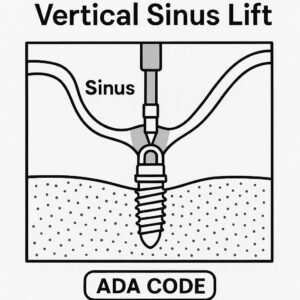
Before we dive into the codes, it is helpful to have a clear picture of what a vertical sinus lift actually entails. The maxillary sinuses are air-filled cavities located above the upper premolar and molar teeth. When these teeth are lost, the bone in that area often resorbs (shrinks), and the sinus cavity expands downward.
If a patient wants a dental implant in that area, there often isn’t enough bone height to secure the implant safely. A sinus lift—also known as sinus augmentation—adds bone to the floor of the sinus.
There are generally two types of sinus lift procedures:
-
Lateral Window Approach (Direct Sinus Lift): This is the traditional method. The surgeon creates a small opening (window) in the lateral wall of the sinus, lifts the Schneiderian membrane (the lining of the sinus), and packs bone graft material into the space. This is typically used for significant vertical deficiencies (usually 4mm or more of bone height).
-
Osteotome Technique (Indirect Sinus Lift): This is a less invasive approach. The surgeon drills through the alveolar ridge (the existing bone) and uses osteotomes to “tap” or fracture the bone floor of the sinus upward, lifting the membrane. Graft material is then placed through the osteotomy site.
When we specifically mention vertical sinus lift, we are usually referring to the need to increase vertical bone height. This is often addressed with the lateral window technique, although the osteotome technique can also provide vertical gain in minor deficiency cases.
The ADA CDT Code Set: Finding the Right Fit
The American Dental Association (ADA) publishes the CDT code set, which is updated annually. There is no single code titled “vertical sinus lift.” Instead, the procedure is categorized under surgical services for implant placement and bone grafting.
The primary code used for a lateral window vertical sinus lift is D7953.
Let’s look at the official descriptor for this code:
-
D7953: Bone replacement graft for ridge preservation – per site.
Wait—that descriptor says “ridge preservation,” not sinus lift. This is where the nuance lies.
In practice, D7953 is the accepted code for a sinus lift when performed via the lateral window approach using a bone graft. However, it is crucial to understand that this code is a “catch-all” for bone grafting that is not for a socket graft at the time of extraction (which is D7950) or a major ridge augmentation (which is D7951 or D7955 depending on complexity).
The Confusion Between D7953 and Other Codes
To code a vertical sinus lift correctly, you have to understand what D7953 is not. Here is a comparison table to clarify the differences.
| CDT Code | Descriptor | Typical Application | Relevance to Sinus Lift |
|---|---|---|---|
| D7950 | Bone replacement graft – per site, socket graft | Graft placed immediately after tooth extraction to preserve the socket. | Not for sinus lifts. |
| D7951 | Bone replacement graft – ridge augmentation, per site | Augmentation of the width or height of the alveolar ridge, often using a block graft or membrane. | Can be used for severe horizontal or vertical ridge defects, but not typically for the sinus floor elevation itself. |
| D7953 | Bone replacement graft – ridge preservation, per site | Preservation of the ridge structure, often in anticipation of implant placement. This is the code used for lateral window sinus lifts. | This is the primary code for vertical sinus lifts. |
| D7955 | Bone replacement graft – major ridge augmentation, per site | Complex augmentation requiring significant tissue manipulation, often involving autogenous bone. | Used for extensive cases, but D7953 is generally preferred for sinus lifts unless the case is extraordinarily complex. |
| D6110 / D6111 | Implant supported prosthesis – maxillary sinus augmentation | These are prosthetic codes, not surgical. They are used to bill for the restoration of implants that involved sinus augmentation. | Used to indicate to the insurance carrier that the implants placed required a sinus lift to achieve adequate bone height. |
Why D7953 is the Standard for Vertical Sinus Lifts
If you are performing a lateral window sinus lift (the classic “vertical” augmentation), D7953 is your code. The descriptor “ridge preservation” is somewhat misleading because the procedure does not just preserve existing bone; it creates new bone volume. However, the ADA has historically classified sinus lifts under this code because the intent is to preserve the ridge for future implant placement.
In 2023, the ADA attempted to clarify this by adding a new code, D7958 (which has since been revised in subsequent editions). However, as of the current CDT version, the most consistent and widely accepted code for a traditional lateral window sinus lift remains D7953.
Note: Always verify the specific requirements of the insurance carrier. Some medical plans (if billing medically) may require different coding, but within dental CDT codes, D7953 is the standard.
The Role of the Osteotome Technique (Indirect Sinus Lift)
If you are performing an osteotome (indirect) sinus lift, the coding strategy changes. Since you are not creating a lateral window, you are not performing a “ridge preservation” in the same sense.
For an osteotome sinus lift, the code is usually:
-
D7960: Sinus augmentation (sinus lift) by osteotome technique, per site.
This code was specifically added to address the indirect method. It is a distinct procedure from D7953.
When to Use D7960 vs. D7953
-
D7953: Use for the lateral window approach. This involves a flap, a window cut into the lateral sinus wall, elevation of the Schneiderian membrane, and placement of graft material. This is the vertical sinus lift we are focusing on in this article.
-
D7960: Use for the crestal approach. The surgeon drills through the ridge, uses osteotomes to push the sinus floor upward, and places graft material through the same hole. This is ideal for situations where you need 2-4mm of vertical height gain.
Documentation: The Key to Successful Reimbursement
You can use the correct code, but if your documentation does not tell the story of why the procedure was necessary, your claim may be denied or downcoded. Insurance carriers require proof of medical necessity.
When submitting a claim for a vertical sinus lift (D7953), your documentation should include:
1. Pre-Operative Radiographic Evidence
You must show that there is insufficient bone height for implant placement. This is best demonstrated with:
-
CBCT (Cone Beam CT) Scan: This is the gold standard. It allows you to measure the exact vertical bone height remaining. Most implant companies and insurance reviewers expect to see measurements (e.g., “4mm of bone height remaining under the sinus”).
-
Panoramic X-ray: While less precise, a panoramic can serve as a baseline. However, a CBCT is significantly stronger evidence.
2. A Detailed Narrative
Your claim should include a narrative report. This is not just a box-ticking exercise. Write a short paragraph explaining the situation.
-
Example: “Patient presents with edentulous area #3. CBCT evaluation reveals severe pneumatization of the maxillary sinus with only 3mm of vertical bone height remaining. To facilitate implant placement, a lateral window sinus lift is necessary. Graft material (xenograft) was placed to augment the sinus floor.”
3. Operative Notes
Your operative notes should clearly describe the surgical steps.
-
Flap design: Full-thickness flap reflected.
-
Window creation: “A lateral window was created using a surgical round bur.”
-
Membrane elevation: “The Schneiderian membrane was carefully elevated without perforation.”
-
Graft material: Specify what was used (e.g., “0.5cc of mineralized allograft mixed with 0.5cc of xenograft”).
-
Closure: “Flap was repositioned and sutured with 4-0 PTFE sutures.”
4. Medical Necessity Language
Insurance adjusters look for keywords. Using language like “insufficient bone height,” “pre-implant surgery,” and “unable to place implant without augmentation” helps justify the service.
Common Challenges and How to Overcome Them
Even with perfect coding, sinus lifts often face scrutiny from insurance companies. Here are the most common challenges and practical solutions.
Challenge 1: “Bundling” or Downcoding
Some insurance companies consider the sinus lift as “inclusive” to the implant placement. They may deny the graft code (D7953) as a separate procedure, stating it is part of the surgical implant code (D6010).
Solution: Check the patient’s plan. Many PPO plans do cover sinus lifts as a separate benefit, but some do not. If the plan denies it, you may need to appeal with the radiographic evidence showing that the procedure was not “routine” but necessary due to anatomical limitations. Include a letter stating that the implant code (D6010) covers placement into existing bone, and since no bone existed, a separate graft procedure was required.
Challenge 2: Perforation of the Membrane
If the Schneiderian membrane perforates during the procedure, does that change the code? Not usually. The code (D7953) still applies because the intent was to perform the augmentation. However, if the perforation is large and the graft cannot be placed, you may need to abort the procedure. In that case, you might bill for the flap reflection (D4249 or similar), but this is rare.
Challenge 3: Medical vs. Dental Coverage
Sometimes, sinus lifts can be billed to medical insurance if the patient has no dental benefits or if the procedure is deemed medically necessary for sinus health or reconstruction after trauma. This is a complex area. If you choose this route, you will need to use medical codes (CPT codes) such as CPT 21299 (Unlisted craniofacial procedure) or specific codes for sinus surgery, though these require extensive documentation and rarely pay out as well as dental plans.
A Step-by-Step Guide to Submitting a Claim for D7953
To streamline your workflow, here is a checklist for your front office or billing team.
-
Verify Benefits: Call the insurance carrier. Ask specifically:
-
“Does the patient have coverage for surgical implant services?”
-
“Is D7953 (bone graft for ridge preservation) a covered benefit?”
-
“What is the frequency limitation? (e.g., once per site per lifetime)”
-
-
Attach Documentation:
-
Claim form (ADA 2012 or J400) with D7953 listed.
-
Attach a copy of the CBCT scan or panoramic X-ray (digital copies are often accepted via secure portals).
-
Attach a narrative report.
-
Attach operative notes.
-
-
Submit Electronically: Most claims are submitted electronically. Ensure your software allows you to attach supporting documents (EOB attachments) for pre-authorization.
-
Follow Up: If the claim is pending for more than 30 days, call the carrier. Ask for the status. If denied, request a written explanation and file an appeal immediately, usually within 30 days of the denial.
Best Practices for Surgical Success and Coding Compliance
Your clinical success directly impacts your ability to code accurately. If you perform the procedure correctly, documenting it becomes easy.
-
Use a Stent: If possible, use a surgical stent to verify the vertical height gain post-operatively. This provides additional documentation for the graft.
-
Photographic Documentation: Intraoperative photos of the window, the graft material in situ, and the final closure can be invaluable if an appeal is necessary.
-
Separate the Codes: Never “bundle” the sinus lift into the implant code. Bill them separately. Even if the plan denies the graft, the patient may be responsible for it, or you may win on appeal.
The Future of Sinus Lift Coding
The ADA reviews the CDT code set annually. There has been a push for a dedicated, unambiguous code for “maxillary sinus floor elevation via lateral window.” While D7953 remains the standard, we may see a more specific code in the next few years. As a professional, staying updated with the ADA’s annual CDT manual is essential.
For now, the consensus among coding experts and dental consultants is clear:
-
For lateral window sinus lifts (vertical augmentation): D7953.
-
For osteotome sinus lifts (crestal approach): D7960.
Additional Resources for Dental Teams
To further assist your practice in mastering implant coding and reimbursement, consider these resources:
-
The ADA CDT Manual: Purchase the official manual each year. It is the definitive source.
-
Local Dental Society Coding Seminars: Many local societies offer workshops on CDT coding.
-
Dental Coding Courses: Organizations like the American Association of Dental Office Management (AADOM) offer certification in dental coding.
Conclusion
Mastering the ADA code for vertical sinus lift procedures is about more than just memorizing a number. It is about understanding the clinical story behind the code. For lateral window sinus lifts aimed at vertical augmentation, D7953 serves as the primary code, supported by rigorous documentation including CBCT imaging and detailed operative notes.
By accurately using D7953 or D7960 where appropriate, and pairing them with clear evidence of medical necessity, you can significantly reduce claim denials and ensure that your practice is compensated fairly for the complex, skill-intensive work of sinus augmentation. Remember, proper coding protects your practice and, more importantly, ensures that patients receive the comprehensive care documentation they deserve.
Frequently Asked Questions (FAQ)
Q1: What is the exact ADA code for a lateral window sinus lift?
A: The most widely accepted ADA CDT code for a lateral window (vertical) sinus lift is D7953 (Bone replacement graft – ridge preservation, per site). While the descriptor does not say “sinus lift,” this is the standard code used for the procedure.
Q2: Can I bill for the sinus lift and the implant on the same day?
A: Yes, you can. It is common to place the graft (D7953) and the implant (D6010) in the same surgical visit if there is sufficient initial stability. However, some insurance plans may have frequency limitations or bundling policies. It is best to check the patient’s specific plan beforehand.
Q3: What code do I use if I perform an osteotome sinus lift?
A: For an osteotome (indirect) sinus lift, you should use D7960 (Sinus augmentation by osteotome technique, per site). This code is specifically designed for the crestal approach.
Q4: How do I prove medical necessity for a sinus lift to insurance?
A: The strongest evidence is a CBCT scan showing the exact measurement of remaining bone height. You should also include a narrative report explaining that the vertical bone height is insufficient to place an implant without the augmentation procedure.
Q5: What happens if my claim for D7953 is denied?
A: Do not accept the denial immediately. Review the explanation of benefits (EOB). If the denial is due to a lack of documentation, file an appeal immediately, attaching your radiographs and operative notes. If it is a plan exclusion (e.g., the plan does not cover bone grafting), you may need to collect the fee from the patient.
Additional Resource
For further reading on surgical implant coding and documentation best practices, the American Dental Association’s Center for Professional Success offers extensive resources and case studies on CDT coding. You can access their coding resources here: ADA Center for Professional Success (Link opens in a new tab).

dentalecostsmile
Newsletter Updates
Enter your email address below and subscribe to our newsletter