ADA Codes for Temporary Implant Crowns: Billing, Coding, and Clinical Clarity
If you have ever stared at a dental claim form wondering which code truly represents the work you just completed, you are not alone. The world of implant coding is a complex landscape, and few areas cause as much confusion as the humble temporary implant crown. Is it a provisional prosthesis? Is it an abutment-supported crown? Does the insurance company even care about the difference?
Understanding the correct ADA (American Dental Association) code for a temporary implant crown is more than just an administrative task. It is the key to ensuring your practice gets paid accurately, avoiding claim denials, and maintaining transparent communication with patients.
This guide is designed to walk you through everything you need to know. We will explore the specific codes, the clinical scenarios that dictate their use, and the common pitfalls that lead to rejected claims. Whether you are a dental biller, a new dentist, or a practice manager looking to tighten up your coding process, you will find practical, actionable information here.
Why Getting the Implant Temporary Code Right Matters
Before we dive into the specific numbers, it is important to understand the “why” behind the coding. In dentistry, especially in implantology, the distinction between a restoration and a surgical component is critical.
A temporary crown placed on a natural tooth is straightforward. But when that crown is screwed or cemented onto a dental implant, the coding logic shifts. We are no longer simply dealing with a tooth; we are dealing with a prosthetic device attached to a surgically placed anchor.
Using the wrong code can lead to several issues:
-
Claim Denials: Insurance carriers often have specific rules about what they cover and how they expect it to be billed.
-
Audit Triggers: Repeatedly using a code that doesn’t match the clinical notes is a red flag for auditors.
-
Patient Confusion: If a patient receives an explanation of benefits (EOB) that describes a service they don’t understand, it leads to frustration and non-payment.
In short, accurate coding protects your practice’s revenue and your professional reputation.
The Primary ADA Codes for Temporary Implant Crowns
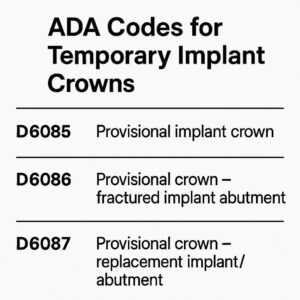
The ADA’s Current Dental Terminology (CDT) code book does not have a single code that says “temporary implant crown.” Instead, the correct code depends on what you are making, how it attaches, and when in the treatment timeline it is placed.
Here are the primary codes you need to know.
D6058: Abutment Supported Porcelain/Ceramic Crown
This is one of the most common codes associated with implant crowns, but it is important to note that it is intended for the final restoration. However, in some scenarios, if a high-quality, custom-milled temporary is fabricated and delivered on a custom abutment, some practices might consider this code.
Caution: Using D6058 for a temporary is generally considered aggressive coding. Insurers expect this code to be used for the definitive, permanent crown. If you use it for a temporary and later submit the final crown, you may face a denial for “duplicate service.”
D6060: Abutment Supported Crown (Cast Metal)
Similar to D6058, this code is for a final restoration. It is rarely used for a temporary unless the temporary is made of metal (which is uncommon in modern esthetic implant cases).
D6010: Surgical Placement of Implant Body
This is a critical code to understand, not because it is the temporary itself, but because it defines the “implant placement” date. Many insurance plans have a “missing tooth clause” or a “waiting period” that starts from the date of the D6010.
The “Provisional” Codes: D6970 and D6971
When we talk about a true temporary implant crown—a non-definitive prosthesis intended for short-term use during the healing or integration phase—the codes that most accurately reflect the service are often found in the provisional category.
-
D6970: Post and core in addition to crown, indirectly fabricated.
-
D6971: Post and core in addition to crown, directly fabricated.
While these codes technically describe “post and core” procedures for natural teeth, they are sometimes used as a proxy for a custom-fabricated provisional restoration when an abutment is involved.
The Reality Check: Many dental practices do not bill separately for a temporary implant crown if it is a simple, pre-fabricated temporary cylinder that comes with the implant system. They consider it part of the overall implant restoration fee. However, if you are fabricating a custom, chairside, or lab-processed temporary that requires significant clinical time and material, you need to represent that work accurately.
D6190 vs. D6059: Understanding the Nuance
To truly master this topic, we need to discuss two codes that are frequently misinterpreted.
D6190: Radiographic/Surgical Implant Index
This code is often confused with a temporary crown. A D6190 is a device used to aid in the surgical placement of implants or to verify positioning. It is not a functional temporary crown. It is a guide. If you are making a clear stent or a verification jig, this is the code. If you are making a crown that the patient wears to eat and smile, this is not the code.
D6059: Abutment Supported Retainer for Cast Metal FPD (Fixed Partial Denture)
This code is used for retainers in a bridge. If your temporary implant crown is part of a larger, screw-retained temporary bridge (for example, in a full-arch “Teeth-in-a-Day” case), you may look toward codes like D6059 or D6061 (for porcelain/ceramic).
Table 1: ADA Codes at a Glance for Implant Temporaries
| ADA Code | Description | Applicability to Temporary Implant Crown | Typical Insurance View |
|---|---|---|---|
| D6010 | Surgical placement of implant body | Defines the start of the implant case. Used for timing. | Usually covered (or partially) under major services. |
| D6058 | Abutment supported porcelain/ceramic crown | Final crown. Risky to use for a temporary. | Expects this to be the permanent restoration. |
| D6970 | Indirectly fabricated post and core | Custom lab-made temporary (if analogized). | Often considered part of the crown fee. May be denied. |
| D6971 | Directly fabricated post and core | Chairside, custom-made temporary (e.g., using a pre-fab cylinder and composite). | Frequently denied if billed separately. |
| D6190 | Radiographic/surgical implant index | Not a crown. This is a surgical guide. | Covered under surgical/supplies if medically necessary. |
| D6080 | Implant maintenance procedures | Cleaning the implant and temporary. | Typically a preventive service. |
When to Bill for a Temporary Implant Crown
One of the most frequent questions in dental administration is: Should I even bill for this?
There is no universal rule. It depends entirely on the insurance contract and the treatment plan. Let’s break it down into scenarios.
Scenario 1: The Stock Healing Abutment
You place the implant (D6010). At the second stage surgery, you place a stock healing abutment that comes in the implant kit. The patient walks out with a metal “button” in their mouth. No tooth structure is present.
Coding Decision: You do not bill for a crown here. The cost of the healing abutment is typically included in the surgical fee (D6010). If you bill for a provisional crown at this stage, it will likely be denied.
Scenario 2: The Pre-Fabricated Temporary Shell
You place the implant. You immediately (or at second stage) take a stock temporary cylinder (a plastic or titanium sleeve) and fill it with composite or acrylic, creating a temporary tooth that screws directly into the implant.
Coding Decision: This is where it gets tricky. Many practices consider this a “bundled service” included in the overall restorative fee. If you wish to bill separately, you might use D6971 (directly fabricated), but you must have a very clear narrative explaining that this is a functional provisional requiring significant clinical skill. Expect a high denial rate, especially with PPO plans.
Scenario 3: The Custom Milled, Screw-Retained Temporary
You take an impression after implant placement. You send it to a lab. The lab returns a high-quality, custom-milled PMMA (polymethyl methacrylate) temporary crown that is screw-retained. This is common in esthetic zones to shape the soft tissue (emergence profile) for several months while the implant integrates.
Coding Decision: This is the strongest case for billing a separate code. Here, you are using significant lab resources and clinical time. You might use D6970 (indirectly fabricated) with a detailed narrative: “Custom provisional restoration to maintain soft tissue architecture and function during osseointegration.”
Alternatively, some clinicians will bill the final crown code early (D6058) and note it as a “provisional,” but this is not recommended as it confuses the insurance timeline.
Table 2: Billing Scenarios and Expected Outcomes
| Clinical Scenario | Recommended Code | Likelihood of Payment | Best Practice |
|---|---|---|---|
| Healing Abutment only | Included in D6010 | 100% (included) | Do not bill separately. |
| Chairside acrylic temporary | D6971 | Low (<30%) | Bundle into restorative fee or use as a patient courtesy. |
| Lab-fabricated custom temporary | D6970 | Moderate (50-70%) | Submit pre-authorization. Include narrative and photos. |
| Permanent crown delivered early | D6058 (or D6060) | High (for final code) | Caution: This will likely prevent billing for the permanent crown later. |
The Role of the Narrative: Your Best Defense
If there is one secret to successful implant temporary billing, it is the narrative. Insurance companies do not read minds. When they see a code like D6971 on a claim for tooth #8, they see a “post and core” for a natural tooth. They assume you made a mistake.
To prevent this, your claim must tell a story.
Elements of a Strong Narrative:
-
State the Diagnosis: “Patient missing tooth #8. Implant placed 6 months ago (D6010).”
-
Describe the Service: “Custom fabricated, screw-retained provisional crown fabricated indirectly (lab) using PMMA material.”
-
Justify Medical Necessity: “Provisional required for 4 months to allow for gingival maturation and emergence profile development prior to final impression for permanent restoration.”
-
Attach Supporting Documents: A periapical X-ray showing the implant and the temporary crown, and a photo of the provisional in place, can work wonders.
Payer Policies: The Wild Card
While the ADA defines the codes, insurance companies define the payment rules. It is crucial to know that many major insurance carriers have specific policies regarding implant temporaries.
Some payers consider the temporary crown an integral part of the surgical procedure (the “uncovery” or second stage). Others consider it part of the final restoration. And a few will pay for it separately—but only if it is “medically necessary.”
Common Payer Language to Watch For:
-
“Temporary crowns are considered inclusive to the final restoration.” This means they will not pay extra for a temp. You need to build that cost into your patient fee.
-
“We will allow a provisional restoration for implants in the esthetic zone.” Some plans make exceptions for anterior teeth (incisors and canines) because the tissue management is critical for esthetics.
-
“Implant crowns are a non-covered benefit.” If the plan doesn’t cover implants at all, they certainly won’t cover the temporary.
Clinical Perspectives: Why the Temp Matters
From a clinical standpoint, the temporary implant crown is not just a placeholder. It serves vital biological and mechanical functions. Understanding these functions can help you justify the need for a custom provisional to both patients and insurance adjusters.
1. Soft Tissue Contouring (Emergence Profile)
Natural teeth have a specific shape where the root meets the crown. When we remove a tooth and place an implant, the gum tissue collapses. A well-designed temporary crown gently shapes the gums to mimic nature, ensuring the final crown looks like it is emerging from the gum rather than sitting on top of it.
2. Occlusal Function
Patients need to chew. While we do not want the implant bearing heavy loads during osseointegration, a lack of function can lead to supraeruption of opposing teeth and bite collapse. A temporary crown provides controlled, light function.
3. Psychological Comfort
For many patients, walking around with a missing tooth or a visible metal healing abutment is emotionally distressing. A temporary crown restores their smile and confidence during the lengthy implant process.
The Cost Factor: What to Tell Patients
Patients often ask, “Why is the temporary so expensive if it’s just temporary?”
This is a fair question. When you bill a code like D6970 or D6971, the patient sees a cost for a “post and core” which sounds like a repair for a root canal tooth. They don’t understand the lab fees, the specific materials, and the clinical time required to create a screw-retained provisional that fits perfectly and supports the gums.
A Script for Patient Communication:
“The temporary crown for your implant is a precision device. It isn’t just glued on; it is engineered to fit your implant exactly and to shape your gums so that your permanent crown looks beautiful and natural. While it’s called a temporary, it requires custom lab work and significant time to ensure the final result is perfect.”
Table 3: Temporary Implant Crown Materials and Coding Implications
| Material | Fabrication Method | Common Code | Notes |
|---|---|---|---|
| Acrylic (PMMA) | Lab Milled | D6970 (Indirect) | Ideal for esthetics and tissue management. Highest lab cost. |
| Bis-acryl Composite | Chairside / Direct | D6971 (Direct) | Good for short-term (weeks). Less durable for months. |
| Stock Cylinder + Composite | Chairside / Direct | D6971 (Direct) | Common for posterior teeth where esthetics are less critical. |
| Pre-fabricated Titanium | Manufacturer | Included in Abutment | Often part of the abutment code (D6056 or D6057). Not a crown. |
Navigating the “Missing Tooth Clause”
A critical element in implant coding involves the “missing tooth clause.” Many dental insurance plans have a clause stating they will not cover a prosthetic replacement for a tooth that was missing before the policy started.
Here is how this affects the temporary implant crown:
-
The Implant (D6010): Often covered under major services, but subject to deductibles and waiting periods.
-
The Temporary Crown: If the plan denies the permanent crown because of a missing tooth clause, they will almost certainly deny the temporary crown as well.
-
The Strategy: If you know a missing tooth clause applies, do not waste time billing the temporary separately. Explain to the patient that this is a non-covered service and offer a flat fee for the provisional phase.
Common Denial Codes and How to Resolve Them
Even with perfect coding, denials happen. Here are the most common denial codes you will see for temporary implant crowns and how to address them.
Denial: CO-97 (The benefit for this procedure is not included in the benefit plan)
Why it happens: The plan does not cover implant services, or they consider the provisional inclusive to the surgical implant placement.
Fix: Verify benefits before treatment. If the plan excludes implants, the patient must pay out-of-pocket. If it is “inclusive,” appeal with a narrative explaining the provisional was necessary for tissue management due to anatomical necessity (e.g., high esthetic risk).
Denial: CO-45 (The procedure code is inconsistent with the modifier used or the service is not a benefit)
Why it happens: You used D6058 (final crown) for a temporary, and the insurance noticed the date of service was too close to the implant placement date (D6010).
Fix: Do not use final crown codes for provisional restorations. If you must, use D6970/D6971 and appeal with proof that this is a provisional.
Denial: CO-94 (The procedure code is not paid separately)
Why it happens: The payer bundles the cost of the temporary into the “restorative” or “surgical” phase.
Fix: Unless your contract specifically allows separate payment, you will rarely win this appeal. It is a contractual limitation.
Best Practices for a Smooth Billing Process
To wrap up the technical side of coding, let’s outline a workflow that minimizes headaches.
-
Verify Benefits Before Surgery: Ask the insurance carrier specifically: “Does the plan cover provisional restorations for implants? If so, under what conditions?” Document the answer with the representative’s name and reference number.
-
Consider a Pre-Authorization: For complex cases (especially anterior esthetic zones), submit a pre-authorization with the narrative and treatment plan. Include codes D6010 (implant), D6056 (custom abutment if used), D6970 (custom provisional), and D6058 (final crown). See what they come back with.
-
Maintain Impeccable Records: Your clinical notes should reflect the decision-making process. “Patient opted for custom provisional to maintain gingival architecture. Lab invoice attached to chart.”
-
Know Your Contract: If you are in-network with a PPO, review your fee schedule. Some contracts explicitly state that the restorative fee (D6058) includes any and all provisionalization. If that is the case, billing D6970 would be a violation of your contract.
-
Patient Communication is Key: Always provide a treatment plan that separates the “implant surgical phase,” “provisional phase,” and “final restoration phase.” Clearly mark which portions are estimated to be covered by insurance and which are patient responsibility.
The Future of Implant Coding
As digital dentistry continues to evolve, the lines between “temporary” and “final” are blurring. With same-day milling (CAD/CAM) and advanced materials, we are now seeing “finalized temporaries” that last for years, or “immediate definitive restorations” placed at the time of surgery.
The ADA updates the CDT codes every year. While there has been talk about creating a dedicated code for “implant provisional,” as of the latest edition, we are still working within the existing framework of D6970/D6971 and the bundled surgical fees.
Staying current with these updates is essential. A code that was considered “bundled” yesterday might become separately payable tomorrow, or vice versa.
Conclusion
Mastering the ADA code for a temporary implant crown requires a blend of clinical knowledge, administrative diligence, and a touch of strategic thinking. There is no single “magic bullet” code. Instead, success comes from accurately matching the clinical service—whether it is a simple chairside temporary or a complex lab-fabricated provisional—to the appropriate code (often D6970 or D6971) while providing a robust narrative that justifies medical necessity.
Remember that insurance reimbursement for these services is inconsistent. The safest approach is often to view the provisional phase as a value-added service that enhances clinical outcomes and patient satisfaction, bundling its cost into your overall implant restorative fee whenever possible. By combining accurate coding with clear patient communication, you can navigate this complex area with confidence and keep your practice’s financial health strong.
Frequently Asked Questions (FAQ)
1. What is the specific ADA code for a temporary implant crown?
There is no single specific code labeled “temporary implant crown.” The most commonly used codes are D6970 (indirectly fabricated provisional) and D6971 (directly fabricated provisional), depending on how the temporary is made. In some bundled cases, it is included in the surgical or restorative fees.
2. Will insurance pay for a temporary implant crown?
It depends on the plan. Some PPO and traditional plans consider it inclusive to the final crown or surgical placement and will not pay separately. Others may allow it, especially for anterior teeth where tissue management is medically necessary. Always verify benefits before treatment.
3. Can I use the final crown code (D6058) for a temporary?
While technically possible, it is not recommended. Using the final crown code for a temporary can lead to claim denials and may prevent you from billing for the actual permanent crown later. It is best to use provisional codes or bundle the service.
4. What is the difference between D6970 and D6971?
D6970 is for an indirectly fabricated (lab-made) post and core/provisional. D6971 is for a directly fabricated (chairside) provisional. If you send an impression to a lab for a custom temporary, D6970 is the more accurate choice.
5. What should I do if my claim for a temporary crown is denied?
First, review the denial reason. If it’s due to a “bundling” clause, there is little recourse. If it’s due to a “missing information” denial, file an appeal with a detailed narrative, X-rays, and a copy of the lab invoice (if applicable) explaining the medical necessity of the provisional.
Additional Resource
For the most current information on dental coding and to verify updates to the CDT codes, visit the American Dental Association’s official Coding and Reimbursement page:
https://www.ada.org/en/publications/cdt
Note: This guide is for informational purposes only and does not constitute legal or billing advice. Dental codes and insurance policies vary by region and carrier. Always consult your specific payer contracts and clinical judgment.