The Essential Guide to the ADA Dental Code for Crown Removal
Let’s be honest: dental billing codes can feel like a foreign language. You are sitting in the dentist’s chair, or perhaps you are the one handling the front office, and suddenly a string of alphanumeric characters determines whether an insurance company pays a bill or sends it back with a confusing denial.
One of the most common sources of confusion surrounds a procedure that happens every day in dental practices across the country: taking a crown off.
It sounds simple, right? But when it comes to coding, the “ADA dental code for crown removal” is not as straightforward as you might think. There isn’t just one button to push. In fact, depending on why you are removing the crown and what you plan to do afterward, the code changes entirely.
If you use the wrong code, you might as well be throwing money out the window.
In this guide, we are going to strip away the confusion (pun intended). We will explore the specific codes used for crown removal, the nuances of insurance coverage, the difference between removing a temporary crown versus a permanent one, and how to ensure your claims are processed smoothly the first time.
Whether you are a dental professional looking to clean up your billing practices, a dental student trying to learn the ropes, or a patient trying to decipher a treatment plan, this article is your comprehensive roadmap.
Understanding the Basics: Why There Isn’t One Single “Crown Removal” Code
Before we dive into the numbers, it is vital to understand a fundamental principle of the Current Dental Terminology (CDT) code set, published by the American Dental Association (ADA). The codes are designed to describe the service provided, not necessarily the physical action.
If you search the CDT manual for “crown removal,” you won’t find a simple entry that says, “Take off crown.” Instead, you will find codes that describe the context of the removal.
Is the crown a temporary placeholder?
Is the crown a permanent restoration that has failed?
Are you removing it to treat the tooth underneath?
The answer to these questions dictates the code. Generally, crown removal falls into two major categories: the removal of a temporary (interim) crown and the removal of a permanent crown.
Let’s break these down.
The Two Primary Codes for Crown Removal
When dental professionals talk about removing crowns, they typically refer to one of two specific ADA codes. Understanding the distinction between these two is the single most important factor in avoiding claim denials.
D2999: The “Unspecified” Workhorse
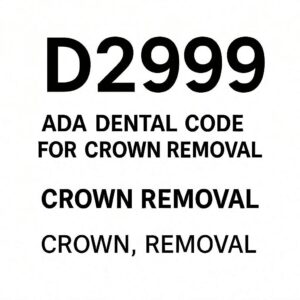
The code D2999 is officially defined as a “Provisional crown – further processing.”
Wait a minute—that definition sounds confusing. It says “provisional crown,” not removal. How does this apply to taking a crown off?
In practice, D2999 is frequently used to bill for the removal of a permanent crown when it is being done to facilitate a separate service, or when no other specific code fits the scenario.
Historically, there was a specific code for the removal of a permanent crown. However, in recent iterations of the CDT, that specific code was eliminated, and its function was folded into the catch-all nature of D2999.
When to use D2999:
-
You are removing an existing permanent crown to access the tooth for a root canal (endodontic therapy).
-
You are removing a permanent crown to repair the tooth structure underneath.
-
You are removing a crown because the patient is experiencing pain, but the final restoration plan (a new crown) hasn’t started yet.
-
The removal is a standalone procedure not tied to a specific “re-cement” code.
The Billing Challenge:
Because D2999 is a “provisional” or “unspecified” code, insurance companies scrutinize it heavily. They want to know why you did it. If you simply submit D2999 without a detailed narrative or an appropriate diagnosis code, it is almost guaranteed to be denied.
D2920: The Recementation Code
The code D2920 is defined as “Recement crown.”
This code implies that the crown is being removed and then put back on.
When to use D2920:
-
A patient comes in with a permanent crown that has fallen out (or is loose), and the dentist cleans the debris out of the crown, checks the tooth, and cements it back into place.
-
The crown is intact, the tooth is healthy, and the only issue is the cement failed.
The Nuance:
If you are removing a crown to treat decay underneath it, do not use D2920. If you bill D2920 and then fill a cavity under the crown, the insurance company will likely deny the filling because the code D2920 implies the crown simply needed re-sticking. In this scenario, you would likely remove it under D2999 and then bill the filling (like D2391 or D2392) and eventually a new crown (D2740 or D2750).
The Third Option: Crown Removal in Multi-Step Procedures
Sometimes, removing a crown isn’t a stand-alone event. It is part of a larger procedure. In these cases, you do not bill a separate “removal” code at all.
Removal for Endodontic Therapy (Root Canal)
If you are removing a permanent crown to perform a root canal (D3330), many insurance carriers consider the removal of the crown to be an inclusive part of the root canal procedure. You cannot charge separately for the removal.
Example: A patient has a tooth with an existing crown that now needs a root canal. The dentist removes the crown, performs the root canal, and places a temporary crown. The claim should reflect the root canal (D3330) and the temporary crown (D2930 or D2931). The removal itself is not billed separately because it is considered a necessary step to complete the root canal.
Removal for Crown Replacement
If you are removing a crown because it is defective (fractured, poor fit, recurrent decay) and you are fabricating a new one, the removal is generally considered part of the crown preparation for the new restoration.
If a patient has an existing crown and you are doing a “crown build-up” (D2950) and a new crown, you do not typically bill a separate D2999 for the removal. The chair time involved in taking the old crown off is factored into the fee for the new crown and build-up.
Comparative Table: Choosing the Correct Code
To help visualize the decision-making process, here is a comparative table that outlines the most common scenarios and the appropriate ADA code to use.
| Scenario | Action | ADA Code | Rationale |
|---|---|---|---|
| Loose Crown | Crown is removed, cleaned, and re-cemented. | D2920 | The crown is being recemented. The removal is intrinsic to the recementation procedure. |
| Failed Crown (Decay) | Crown is removed to treat decay. New crown will be made later. | D2999 (with narrative) | The crown is not being reused. The removal is a service separate from the new crown fabrication. |
| Failed Crown (Fracture) | Crown is removed to assess tooth. Tooth needs extraction. | D2999 (with narrative) | The removal was a diagnostic/therapeutic step leading to extraction. |
| Root Canal Access | Crown is removed to perform root canal. | No separate code | The removal is considered a component of the endodontic therapy (D3330). |
| Temporary Crown | Temporary crown is removed. | Usually inclusive | If done during the same visit as the permanent crown seat, it is inclusive. If done separately, use D2999 with narrative. |
| Consultation/Second Opinion | Crown is removed to examine underlying tooth structure. | D2999 (with narrative) | The removal is for diagnostic purposes only, with no immediate treatment. |
The Case of the Temporary Crown
Temporary crowns (acrylic or polycarbonate) are meant to be removed. However, billing for this removal is tricky.
If you are seating the final crown (D2740) on the same day you remove the temporary, do not bill separately for the removal. The fee for seating the final crown (delivery) includes the removal of the provisional.
If, however, the patient comes in on a separate day because the temporary crown broke or fell off, and you need to remove the remnants or recement it, you may need to bill.
-
Recementing a temporary crown: This is often billed under the same code as permanent recementation? No. Usually, if a temp comes off, you will use a “miscellaneous” code, often D2999, with a description stating “recement temporary crown.” Many insurances do not cover this, and it is often written off as a courtesy to the patient.
Insurance Nuances: Getting Paid
This is where the rubber meets the road. Even if you select the correct ADA code, insurance companies have their own rules. These rules are often called “policies” or “guidelines.”
Here are the hard truths about insurance reimbursement for crown removal:
1. Frequency Limitations
Most PPO plans consider crown removal (D2999 or D2920) a procedure that is only payable once every 12 to 36 months per tooth. If you try to bill D2920 (recement) on the same tooth within a year, it will likely be denied as a “frequency limitation.”
2. The “Re-cement” Trap
Insurance companies love to deny D2920 if the crown is less than 5 years old. Why? Their logic is that if a crown fails within 5 years, it should be covered under the dentist’s warranty or the lab’s warranty. They often consider recementation a “corrective” procedure, not a “covered benefit.”
3. D2999 and the Narrative
If you are using D2999, you must submit a narrative (a written explanation). The narrative should include:
-
The tooth number.
-
The reason for removal (e.g., “recurrent decay,” “pain upon percussion,” “fracture of porcelain,” “needs endodontic evaluation”).
-
What was found.
-
What happened to the crown (discarded or saved).
If you submit D2999 with just a standard x-ray and no narrative, you will not get paid. It is that simple.
Clinical Scenarios: Real-World Application
Let’s walk through three typical days in a dental practice to see how these codes play out in reality.
Scenario 1: The Loose Crown
A patient walks in as an emergency. Their crown on tooth #19 is loose. They can wiggle it with their tongue. You take an x-ray and see there is no new decay; the cement simply washed out. You remove the crown (it pops off easily), clean the inside with pumice, clean the tooth, and use permanent cement to bond it back.
-
Code: D2920 (Recement Crown)
-
Fee: Standard office fee.
-
Outcome: High probability of payment, though frequency limitations may apply if done recently.
Scenario 2: The Decay Under the Crown
A patient is in for a routine exam. X-rays show a shadow under the margin of the existing crown on tooth #14. The patient is not in pain yet, but the decay is progressing. You explain the crown needs to be removed. You cut the crown off (destroying it in the process), remove the decay (D2392), place a core build-up (D2950), take an impression for a new crown, and place a temporary.
-
Coding Strategy:
-
You cannot bill D2920 because you are not re-cementing the old crown.
-
You bill D2392 (2-surface resin composite) for the filling.
-
You bill D2950 (core build-up) if necessary.
-
You bill D2999 for the removal of the permanent crown. *Note: Some dentists choose to “absorb” the cost of the removal into the new crown fee to avoid insurance hassles, but if you are billing fee-for-service, D2999 is the technical code.*
-
-
Outcome: D2392 and D2950 usually pay. D2999 may pay, but often requires the narrative to justify why the old crown couldn’t be saved.
Scenario 3: The Root Canal
A patient presents with a tooth that has a crown and is sensitive to percussion. The tooth needs a root canal. You remove the crown, perform the root canal (D3330), and place a temporary crown.
-
Code: D3330 (Root Canal)
-
No separate removal code.
-
Outcome: The root canal fee is paid. The removal is considered inclusive. If you try to bill D2999 in addition, the insurance will “bundle” it, meaning they will deduct the amount from the root canal or deny it outright as inclusive.
Patient Perspective: What to Look for on Your Treatment Plan
If you are a patient reading this, you might be looking at a treatment plan that says “D2999” or “Crown Removal” with a fee attached. Here is how to be an informed consumer.
Is it Covered?
Most dental insurance plans do not cover crown removal unless it is a result of a traumatic injury or it is part of a covered procedure like a root canal.
If your insurance covers a root canal (D3330) at 80%, but the removal of the crown (D2999) is a separate line item, they may consider the removal a “non-covered service” and you will be responsible for the full fee.
Is the Fee Fair?
The fee for removing a permanent crown (D2999) typically ranges from $75 to $200, depending on the geographic location and the complexity (e.g., if it requires sectioning with a handpiece). For recement (D2920), the fee is usually similar, often ranging from $60 to $150.
If a dentist is charging you $300 to pop a loose crown off and glue it back on, you are likely being overcharged relative to standard regional averages.
What if the Crown is Gold or Porcelain?
If the crown is a high-value material (gold or high noble metal) and it is in good condition, the dentist should attempt to remove it intact so it can be re-cemented. If the dentist destroys the crown to remove it without discussing that it could have been saved, you have a right to ask why. The code D2920 implies the crown is saved. D2999 often implies the crown was discarded.
Documentation: The Key to Success
For the dental professional, documentation is your shield against denials and audits. When it comes to crown removal, your notes need to be bulletproof.
Here is a checklist of what should be in the patient’s chart when billing for crown removal:
-
Radiographic Evidence: A pre-operative x-ray showing the reason for removal (decay, open margin, periapical pathology).
-
Clinical Findings: Notes describing the mobility of the crown, presence of decay, or patient symptoms.
-
Reason: A clear statement: “Crown removed due to recurrent decay at distal margin.”
-
Condition: “Crown was sectioned and discarded due to extensive porcelain fracture.”
-
Procedure Linkage: If you are billing a root canal or build-up, ensure the narrative links the removal as a necessary step to complete that procedure.
Common Billing Mistakes and How to Avoid Them
Let’s look at the top errors that cause claims to be rejected or audited.
Mistake #1: Using D2920 for a Crown that Will Not be Re-cemented
This is the most common error. A dentist removes a crown, finds decay, and decides a new crown is needed. The office bills D2920 out of habit. This is fraud. If you do not put the same crown back on, you cannot bill for recementation. You must use D2999 or include the removal in the new crown fee.
Mistake #2: Using D2999 for a Root Canal
As noted above, attempting to bill a separate removal code alongside a root canal (D3330) on the same tooth on the same day is a guaranteed denial or down-code. Insurance adjusters will bundle these procedures. Save yourself the headache—don’t do it.
Mistake #3: No Narrative for D2999
Submitting D2999 electronically without a 1500 claim form attachment or a box 35 narrative is asking for a denial. Most clearinghouses will flag this. Always attach a note.
The Evolution of the Codes
To fully understand the “ADA dental code for crown removal,” it helps to know a little history. Up until the 2017/2018 CDT code updates, there was a specific code: D6970 (Post removal) and a few others that touched on removal. However, the landscape changed.
The removal of a crown used to be a “hard” code. Now, the ADA relies more heavily on the narrative and the catch-all D2999 to describe this service. This shift was intended to reduce the number of overly specific codes, but it inadvertently made billing more complicated because it forced providers to rely on a code that insurance companies inherently distrust.
Frequently Asked Questions (FAQ)
1. Is there a specific ADA code just for crown removal?
No. There is no specific single code that says “Crown Removal.” The procedure is most commonly billed using D2999 (Provisional crown – further processing) for permanent crown removal, or D2920 (Recement crown) if the crown is being put back on.
2. Will my insurance pay for crown removal?
It depends on the reason. If the removal is to treat decay or a fracture so a new crown can be made, it is often a patient responsibility (non-covered). If the removal is to recement a crown that fell out (D2920), it is often covered at 50-80%, subject to frequency limits.
3. Why did my dentist charge me for removing a temporary crown?
If the temporary crown was removed on the same day the permanent crown was inserted, the removal should be included in the permanent crown fee. If the temporary crown required a separate visit to remove (e.g., it broke and needed removal before the permanent was ready), a separate charge (often D2999) may apply.
4. What happens if a dentist breaks a crown while trying to remove it?
If the crown was intended to be saved (recemented), the dentist usually bears the responsibility for replacement if they break it during removal. However, if the removal was for decay or root canal access where the crown was going to be discarded anyway, the breakage is irrelevant to the treatment plan.
5. Can I bill for crown removal if I am doing a new crown on the same day?
Technically, yes, you can bill D2999. However, many dentists do not, because it is administratively heavy. They often incorporate the time and effort into the build-up (D2950) or crown fee (D2740) to simplify the claim and avoid insurance bundling.
Additional Resources
For the most current information regarding CDT codes, billing practices, and insurance regulations, it is essential to consult primary sources.
-
American Dental Association (ADA) – CDT Code: The official source for the Current Dental Terminology. You can purchase the current CDT manual or subscribe to the online version to ensure you are using the most up-to-date codes and definitions.
-
Dental Insurance Coding Workshops: Organizations like the American Association of Dental Office Management (AADOM) offer workshops and resources specifically for front office staff to stay current on changing billing rules.
Conclusion
Navigating the coding landscape for crown removal requires more than just picking a number from a list. It demands a clear understanding of clinical intent, insurance policy nuances, and meticulous documentation.
The primary codes to remember are D2920 for re-cementing an existing crown and D2999 for removing a crown that will not be reused or for diagnostic purposes. However, critical exceptions exist, such as when removal is bundled with root canal therapy or new crown fabrication. By focusing on accurate diagnosis coding and providing a strong narrative, dental professionals can significantly reduce claim denials and ensure that the necessary work is compensated fairly. For patients, understanding this distinction helps clarify treatment plans and manage expectations regarding insurance coverage.