ADA Dental Code for Root Canals
If you have ever looked at a dental bill, you know it can feel like reading a secret language. Between the numbers, abbreviations, and insurance notes, it is easy to get lost.
One set of codes causes more questions than most: the ADA dental code for root canals.
These codes are not random. They tell your dentist exactly what work was done, on which tooth, and how complex the procedure was. They also decide how much your insurance will pay.
This guide walks you through every root canal code in the ADA manual. You will learn what each code means, which tooth it applies to, and how to avoid surprise bills. No fluff. No fake information. Just clear, honest facts.
What Are ADA Dental Codes? A Quick Overview
The American Dental Association (ADA) publishes the Current Dental Terminology (CDT) code set. These codes are updated every year.
Every dental procedure has a unique five-character code starting with “D”. For example, a routine cleaning is D1110. A full mouth X-ray is D0210.
Insurance companies use these codes to process claims. If your dentist uses the wrong code, your claim may be denied or paid at a lower rate.
Note for readers: Always ask your dentist for the exact code before the procedure. Then call your insurance to verify coverage. This simple step saves hundreds of dollars.
The Main ADA Dental Code for Root Canals (Complete List)
There is not just one root canal code. The ADA separates root canals by the type of tooth and the stage of treatment.
Here is the complete list of active, valid codes for root canal therapy:
| ADA Code | Procedure Description | Tooth Type |
|---|---|---|
| D3220 | Pulpotomy (partial nerve removal) | Primary or permanent |
| D3221 | Pulpal debridement (emergency) | Any tooth |
| D3230 | Pulpal therapy (anterior primary tooth) | Baby front tooth |
| D3240 | Pulpal therapy (posterior primary tooth) | Baby back tooth |
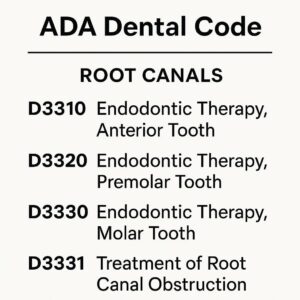
| D3310 | Root canal – anterior tooth | Incisors & canines |
| D3320 | Root canal – premolar (bicuspid) | First & second premolars |
| D3330 | Root canal – molar | First, second, third molars |
| D3331 | Treatment of root canal obstruction | Any tooth |
| D3332 | Incomplete root canal therapy (non-obturated) | Any tooth |
| D3333 | Internal root repair (perforation) | Any tooth |
The three codes you will see most often are D3310, D3320, and D3330. These cover the vast majority of adult root canals.
D3310 – Root Canal on an Anterior Tooth
Anterior teeth are your front six teeth (incisors and canines). They have one root, sometimes two.
-
Typical cost: $600 – $1,200
-
Average time: 30 – 60 minutes
-
Difficulty: Low
Because these teeth have straight, simple canals, this code has the lowest insurance reimbursement.
D3320 – Root Canal on a Premolar (Bicuspid)
Premolars are the teeth between your canines and molars. You have eight premolars. Most have one or two roots.
-
Typical cost: $700 – $1,400
-
Average time: 45 – 75 minutes
-
Difficulty: Moderate
D3330 – Root Canal on a Molar
Molars are your large back teeth. Lower molars usually have two or three roots. Upper molars have three roots, sometimes four.
-
Typical cost: $1,000 – $2,000+
-
Average time: 90 minutes (can be longer)
-
Difficulty: High
Important: D3330 is the most expensive root canal code. Some insurance plans only cover 50% of this code. Always verify your molar coverage before scheduling.
Emergency Root Canal Codes (D3220 and D3221)
Not every root canal is completed in one visit. Sometimes you need immediate relief.
D3220 – Pulpotomy
A pulpotomy removes only the infected part of the nerve. The dentist leaves the healthy root nerves in place.
-
Used most often on baby teeth
-
Can be a temporary fix on permanent teeth
-
Often followed by a full root canal (D3310–D3330)
D3221 – Pulpal Debridement
This is an emergency procedure to clean out the inside of the tooth. The dentist removes infected tissue and places medicine.
-
Does not complete the root canal
-
Relieves severe pain
-
Buys time until a full root canal is scheduled
Example: You have a badly infected molar on a Friday night. Your dentist opens the tooth, cleans it, and gives you antibiotics. That is D3221. The following week, you return for D3330. Both codes are billed separately.
Primary (Baby) Tooth Root Canal Codes
Children can need root canals too. The ADA has specific codes for baby teeth.
| ADA Code | Description |
|---|---|
| D3230 | Pulpal therapy – anterior primary tooth |
| D3240 | Pulpal therapy – posterior primary tooth |
These procedures remove infected nerve tissue from baby teeth. The goal is to save the tooth until it falls out naturally.
Do not confuse these with adult codes. Insurance for pediatric root canals often works differently. Many medical plans cover part of the cost if the infection is severe.
Special Situation Codes (Retreatment, Obstruction, Perforation)
Root canals can become complicated. These codes cover unusual cases.
D3331 – Treatment of Root Canal Obstruction
Sometimes a broken instrument, hard calcification, or foreign material blocks the canal. The dentist must spend extra time removing the blockage.
-
Billed in addition to the main root canal code
-
Requires specialist skill (endodontist)
-
Adds $150 – $400 to the bill
D3332 – Incomplete Root Canal Therapy (Non-Obturated)
This code is rare. It applies when a dentist starts a root canal but does not fill (obturate) the canals. Perhaps the patient moved away or stopped treatment.
D3333 – Internal Root Repair (Perforation)
During a root canal, a small hole can accidentally be made in the root. This code covers repairing that hole.
-
Almost always performed by an endodontist
-
Uses special materials (MTA or bioceramics)
-
Adds significant time and cost
Root Canal Codes vs. Apicoectomy Codes (Do Not Confuse Them)
Many people confuse root canal codes with surgical codes. They are not the same.
| Procedure | ADA Code(s) | Approach |
|---|---|---|
| Root canal (non-surgical) | D3310, D3320, D3330 | Through the top of the tooth |
| Apicoectomy (surgical) | D3410, D3421, D3425 | Through the gum and bone |
An apicoectomy is used when a root canal fails. The dentist cuts the gum, removes the root tip, and seals the end. It is surgery, not a standard root canal.
If your dentist recommends D3410, ask why a standard root canal (D3330) is not possible.
How Insurance Processes Root Canal Codes
Insurance does not pay the same for every code. Here is how it usually works.
Typical Coverage by Code
| ADA Code | Insurance Category | Typical Coverage |
|---|---|---|
| D3310 | Basic / Major | 70% – 80% |
| D3320 | Basic / Major | 60% – 70% |
| D3330 | Major | 50% – 60% |
| D3220 | Basic | 70% – 80% |
| D3221 | Basic | 70% – 80% |
Common Insurance Rules
-
Waiting periods: Many plans make you wait 6–12 months for major services (D3330).
-
Missing tooth clause: If the tooth was missing before the plan started, no coverage.
-
Alternate benefit: Insurers may pay for D3320 (premolar) instead of D3330 (molar) even if you need a molar root canal. This is legal. You pay the difference.
Realistic advice: Never assume a code is covered. Call your insurance with the exact code. Get a reference number for the call. Write down the date and representative’s name.
What Happens When the Wrong Code Is Used?
Mistakes happen. A dentist might accidentally bill D3320 for a molar root canal. The insurance pays less than expected. You get a surprise bill.
Common Wrong Code Scenarios
| Correct Code | Wrong Code Used | Consequence |
|---|---|---|
| D3330 (molar) | D3320 (premolar) | Lower payment, patient balance higher |
| D3330 (molar) | D3310 (anterior) | Claim denial (tooth number mismatch) |
| D3221 (debridement) | D3310 (full root canal) | Insurance overpayment, later clawback |
How to Protect Yourself
-
Ask for the code before treatment. Write it down.
-
Check the tooth number. The ADA code alone is not enough. Your dentist must also list the tooth number (1–32 for adults).
-
Review your explanation of benefits (EOB). Compare the code on the EOB to the code your dentist gave you.
-
Dispute errors immediately. Most states give you 180 days to file a claim dispute.
Pricing Reference: Average Costs by Code (USA, 2025)
Prices vary by city, dentist, and insurance. These are realistic out-of-pocket averages for patients without insurance or with insurance that has not met the deductible.
| ADA Code | Without Insurance | With Insurance (after deductible) |
|---|---|---|
| D3310 | $600 – $1,200 | $150 – $350 |
| D3320 | $700 – $1,400 | $200 – $450 |
| D3330 | $1,000 – $2,200 | $350 – $900 |
| D3220 | $150 – $400 | $30 – $120 |
| D3221 | $200 – $500 | $50 – $150 |
| D3331 (obstruction) | +$150 – $400 | +$50 – $150 |
Note: Endodontists (root canal specialists) charge 30–50% more than general dentists. But they also have higher success rates for difficult cases.
Step-by-Step: How to Read a Dental Claim Form for Root Canals
Your dental claim form (ADA 2024 form) has boxes. Here is what matters for root canals.
-
Box 32 – Procedure Code: This is the ADA code (D3330, etc.).
-
Box 33 – Tooth Number: Adult teeth 1–32. Baby teeth A–T.
-
Box 34 – Tooth Surface: Usually “Whole Tooth” for root canals.
-
Box 35 – Description: Brief note (e.g., “Root canal – tooth #19”).
-
Box 36 – Fee: What the dentist charges.
-
Box 37 – Allowed Amount: What insurance agrees is reasonable.
If any of these boxes are empty or wrong, the claim will likely be delayed or denied.
Documentation Requirements for Dentists
Dentists cannot just bill a code. They must prove the work was done. The ADA requires specific documentation for root canal codes.
Required for D3310, D3320, D3330
-
Pre-op X-ray showing infection or deep decay
-
Post-op X-ray showing filled canals (obturation)
-
Clinical notes describing:
-
Tooth number
-
Reason for treatment
-
Number of canals found
-
Irrigants used
-
Obturation material (usually gutta-percha)
-
Required for D3221 (Debridement)
-
Note stating “emergency pulpal debridement”
-
Evidence of pain or swelling
-
Medication placed (if any)
Without this documentation, an audit can force the dentist to refund the insurance payment.
For patients: If your dentist cannot show you a post-op X-ray, ask why. A missing X-ray might mean the root canal was not completed properly.
How to Find a Dentist Who Uses Correct Codes
Most dentists use correct codes. But some accidentally use outdated or incorrect codes.
Signs of a Dentist Who Codes Correctly
-
They give you a written treatment plan with codes before starting work.
-
They explain which code applies to which tooth.
-
They submit X-rays with every claim.
-
Their front desk staff can answer code questions without hesitation.
Red Flags
-
“We will just bill it as a regular root canal” (too vague).
-
Refusal to give you the code in writing.
-
Billing D3330 for a premolar (fraud).
-
Billing D3310 for a molar (underbilling – rare but happens).
The Difference Between “Root Canal” and “Root Canal Therapy” in Codes
There is no difference. The ADA uses “root canal therapy” and “endodontic therapy” interchangeably.
However, some dental offices use informal terms that do not match codes. For example:
| Office Term | Correct ADA Code |
|---|---|
| “Baby root canal” | D3230 or D3240 |
| “Partial root canal” | D3221 |
| “Root canal start” | D3221 |
| “Nerve treatment” | D3310–D3330 |
Always ask for the exact five-character code. Do not rely on descriptive terms.
Can a Dental Code Be Used Twice on the Same Tooth?
Yes, but only under specific circumstances.
-
Retreatment (D3330 again): If a root canal fails, the dentist can bill D3330 again on the same tooth. Most insurance plans allow this once every 2–5 years.
-
Debridement + Root canal (D3221 + D3330): Billed separately on different dates.
-
Obstruction (D3331 + D3330): Billed on the same date but as separate line items.
What you cannot do: Bill D3330 twice on the same day for the same tooth.
State-by-State Variations (Brief Overview)
Most states follow the ADA CDT codes exactly. However, a few states have additional rules for dental claims.
-
California: Requires disclosure of “downcoding” (when insurance pays for a cheaper code).
-
New York: Dentists must give patients a code estimate within 3 days of request.
-
Texas: Insurance cannot deny a claim solely because of a minor code error (but they can reduce payment).
For all other states, the ADA codes apply as written.
Future Changes to Root Canal Codes (2025 and Beyond)
The ADA updates CDT codes every year on January 1. Major changes are rare, but small adjustments happen.
Predicted changes (based on ADA committee notes)
-
Possible new code for regenerative endodontics (growing new nerve tissue)
-
Clarification on D3332 (incomplete therapy)
-
Possible deletion of D3230/D3240 in favor of more precise pediatric codes
No current root canal codes (D3310, D3320, D3330) are scheduled for deletion or replacement.
Common Myths About Root Canal Codes
Let us clear up some false information circulating online.
Myth 1: “D3330 is only for molars with four canals.”
Truth: D3330 applies to any molar, regardless of canal number.
Myth 2: “You can bill D3330 for a premolar if it has three canals.”
Truth: No. Tooth type determines the code, not canal count.
Myth 3: “Insurance always pays 80% of D3310.”
Truth: Only if you have met your deductible and have no waiting period. Many plans pay less.
Myth 4: “D3221 is the same as a pulpotomy.”
Truth: No. D3220 = pulpotomy (partial). D3221 = debridement (emergency cleaning).
Practical Tips to Save Money Using the Correct Code
You cannot change the code your dentist uses. But you can use code knowledge to save money.
Tip 1: Ask for a Code Breakdown Before Treatment
Request a written estimate with:
-
ADA code
-
Tooth number
-
Insurance allowed amount
-
Your estimated copay
Tip 2: Check If a Different Code Applies
Sometimes a pulpotomy (D3220) can buy you months or years before a full root canal. It costs much less.
Tip 3: Use FSA or HSA Funds
Root canal codes are eligible expenses. Save your receipts.
Tip 4: Appeal Denials Using the Correct Code
If insurance denies D3330 but covers D3320, appeal in writing. Explain that a molar is not a premolar. Attach X-rays. Many appeals succeed.
Sample Dialogue: Asking Your Dentist About the Code
Here is how to ask without feeling awkward.
You: “Before we start, could you write down the ADA code for my root canal?”
Dentist: “Sure. It is D3330 for your lower molar.”
You: “Great. And just to confirm, that is for tooth #19?”
Dentist: “Yes.”
You: “Would you mind if I take a photo of the treatment plan?”
Dentist: “Not at all.”
That is professional, polite, and protects you.
Frequently Asked Questions (FAQ)
1. What is the most common ADA code for a root canal?
D3330 (molar root canal) is the most frequently billed code because molars are the most likely teeth to need root canals.
2. Does insurance cover D3330 the same as D3310?
No. Most insurance pays a lower percentage for D3330 (50–60%) compared to D3310 (70–80%).
3. Can a general dentist use the same codes as an endodontist?
Yes. The codes are identical. The difference is the dentist’s training, not the code.
4. What code is used for a root canal retreatment?
The same code as the original root canal (D3310, D3320, or D3330). There is no separate “retreatment” code.
5. Is D3220 considered a root canal?
Not exactly. It is a pulpotomy. It removes only part of the nerve. A full root canal removes all nerve tissue.
6. Why was my claim denied with code D3330?
Common reasons: waiting period not satisfied, missing tooth clause, no pre-authorization, or tooth number mismatch.
7. Can I look up ADA codes myself?
Yes. The ADA publishes a concise version online. Your dentist can also provide a printed copy upon request.
8. How long are root canal codes valid?
Codes are valid from January 1 to December 31 of the current year. The ADA may revise codes annually, but D3310–D3330 have been stable for over a decade.
Additional Resource
For the official, up-to-date list of all ADA dental codes, visit the American Dental Association’s CDT Code page:
🔗 https://www.ada.org/en/publications/cdt
This is the only official source. Avoid third-party websites that may show outdated or incorrect codes.
Conclusion
The ADA dental code for root canals is not a single number. It depends on the tooth (anterior, premolar, or molar) and the stage of treatment (emergency, partial, or complete). D3310 covers front teeth, D3320 covers premolars, and D3330 covers molars. Emergency codes D3220 and D3221 handle pain relief and infection control. Knowing these codes helps you verify insurance coverage, avoid billing errors, and make informed decisions about your dental care. Always ask for the exact code in writing before any procedure.