ADA Dental Code for Sectioning a Bridge
If you have ever been told that a dental bridge needs to be removed, you probably expected a straightforward process. But when a bridge is solid, healthy, or permanently cemented, dentists often cannot simply “pull it off.” Instead, they perform a procedure called sectioning.
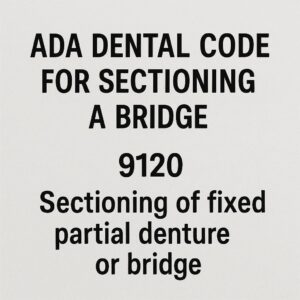
In the dental world, every procedure has a specific code. For sectioning a bridge, that code is D9120.
Understanding what this code means can save you confusion, help you navigate insurance claims, and prepare you for what happens in the dental chair. Whether you are a patient facing this procedure or a front-office professional looking for clarity on billing, this guide breaks down everything you need to know.
We will look at why sectioning is necessary, how the procedure works, the costs involved, and—most importantly—how the ADA code fits into your treatment plan.
What Is a Dental Bridge?
Before we dive into the specifics of sectioning, it helps to understand what a dental bridge actually is. A bridge is a fixed dental restoration used to replace one or more missing teeth. It literally “bridges” the gap where teeth are absent.
Bridges are typically made up of two main components:
-
Abutments: These are the teeth (or dental implants) on either side of the gap. They serve as the anchors.
-
Pontics: These are the false teeth that fill the gap.
Unlike removable partial dentures, bridges are cemented into place. They are not designed to be taken out by the patient. Because of this permanent bond, removing them later—especially if they are in good condition—requires careful planning.
Why Would a Dentist Need to Section a Bridge?
You might wonder why a dentist can’t just yank a bridge off. The answer lies in how bridges are attached. They are secured with strong dental cement designed to last for years, sometimes decades.
Sectioning a bridge becomes necessary in several specific scenarios:
Recurrent Decay (Cavities)
Even though the bridge itself is artificial, the abutment teeth underneath are still vulnerable to cavities. If decay develops under the bridge, the dentist needs to access the tooth to clean it out. Sectioning allows the dentist to remove the bridge without destroying the healthy tooth structure.
Endodontic Issues (Root Canals)
If an abutment tooth becomes infected and requires a root canal, the dentist must access the tooth. A solid bridge blocks that access. Sectioning the bridge releases it so the root canal can be performed.
Bridge Failure or Fracture
Porcelain or metal bridges can fracture over time due to wear and tear. If the bridge itself breaks, sectioning is often the safest way to remove the remaining pieces without damaging the underlying teeth or gums.
Upgrading or Replacing the Restoration
Dentistry has advanced significantly. A bridge that was placed 15 years ago might be functional but outdated. If a patient wants to upgrade to an implant-supported restoration or a new, better-fitting bridge, the old one must be removed.
Cement Failure or Loose Bridge
Sometimes, the cement holding the bridge fails. If the bridge becomes loose but cannot be easily lifted off because of its design, sectioning allows the dentist to remove it in pieces to clean and recement it.
ADA Dental Code D9120 Explained
The American Dental Association (ADA) maintains the Current Dental Terminology (CDT) code set. This is the standardized language dentists use to describe procedures for insurance claims and patient records.
The code specifically for sectioning a bridge is D9120.
What Does D9120 Cover?
According to the ADA’s code description, D9120 is defined as:
“Sectioning of a fixed partial denture (bridge).”
This code is used when a dentist cuts through the connectors of a bridge (the parts that join the pontic to the abutment crowns) to remove it in sections. It is a distinct procedure because it requires specialized burs (dental drills), time, and skill.
D9120 vs. Simple Removal
It is important to distinguish between this and a simple removal.
-
Simple removal: If a bridge is temporary or loosely cemented, a dentist can often pop it off with a tool called a crown remover. This usually isn’t billed separately because it takes minimal time and effort.
-
Sectioning (D9120): If the bridge is permanent, made of hard materials like zirconia, or has been cemented for decades, sectioning is required. This is a surgical procedure in the sense that it involves cutting metal or ceramic.
The Procedure: How Dentists Section a Bridge
If your dentist has told you that you need code D9120, knowing what to expect can ease your anxiety. The procedure is precise and methodical.
Step 1: Assessment and Anesthesia
Before any cutting begins, the dentist will take X-rays to assess the condition of the abutment teeth and the surrounding bone. Local anesthesia is almost always administered. Even though the bridge itself doesn’t have nerves, the gums and teeth underneath are highly sensitive. You should feel pressure, but not pain.
Step 2: Cutting the Connectors
The dentist uses a high-speed handpiece with a specialized carbide or diamond bur. They carefully cut through the connectors—the “joints” between the crowns and the pontics.
-
For a three-unit bridge: The dentist will typically cut between the pontic and each abutment.
-
For a longer bridge: More cuts are made to separate it into individual units.
This step requires extreme caution. The dentist must cut through the hard restoration material without accidentally cutting into the natural tooth underneath.
Step 3: Removal and Dislodging
Once the bridge is cut into separate pieces, each piece becomes much easier to remove. The dentist uses instruments like elevators or hemostats to gently lift each section away from the tooth.
Step 4: Cleaning and Evaluation
After the bridge is removed, the dentist cleans off all residual cement from the abutment teeth. This is a critical step. If cement is left behind, it can lead to gum inflammation or future decay.
At this point, the dentist evaluates the abutment teeth. Often, if a bridge is being sectioned due to decay, the teeth underneath require repair or root canal treatment before a new bridge can be made.
Insurance and Billing for D9120
Navigating dental insurance can be tricky. The D9120 code is often a point of confusion for patients because it represents a procedure that is “incidental” to the main treatment.
Is D9120 Covered?
Coverage depends entirely on why the bridge is being sectioned.
-
If it is medically necessary: If the bridge is being removed to treat decay, perform a root canal, or address an infection, the insurance company is more likely to cover the procedure.
-
If it is elective: If the patient simply wants to upgrade an old but perfectly healthy bridge to a nicer one, the insurance may deny the claim, classifying it as an elective or cosmetic procedure.
Billing Nuances
In many cases, the D9120 code is billed in conjunction with other codes. For example, if the patient needs a root canal on an abutment tooth, the dentist might bill:
-
D9120 (Sectioning of bridge)
-
D3330 (Root canal on a molar)
Some insurance plans consider sectioning part of the “global fee” for the new bridge. In these cases, the insurance may bundle the cost into the new restoration rather than paying for it separately.
Tips for Patients
If you have an upcoming sectioning procedure, here are a few tips to avoid billing surprises:
-
Ask for a pre-determination: Ask your dentist’s office to send a pre-treatment estimate to your insurance company. This will tell you exactly what they will pay for D9120.
-
Clarify the reason: Make sure the dentist’s office documents the medical necessity clearly. Notes like “decay under abutment” or “fractured porcelain” justify the need for the code.
-
Know your out-of-pocket costs: If insurance denies the claim, the cost of sectioning typically falls to the patient.
Cost Analysis: What to Expect to Pay
The cost of sectioning a bridge varies widely based on geographic location, the complexity of the case, and whether it is done by a general dentist or a specialist (like a prosthodontist).
Average Costs
| Procedure | Typical Fee Range (Without Insurance) | Typical Fee Range (With Insurance) |
|---|---|---|
| D9120 Sectioning | $150 – $350 per unit | Copay or deductible applies |
| Complex Sectioning (Specialist) | $300 – $600 | Varies by plan |
Note: These are estimates. Costs vary significantly by region and practice.
Why the Price Varies
-
Material of the bridge: Cutting through a pure zirconia bridge is harder and takes longer than cutting through an acrylic temporary bridge.
-
Location in the mouth: Sectioning a bridge in the front of the mouth is generally easier than sectioning a bridge in the back where access is limited.
-
Number of cuts: A three-unit bridge requires two cuts. A six-unit bridge might require five cuts, increasing the time and complexity.
Sectioning Bridges vs. Crown Removal
Patients often confuse sectioning a bridge with removing a single crown. While they are similar, there are key differences.
| Feature | Crown Removal | Bridge Sectioning (D9120) |
|---|---|---|
| Number of units | One single crown. | Multiple units connected (2 or more). |
| Method | Often uses crown remover tool (slapper). | Requires cutting connectors with a bur. |
| Preservation | Aim is to preserve the crown if possible. | The bridge is usually destroyed and cannot be reused. |
| Code | D2971 (if sectioning a crown) or included in crown removal. | D9120 specifically. |
A crucial point to understand: A sectioned bridge is almost always destroyed. Because the dentist has to cut through the metal or ceramic, the structural integrity of the restoration is compromised. Do not expect to keep your old bridge. If you want to keep it as a souvenir, let your dentist know before they start cutting, as they might be able to save a piece for you.
Risks and Complications
While sectioning a bridge is a routine procedure for experienced dentists, it is not without risks. A good dentist will explain these to you beforehand.
Damage to Abutment Teeth
The most common risk is inadvertently nicking or damaging the natural tooth underneath the bridge. Dentists use magnification (loupes or microscopes) to minimize this risk, but it is always a possibility, especially if the tooth has large previous fillings.
Pulp Exposure
If the bridge was placed over a tooth that was already heavily restored, cutting through the bridge might expose the nerve (pulp) of the tooth. If this happens, the tooth will require a root canal immediately.
Fractured Roots
In rare cases, if an abutment tooth is very weak, the pressure required to dislodge the sectioned pieces can cause the tooth root to fracture. If this happens, the tooth may need to be extracted.
Soft Tissue Trauma
The gums around the bridge are often inflamed due to trapped bacteria. During sectioning, the burs or elevators can irritate the gum tissue, leading to temporary soreness.
Alternatives to Sectioning
Is there any way to remove a bridge without cutting it? In some cases, yes. However, these alternatives are limited.
Crown Removal Instruments
For bridges with weak cement or temporary cement, a dentist may use a “crown slapper” or “coronaflex” system. These tools use vibration or air pressure to break the cement seal. If this works, the bridge comes off in one piece.
Drilling Off (Abrasive Removal)
Some dentists use ultrasonic tips or soft diamond burs to wear down the cement margin. However, if the bridge has been cemented with permanent resin cement, this is often ineffective.
When Sectioning is Mandatory
If the bridge is:
-
Made of zirconia
-
Cemented with resin-modified glass ionomer
-
More than 5 years old
-
Connected to implants
…sectioning is almost always the safest and most predictable method.
The Technical Details: Burs and Techniques
For the dental professionals reading this, or the curious patient, understanding the “how” adds depth to the guide.
Types of Burs Used
-
Carbide burs: These are often preferred for cutting metal frameworks (non-precious metal or semi-precious metal).
-
Diamond burs: These are used for cutting through porcelain or zirconia. They generate heat, so water spray is essential.
-
Specialized sectioning burs: Some manufacturers make long-neck tapered burs specifically designed to cut through connectors without touching the adjacent teeth.
The “Window” Technique
Sometimes, instead of cutting the bridge into pieces, a dentist will drill a “window” into the bridge over the problematic tooth. This allows them to perform a root canal through the bridge. While this avoids destroying the bridge, it leaves a hole that must be filled. This is not coded as D9120, but rather as a restorative repair (usually D2950 or D2999).
Patient Experience: What Does It Feel Like?
If you are a patient scheduled for D9120, you might be nervous. Let’s demystify the sensory experience.
Sound
You will hear the high-pitched whine of the dental drill. Because the drill is cutting through hard ceramic or metal, it might be louder than a typical filling. If this bothers you, bring noise-canceling headphones.
Vibration
Cutting through a bridge produces vibration. You will feel this in your jaw. It is not painful (thanks to the anesthetic), but it is a strange sensation. Let your dentist know if you feel any sharp pain—this indicates you might need more freezing.
Taste
You may taste a gritty or metallic residue. This is the dust from the bridge material. The dental assistant will use suction to keep your mouth clear, but some residue is normal.
Time
Depending on the complexity, sectioning a bridge takes between 15 and 45 minutes. If the dentist also needs to perform a root canal or prepare the teeth for a new bridge immediately after, the appointment will be longer.
Aftercare: What Happens Next?
Once the bridge is removed, you are not done with treatment. The dentist will likely discuss the next steps.
Immediate Aftercare
Your gums may be sore for a few days. The abutment teeth might be sensitive to temperature.
-
Rinse with warm salt water.
-
Avoid chewing on that side for 24 hours.
-
Use over-the-counter pain relievers like ibuprofen if needed.
Temporary Restoration
Unless a new bridge is being placed immediately, the dentist will usually make a temporary bridge or place temporary crowns on the abutment teeth. You cannot leave the abutment teeth exposed for long periods, as they are vulnerable to shifting (drifting) and temperature sensitivity.
Long-Term Options
After sectioning, your long-term options typically include:
-
New Bridge: A new, better-fitting bridge is fabricated.
-
Implant Restoration: The abutment teeth are extracted or left, and dental implants are placed to support a new bridge.
-
Partial Denture: If the abutment teeth are compromised, a removable partial denture might be the best option.
How to Find a Dentist Skilled in Sectioning
Not all dentists feel comfortable sectioning complex bridges. This is a skill that requires experience, especially with high-strength materials like zirconia.
Questions to Ask
If you are looking for a second opinion or need a specialist:
-
“How often do you perform D9120?”
-
“Do you use magnification (loupes) for sectioning?”
-
“What is your protocol if the abutment tooth gets damaged during removal?”
Who Performs This?
-
General Dentists: Most experienced general dentists perform this regularly.
-
Prosthodontists: These are specialists in restoration and replacement. They handle the most complex cases.
-
Oral Surgeons: Sometimes, if the sectioning is combined with an extraction, an oral surgeon will perform the removal.
Common Misconceptions About Sectioning Bridges
There is a lot of misinformation out there. Let’s clear up a few myths.
Myth 1: “Sectioning ruins the teeth underneath.”
Reality: When done correctly, sectioning preserves the teeth. Leaving a decayed bridge in place ruins the teeth underneath. Sectioning is the rescue operation.
Myth 2: “It’s cheaper to just pull the tooth than to remove the bridge.”
Reality: While extracting a tooth is often cheaper than sectioning a bridge, losing a tooth changes your dental architecture. You will likely need an implant or a longer bridge later, which is far more expensive in the long run.
Myth 3: “My insurance should cover 100% of the removal.”
Reality: Insurance often covers 50-80% of diagnostic and minor surgical procedures like D9120, depending on your plan. “100% coverage” is rare for this code unless you have a top-tier PPO plan.
Myth 4: “The dentist can reuse my bridge after sectioning.”
Reality: No. A sectioned bridge is like a broken vase. Even if you glue it back together, it will never be as strong as it was, and it will harbor bacteria at the cracks.
Advanced Considerations: Implant Bridges
The D9120 code applies to tooth-supported bridges. However, there is a growing trend toward implant-supported bridges (fixed detachable prostheses).
Removing a bridge that is screwed into implants is completely different. It does not use code D9120. Instead, the dentist simply unscrews the bridge.
If the implant bridge is cemented (cement-retained), the removal process is similar to a tooth bridge, but the risk is higher. Implants do not have a periodontal ligament (the cushion that natural teeth have). Applying too much force to an implant during removal can fracture the implant screw or the implant itself. In these cases, sectioning must be done with extreme precision, often using ultrasonic tips rather than burs.
Legal and Ethical Considerations
From a practice management perspective, documenting the need for D9120 is crucial.
Informed Consent
Patients must sign a consent form specifically for sectioning. This consent should note:
-
The bridge will be destroyed.
-
There is a risk of damage to the underlying teeth.
-
The need for additional treatment (like root canals or extractions) may arise.
Insurance Fraud
It is unethical and illegal to bill D9120 if the bridge was simply “popped off” without cutting. Similarly, billing D9120 for a temporary bridge that was designed to be removable is considered upcoding. Dentists must use the code only when the clinical situation meets the definition.
Future of Bridge Removal: Technology
Dental technology is evolving. In the future, sectioning bridges may become less invasive.
Lasers
Erbium lasers can cut through ceramic and cement. Currently, they are not widely used for sectioning because they are slower than burs, but they offer the advantage of being less traumatic to the tooth structure.
3D Printing and Digital Planning
Before sectioning a complex bridge, some dentists use intraoral scanners to create a 3D model. They can plan exactly where to cut on a computer screen before touching the patient. This improves accuracy and reduces the risk of damaging the underlying tooth.
Summary of Key Takeaways
To summarize the essential points about the ADA dental code for sectioning a bridge:
-
Code D9120 is the specific ADA code used to bill for the surgical separation and removal of a fixed bridge.
-
It is necessary when decay, fracture, or root canal issues occur under an existing bridge.
-
The procedure involves cutting the connectors of the bridge to remove it in pieces, which usually destroys the bridge.
-
Costs typically range from $150 to $600 depending on complexity and location, though insurance may cover it if medically necessary.
-
Risks include damage to the abutment teeth, pulp exposure, and soft tissue irritation, though these are minimized by skilled practitioners.
-
Alternatives exist (like crown removers), but permanent bridges usually require sectioning for safe removal.
Conclusion
Understanding the ADA dental code for sectioning a bridge (D9120) transforms a stressful situation into a manageable one. It allows patients to verify insurance coverage and understand the value of the technical skill involved. For dental professionals, it represents a commitment to preserving natural teeth by safely removing failed restorations.
While the idea of cutting through a dental bridge sounds intimidating, it is a routine, life-saving procedure for teeth trapped underneath failing restorations. By recognizing the importance of this code, you ensure that you receive not only the correct treatment but also fair and transparent billing.
Frequently Asked Questions (FAQ)
1. Is D9120 the only code for removing a bridge?
Generally, yes. D9120 is the specific CDT code for sectioning a fixed partial denture. If a bridge is removed without sectioning (e.g., it comes off in one piece), the dentist may use a different code or include it in the fee for the new restoration.
2. Will I feel pain during the sectioning procedure?
No. Your dentist will administer local anesthetic to numb the area completely. You will feel pressure and vibration, but you should not feel sharp pain. If you do, tell your dentist immediately so they can administer more anesthetic.
3. Can I keep my bridge after it is sectioned?
You can ask to keep it, but it will be in pieces. Since the bridge is cut into sections, it is no longer functional. Some patients like to keep it as a reminder or curiosity, but it cannot be re-used.
4. Does insurance always cover D9120?
Not always. If the removal is considered part of the preparation for a new bridge (elective), some insurance plans deny coverage. However, if the removal is required to treat a medical condition like decay or infection, it is typically covered under your major or basic services category.
5. How long does it take to recover from bridge sectioning?
There is usually no “downtime” other than local soreness. If the gums were inflamed, they may be tender for 2-3 days. You can usually resume normal activities immediately after the appointment.
6. What happens if the tooth breaks during removal?
If an abutment tooth fractures during sectioning, the dentist will evaluate whether it can be saved. If the fracture extends below the gum line, the tooth may need to be extracted. This is a known risk that should be discussed before the procedure begins.
7. Can a general dentist perform D9120, or do I need a specialist?
Most general dentists perform D9120 routinely. However, if the bridge is extremely complex, located near the sinus, or attached to implants, your general dentist may refer you to a prosthodontist or oral surgeon.
8. How do I know if my bridge needs sectioning?
Your dentist will test the bridge’s stability. If it does not budge with gentle pressure and X-rays show it is solid, they will likely opt for sectioning. Trying to force a bridge off without cutting can damage the supporting teeth or jaw.
Additional Resource
For the most up-to-date information on CDT codes and dental procedure definitions, the American Dental Association (ADA) is the definitive source.
Link: ADA Current Dental Terminology (CDT)