ADA Dental Code for Veneers: A Complete Guide for Patients
- On
- InDENTAL CODE
If you have been told you might need veneers, or if you are simply curious about how dentists bill for this popular cosmetic procedure, you have probably seen a confusing mix of letters and numbers on a treatment plan. One of the most common questions patients ask is: what is the correct ADA dental code for veneers?
The short answer is that there is not just one code. Dentists in the United States use the Current Dental Terminology (CDT) codes published by the American Dental Association (ADA). For veneers, the codes depend on the material used and the number of surfaces covered.
This guide walks you through everything you need to know. We will explain each code in plain language, talk about costs, discuss insurance limitations, and help you read your dental bill like a pro.
Let us start with the basics.
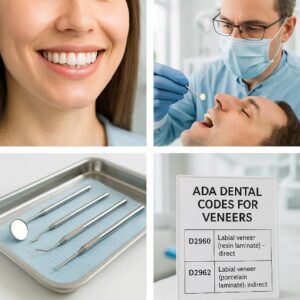
Table of Contents
ToggleWhat Are Dental Veneers?
Before we look at the codes, it helps to understand what a veneer actually is. A veneer is a thin, custom-made shell that a dentist bonds to the front surface of a tooth. The goal is to improve the appearance of your smile.
Veneers can fix several cosmetic issues, including:
-
Discolored teeth that do not respond to whitening
-
Chipped or worn-down teeth
-
Gaps between teeth
-
Irregularly shaped or slightly crooked teeth
Most veneers are made from either composite resin (applied directly in the office) or porcelain (fabricated in a lab and bonded later). The material matters a lot for billing, which you will see in the codes below.
Why the ADA Dental Code for Veneers Matters to You
You might wonder why you should care about a billing code. After all, your dentist handles insurance and paperwork, right? That is true, but understanding the code helps you in several ways.
First, it lets you verify that your dentist is billing for the correct procedure. Mistakes happen. Second, it helps you talk to your insurance company. If you know the exact code, you can ask specific questions about coverage. Third, it allows you to compare treatment plans from different dental offices.
In short, knowing the code puts you in control.
The Official ADA Dental Codes for Veneers
The ADA does not have a single code called “veneers.” Instead, veneer procedures fall under several codes. The three main ones you will see are D2960, D2961, and D2962.
Let us break down each one.
D2960 – Labial Veneer (Resin Laminate) – Chairtime
This code is used for a direct resin veneer. The dentist builds the veneer directly on your tooth during a single visit. There is no dental laboratory involved.
Here is what happens step by step:
-
Your dentist prepares the tooth surface (usually minimal shaping).
-
A bonding agent is applied.
-
Layers of composite resin are placed, shaped, and hardened with a special light.
-
The veneer is polished to match your other teeth.
Because this is done entirely in the chair (chairtime), it is often less expensive than lab-made veneers. However, resin veneers generally do not last as long as porcelain. You might need replacements or repairs after three to five years.
Key point: D2960 covers only the front surface (labial) of the tooth. This is the surface facing your lips or cheeks.
D2961 – Labial Veneer (Resin Laminate) – Laboratory
This code also covers a resin veneer, but with a major difference. The veneer is made in a dental laboratory, not directly on your tooth.
The process involves:
-
Your dentist prepares the tooth and takes an impression.
-
The impression is sent to a lab.
-
A technician fabricates the resin veneer.
-
In a second visit, your dentist bonds the finished veneer to your tooth.
Why choose a lab-fabricated resin veneer? It can offer better fit and more consistent thickness compared to a direct resin veneer. It also allows for more complex color matching. But it requires two visits and higher lab fees.
D2962 – Labial Veneer (Porcelain Laminate) – Laboratory
This is the most popular code for cosmetic veneers. D2962 covers a porcelain (ceramic) laminate veneer made in a laboratory.
Porcelain veneers are known for:
-
Excellent stain resistance
-
Natural translucency that mimics real tooth enamel
-
Longevity (ten to fifteen years or more with good care)
-
Strength and durability
Like D2961, this code requires two visits. The dentist prepares the tooth, takes impressions, places temporary veneers (if needed), and then bonds the final porcelain veneers at the second appointment.
D2962 is the code most dentists use for high-quality cosmetic smile makeovers.
Quick Reference Table: ADA Veneer Codes
Here is a simple table to help you compare the three main codes at a glance.
| ADA Code | Procedure Description | Material | Laboratory Involvement | Typical Number of Visits |
|---|---|---|---|---|
| D2960 | Direct resin veneer (chairtime) | Composite resin | No | One |
| D2961 | Indirect resin veneer (lab) | Composite resin | Yes | Two |
| D2962 | Indirect porcelain veneer (lab) | Porcelain/ceramic | Yes | Two |
Are There Other Related Codes You Should Know?
Yes. The three codes above are the core veneer codes, but your dental treatment plan might include other ADA codes. These are not veneer codes themselves, but they often appear alongside veneer work.
D2391 – D2394 (Resin-Based Composite Restorations)
These codes cover composite fillings. In some cases, a dentist might build up a tooth with composite resin without calling it a full veneer. This is more common for repairing a single small chip. The cost is usually lower than a D2960.
D2980 – Crown Repair
If an existing crown needs repair, this code might be used. It is not a veneer code, but patients sometimes confuse crown repair with veneer placement.
D9110 – Palliative (Emergency) Treatment
If you come in with pain or sensitivity related to a veneer, this code might cover an emergency visit. It is not a replacement for the veneer code itself.
D9999 – Unspecified Adjunctive Procedure
Rarely, a dentist might use this code for a unique or experimental veneer-like procedure. If you see D9999 on your bill, ask for a clear explanation.
What About Bonding? Is That a Veneer?
This is a common point of confusion. Dental bonding is not the same as a veneer, even though both use composite resin.
-
Bonding (often billed as D2330-D2335) is usually for smaller repairs. The dentist applies resin to a limited area, like a chipped corner.
-
A direct resin veneer (D2960) covers the entire labial (front) surface of the tooth.
In practice, some dentists use the terms loosely. If you are quoted a price for bonding but expect a full veneer, ask which ADA code will be used. The difference matters for cost and insurance.
How Much Do Veneers Cost Under Each ADA Code?
Costs vary widely depending on where you live, the dentist’s experience, and the laboratory fees. However, national averages give you a useful benchmark.
| ADA Code | Average Cost Per Tooth (USA) | Typical Range |
|---|---|---|
| D2960 (Direct resin) | $250 – $600 | $200 – $800 |
| D2961 (Indirect resin) | $400 – $900 | $350 – $1,200 |
| D2962 (Porcelain) | $900 – $2,500 | $800 – $3,500+ |
These costs usually include:
-
The initial consultation and exam
-
Tooth preparation
-
Impressions or digital scans
-
The veneer itself (direct or lab-made)
-
Bonding and finishing
-
Follow-up adjustments
They do not usually include:
-
X-rays (billed under D0210, D0220, D0230, etc.)
-
Diagnostic casts or study models (D0470)
-
Temporary veneers (sometimes included, sometimes separate)
-
Anesthesia or sedation
Always ask for a written treatment plan with all ADA codes and fees before you start.
Does Dental Insurance Cover Veneers?
This is the part most patients find disappointing. The honest answer is: usually not.
Because veneers are considered a cosmetic procedure, most dental insurance plans exclude them. Insurance companies follow the logic that veneers improve appearance rather than restore health or function.
However, there are some exceptions.
When Insurance Might Pay
A few scenarios might lead to partial coverage:
-
Medical necessity: If a veneer is needed to restore a tooth after trauma or decay, a portion might be covered. The dentist would need to submit X-rays and a narrative explaining why a filling or crown is not appropriate.
-
Alternative benefit clause: Some plans allow coverage for the least expensive alternative treatment. For example, if a crown costs $1,200 and a veneer costs $900, the plan might cover the $900 veneer as an alternative.
-
Accidental damage rider: Rarely, a dental plan includes a rider for accidental damage to front teeth. This might cover a veneer if the original tooth was healthy before an accident.
Even in these cases, you will likely pay a deductible and a percentage (often 50% after meeting the deductible). Annual maximums also apply.
Important Note for Readers
*Do not assume your insurance will cover veneers just because a dentist uses an ADA code. Many dentists will still submit a claim using D2960, D2961, or D2962. The insurance company will likely deny it as cosmetic. Always get a pre-treatment estimate (predetermination) before committing to veneers.*
Can You Use Dental Savings Plans or Discounts?
Yes. If you do not have traditional insurance, or if your plan excludes veneers, you have options.
-
In-house membership plans: Some dental offices offer their own discount plans. You pay an annual fee and receive 10% to 20% off all procedures, including veneers.
-
Third-party discount cards: Companies like Careington or Aetna Dental Access offer discounted fee schedules. The discount varies by provider and region.
-
Health Savings Account (HSA) or Flexible Spending Account (FSA): Even if insurance does not cover veneers, you can use pre-tax dollars from these accounts to pay for them. The ADA code on your receipt serves as proof of a dental procedure.
Reading Your Dental Bill: A Step-by-Step Example
Let us walk through a real-world example. Imagine you receive porcelain veneers on teeth #7 and #8 (the two front teeth).
Your itemized bill might look like this:
| Code | Description | Tooth Number | Fee |
|---|---|---|---|
| D0150 | Comprehensive oral exam | $85 | |
| D0210 | Full mouth X-rays | $125 | |
| D2962 | Labial veneer (porcelain) | Tooth #7 | $1,800 |
| D2962 | Labial veneer (porcelain) | Tooth #8 | $1,800 |
| D0470 | Diagnostic casts | $75 | |
| D2950 | Core buildup (if needed) | Tooth #7 | $150 |
| Total | $4,035 |
Insurance (if cosmetic exclusion applies) might pay $0. If there is an alternative benefit, they might pay 50% of the cost of composite veneers (D2960) as a substitute, which could be around $250 per tooth.
The key takeaway: always ask your dentist to list every ADA code before treatment begins. Then you can check with your insurance or plan your budget.
How to Verify an ADA Dental Code with Your Dentist
Sometimes, a dentist might use a different code than expected. Here is how to politely confirm.
Ask this: “I see you are using code D2962 for my porcelain veneers. Could you confirm that this is the correct ADA code for this procedure?”
Then ask: “Is there any chance my insurance might consider an alternative code like D2960 for billing purposes?”
A transparent dental office will answer both questions without hesitation. If a dentist refuses to share or explain codes, consider getting a second opinion.
Common Mistakes Patients Make with Veneer Codes
Avoid these errors to save yourself money and confusion.
Mistake #1: Assuming One Code Fits All
Some patients think “veneers” means one price and one code. As you have seen, there are three main codes, and each has different costs and lab requirements.
Mistake #2: Not Getting a Predetermination
Even if your dentist says “we take your insurance,” that does not mean veneers are covered. A predetermination is a written estimate from your insurance company. Without it, you are guessing.
Mistake #3: Ignoring the Tooth Number
The ADA code alone is not enough. The bill must also list the tooth number (using the universal numbering system: teeth #1 through #32). Check that each veneer is listed on the correct tooth.
Mistake #4: Confusing Veneer Codes with Crown Codes
A crown (D2740 for porcelain crown) covers the entire tooth, including the back. A veneer only covers the front. Crowns are generally more expensive and more invasive. Make sure you are getting the procedure you actually want.
What the ADA Says About Veneer Codes (Official Guidance)
The American Dental Association updates the CDT codes every two years. As of the most recent edition (CDT 2024), the codes D2960, D2961, and D2962 remain active and unchanged.
The ADA defines a veneer as: “A thin covering of the facial surface of a tooth that is directly placed or indirectly fabricated and cemented.”
They also clarify that a veneer is not a crown. If a restoration covers the entire tooth, including the lingual (tongue) side, you should use crown codes instead.
You can purchase the full CDT manual from the ADA’s website, but for most patients, the information above is sufficient.
Frequently Asked Questions (FAQ)
1. What is the most common ADA code for porcelain veneers?
D2962 is the standard code for porcelain (ceramic) laminate veneers made in a laboratory.
2. Can a dentist bill D2960 if they use porcelain?
No. D2960 is specifically for direct resin (composite) veneers. Porcelain veneers require a lab code: either D2962 (most common) or occasionally D2963 for pressed ceramic.
3. Is there an ADA code for veneer repair?
There is no specific veneer repair code. Dentists typically use D2980 (crown repair) or D2999 (unspecified restorative procedure) for veneer repairs. Some use a composite bonding code like D2330. Ask for clarification before the repair.
4. Do all dentists use the same ADA codes?
Yes. The CDT codes are standardized across the United States. Any dentist who bills insurance or provides an itemized receipt should use the official ADA codes. The interpretation of when to use each code can vary slightly, but the code numbers are universal.
5. Why did my dentist use D2961 instead of D2962?
Your dentist might prefer indirect resin veneers because they are less expensive than porcelain but offer better fit than direct resin. It is a valid code for resin lab-fabricated veneers. If you expected porcelain, discuss the difference in materials and longevity.
6. How can I look up an ADA code myself?
You can purchase the CDT manual from the ADA Store (ada.org). Alternatively, many dental billing websites offer free code lookup tools, but always verify with official sources.
7. Will my insurance cover D2960 if it is medically necessary?
Possibly. If a front tooth has decay or fracture that requires a restoration, and a veneer is the most appropriate treatment, some plans will cover D2960 as a medically necessary service. You will need documentation from your dentist, including X-rays and a narrative letter.
8. Can I use D2962 for a single tooth?
Yes. Veneer codes are per tooth. You can bill D2962 for one tooth, two teeth, or ten teeth. Each tooth is listed separately on the claim form.
9. What is the difference between D2962 and D2740?
D2962 is a porcelain veneer (front surface only). D2740 is a porcelain crown (full coverage). Crowns cost more and require more tooth reduction.
10. Are there any new veneer codes coming in future CDT editions?
As of now, no new veneer codes have been announced for CDT 2025 or 2026. The ADA periodically reviews codes, but D2960, D2961, and D2962 have been stable for many years.
Additional Resources for Readers
For further reading and official verification, we recommend the following trusted source:
🔗 American Dental Association – CDT Code Lookup
Visit the official ADA website and search for “CDT Codes” to access the most current dental procedure codes. You can also purchase the full CDT manual directly from the ADA Store.
Note: Always rely on official ADA publications for definitive coding guidance. This article is for educational purposes and does not replace professional dental or insurance advice.
Final Thoughts: Choosing the Right Veneer Code for Your Smile
Understanding the ADA dental code for veneers does not have to feel overwhelming. Whether your treatment plan shows D2960, D2961, or D2962, each code represents a different combination of materials, time, and laboratory work.
The best code for you depends on your budget, your cosmetic goals, and how long you want your veneers to last.
-
Choose D2960 if you want a quick, affordable solution and do not mind replacing the veneers more often.
-
Choose D2961 if you want a resin veneer with better lab precision but at a mid-range price.
-
Choose D2962 if you want the most natural, durable, and stain-resistant option for a long-term smile investment.
Before you sign any treatment plan, ask your dentist to write down every ADA code and explain it in plain English. A great dentist will be happy to do this. Then, call your insurance company for a predetermination. Even if they deny coverage, you will know exactly what to expect.
Your smile is unique, and the right veneer code is simply a tool to help you get there with clarity and confidence.
Conclusion
The ADA dental codes for veneers are D2960 (direct resin), D2961 (indirect resin), and D2962 (porcelain). Each code reflects different materials, lab involvement, and cost. Insurance rarely covers veneers because they are cosmetic, but understanding these codes helps you verify bills, compare treatment plans, and make informed decisions about your smile.
Disclaimer: This article provides general information about ADA dental codes for educational purposes. It does not constitute medical, dental, or legal advice. Always consult with a licensed dentist and your insurance provider for decisions about your specific dental treatment.

dentalecostsmile
Newsletter Updates
Enter your email address below and subscribe to our newsletter