The Complete Guide to Understanding CBCT Scan Dental Cost in 2025
Navigating the world of advanced dental imaging can feel overwhelming, especially when you’re trying to budget for your care. If your dentist has recommended a Cone Beam Computed Tomography (CBCT) scan, your first question is likely a practical one: “What will this cost?” You’re not alone. The price of a dental CBCT scan isn’t a single number you can find on a menu; it’s a variable influenced by a myriad of factors, from the technology used to the specific reason for your scan.
This guide is designed to demystify CBCT scan dental costs entirely. We’ll move beyond simple price ranges and delve into the why behind the numbers. You’ll learn what a CBCT scan is, what makes it different (and sometimes more expensive) than traditional X-rays, and the key elements that determine your final bill. More importantly, we’ll provide you with a realistic framework for understanding costs in 2025, discuss insurance nuances, and offer practical strategies for managing this investment in your oral health. Our goal is to empower you with knowledge, turning a question mark into a clear, actionable understanding.
What is a Dental CBCT Scan?
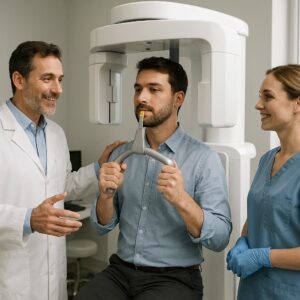
Before we talk about cost, it’s crucial to understand what you’re paying for. A CBCT scan is a specialized type of X-ray machine that revolutionizes how dentists see your oral and maxillofacial structure (that’s your jaw, teeth, nerves, sinuses, and bone).
Imagine taking a traditional dental X-ray, which gives a flat, two-dimensional picture, and transforming it into a detailed three-dimensional model. That’s the power of CBCT. The machine rotates around your head in a single, quick pass (usually in under a minute), capturing hundreds of distinct images. Sophisticated computer software then stitches these images together to create a precise 3D volumetric model of your anatomy.
Key Differences Between CBCT and Traditional X-Rays
-
3D vs. 2D: CBCT provides depth, allowing dentists to view structures from any angle, slice through bone, and measure dimensions with high accuracy. A traditional panoramic or bitewing X-ray is flat and can superimpose structures, hiding potential issues.
-
Detail and Clarity: CBCT offers exceptional detail of bone quality, tooth orientation, nerve pathways, and soft tissue outlines. This is invaluable for complex procedures.
-
Radiation Exposure: While a CBCT scan uses more radiation than a single small intraoral X-ray, it often uses significantly less than a traditional medical CT scan. The exposure is targeted and optimized for dental purposes, making it a safe and effective diagnostic tool when appropriately prescribed.
Common Dental Applications for CBCT Scans
This technology isn’t used for routine check-ups. Dentists prescribe it for specific, often complex, diagnostic and planning scenarios where 2D imaging falls short:
-
Dental Implant Planning: This is the most common use. The 3D image allows the surgeon to precisely evaluate bone density, volume, and location of critical structures like the inferior alveolar nerve (the nerve that gives feeling to your lower lip and chin) and sinuses. This enables virtual placement of implants for optimal function and aesthetics, often eliminating surprises during surgery.
-
Impacted Tooth Assessment: For impacted wisdom teeth or canines, CBCT shows the exact position of the tooth in relation to roots of adjacent teeth and nerves, guiding safe extraction or exposure procedures.
-
Endodontic (Root Canal) Diagnosis and Treatment: It can reveal complex root canal anatomy, fractures, infections (abscesses), or resorption that are invisible on standard X-rays.
-
TMJ (Temporomandibular Joint) Analysis: It provides detailed images of the jaw joint’s bony structures, helping diagnose arthritis, degeneration, or other disorders.
-
Orthodontic Planning: For complex orthodontic cases, especially those involving surgical correction of jaw discrepancies, CBCT provides a comprehensive view of tooth roots, airway space, and skeletal relationships.
-
Oral Surgery and Pathology: It aids in evaluating cysts, tumors, or other lesions within the jawbone, determining their size, extent, and effect on surrounding structures.
A leading oral surgeon notes: “CBCT imaging has moved from a luxury to a standard of care for implantology and complex oral surgery. The cost of the scan is an investment in predictability and safety, often reducing surgical time, improving outcomes, and minimizing the risk of complications that are far more costly to address.”
Breaking Down the Factors That Influence CBCT Scan Dental Cost
So, why does the price seem to vary so much from one practice to another, or even from one patient to another? The final cost is not arbitrary; it’s built from several key components. Understanding these will help you interpret any quote you receive.
1. Type of Scan and Field of View (FOV)
This is arguably the most significant factor. The “Field of View” refers to the size of the area captured by the scan. Machines can typically capture small, medium, or large volumes of data.
-
Small FOV (e.g., 5cm x 5cm): Focuses on a tiny area, like 2-3 teeth. Ideal for a single implant site or a detailed endodontic assessment of one tooth. This is usually the least expensive option.
-
Medium FOV (e.g., 10cm x 10cm): Captures a full dental arch (upper or lower jaw) and beyond. Used for multiple implant planning, assessing impacted teeth, or evaluating a quadrant of the mouth.
-
Large FOV (e.g., 15cm x 15cm or larger): Captures both jaws, sinuses, nasal cavity, and TMJs—essentially the entire maxillofacial region. Required for orthognathic (jaw) surgery planning, full-mouth reconstruction, or complex airway analysis. This is typically the most expensive option due to the volume of data and diagnostic complexity.
2. Geographic Location and Practice Overhead
Just like the cost of living, dental care costs fluctuate by region. A practice in a major metropolitan city (e.g., New York, San Francisco, London) will almost always have higher operational costs—rent, salaries, utilities—than a practice in a suburban or rural area. These overheads are reflected in all their fees, including imaging.
3. Type of Dental Practice
The setting where you get the scan plays a role.
-
Specialist Practice (Oral Surgeon, Endodontist, Periodontist): Specialists who perform complex procedures like implants or root canals may have higher scan fees. This often includes a detailed interpretation and surgical guide planning. You’re paying for their advanced expertise in using the data.
-
General Dentist Office: An increasing number of general dentists have in-house CBCT machines. Their fees might be slightly lower, especially if the scan is for a straightforward referral or initial assessment. However, they may still refer the data to a specialist for interpretation in complex cases.
-
Independent Imaging Center: Some areas have dedicated radiology centers that serve multiple dental practices. Their prices can be competitive, but you may need a separate appointment and your dentist will receive the images for review.
4. Complexity of Interpretation and Planning
A CBCT scan produces raw data. The value lies in what the dental professional does with it. The fee often includes:
-
Radiologist’s Report: Some scans, especially large FOVs, may be sent to a maxillofacial radiologist for an official diagnostic report, adding to the cost.
-
Surgical Guide Design: For dental implants, the 3D data is used to design and fabricate a custom surgical guide—a stent that fits over your teeth/gums to direct drill placement with pinpoint accuracy. The cost of designing and producing this guide is frequently bundled into the total “implant planning” fee, which includes the scan.
-
Consultation Time: The time your dentist or surgeon spends analyzing the 3D model, explaining it to you, and integrating it into your treatment plan is part of the professional service.
5. Technology and Software
Newer machines with higher resolution, lower radiation doses, and advanced imaging software may command a higher fee. Practices must recoup the substantial investment (often $100,000+ for the equipment) and ongoing software licensing costs.
CBCT Scan Dental Cost Ranges in 2025: A Realistic Breakdown
Please treat the following figures as guidelines and estimates. You must always get a formal, written treatment plan and quote from your specific dental provider. These ranges reflect market trends as of 2025 for the scan procedure itself, not including additional consultation or procedure fees.
Comparative Cost Table: CBCT Scan by Type
| Type of CBCT Scan | Typical Field of View (FOV) | Primary Use Cases | Estimated Cost Range (2025) | Notes |
|---|---|---|---|---|
| Small FOV Scan | Focused area (e.g., 1-3 teeth) | Single implant site, detailed root canal analysis, small lesion assessment. | $150 – $350 | Most limited scan. Often the lowest cost and radiation dose. |
| Medium FOV / Single Arch | One full jaw and surrounding area | Multiple implant planning in one jaw, assessment of impacted teeth (e.g., wisdom teeth), sinus evaluation. | $250 – $500 | The most commonly quoted range for standard implant planning cases. |
| Large FOV / Full Mouth | Both jaws, sinuses, TMJs | Full-mouth reconstruction, orthognathic surgery, complex airway/sleep apnea analysis, major trauma. | $400 – $800+ | Highest data volume. Cost includes broader diagnostic interpretation. May require radiologist’s report. |
| Scan with Implant Surgical Guide | Varies (usually Medium FOV) | Guided implant surgery for precision. | $500 – $1,200+ | This is a bundled fee. Includes scan, software planning, and fabrication of the custom physical guide. Price varies by number of implants. |
Additional Cost Considerations
-
New Patient/Comprehensive Exam Fee: If the CBCT is part of an initial work-up, there may be a separate new patient exam fee.
-
Follow-Up or Review Scan: In some long-term treatments, a follow-up scan may be needed to monitor healing or graft integration, incurring an additional cost.
-
Image Transfer Fees: Some practices may charge a small fee to provide a copy of your DICOM files (the raw 3D data) on a disc or via a secure portal, which is useful for seeking a second opinion.
Dental Insurance and CBCT Scans: What to Expect
Navigating insurance coverage for CBCT can be confusing. Here’s a realistic overview:
-
Medical Necessity is Key: Insurance companies, both dental and medical, typically cover procedures they deem “medically necessary.” A CBCT for a simple cavity check won’t qualify. However, a scan for diagnosing a suspected pathology (cyst, tumor), evaluating TMJ disorders, or planning for the extraction of a deeply impacted wisdom tooth may have coverage, often under your medical insurance, not dental.
-
Dental Insurance Coverage: For implant planning, coverage is highly variable. Some premium PPO plans may offer a partial reimbursement (e.g., 50% of the scan fee, up to a yearly maximum), considering it part of the diagnostic process for a covered implant procedure. Many basic plans exclude it entirely, labeling it as “advanced imaging” or “not a routine service.”
-
Pre-Determination/Pre-Authorization is Crucial: This is the most important step you can take. Before scheduling the scan, ask your dental provider’s office to submit a pre-authorization request to your insurance company. This requires them to send a narrative and X-rays justifying the need for the CBCT. The insurance company will then respond in writing, stating what, if anything, they will cover. This prevents unexpected bills.
-
Medical Insurance for Major Cases: For scans related to sleep apnea appliance design, jaw surgery (orthognathic surgery), or trauma, your medical insurance is the primary payer. Your dental team will need to work with your physician to submit the claim with appropriate medical diagnosis codes (ICD-10) and procedure codes (CPT codes).
Important Note for Readers: “Do not assume your CBCT scan is covered. Always, without exception, request a pre-determination from your insurance provider based on the specific procedure code and diagnosis your dentist provides. This simple step can save you hundreds of dollars in surprises.”
How to Navigate and Manage the Cost of a Dental CBCT Scan
Feeling informed is the first step to feeling in control. Here are actionable strategies:
1. Ask Informed Questions
When a CBCT is recommended, have a conversation with your dentist:
-
“Why is a CBCT necessary for my case compared to traditional X-rays?”
-
“What size Field of View (FOV) do you recommend, and why?”
-
“Can you provide a detailed, written breakdown of the cost for the scan alone, and the cost if it’s part of a larger procedure (like implants)?”
-
“Does this fee include your interpretation and analysis, or a radiologist’s report?”
-
“Do you offer a payment plan for this service?”
2. Seek a Second Opinion
If a recommended treatment plan involving a CBCT scan is extensive and expensive, it is perfectly reasonable and prudent to seek a consultation with another qualified dentist or specialist. You can request a copy of your existing X-rays (and the CBCT DICOM files if already taken) to bring with you, potentially avoiding a duplicate scan.
3. Explore Financing Options
Most dental practices understand that large, unplanned expenses are challenging. They often offer:
-
In-House Payment Plans: Spreading the cost over a few months without interest.
-
Third-Party Medical Financing: Through companies like CareCredit, Alphaeon, or LendingClub. These often offer promotional periods with no interest if paid in full within a set time (e.g., 6, 12, or 18 months). Read the terms carefully, as deferred interest can be significant if not paid in time.
4. Understand the Value Proposition
It’s vital to reframe the cost from an expense to an investment. A CBCT scan can:
-
Increase Safety: By clearly mapping nerve canals and sinus cavities, it drastically reduces the risk of nerve damage or sinus perforation during surgery.
-
Improve Outcomes: Accurate planning leads to better implant positioning, more successful grafts, and optimal aesthetic results.
-
Save Time (and Money) Long-Term: It can prevent unforeseen complications during surgery, which are more complex and costly to fix. It also helps ensure the longevity of your treatment.
Conclusion
The cost of a dental CBCT scan is a variable investment in precision, safety, and successful long-term outcomes, typically ranging from $150 for a small area to over $800 for a full-mouth scan in 2025. Your final price is shaped by the scan’s scope, your location, and the required professional analysis. By understanding these factors, proactively engaging with your insurance, and viewing the scan as a critical tool for informed care, you can approach this aspect of modern dentistry with confidence and clarity.
Frequently Asked Questions (FAQ)
Q: Is a CBCT scan really worth the extra cost compared to a regular X-ray?
A: For routine check-ups, no. But for complex procedures like implants, impacted tooth removal, or diagnosing obscure pain, it is often invaluable. It provides a 3D roadmap that 2D X-rays cannot, leading to safer, more predictable, and often more efficient treatment. The cost can be offset by avoiding complications.
Q: How often will I need a CBCT scan?
A: It is not a routine screening tool. You will likely only need one for the specific diagnosis or treatment planning of a complex issue. In some multi-phase treatments (e.g., bone grafting followed later by implants), a follow-up scan may be needed to assess healing before proceeding.
Q: Can I get my CBCT scan done at a cheaper imaging center and bring it to my dentist?
A: Sometimes, yes. If there is an independent imaging center nearby, you can get a prescription/referral from your dentist. However, ensure the center can provide the correct Field of View (FOV) and deliver the data in the required format (DICOM files) that your dentist’s software can use. Coordination is key.
Q: Does the radiation from a CBCT scan pose a significant risk?
A: Dental CBCT uses significantly less radiation than a medical CT scan. The dose is carefully calibrated and justified by the diagnostic benefit. Dentists follow the “ALARA” principle (As Low As Reasonably Achievable). The risk from undiagnosed and untreated dental disease is generally considered far greater than the minimal risk from a properly indicated CBCT scan.
Q: If I pay for a CBCT scan, do I own the images?
A: Legally, the images are part of your medical record, which is owned by the dental practice. However, you have a right to access and obtain a copy of your records. You can and should request a copy of the DICOM files on a CD or via a secure download. This is essential for seeking second opinions or transferring care.
Additional Resources
-
American Dental Association (ADA) Statement on CBCT: For a professional overview of the uses and guidelines for CBCT in dentistry.
-
American Academy of Oral and Maxillofacial Radiology (AAOMR): The leading professional organization for dental radiologists. Their website contains patient education materials on various imaging techniques.
-
Your Local Dental School: University dental clinics often provide advanced services like CBCT scans at a reduced cost, as they are teaching institutions. Treatment is performed by supervised students or residents.
Disclaimer: This article is for informational purposes only and does not constitute medical or financial advice. All cost estimates are based on 2025 market trends and can vary widely. Always consult with your qualified dental care provider for a definitive diagnosis, treatment plan, and cost estimate tailored to your individual needs. Discuss all insurance and payment details directly with your provider and insurance company.
Date: December 31, 2025
Author: The Dental Care Insights Team