The Real Cost of Full Mouth Dental Implants in Missouri: A 2026 Guide
If you’re considering full mouth dental implants in Missouri, the first question is almost always about cost. It’s a significant decision, both for your health and your finances. The price tag can seem daunting at first glance, but understanding what goes into that number is the first step toward making a confident choice.
This guide will provide you with a clear, realistic, and detailed breakdown of what to expect when investing in a new smile in the Show-Me State. We’ll move beyond simple price lists and explore the factors that influence cost, the different types of procedures available, and how to navigate financing. Our goal is to empower you with knowledge, so you can have informed conversations with dental professionals.
Understanding Full Mouth Dental Implants: More Than Just “Teeth”
Before we talk numbers, let’s clarify what we’re discussing. Full mouth dental implants aren’t simply individual implants for every missing tooth. That would be impractical and often unnecessary. Instead, modern techniques use a strategic number of implants to support a full arch of teeth.
This is typically achieved through one of two advanced procedures:
-
All-on-4® or Similar Protocol: A full arch of prosthetic teeth is permanently secured on just four strategically placed dental implants. This often avoids the need for bone grafting.
-
Full Mouth Implant-Supported Dentures: Similar in concept, but may use more implants (like 6-8 per arch) for enhanced stability and support, especially for patients with stronger bone density.
As Dr. Angela Roberts, a board-certified prosthodontist in Springfield, notes, “The evolution of implant dentistry has shifted the focus from simply replacing teeth to restoring a patient’s entire oral system—function, health, and aesthetics. The value lies in the comprehensive treatment plan, not just the prosthetic.”
Breaking Down the Cost of Full Mouth Dental Implants in Missouri
So, what is the investment? It’s crucial to understand that there is no single, set price. The cost is a sum of several components, each varying based on your specific needs and your chosen provider.
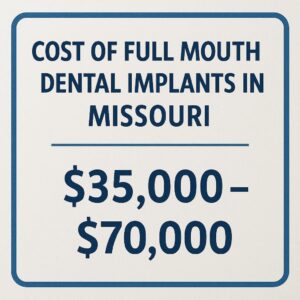
Here is a realistic cost range for full mouth dental implants in Missouri as of 2026:
| Treatment Scope | Estimated Cost Range (Per Arch) | Estimated Cost Range (Full Mouth) | Key Considerations |
|---|---|---|---|
| Basic Full Arch (e.g., All-on-4®) | $18,000 – $28,000 | $36,000 – $56,000 | Includes surgery, implants, temporary prosthesis. Final prosthesis may be acrylic. |
| Premium Full Arch | $25,000 – $35,000 | $50,000 – $70,000 | Often includes higher-quality materials (e.g., zirconia finals), more complex planning (3D/CBCT). |
| Full Mouth with Extractions & Grafting | Add $2,000 – $8,000+ | Add $4,000 – $16,000+ | Necessary if teeth are present and/or bone density is insufficient. Significantly impacts timeline. |
| Full Mouth with Specialist Team | Higher end of ranges | Higher end of ranges | Involves a surgeon (periodontist/oral surgeon) and a restorative dentist/prosthodontist. |
Important Note: These ranges are estimates for Missouri. Prices in metropolitan areas like St. Louis or Kansas City may trend toward the higher end due to higher practice overhead, while clinics in rural areas may offer more competitive pricing. However, expertise and technology should be weighed more heavily than geography alone.
What’s Included in That Total Cost?
A reputable provider will give you a detailed, all-inclusive quote. Here’s what that should cover:
-
Diagnostics & Planning: 3D cone beam CT scans, digital impressions, surgical guides, and the time for the diagnostic workup.
-
Preparatory Procedures: Extractions, bone grafts, sinus lifts, or treatment for gum disease.
-
The Implant Surgery: The cost of the implant fixtures themselves, anesthesia/sedation fees, and the surgical procedure.
-
The Prosthesis (Your New Teeth): The temporary teeth you’ll wear during healing and the final, permanent set of teeth (made from acrylic, porcelain-fused-to-metal, or zirconia).
-
Follow-Up Care: Appointments for fitting the final teeth, adjustments, and a specific post-operative care plan.
Reader Alert: Be wary of advertisements offering “full mouth implants for $15,000.” These often exclude critical parts of the treatment, like the final prosthesis, necessary extractions, or bone grafts, leading to surprise costs later. Always ask for a detailed, written treatment plan with a complete fee schedule.
The 5 Key Factors That Determine Your Final Price
Why such a wide range? Your cost is personalized. These five elements have the biggest impact:
-
The State of Your Oral Health: Do you need teeth extracted? Is there significant bone loss requiring grafting? These preparatory procedures add time and cost but are essential for long-term success.
-
The Number & Brand of Implants: While protocols like All-on-4® use fewer implants, some cases benefit from 6 or 8 per arch for better support. Implant brands also vary in quality and price (e.g., Nobel Biocare, Straumann, Zimmer).
-
Material & Craftsmanship of the Prosthesis: This is a major differentiator. A long-term, high-quality zirconia bridge is more expensive than an acrylic hybrid but offers exceptional durability and aesthetics.
-
The Expertise of the Dental Team: The experience, training, and reputation of your provider influence cost. A specialist team (surgeon + restorative dentist) may charge more but brings a high level of skill to complex cases.
-
Technology & Facility: Practices that invest in state-of-the-art technology—like 3D imaging, in-house labs, and guided surgery software—provide greater precision, safety, and comfort, which is reflected in their fees.
Financing Your New Smile in Missouri
Few people pay the entire cost upfront. Reputable clinics understand this and offer solutions:
-
Dental Office Payment Plans: Many practices partner with third-party financiers like CareCredit or Sunbit to offer low- or no-interest payment plans for qualified patients.
-
Medical Financing Loans: Similar to payment plans but for larger amounts and longer terms.
-
Dental Insurance: While most plans exclude full mouth reconstructions, they may cover portions like extractions, some grafts, or even a few implants. Submit a pre-treatment estimate.
-
Health Savings Accounts (HSA) / Flexible Spending Accounts (FSA): These allow you to use pre-tax dollars for qualified medical expenses, which include dental implants.
-
In-House Membership Plans: Some practices offer annual membership plans that provide a discount on treatments for an annual fee, which can be useful for the maintenance phase.
How to Choose the Right Provider: Value Over Price
Choosing based solely on the lowest cost can be risky. This is a complex, surgical procedure with lifelong implications. Focus on finding the best value.
Essential Questions to Ask During a Consultation:
-
“Can you walk me through a detailed, line-item estimate?”
-
“How many full arch cases has the doctor personally completed?”
-
“What is the warranty or guarantee on the implants and the prosthesis?”
-
“What happens if an implant fails? What are the associated costs?”
-
“Who will handle emergencies or after-hours care?”
-
“May I see before-and-after photos of similar cases you’ve treated?”
Take your time. Consult with 2-3 different providers. You should feel heard, understood, and confident in their proposed plan.
Conclusion
The journey to full mouth dental implants in Missouri is a significant investment in your health, confidence, and quality of life. While costs typically range from $36,000 to $70,000+, this price reflects a personalized, high-level medical procedure, not a commodity. By understanding the components of cost, the factors that influence it, and the financing options available, you can move forward with clarity and purpose. Prioritize the expertise of your dental team and the quality of your treatment plan above all, ensuring your new smile is built to last for decades to come.
Frequently Asked Questions (FAQ)
Q: Are dental implants in Missouri more affordable than in other states?
A: Missouri generally has a lower cost of living compared to coastal states, which can be reflected in dental fees. However, the variance between individual providers based on their skill and technology is far greater than the variance between Missouri and, say, Illinois or Kansas. Focus on the provider, not just the state.
Q: How long do full mouth implants last?
A: With proper care and maintenance, the implant posts themselves are designed to last a lifetime. The prosthetic teeth (the bridge or denture) typically last 10 to 20 years before可能需要 repair or replacement due to normal wear and tear.
Q: Can I get dental implants if I have severe bone loss?
A: In many cases, yes. Techniques like All-on-4® are designed to maximize existing bone. If bone loss is more advanced, procedures like zygomatic implants (anchored in the cheekbone) or strategic bone grafting can make implants possible. A 3D CT scan is necessary to determine your options.
Q: What does the recovery process feel like?
A: Most patients manage post-surgical discomfort with over-the-counter or prescribed pain medication. You’ll be on a soft food diet for several weeks. Swelling and bruising are common but subside within a week or two. Your provider will give you detailed aftercare instructions.
Disclaimer: This article is for informational purposes only and does not constitute medical advice. The cost estimates provided are averages and can vary widely. You must consult with a qualified dental professional for an accurate diagnosis and personalized treatment plan. Date: January 23, 2026. Author: Professional Web Writer.