The Complete Guide to the D4355 Dental Code: Full Mouth Debridement
- On
- InDENTAL CODE
Visiting the dentist after a long break can be a nerve-wracking experience. If you haven’t had a cleaning in years, or if you’re dealing with significant buildup on your teeth, your dentist might mention a procedure with a code you’ve never heard of: D4355.
For many patients, this code looks like a mystery line item on a treatment plan. What does it mean? Why does it cost more than a regular cleaning? And most importantly, is it necessary?
In this guide, we’re going to break down everything you need to know about the D4355 dental code. Whether you’re a patient trying to understand your bill or just someone looking to get back on track with their oral health, consider this your friendly, reliable roadmap.
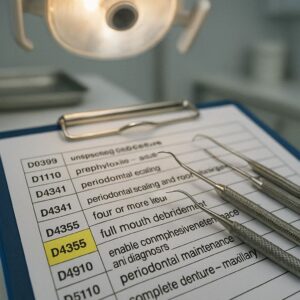
Table of Contents
ToggleWhat Exactly is the D4355 Dental Code?
Let’s start with the basics. In the world of dentistry, every procedure has a specific code used for insurance billing and record-keeping. These are called Current Dental Terminology (CDT) codes, maintained by the American Dental Association (ADA).
The code D4355 is officially defined as a “Full mouth debridement to enable comprehensive evaluation and diagnosis.”
That’s a mouthful, so let’s break it down into plain English.
The Simple Explanation
Imagine you have an overgrown garden. The bushes are so thick that you can’t even see the soil or the fence line. You can’t start planting new flowers or repairing the fence until you clear away all that overgrowth first.
A full mouth debridement is the dental equivalent of that initial clearing.
It is a preliminary procedure designed to remove heavy deposits of plaque, calculus (tartar), and stain that are so extensive that the dentist cannot perform a proper oral exam. The goal isn’t to “clean” the teeth perfectly; the goal is to clear the way so the dentist can actually see what’s going on underneath.
Important Note: D4355 is not a regular cleaning (prophylaxis). It is not a deep cleaning (scaling and root planing). It is a distinct procedure with a specific purpose: diagnosis.
When is the D4355 Code Used? (The “Overgrowth” Scenario)
You won’t see the D4355 code used for someone who visits the dentist every six months. It is almost exclusively used for patients who have not had dental care for an extended period—often several years or decades.
Here are the common scenarios that warrant a full mouth debridement:
-
Long-Term Neglect: A patient hasn’t seen a dentist in 5, 10, or even 20 years. Significant buildup has accumulated.
-
Physical Inability: A patient with a physical or developmental disability that makes daily brushing and flossing difficult.
-
Medical Side Effects: A patient taking medications that cause extreme dry mouth (xerostomia), which drastically accelerates the buildup of plaque and tartar.
-
New Patient to a Practice: A new patient with a long history of no dental care comes in for their first appointment. The dentist needs to see the teeth and gums to create a treatment plan, but the buildup is blocking the view.
What Does the Dentist See?
Before the procedure, the dentist is essentially working blind. Heavy calculus deposits can:
-
Hide cavities: Decay can be lurking underneath a rock-hard shell of tartar.
-
Mask gum disease: The true condition of the gum tissue is hidden.
-
Conceal fractures or other issues: You can’t see a crack in a tooth if you can’t see the tooth.
The primary reason for performing D4355 is to get a clear picture. It’s a diagnostic necessity.
The D4355 Procedure: What to Expect as a Patient
If your dentist recommends a D4355, knowing what’s going to happen can help ease anxiety. The experience is different from a standard cleaning.
Before the Procedure: The Assessment
The dentist or hygienist will first take a look to confirm that the buildup is significant enough to warrant a debridement. They may take X-rays to check for obvious issues below the gum line, though the quality of the X-rays can sometimes be compromised by the heavy deposits.
During the Procedure: The Clearing Process
This is not a quick “polish and go” appointment. A full mouth debridement is meticulous and can take anywhere from 45 minutes to over an hour, depending on the severity of the buildup.
The hygienist will use a combination of tools:
-
Ultrasonic Scalers: These devices use high-frequency vibrations and a water spray to break up large chunks of hard calculus.
-
Hand Scalers and Curettes: Fine manual instruments are used to carefully scrape away the remaining deposits, both above and slightly below the gum line.
The sensation can be uncomfortable. You might feel scraping, vibration, and the spray of water. It is generally not described as painful, but rather as intense and “invasive.”
A Note on Discomfort: If you are concerned about sensitivity or pain, talk to your dentist. They may offer a topical anesthetic to numb the gums or, in more severe cases, local anesthesia (novocaine) for specific areas. Don’t be afraid to ask. Your comfort is important.
After the Procedure: The Evaluation
Once the worst of the buildup is removed, the dentist will come back to perform a comprehensive exam. Now that the teeth are visible, they can probe for gum disease, check for cavities, and look for any other pathology.
This is the moment the code is named for: “to enable comprehensive evaluation and diagnosis.”
Following the exam, the dentist will discuss their findings. The surface of your teeth may feel strange—rough, “fuzzy,” or sensitive. This is normal, as a layer of protective buildup has been removed.
D4355 vs. Other Cleaning Codes: A Crucial Comparison
This is where most of the confusion happens. Because a “cleaning” isn’t just a cleaning. There are different codes for different levels of disease and neglect. Understanding the difference is key to understanding your treatment plan.
Here is a simple breakdown of how D4355 compares to other common preventive procedures.
| CDT Code & Procedure | Purpose | Typical Patient | What It Involves |
|---|---|---|---|
| D1110: Prophylaxis (Adult) | Routine maintenance to prevent disease. | A generally healthy patient with little to no gum disease (gingivitis or periodontitis). | Removal of plaque, calculus, and stains from above the gum line. Polishing teeth. |
| D4346: Scaling in presence of generalized gingival inflammation | To treat moderate to severe inflammation of the gums, but where the tissue is still firmly attached to the tooth. | A patient with significant gum inflammation (swollen, bleeding gums) but no bone loss (periodontitis). | Removal of deposits above and slightly below the gum line in areas of inflammation. |
| D4341 / D4342: Scaling and Root Planing (SRP) | A therapeutic (non-preventive) procedure to treat active gum disease (periodontitis). This is the “deep cleaning.” | A patient diagnosed with bone loss and gum pockets that have detached from the tooth. | Removal of plaque and calculus from deep below the gum line, smoothing the tooth root to help the gum re-attach. Often requires local anesthesia. |
| D4355: Full Mouth Debridement | A preliminary procedure to clear heavy deposits so a comprehensive exam can be performed. | A patient with such extensive buildup that an accurate exam for gum disease and cavities is impossible. | Gross removal of heavy plaque and calculus to enable diagnosis. It is not a complete cleaning. |
Why This Matters
You might look at the D4355 code and think, “This is just an expensive cleaning.” But as the table shows, it serves a different purpose. Think of it this way:
-
D1110 (Prophylaxis) is like routine maintenance on a car—an oil change and tire rotation.
-
D4341/4342 (SRP) is like major repair work—fixing a transmission that’s already failing.
-
D4355 (Debridement) is like power-washing a car that’s been sitting in a mud pit for years, just so the mechanic can open the hood and see the engine.
You cannot perform routine maintenance or major repairs until you can see what you’re working with.
The Controversy and Insurance Perspective on D4355
The D4355 code is one of the most misunderstood and sometimes contested codes in dentistry, both by patients and insurance companies.
Why Do Patients Get Upset?
This is the most common scenario: A patient goes to the dentist for the first time in years expecting a “routine cleaning.” The dentist says they need a D4355 first. The patient agrees. At the end of the appointment, they are told they need to come back for another cleaning (or multiple cleanings) and that the insurance might not cover all of it. The patient feels cheated, thinking, “I just had a cleaning, why do I need another one?”
The disconnect is that the patient feels like they had a cleaning, but clinically, they had a debridement. The goal was not to finish the job, but to start it.
The Insurance Company’s View
Insurance companies are businesses that manage risk. They often have strict rules about D4355:
-
Frequency Limitations: Most plans will only pay for a full mouth debridement once every 3 to 5 years. This makes sense because it’s a procedure for extreme neglect, not routine care.
-
The “Crossover” Rule: Some insurance plans will not pay for a D4355 if it is performed on the same day as a comprehensive exam. They may consider the exam part of the debridement and deny the claim for the exam.
-
The Upgrade Denial: This is the most frustrating scenario for patients. A patient’s insurance might cover a “routine cleaning” (D1110) at 100%. But because the patient needed a D4355, which is a different, often more expensive code, the insurance may only pay what they would have paid for the routine cleaning, leaving the patient to cover the difference. This is often called “alternative benefits.”
What This Means for You
It is vital to have a conversation with your dental office’s billing coordinator before the procedure. A good office will:
-
Explain why you need a D4355 and not a regular cleaning.
-
Contact your insurance to get an estimate of your benefits.
-
Explain your potential out-of-pocket costs upfront.
If an office does not do this, be your own advocate and ask: “Can you check my insurance benefits for code D4355 and let me know what my portion will be?”
The Road to Recovery: What Happens After D4355
The debridement is just the first step on a journey back to oral health. It opens the door to a comprehensive treatment plan.
Step 1: The Diagnosis Appointment
Immediately after the debridement, or at a follow-up appointment very soon after, the dentist will perform a complete exam. This will likely include:
-
Periodontal Charting: Measuring the “pockets” around each tooth to check for gum disease.
-
Caries (Cavity) Detection: A visual exam and review of X-rays to find any decay.
-
Oral Cancer Screening: A check of your entire mouth, tongue, and throat.
Step 2: The Treatment Plan Discussion
Based on the exam, the dentist will present a plan. This could include:
-
Scenario A: The “Clean Bill of Health.” If the debridement revealed minimal issues, the next step might simply be a prophylaxis (D1110) to finish the cleaning and polish the teeth.
-
Scenario B: Significant Gum Inflammation. If the gums are inflamed but there is no bone loss, the next step might be scaling in the presence of inflammation (D4346) .
-
Scenario C: Active Gum Disease (Most Likely). If the exam shows bone loss and deep gum pockets, the next step will be scaling and root planing (D4341/4342) . This is often done in quadrants over several appointments.
-
Scenario D: Restorative Needs. In addition to gum treatment, you may need fillings, crowns, or other work for cavities found during the exam.
It is not uncommon for a patient who needs a D4355 to require several follow-up appointments to address all the issues that were hidden beneath the buildup.
Frequently Asked Questions About D4355
We’ve covered a lot of ground. Here are answers to some of the most common questions patients have about this procedure.
1. Is a full mouth debridement painful?
Most patients experience discomfort rather than sharp pain. You will feel scraping, vibration, and pressure. If you have sensitive teeth or gums, let your hygienist know. They can adjust their technique or use a numbing gel or local anesthetic to keep you comfortable.
2. How much does D4355 cost without insurance?
The cost varies significantly by geographic location and the dental practice. On average, you can expect to pay between $150 and $350 for a full mouth debridement. This is typically more than the cost of a routine cleaning (prophylaxis) because it is a more time-consuming and difficult procedure.
3. Will my dental insurance cover D4355?
Most dental insurance plans cover a portion of the D4355 code, but it is often subject to your deductible and coinsurance. Because it falls under “diagnostic and preventive” care in many plans, it is often covered at a higher percentage (80-100%) than major procedures. However, as mentioned earlier, some plans may apply the “alternative benefits” clause and only pay the equivalent of a regular cleaning. Always check with your insurance provider or the dental office first.
4. Why can’t I just get a regular cleaning?
If your dentist is recommending D4355, it’s because the buildup is too heavy to remove with a standard prophylaxis. A regular cleaning is designed for maintenance, not for clearing away years of accumulation. Attempting a routine cleaning on a mouth with severe buildup would be ineffective, time-consuming, and potentially uncomfortable, and it still wouldn’t allow for a proper exam.
5. How long does the procedure take?
A full mouth debridement usually takes between 45 and 75 minutes. This can vary based on the amount of buildup and the patient’s sensitivity.
6. My teeth feel rough and look yellow after the debridement. Is this normal?
Yes, this is completely normal. For years, your teeth were covered with a layer of hard calculus. Once that “blanket” is removed, the exposed tooth surface can feel rough, and the natural color of the tooth (which may be stained or yellowed) is revealed. The rough feeling will go away, and the appearance will be addressed in subsequent cleaning appointments.
7. Can I eat and drink normally after the procedure?
Yes, you can eat and drink right away. However, your gums and teeth might be a little sensitive. It’s best to avoid extremely hot, cold, or spicy foods for the rest of the day. Stick to softer foods if you’re feeling tender.
8. Will one debridement get my teeth perfectly clean?
No. The goal of the debridement is not a perfect clean; it’s a diagnostic clean. Think of it as the first coat of paint—it preps the surface for the real work. You will almost certainly need at least one more appointment for a definitive cleaning or gum therapy to complete the job.
Additional Resources for Your Dental Journey
Understanding your dental health is the first step to improving it. Here are a few reliable resources you can use to become a more informed patient.
-
American Dental Association (ADA): The ADA’s website (ada.org) has a section for the public called “Mouth Healthy” (mouthhealthy.org). It’s an excellent resource for learning about different procedures and conditions in plain language.
-
Your Dental Office’s Patient Portal: Many dental offices now have online portals where you can view your treatment plan, see the codes being used, and review educational materials tailored to your needs. Don’t hesitate to ask your dentist for their recommended reading list.
Conclusion: A Step Towards Better Health
Seeing the D4355 code on your treatment plan can be the first, courageous step toward taking control of your oral health after a long absence from the dentist’s chair. It is not a punishment for neglecting your teeth, nor is it a trick to charge you more money. It is a necessary diagnostic procedure designed to clear away the “fog of war” so your dental team can see the battlefield clearly.
Understanding that D4355 is a preparatory step—and not a final cleaning—is the key to having realistic expectations. It paves the way for an accurate diagnosis and a personalized treatment plan, setting you on a path to a healthier mouth, a brighter smile, and renewed confidence. It’s the start of a conversation with your dentist, not the end of one.

dentalecostsmile
Newsletter Updates
Enter your email address below and subscribe to our newsletter