Dental Code D2957: The Nuances of “Pin Retention”
If you’ve ever sat in a dental chair and heard the dentist mention a “pin” or stared at a treatment plan filled with numbers, you know the process can feel overwhelming. For dental professionals, those numbers—specifically the Current Dental Terminology (CDT) codes—are the language of insurance, billing, and clinical accuracy.
One code that often causes confusion, yet is vital for saving severely damaged teeth, is Dental Code D2957.
Whether you are a dental hygienist trying to understand a chart, a office manager processing claims, or a patient wondering why there is an extra charge on your bill, this guide is for you. We will strip away the jargon and explain D2957 in plain English, covering exactly what it is, when it is necessary, and how it fits into the larger puzzle of restorative dentistry.
What is Dental Code D2957? A Simple Definition
Let’s start with the basics. In the world of dentistry, CDT codes are maintained by the American Dental Association (ADA). They ensure that every procedure has a standardized name and number, so whether you are in a clinic in California or New York, an insurance company knows exactly what treatment was provided.
Dental Code D2957 is officially described as: “Pin retention – per tooth, in addition to restoration.”
Think of it as the “helper” code. It is never used alone. It is always an add-on to a primary restorative procedure, like a filling (composite or amalgam) or a crown.
Breaking Down the Terminology
To really understand D2957, let’s look at the two key words:
-
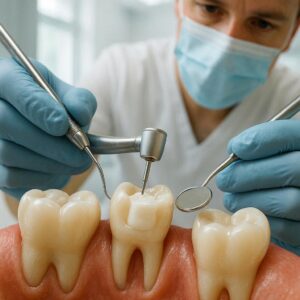
Pin: A very small, thin metal or fiber post (think of a tiny nail) that a dentist drills into the tooth structure.
-
Retention: The act of holding something firmly in place.
So, D2957 is used when a dentist places one or more small pins into a tooth to help hold the filling material securely. Imagine trying to build a sandcastle on a very windy day. Sometimes, you need to stick a stick deep into the sand to give the structure something to hold onto. That is precisely what a pin does for a filling.
Why Would a Tooth Need a Pin? The Clinical Necessity
Tooth decay is destructive. When a dentist removes all the bacteria and infected tissue (dentin), they are often left with a cavity that is very large. In a healthy tooth, the filling stays in place because the remaining tooth walls form a natural “box” that locks the material in.
However, when too much of the natural tooth is missing, there isn’t enough structure to hold the filling. This is where D2957 comes into play. The pins are embedded into the healthy part of the tooth, and the filling material is packed around them. Once the filling hardens, the pins act like anchors, preventing the filling from popping out when you chew sticky foods or apply pressure.
Common Scenarios for D2957
-
Severe Decay: A patient comes in with a cavity that covers more than half the width of the tooth.
-
Fractured Cusps: A tooth has broken, leaving a missing wall. The pin helps rebuild that wall with filling material.
-
Replacing a Failed Filling: An old, large filling has fallen out, and the remaining tooth structure is compromised.
D2957 vs. Core Buildup (D2950): Clearing Up the Confusion
This is arguably the most common point of confusion in dental billing. Both procedures involve adding material to a tooth, but they serve different purposes.
To understand the difference, you must understand retention and resistance.
-
Core Buildup (D2950): This is used when a tooth is so broken down that there is almost nothing left above the gum line. The dentist needs to build a “core” to hold a future crown. It replaces missing tooth structure entirely.
-
Pin Retention (D2957): This is used when the tooth structure is present, but it is weak. The pins are used to retain the filling material inside the existing tooth walls.
Side-by-Side Comparison
| Feature | Dental Code D2957 (Pin Retention) | Dental Code D2950 (Core Buildup) |
|---|---|---|
| Purpose | To anchor a filling inside an existing tooth. | To rebuild a significant portion of a missing tooth. |
| Structure | The natural tooth walls are largely intact but weak. | The natural tooth structure is severely missing. |
| The “Pin” | The pin is the star of the show. | Pins may be used, but the code covers the buildup material itself. |
| Context | Used under a crown OR a direct filling. | Almost always done in preparation for a crown. |
Important Note for Billers: You generally cannot bill D2957 and D2950 on the same surface of the same tooth on the same day. They are distinct methods of achieving retention. If you are performing a true core buildup and using a pin for extra support, the core buildup code (D2950) is the primary code, as it more accurately describes the extensive nature of the work.
The Procedure: What Happens When a Pin is Placed?
If you are a patient reading this, you might be nervous about the idea of a metal pin being drilled into your tooth. Don’t be! The process is minimally invasive and done under local anesthesia.
-
Preparation: The dentist cleans out the decay and prepares the tooth for the filling.
-
Drilling the Pin Hole: Using a very small, specialized drill, the dentist creates a tiny hole (channel) in a safe area of the tooth. They must be careful to drill into solid dentin, avoiding the pulp (nerve) of the tooth.
-
Placing the Pin: The pin, which is usually self-threading (like a tiny screw), is gently placed into the hole. Sometimes it is cemented in place for a passive fit.
-
Building the Tooth: The dentist applies the filling material (composite or amalgam) over and around the pin.
-
Finishing: Once the material sets, the tooth is shaped, polished, and adjusted to fit comfortably with the opposing teeth.
The Cost and Insurance Perspective
Dental insurance can be complex. Because D2957 is an “add-on” code, it usually follows the rules of the primary procedure.
-
Patient Responsibility: If your insurance covers 80% of a filling, they will likely cover 80% of the pin retention procedure, minus your deductible. However, because it is an additional service, you will have an extra copay.
-
Frequency: Insurance companies are strict about how many pins they will pay for on a single tooth. While a dentist might place 2 or 3 pins on a large molar to ensure stability, some insurance plans have a hard limit (e.g., they will only cover one pin per tooth). If the dentist deems more medically necessary, the patient may be responsible for the difference.
-
Medical Necessity: For the claim to be accepted, the dentist’s notes must reflect why the pin was needed. A simple phrase like “Insufficient tooth structure for retention of restoration” is usually sufficient.
Advantages and Disadvantages of Using Pins
Like any medical procedure, pin retention has its pros and cons. A good dentist will weigh these options before deciding to use a pin.
Advantages (The “Pros”)
-
Preservation of Tooth Structure: Pins allow the dentist to save a tooth that might otherwise need a root canal or extraction.
-
Strength: They provide excellent mechanical retention for large restorations.
-
Cost-Effective: Adding a pin is significantly cheaper than replacing the tooth with a bridge or implant.
Disadvantages (The “Cons”)
-
Risk of Pulp Exposure: If the pin channel is drilled too deep, it can hit the nerve, potentially requiring a root canal.
-
Fracture Risk: Drilling into the tooth creates a slight stress point. In rare cases, this can lead to a crack in the tooth structure over time.
-
Microleakage: If the pin isn’t perfectly sealed, it can create a pathway for bacteria to seep in around the filling.
Frequently Asked Questions (FAQ)
To wrap up, let’s address some of the most common questions we hear regarding Dental Code D2957.
Is D2957 considered a “major” or “basic” service?
It depends on your insurance plan. Typically, since it is an adjunct to a filling (a basic service), it is often classified under the “basic” restorative category. However, if it is used in conjunction with a crown, it might follow the crown’s classification. Always check the patient’s specific plan benefits.
How many pins can be placed under D2957?
The code D2957 is defined as “per tooth.” It covers the placement of one or more pins. The fee for the code usually covers the complexity and materials, regardless of whether the dentist places one pin or three. You do not bill D2957 multiple times for the same tooth.
Can D2957 be used on baby teeth (primary dentition)?
Yes, it can be used on primary teeth if the tooth structure is severely damaged and the tooth is meant to be retained (i.e., not close to falling out naturally). It is a good way to save a baby tooth that acts as a space maintainer for the permanent tooth.
What is the difference between a pin and a post?
This is a great question. A post (like a prefabricated post or a cast post and core) is placed inside a tooth after a root canal. It goes down into the empty nerve canal to hold the core. A pin (D2957) is placed into the natural dentin of a tooth that still has a vital nerve (or has had a root canal) to hold a filling.
Conclusion
Dental Code D2957 (Pin Retention) is a small but mighty tool in restorative dentistry. It acts as an anchor, allowing dentists to save teeth that are too broken down for a standard filling but not so broken down that they require a full core buildup. By understanding the distinction between this code and others, dental professionals can ensure accurate billing, and patients can feel confident that their dentist is taking every possible step to preserve their natural smile.
Ultimately, it represents the dental community’s commitment to conservation—doing everything possible to keep your natural teeth functional and healthy for years to come.
Additional Resource
For the most up-to-date information on CDT codes and billing practices, the definitive resource is the American Dental Association. You can visit their official store to purchase the current Current Dental Terminology (CDT) code book, which is updated annually to reflect changes in the industry.
[Click here to visit the ADA Catalog for the latest CDT Manual ->] (https://www.ada.org/en/publications/cdt)