Dental Code D3427: The Complete Guide to Surgical Extraction
Nobody ever looks forward to hearing the words “you need a tooth pulled.” It sounds painful, expensive, and complicated. However, modern dentistry has evolved to make even complex tooth removal a routine, manageable procedure. If you have been told you need a surgical extraction, you might have noticed a code on your treatment plan: D3427.
This string of numbers isn’t just random billing jargon. It is a specific identifier used by dental insurance companies and dentists to describe a particular type of service. Understanding what this code means—why you need it, how it differs from a simple extraction, and what it will cost—can transform a confusing medical bill into a clear roadmap for your health.
In this guide, we will strip away the complexity. Whether you are a patient trying to decipher an insurance Explanation of Benefits (EOB) or someone preparing for a procedure, this article will walk you through everything you need to know about Dental Code D3427.
What is Dental Code D3427?
In the world of dentistry, a standardized language ensures that a dentist in California and a dentist in New York are talking about the same thing when they discuss a procedure. This language is the Current Dental Terminology (CDT) , maintained by the American Dental Association (ADA).
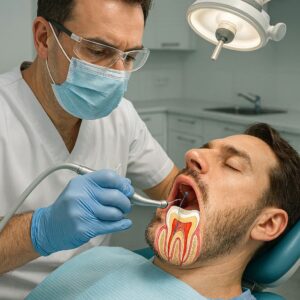
Dental Code D3427 falls under the broader category of surgical extractions. Specifically, it refers to the removal of a tooth that requires more than simply grasping it with forceps and pulling it out.
To put it simply:
-
Simple Extraction: The tooth is visible in the mouth, and it can be removed easily.
-
Surgical Extraction (D3427): The tooth is difficult to access, broken off at the gum line, or has not erupted properly. This procedure involves cutting into the gum tissue (an incision) to access the tooth.
Important Note: While the term “extraction” often refers to the whole tooth, D3427 specifically pertains to the surgical removal of an erupted tooth. If the tooth is still completely hidden under the gums (impacted), different codes (like D7230 for partial bony impaction) are used.
D3427 vs. Other Extraction Codes: A Comparative Guide
One of the biggest sources of confusion for patients is why one tooth costs more to remove than another. It all depends on the complexity. The table below breaks down the differences between the most common extraction codes.
| Code | Procedure Name | Description | Typical Scenario |
|---|---|---|---|
| D7140 | Simple Extraction | Removal of a visible tooth using forceps. No incision or bone removal required. | A baby tooth that is loose, or a permanent tooth with severe decay but an intact crown. |
| D7210 | Simple Extraction (with complications) | Removal of a visible tooth where the crown is destroyed, requiring sectioning of the tooth or removal of gum tissue. | A tooth broken off at the gum line, but the root is still simple to remove. |
| D3427 | Surgical Extraction | Removal of an erupted tooth requiring an incision through the gum and possibly the removal of bone or sectioning of the tooth. | A molar with curved roots, a tooth that has broken off, or a tooth that needs to be removed to prepare for an implant. |
| D7230 | Surgical Extraction (Impaction) | Removal of a tooth that is partially covered by bone (partial bony impaction). | A wisdom tooth that has partially erupted but is still partly stuck in the jawbone. |
Why would my dentist choose D3427 over D7140?
Your dentist isn’t choosing a code to charge you more; they are choosing the code based on the anatomy of the situation. If your tooth has roots that are hooked, if the crown has completely disintegrated leaving only the roots, or if the tooth is in a location near a nerve, a simple “yank” isn’t possible. A surgical approach (D3427) is the safest method to ensure the tooth comes out cleanly without damaging the surrounding bone or nerves.
Why is D3427 Necessary? The “Broken Down” Tooth Scenario
Most patients encounter D3427 when a tooth has failed them. Perhaps you had a large filling that finally cracked, or maybe a tooth broke while eating something hard. When the natural crown of the tooth—the part you see and chew with—is gone, the dentist has nothing to grab onto.
In these cases, the tooth is technically “erupted” (it came into the mouth years ago), but it is no longer accessible. The dentist must perform a surgical procedure to retrieve it. Here is what usually necessitates a surgical approach:
-
Subgingival Decay: The cavity extends deep below the gum line. The dentist must reflect the gum tissue to see where the tooth ends and the bone begins.
-
Root Fracture: If the tooth cracked vertically, part of the root might be holding on. Leaving a fragment behind can lead to infection, so the dentist must go in surgically to retrieve the pieces.
-
Dense Bone: Some patients have very dense jawbones. The tooth might be locked in place. The dentist may need to remove a small amount of bone surrounding the tooth to “release” it.
The Step-by-Step Procedure: What Happens During D3427?
If you are scheduled for a procedure with the code D3427, knowing what to expect can significantly reduce anxiety. While every dentist has their own style, the process generally follows a standard medical protocol.
Step 1: Anesthesia and Numbing
Before anything else, the area must be completely numb. You will receive a local anesthetic (like lidocaine). You might feel a small pinch or burn as the numbing agent is injected, but once it takes effect, you should feel pressure only—not sharp pain. For anxious patients, dentists may also offer sedation options like nitrous oxide (laughing gas) or oral conscious sedation.
Step 2: The Incision and Reflection
Once you are numb, the dentist will use a scalpel to make a small incision in your gum tissue. They will then gently push the gum tissue aside (reflecting a flap) to expose the underlying bone and the root of the tooth.
Step 3: Tooth Removal (Osteotomy or Sectioning)
This is the core of the surgical extraction.
-
Bone Removal: If the tooth is locked in by bone, the dentist uses a high-speed handpiece (drill) to carefully remove a small amount of bone surrounding the tooth. This creates space.
-
Sectioning: If the tooth has multiple roots (like molars), the dentist may cut the tooth into separate pieces. Removing the tooth in sections is often less traumatic than trying to wrench the whole thing out in one piece.
Step 4: Luxation and Delivery
Using a specialized instrument called an elevator, the dentist gently rocks the tooth (or tooth sections) back and forth to widen the socket and break the periodontal ligament that holds the tooth in place. Once it is sufficiently loosened, it is removed with forceps.
Step 5: Debridement and Suturing
After the tooth is out, the socket is thoroughly cleaned. The dentist will remove any infected tissue, cysts, or debris. Finally, the gum flap is placed back into its original position and stitched (sutured) closed. These stitches may be dissolvable or may need to be removed at a follow-up appointment.
Recovery and Aftercare: Healing from a Surgical Extraction
Healing from D3427 is generally a bit more involved than a simple extraction because the body is healing a surgical wound, not just a hole where a tooth used to be. The first 24 to 48 hours are critical for setting the stage for smooth healing.
Immediate Post-Op (The First 24 Hours)
-
The Gauze: Bite firmly on the gauze pack placed by your dentist. The pressure helps stop the bleeding. Keep it in place for 30–60 minutes. If bleeding continues, replace it with a fresh, damp gauze.
-
Ice is Your Friend: Apply an ice pack to the outside of your face (20 minutes on, 20 minutes off) for the first 24 hours. This constricts blood vessels and minimizes swelling.
-
No Spitting or Straws: This is the golden rule. Spitting or sucking on a straw creates suction in your mouth. This suction can dislodge the protective blood clot that is forming in the socket, leading to a painful condition called dry socket. Just let saliva dribble out if needed.
-
Rest: Keep your head elevated, even when sleeping, to reduce swelling.
The Healing Phase (Days 2–7)
-
Swelling: Swelling usually peaks around day 2 or 3. Don’t be alarmed if your face looks puffier before it looks better.
-
Diet: Stick to soft foods. Think yogurt, mashed potatoes, smoothies (eaten with a spoon, not a straw), soup, and scrambled eggs. Avoid anything hard, crunchy, or spicy that could irritate the wound.
-
Oral Hygiene: You can gently brush your other teeth, but avoid the surgical site. After 24 hours, you can usually start rinsing gently with warm salt water several times a day to keep the area clean.
A Critical Note on Pain: Some discomfort is expected. Over-the-counter ibuprofen (Advil) or acetaminophen (Tylenol) is usually sufficient, though your dentist may prescribe something stronger. However, if the pain intensifies after a few days instead of getting better, call your dentist immediately. This is a classic sign of dry socket.
The Financial Aspect: Cost and Insurance for D3427
Let’s talk money. Dental procedures can be expensive, and surgical extractions are pricier than simple ones due to the increased chair time, skill, and complexity.
What is the average cost?
The cost of D3427 varies widely based on your geographic location, the dentist’s experience, and the specific tooth being removed. However, you can generally expect the following ranges:
-
Without Insurance (Cash Price): Typically ranges from $200 to $600 per tooth.
-
With Insurance (Negotiated Rate): Insurance companies negotiate lower rates with providers, so the “allowed amount” might be between $150 and $400.
Factors influencing cost:
-
Molars vs. Front Teeth: Molars (back teeth) are harder to remove because they have multiple roots and are in a more difficult area. They usually cost more than incisors or canines.
-
Specialist vs. General Dentist: If your general dentist refers you to an oral surgeon, the fee will likely be higher due to the specialist’s advanced training.
How does dental insurance handle D3427?
Most dental insurance plans cover extractions, but they do so in a specific way.
-
Classification: Surgical extractions (D3427) are almost always classified as “Basic” restorative services.
-
Coverage Percentage: A typical plan might cover 50% to 80% of the cost after you have met your annual deductible.
-
Annual Maximums: Remember that dental insurance has a cap on what they will pay per year (usually $1,000 to $2,000). If you have other major work planned, the extraction might eat up a large portion of your benefits.
Cost Comparison: Extraction vs. Root Canal and Crown
Many patients facing D3427 ask, “Why not just save the tooth?” Sometimes, saving the tooth is the better option, and sometimes it isn’t. Here is a quick financial and practical comparison:
| Procedure | Average Cost (No Insurance) | Lifespan | Pros | Cons |
|---|---|---|---|---|
| Surgical Extraction (D3427) | $200 – $600 | Permanent removal | Solves the problem immediately; usually cheaper upfront. | You lose the tooth; may need implant/bridge later. |
| Root Canal + Crown | $1,500 – $3,000+ | 10-15+ years | Saves natural tooth; maintains bone and bite. | More expensive; takes multiple visits. |
Alternatives to Extraction: Is D3427 Your Only Option?
The decision to extract a tooth using D3427 is rarely taken lightly. Dentists are generally in the business of saving teeth, not removing them. However, there are scenarios where extraction is the most predictable, healthiest option.
When an extraction is unavoidable:
-
Severe Decay: The cavity is so large that there isn’t enough healthy tooth structure left to hold a crown.
-
Advanced Gum Disease: The bone holding the tooth in place has been destroyed.
-
Fracture: The tooth has a vertical root fracture. This is almost always a death sentence for a tooth, as bacteria can travel down the crack.
-
Orthodontics: Sometimes, teeth need to be removed (like premolars) to create space to straighten the rest of the smile.
The “Save the Tooth” Argument
If the tooth can be saved with a large filling, root canal, or crown, it is almost always better to do so. Natural teeth are stronger than artificial ones, and they stimulate the jawbone, preventing the bone loss that occurs after an extraction.
“The mouth is an ecosystem. Removing one tooth changes the dynamics for all the others. Neighboring teeth may drift, and the opposing tooth may super-erupt (grow out of the socket) because it has nothing to chew against. Always ask your dentist: ‘Is there a viable way to save this tooth?'” — General Dentistry Principle
FAQ: Your Burning Questions About Dental Code D3427
Q: Is D3427 considered major or basic dental care?
A: It is generally classified as Basic Care by most insurance providers. It sits in the middle tier, between preventive care (cleanings) and major care (crowns, bridges, dentures).
Q: Does D3427 include the cost of anesthesia (like laughing gas)?
A: Usually, no. The fee for D3427 typically covers the surgical procedure and local anesthetic (the numbing shots). If you opt for nitrous oxide, oral sedation, or IV sedation, those are separate codes (e.g., D9230 for nitrous oxide) and will add to the total bill.
Q: How long does the D3427 procedure take?
A: While a simple extraction can take just a few minutes, a surgical extraction (D3427) usually takes between 20 and 40 minutes, depending on the complexity of the roots and the condition of the tooth.
Q: I have a dry socket. Does that mean the D3427 code was wrong?
A: Absolutely not. Dry socket is a potential complication of any extraction, surgical or simple. It occurs when the blood clot in the socket dissolves or dislodges prematurely, exposing the underlying bone and nerves. It is not a sign that the procedure was performed incorrectly, though you should contact your dentist immediately for treatment to relieve the pain.
Q: Can a general dentist perform D3427, or do I need an oral surgeon?
A: Many general dentists are fully trained and equipped to perform surgical extractions (D3427). However, if the case is particularly complex—such as roots that are intertwined with a nerve, or a patient with complex medical issues—the general dentist will refer you to an oral surgeon for safety.
Conclusion
Dental Code D3427 represents a specific, common, and safe procedure designed to remove a tooth that cannot be taken out with simple forceps. While the term “surgical extraction” sounds intimidating, it is a routine dental service that prioritizes patient safety and long-term oral health. By understanding that this code reflects the complexity of your unique dental anatomy—rather than an arbitrary billing choice—you can approach your treatment with confidence. Whether you are dealing with a broken tooth or preparing for dentures, knowing what D3427 entails helps you navigate the financial, procedural, and recovery phases with clarity.
Additional Resources
To further your understanding of dental procedures and insurance, the following resource is invaluable:
-
American Dental Association (ADA) – CDT Code Lookup: Link to ADA Shopping Store / CDT (Note: This is the official source for purchasing the codebook, but patients can often find basic code explanations on dental insurance provider sites or the ADA’s public information pages.)