Dental Code D4320: The Complete Guide to Splinting Teeth
When a dentist mentions the need to “splint” your teeth, it can sound intimidating. It might evoke images of complex surgeries or bulky metal contraptions. However, the reality is that dental splinting is a routine, minimally invasive procedure designed to provide stability and relief.
If you have recently received a treatment plan containing the code D4320, you are likely searching for clear, honest answers. What does this code mean? Why do you need it? Will your insurance cover it? And most importantly, how much is this going to cost?
You have come to the right place. This guide is designed to be your definitive resource for understanding Dental Code D4320. We will break down the clinical jargon, explore the procedure step-by-step, compare it to other codes, and give you the knowledge you need to discuss your treatment confidently with your dental provider.
Let’s get started.
What is Dental Code D4320? A Clear Definition
In the world of dentistry, every procedure has a specific code. These are known as CDT codes (Current Dental Terminology). They are the universal language that dentists use to communicate with insurance companies and maintain patient records.
D4320 is a specific CDT code. Its formal description is:
Provisionally splinting teeth, intracoronal.
To understand what this means, let’s break it down into simple terms.
-
Splinting: Think of a splint for a broken finger. It stabilizes the injured finger by binding it to a healthy neighbor. Dental splinting does the same thing. It connects a loose or compromised tooth to adjacent, stable teeth to provide support.
-
Provisionally: This indicates that the splint is not necessarily a permanent fixture. It is designed to last for a specific period—perhaps months or a couple of years—to allow for healing or to stabilize the situation while a long-term treatment plan is developed.
-
Intracoronal: This is the technical part. “Intracoronal” means “within the crown” of the tooth. This type of splint involves preparing a small channel or groove that connects the teeth being splinted. A strong, rigid material (like composite resin or fiber-reinforced ribbon) is then placed into this channel, physically linking the teeth together from within their structure.
In essence, D4320 is the code for a temporary fix that physically bonds loose teeth together from the inside to make them stronger as a unit.
Why Would a Dentist Recommend This Procedure? The Medical Necessity
A dentist doesn’t recommend splinting on a whim. There must be a clear medical reason, or “medical necessity,” to justify the procedure. D4320 is typically reserved for situations where tooth stability is compromised.
Here are the most common reasons a dentist would recommend an intracoronal splint:
1. Periodontal Disease (Gum Disease)
This is the most frequent reason for D4320. Advanced gum disease (periodontitis) destroys the bone and tissue that hold your teeth in place. As the support structure deteriorates, teeth can become loose, or “mobile.”
-
The Problem: A single loose tooth is at risk of falling out. It also moves abnormally when you chew, causing discomfort and further bone loss.
-
The Solution: By splinting a loose tooth to a healthy, stable one, the dentist distributes the chewing forces. The stable tooth acts as an anchor, giving the loose tooth a chance to function without excessive movement. This can significantly improve patient comfort and slow the progression of tooth loss.
2. Trauma
A sudden impact, such as a fall, a sports injury, or a car accident, can physically knock a tooth out of its normal position or loosen it.
-
The Problem: The tooth may be intact, but the ligaments and bone holding it are damaged. It needs time to re-anchor itself.
-
The Solution: A provisional splint acts like a cast for your tooth. It holds it perfectly still in the correct position, allowing the damaged ligaments to heal and reattach securely.
3. Orthodontic Relapse Prevention (Less Common)
In some specific cases, after orthodontic treatment, there is a high risk of teeth shifting back (relapse). While permanent retention is usually managed with bonded wires (lingual retainers), which are technically a form of splinting, an intracoronal approach might be chosen for specific situations involving significant gaps or severe rotations to ensure absolute stability during the initial healing phase.
4. Hyperfunction or Occlusal Trauma
Sometimes, a patient’s bite is so strong, or they grind their teeth so severely (bruxism), that the forces generated are too much for the supporting structures.
-
The Problem: Constant excessive force can cause teeth to become loose over time, even with healthy gums.
-
The Solution: Splinting the teeth creates a “reinforced unit.” Just as a bundle of sticks is harder to break than a single one, a group of splinted teeth can collectively withstand the heavy forces of chewing and grinding better than individual teeth could.
D4320 vs. Other Splinting Codes: A Comparative Guide
One of the most confusing aspects for patients is the difference between various splinting codes. It’s easy to get them mixed up. To make it clear, let’s look at a comparison table.
| Code | Description | Key Feature | Typical Use Case |
|---|---|---|---|
| D4320 | Provisionally splinting teeth, intracoronal | Splint is placed within the prepared tooth structure. | Loose teeth due to gum disease, where a stronger, more integrated hold is needed. |
| D4321 | Provisionally splinting teeth, extracoronal | Splint is placed on the outside surface of the teeth. | Minor stabilization, post-orthodontic retention (lingual wire), or as a quick, non-invasive measure. |
| D4322 | Provisionally splinting teeth, intracoronal, direct | Similar to D4320, but specifies a “direct” technique (built up in the mouth). | This is a nuance of D4320. Often used interchangeably in clinical notes, but specifies the method of application. |
| D4346 | Scaling in presence of generalized moderate or severe gingival inflammation | A cleaning procedure, not a stabilization one. | Treating gum inflammation before it leads to the bone loss that requires splinting. |
| D5919 | Facial augmentation (prosthesis) | A surgical code for implants, unrelated to tooth splinting. | Replacing missing bone or tissue structure. |
Important Note: The choice between D4320 (intracoronal) and D4321 (extracoronal) often comes down to the level of stability required. Intracoronal splints are generally stronger and more durable because the connecting material is embedded into the tooth, making it harder to break or detach. Extracoronal splints are bonded to the surface and can sometimes be more prone to fracture or debonding.
The Procedure: A Step-by-Step Walkthrough
Knowing what will happen during your appointment can significantly reduce anxiety. Here is a realistic, step-by-step look at how a dentist performs a D4320 procedure.
Step 1: Diagnosis and Treatment Planning
Before any work begins, your dentist will perform a thorough examination. This includes:
-
Periodontal Charting: Measuring the “pockets” around each tooth to assess bone loss.
-
Mobility Grading: Assigning a grade (0-3) to the looseness of your teeth.
-
Radiographs (X-rays): To see the bone levels and the health of the roots.
-
Discussion: Your dentist will explain why they recommend the splint, which teeth will be involved, and what you can expect.
Step 2: Anesthesia (If Needed)
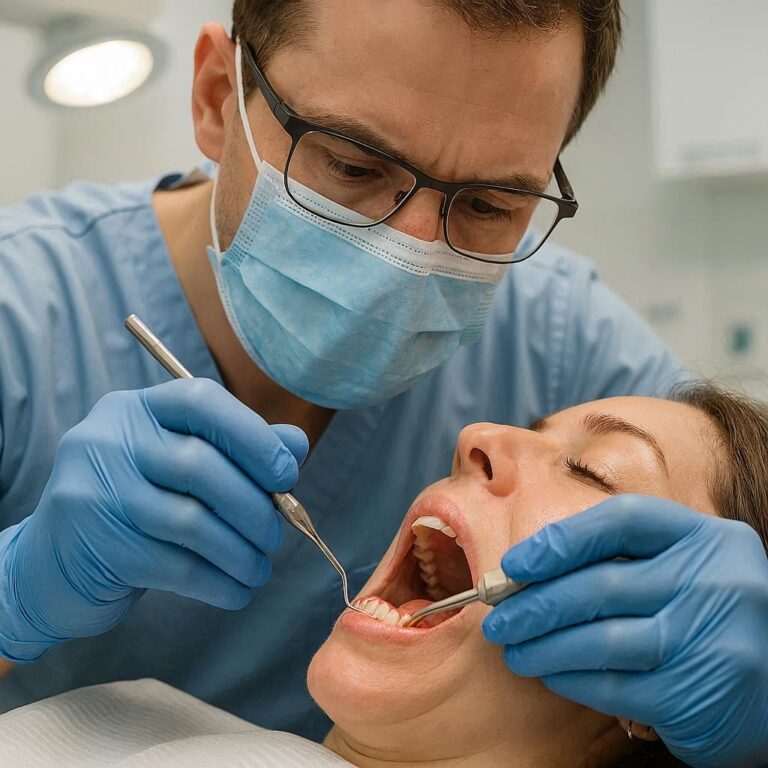
Because D4320 involves preparing a small channel within the tooth, it often requires drilling into the enamel and sometimes a bit into the dentin. To keep you comfortable, the dentist will likely apply a local anesthetic to numb the area.
Step 3: Tooth Preparation (The “Intracoronal” Part)
Using a high-speed dental handpiece, the dentist will cut a very small, precise groove that connects the teeth to be splinted. This groove is usually placed on the biting surface or the inside (lingual/palatal) surface of the teeth, depending on the location and aesthetic needs. The depth is carefully controlled to stay within the tooth structure and avoid the nerve.
Step 4: Placement of the Splinting Material
The prepared groove is cleaned and etched with a special gel to create a micro-scrubbed surface for bonding. A bonding agent (adhesive) is painted on. Then, the dentist will place a strong, flowable composite resin or a fiber-reinforced ribbon into the groove. This material physically links the teeth together.
Step 5: Curing and Finishing
A special bright blue light (curing light) is used to harden the composite material instantly. Once hard, the dentist will shape and polish the splint. They will check your bite to ensure the splint doesn’t interfere with how your teeth come together, and adjust it as necessary. The final result should feel smooth and natural.
Step 6: Post-Operative Instructions
The dentist will give you instructions on how to care for your splinted teeth, which is crucial for its longevity.
The Real Cost of D4320 and Navigating Insurance
Let’s talk about money. Dental treatment is an investment in your health, and it’s important to have a realistic picture of the costs involved.
How Much Does D4320 Cost?
The cost for a D4320 procedure can vary widely based on your geographic location, the dentist’s experience, and the complexity of the case (how many teeth are being splinted).
-
Price Range: As a general estimate, you can expect the fee for a D4320 procedure to range from $250 to $500+ per splint unit. This usually covers the splinting of 2-3 teeth. If the splint connects multiple teeth across the arch, the cost will be higher.
Will Dental Insurance Cover It?
This is where it gets tricky. Insurance coverage for D4320 is not guaranteed. Here is how to navigate it:
-
Medical vs. Dental Necessity: Insurance companies scrutinize this code. They will ask: “Is this procedure medically necessary to restore function and stability?”
-
Periodontal Disease: If the splint is due to advanced gum disease, it is more likely to be covered, but often only after a waiting period and under the “major services” category of your plan.
-
Coverage Limits: Even if covered, it will likely be subject to your plan’s annual maximum (often $1,000-$2,000) and your co-insurance (e.g., they pay 50%, you pay 50%).
-
Trauma: If the splint is due to a traumatic accident, your medical insurance might provide some coverage, as this is considered an injury. Always ask your dentist for a “letter of medical necessity” to submit to your medical insurer.
-
Exclusions: Some plans explicitly exclude “splinting” as a covered benefit, considering it a reconstructive or cosmetic procedure (even when it’s not). Always verify your benefits with your insurance company before treatment.
Questions to Ask Your Insurance Provider
Before your procedure, call the customer service number on your insurance card and ask these specific questions:
-
“Is code D4320 (provisional intracoronal splinting) a covered benefit on my plan?”
-
“What is my coverage percentage for this code (e.g., 50%, 80%)?”
-
“Does this code apply to my annual deductible?”
-
“Is there a waiting period for this type of procedure?”
Living with a Splint: Maintenance and Longevity
Getting the splint is only half the journey. Living with it requires a partnership between you and your dentist. A provisional splint is not a “set it and forget it” device.
Lifespan of a Provisional Splint
The word “provisional” is key. These splints are not designed to last forever. With excellent care, a well-placed intracoronal splint can last anywhere from 2 to 5 years, or sometimes longer. However, they can also fail sooner if not maintained.
Why Do Splints Fail?
-
Debonding: The most common failure. The adhesive bond between the splint material and the tooth can break. This can happen from chewing hard or sticky foods.
-
Fracture: The composite material itself can crack or break under excessive force.
-
Secondary Decay: This is a major risk. The junction where the splint meets the tooth is a potential plaque trap. If oral hygiene is poor, decay can start at this margin, destroying the tooth structure underneath the splint.
-
Progression of Disease: If the underlying gum disease is not controlled, bone loss can continue, eventually making even the splinted teeth unstable.
Essential Care Tips
To maximize the life of your splint and protect your teeth, follow these guidelines:
-
Master Your Oral Hygiene: This is non-negotiable.
-
Use floss threaders or superfloss. Regular floss won’t fit under the splint. You must thread the floss under the connecting bar to clean between the splinted teeth.
-
Consider an interdental brush for cleaning around the gumline of the splinted area.
-
Use an anti-bacterial mouthwash (like one with chlorhexidine or essential oils) to reduce plaque bacteria, as recommended by your dentist.
-
-
Mind Your Diet:
-
Avoid hard foods: Ice, hard candies, nuts, and bones can fracture the splint.
-
Avoid sticky foods: Caramel, taffy, and gummy candies can pull on the splint and cause debonding.
-
-
Protect Against Grinding: If you grind your teeth at night (bruxism), you must wear a night guard. The forces from grinding can easily break a splint. The night guard protects both your natural teeth and the splint.
-
Keep Your Regular Dental Visits: Do not skip your cleanings and check-ups. Your dentist and hygienist need to monitor the splint, check for decay, and professionally clean areas you might be missing.
Advantages and Disadvantages of Intracoronal Splinting
To help you make an informed decision, here is a balanced look at the pros and cons of choosing a D4320 procedure.
✅ Advantages
-
Superior Strength: Because the splint material is embedded into the tooth, it is significantly stronger and more resistant to peeling off than surface-bonded (extracoronal) splints.
-
Durability: When done well, it can last for several years, providing long-term provisional stability.
-
Comfortable: Once polished, the splint is smooth and usually doesn’t trap food as much as some extracoronal designs. It feels like a natural part of your tooth.
-
Aesthetics: If placed on the inside (lingual) surfaces of the teeth, it is completely invisible. Even on biting surfaces, it blends in with the tooth color.
❌ Disadvantages
-
Invasive Nature: It requires drilling into healthy tooth structure to create the channel. This is irreversible.
-
Complexity of Repair: If a portion of the splint breaks, it can be more difficult to repair than an extracoronal splint. It often requires removing the old composite and redoing the section.
-
Cost: It is generally more expensive than an extracoronal splint (D4321) due to the more complex technique and time involved.
-
Risk of Decay: If oral hygiene slips, the margins of the preparation are a prime spot for new cavities to form.
Alternatives to D4320: What Are Your Options?
Splinting is not the only answer for loose teeth. Depending on your specific diagnosis, your dentist may have discussed other options. It’s always good to know the full landscape of possibilities.
Alternative 1: Extracoronal Splinting (D4321)
As discussed in the comparison table, this is the less invasive cousin. A strong wire or ribbon is bonded directly to the back surfaces of the teeth.
-
Best for: Minor stability, quick fixes, or when the dentist wants to avoid any tooth preparation.
Alternative 2: Removable Partial Denture (RPD)
If the long-term prognosis for the loose teeth is poor, or if you are missing other teeth, a partial denture might be considered.
-
Best for: Replacing multiple missing teeth while also providing some indirect stabilization to remaining teeth, though it doesn’t “splint” them internally.
Alternative 3: Orthodontic Extrusion
In some cases of tooth fracture or isolated bone loss, an orthodontist can gently “pull” the tooth slightly out of the socket using braces. This can bring the healthy bone and gum tissue up with it, improving the crown-to-root ratio and stability.
-
Best for: Specific, isolated defects, often on front teeth for aesthetic reasons before a crown.
Alternative 4: Extraction and Implant
If a tooth is hopelessly loose due to severe bone loss or a vertical root fracture, the most predictable long-term solution may be to remove it and replace it with a dental implant. An implant is a titanium post that fuses with the bone and acts as a new, stable tooth root.
-
Best for: Single hopeless teeth that cannot be saved, offering a permanent, stand-alone solution.
Frequently Asked Questions (FAQ)
Q: Is the D4320 procedure painful?
A: Most patients report little to no discomfort during the procedure because a local anesthetic is used to numb the area. After the anesthesia wears off, there may be mild sensitivity to cold or pressure for a day or two, but this is usually manageable with over-the-counter pain relievers.
Q: How long does the appointment take?
A: The appointment time depends on the number of teeth being splinted. For a simple splint connecting 2-3 teeth, you can expect the appointment to last between 45 minutes to an hour. More complex splints will take longer.
Q: Can I still floss if I have a D4320 splint?
A: Yes, absolutely. In fact, you MUST floss. However, you cannot floss normally. You will need to use “superfloss” or floss threaders to gently guide the floss under the connecting bar of the splint and clean in between each tooth.
Q: Will the splint be noticeable when I smile?
A: This depends on its location. Dentists are very conscious of aesthetics. Whenever possible, they will place an intracoronal splint on the back (lingual/palatal) side of your teeth or within the grooves of your back teeth, making it practically invisible. If it must be placed on a front tooth, tooth-colored composite resin is used so it blends in seamlessly.
Q: What happens if my splint breaks?
A: If your splint breaks or comes loose, contact your dentist immediately. Do not wait for your next regular check-up. A broken splint can allow teeth to shift back or become loose again. Your dentist will need to repair or replace it.
Conclusion
Navigating dental treatment codes can feel like learning a new language. Dental Code D4320, representing provisional intracoronal splinting, is a sophisticated and effective procedure designed to bring stability and comfort to teeth compromised by gum disease, injury, or other factors. It is a testament to modern dentistry’s ability to not just extract, but to save and preserve your natural smile.
While it requires a commitment to excellent oral hygiene and carries a higher initial cost than simpler methods, its strength and durability make it a valuable tool in a dentist’s hands. By understanding the procedure, its purpose, and how to care for it, you become an active partner in your dental health, ensuring the best possible outcome for your smile.