Dental Implants Pros and Cons of Cost
So, you’re missing a tooth. Or maybe several. And you’ve heard that dental implants are the “gold standard.” But then you saw the price tag.
I get it. That sticker shock is real.
You want to know one thing above all else: Is this really worth my money?
Let’s sit down and talk honestly about the dental implants pros and cons of cost. No fluff. No fake promises. Just real numbers, real risks, and real value.
By the end of this guide, you’ll know exactly what to expect—and whether implants are the right choice for your smile and your wallet.
What Exactly Are Dental Implants? (A Quick Refresher)
Before we dive into dollars and sense, let’s make sure we’re on the same page.
A dental implant is not a denture. It’s not a bridge. It’s a small titanium post that a surgeon places into your jawbone. Over time, that post fuses with your bone—a process called osseointegration. Once healed, your dentist attaches a custom-made crown on top.
Think of it as a new artificial tooth root.
You get three parts:
-
The implant post (in the bone)
-
The abutment (connector piece)
-
The crown (the visible tooth)
Now, let’s talk about what that costs—and whether the price makes sense.
The Real Cost of Dental Implants (No Hidden Numbers)
Here is where most articles get vague. They say “implants cost between $3,000 and $6,000.” But that’s only half the truth.
Let me break it down line by line.
Average Cost Breakdown for a Single Tooth Implant
| Component | Average Cost (USD) |
|---|---|
| Implant post placement (surgery) | $1,500 – $2,500 |
| Abutment | $300 – $500 |
| Custom crown | $1,000 – $2,000 |
| CT scan and X-rays | $150 – $500 |
| Extractions (if needed) | $200 – $600 per tooth |
| Bone graft (if needed) | $300 – $800 per site |
| Total (single tooth, no complications) | $3,000 – $6,500 |
Important note: These numbers vary wildly by location. A dental implant in New York City or Los Angeles can easily cost 40% more than one in a smaller town. Also, specialist fees (periodontist vs. oral surgeon vs. general dentist) differ.
For a full mouth of implants (like All-on-4), you’re looking at $15,000 to $30,000 per arch. Yes, per jaw. So $30,000 to $60,000 for both upper and lower.
That’s a lot of money. No one denies that.
But here is where the dental implants pros and cons of cost get interesting. Because price is not the same as value.
Pros of Dental Implants (Why the Cost Might Be Worth It)
Let’s start with the good news. There’s a reason dentists recommend implants so often.
1. They Last Decades (Even a Lifetime)
A good dental bridge lasts 7 to 15 years. Then you replace it. A denture? 5 to 8 years before it loosens or wears out.
A well-cared-for dental implant can last 25+ years or a lifetime. The crown may wear down after 15–20 years, but the implant post stays.
When you spread the cost over 30 years, a $5,000 implant costs about $167 per year. A $2,000 bridge replaced every 10 years? That’s $200 per year—plus more dental visits, more drilling on healthy teeth, and more hassle.
Long-term, implants often cost less.
2. They Save Your Neighboring Teeth
A traditional bridge requires shaving down the two adjacent teeth. Those teeth become weaker forever. An implant stands alone. No damage to healthy neighbors.
That alone is a huge win for your long-term dental health.
3. They Stop Bone Loss
When you lose a tooth, your jawbone starts melting away. Literally. Within one year, you can lose 25% of your bone width. Dentures and bridges do nothing to stop this.
Implants stimulate the bone like a natural root. Your jaw stays strong. Your face keeps its shape. No sunken-in look later in life.
4. Comfort and Confidence
Have you ever tried to eat an apple with loose dentures? It’s miserable.
Implants feel like your own teeth. They don’t slip. They don’t click. You don’t need special adhesives or pastes. You chew normally. You smile fully. That confidence has a real value—even if it’s hard to put a number on it.
5. No Cavities (But Still Need Care)
The titanium post cannot decay. That’s a relief. You only need to worry about gum health and cleaning the crown. Normal brushing and flossing (plus regular checkups) keep them going strong.
Cons of Dental Implants (The Real Downsides You Must Know)
I promised honesty. So let’s talk about the other side.
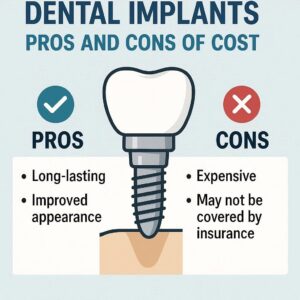
1. High Upfront Cost
This is the biggest barrier. Most people don’t have $5,000 sitting in a “tooth fund.” Even with financing, monthly payments can strain a budget.
If you need multiple implants or bone grafting, the upfront number becomes intimidating. There’s no way around that.
2. Insurance Covers Very Little
Here is a painful truth: most dental insurance plans were designed decades ago, before implants were common. Many call implants “cosmetic” or “not medically necessary.”
Typical insurance scenario:
– Annual max: $1,000–$1,500
– Implant coverage: 0% to 30% (if any)
– Waiting periods: 6–12 months
That means you pay 70–100% out of pocket. Some medical insurance may cover part if the tooth loss is due to an accident or injury, but don’t count on it.
3. It’s Surgery (With Real Risks)
An implant is a surgical procedure. Possible complications include:
-
Infection at the implant site
-
Nerve damage (numbness or tingling in lip, chin, or tongue)
-
Sinus problems (upper jaw implants)
-
Implant failure (the bone rejects the post – about 5% failure rate, higher for smokers)
Most of these are rare with a good surgeon, but they are not zero. And fixing a failed implant costs more money.
4. The Process Takes Months
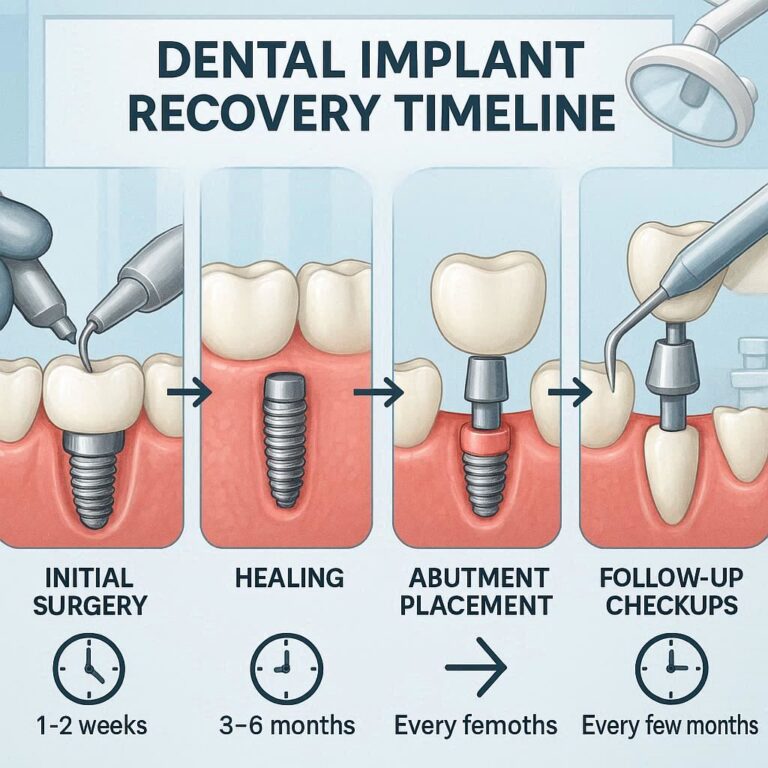
From extraction to final crown, expect:
-
Healing after extraction: 4–12 weeks
-
Implant placement surgery
-
Osseointegration (bone fusion): 3–6 months
-
Abutment placement and healing: 2–4 weeks
-
Crown fabrication and fitting: 2–4 weeks
Total timeline: 4 to 9 months. You may wear a temporary tooth during that time, but it’s not the same as having a finished implant. Patience is required.
5. Not Everyone Is a Candidate
You need healthy gums and enough jawbone density. Smokers, diabetics (uncontrolled), and people who grind their teeth heavily may have higher failure rates.
If you lack bone, you need a bone graft—extra cost, extra time, extra surgery.
Dental Implants vs. Alternatives: A Cost Comparison Table
Let’s put everything side by side. This will help you see where the dental implants pros and cons of cost really matter.
| Feature | Dental Implant | Fixed Bridge | Removable Denture |
|---|---|---|---|
| Upfront cost (single tooth) | $3,000 – $6,500 | $1,500 – $3,500 | $300 – $800 |
| Lifespan | 25+ years | 7–15 years | 5–8 years |
| Long-term cost (30 years) | $3k–$6k (one time) | $4.5k–$10.5k (replacements) | $1.8k–$4.8k (replacements + adhesives) |
| Affects adjacent teeth? | No | Yes (shaved down) | No |
| Prevents bone loss? | Yes | No | No |
| Feels like natural teeth? | Yes | Mostly | No (loose, bulky) |
| Surgery required? | Yes | No (but drilling) | No |
| Eating restrictions | None | Mild (no sticky foods) | Significant |
| Insurance coverage | Low | Moderate | Moderate to high |
Note: The “long-term cost” for dentures looks lower, but that doesn’t include soft relines, hard relines, repairs, or the cost of denture adhesives ($50–$100 per year). Also, it ignores the health cost of bone loss over decades.
Hidden Costs Nobody Tells You About
Let me pull back the curtain on expenses that surprise most patients.
Diagnostic Imaging
A simple X-ray isn’t enough. You need a 3D CBCT scan. That’s $150–$500. Some offices include it in the surgical fee. Many do not.
Temporary Teeth
While your implant heals, you may want a temporary partial denture or a “flipper.” That’s an extra $300–$800.
Sedation or Anesthesia
Local anesthesia is usually included. But if you want IV sedation or general anesthesia (common for multiple implants or anxious patients), add $300–$800 per hour.
Bone Grafting
About 50% of implant patients need some form of bone graft. A simple socket graft after extraction: $300–$500. A larger sinus lift or block graft: $1,500–$3,000.
Crown Repairs
The porcelain crown on top can chip or wear out after 10–20 years. Replacing just the crown costs $800–$2,000. That’s not an implant failure—just normal wear and tear.
Travel Costs if You Go Abroad
Many people consider dental tourism (Mexico, Costa Rica, Thailand, Turkey). An implant that costs $5,000 in the US might be $1,500 abroad. But add:
-
Flights: $400–$1,200
-
Accommodation: $500–$1,500
-
Lost work time: variable
-
Follow-up care (if complications arise at home): often not covered by local dentists
It can still save money. But it’s not risk-free.
How to Make Implants More Affordable (Real Strategies)
You don’t have to pay the full sticker price tomorrow. Here are practical ways to manage the cost.
1. Dental Schools
Major universities with dental schools offer implant treatment at 30–50% less than private practice. The work is done by supervised students or residents. It takes longer, but the quality is often excellent.
2. CareCredit or Medical Credit Cards
CareCredit offers 6, 12, or 18 months of no-interest financing if paid in full. After that, interest rates are high. Read the fine print.
3. FSA or HSA Dollars
Use your Flexible Spending Account or Health Savings Account. These are pre-tax dollars. If you have an FSA, plan ahead—use it or lose it by year end.
4. Ask About Staged Treatment
You don’t have to do all implants at once. Do one this year. Save. Do another next year. Many offices will work with you.
5. In-House Membership Plans
Some dentists offer discount plans for uninsured patients. You pay a yearly fee ($200–$400) and get 15–25% off implants and other services.
6. Negotiate
Yes, you can ask. Especially if you’re paying in cash (no insurance processing). Say: “If I pay the full amount today, can you give me a 10% discount?” Many offices will say yes.
When Are Implants NOT Worth the Cost?
Let’s be real. Implants are not for everyone.
Consider alternatives if:
-
You have a serious medical condition that impairs healing (uncontrolled diabetes, active cancer treatment, severe immune disorders).
-
You smoke heavily and won’t quit. Smokers have a significantly higher failure rate.
-
You have severe bruxism (teeth grinding) and won’t wear a night guard.
-
You only need to replace a tooth for a few years (e.g., you’re saving for something else).
-
You are not willing to commit to excellent daily hygiene.
A well-made bridge or even a partial denture can be a perfectly good solution for many people. Don’t let anyone shame you into implants if they don’t fit your life or budget.
What the Research Says About Implant Success and Cost-Effectiveness
A 2019 study in the Journal of Dental Research followed implant patients for over 20 years. The survival rate for single implants was 94.6% after 20 years. For implant-supported bridges, 90.1%.
Another study compared costs over 15 years. Implants were more cost-effective than bridges in the long run—but only if the patient kept up with maintenance.
That “if” matters. Skipping cleanings, poor brushing, and smoking will kill an implant just like a natural tooth (but from gum disease, not decay).
Bottom line from the research: Implants are a sound long-term investment for healthy, motivated patients. For others, the value drops.
Final Verdict: Are Dental Implants Worth the Cost?
Here is my honest answer after walking through all the dental implants pros and cons of cost.
If you are healthy, non-smoking, and plan to keep your teeth for 20+ years, yes—implants are worth the money. The upfront cost stings, but the long-term comfort, function, and bone preservation beat every alternative.
If you are on a very tight budget, have health issues, or only need a temporary solution, a bridge or partial denture is fine. You can always switch to an implant later.
The worst decision? Doing nothing. Leaving a missing tooth leads to shifting teeth, bone loss, and more expensive problems down the road.
Conclusion (Three Lines)
Dental implants cost more upfront but often save money over decades by lasting a lifetime and protecting your jawbone. The real trade-off is between short-term affordability (bridges/dentures) and long-term value (implants). Talk to two or three dentists, ask about financing, and choose what fits both your health and your budget today.
Frequently Asked Questions (FAQ)
1. Does insurance cover dental implants at all?
Some plans cover a portion of the crown or abutment, but rarely the implant post itself. Medicare generally does not cover implants. Medicaid coverage varies by state and is usually limited to children or specific medical necessity.
2. Can I get one dental implant for two missing teeth?
No. One implant supports one crown. For two missing teeth next to each other, you typically need two implants or an implant-supported bridge (two implants holding three crowns).
3. How painful is the implant surgery?
Most patients report less pain than a tooth extraction. You receive local anesthesia. Afterward, over-the-counter pain relievers usually suffice. Discomfort peaks at day 2–3, then fades.
4. What happens if my implant fails?
The dentist removes the failed implant. You wait for the bone to heal (3–6 months). Then you can try again, often with a wider implant or bone graft. Additional costs apply unless you have a warranty.
5. Can I get implants years after losing a tooth?
Yes, but you may need a bone graft if significant bone loss occurred. Many patients get implants 10, 20, or even 30 years after tooth loss.
6. Do dental implants look natural?
Yes. Modern crowns are custom-shaded and shaped to match your adjacent teeth. Unless you point it out, no one will know it’s an implant.
7. How do I clean dental implants?
Brush twice daily, floss normally (use superfloss or implant-specific floss), and use a water flosser if possible. Your dentist may recommend plastic-coated scalers for home use.