Dental Insurance Providers and Coverage Details
Let’s be honest for a moment. When was the last time you actually looked forward to reviewing your dental insurance policy? If you are like most people, the answer is probably “never.” Dental insurance often feels like a necessary evil—a piece of paperwork we pay into every month but hope we never have to use. Yet, when that familiar twinge in your molar turns into a full-blown toothache, suddenly, understanding your “dental insurance providers and coverage details” becomes the most important thing in the world.
I have been there myself. Sitting in a dentist’s chair, clutching a pamphlet filled with acronyms like “D1000” and “D2000,” wondering why a procedure that seems essential isn’t fully covered. It can be frustrating, overwhelming, and frankly, a little scary.
But here is the good news: dental insurance doesn’t have to be a mystery. In fact, once you learn how to read the map, navigating the world of PPOs, DHMOs, deductibles, and annual maximums becomes surprisingly straightforward.
Think of this article as your friendly guide. We are going to pull back the curtain on the biggest names in the industry—Delta Dental, Cigna, MetLife, and others—and break down exactly what they offer. More importantly, we will decode the confusing coverage details that often lead to surprise bills. Whether you are shopping for individual coverage, evaluating your employer’s open enrollment options, or just trying to figure out why your last cleaning cost more than expected, you are in the right place.
Let’s get started on the journey to a healthier smile—without the financial headaches.
The Basics: How Dental Insurance Actually Works
Before we dive into specific providers, we need to establish a solid foundation. Dental insurance is fundamentally different from medical insurance. While medical insurance is designed to protect you from catastrophic financial loss, dental insurance is more of a “maintenance” plan. It is built around the idea that preventive care prevents bigger problems down the road.
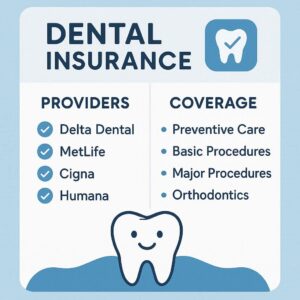
Most dental plans operate on a 100-80-50 structure. This is the industry standard, though it can vary.
-
100% Preventive Care: This usually includes routine cleanings, exams, and X-rays. The plan typically pays for this entirely, or after a small deductible.
-
80% Basic Care: This category covers fillings, simple extractions, and sometimes root canals. You are usually responsible for the remaining 20%.
-
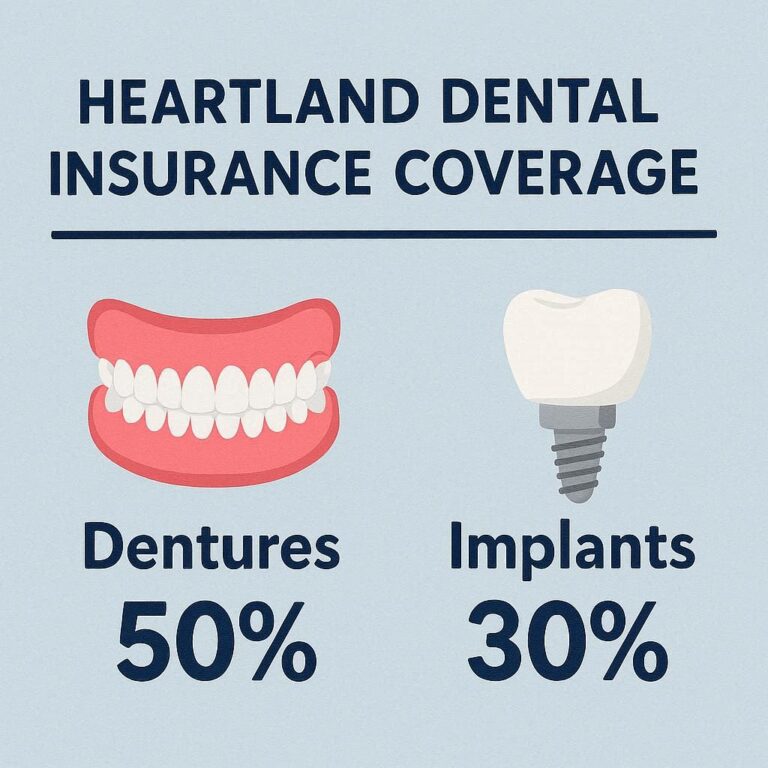
50% Major Care: This includes crowns, bridges, dentures, and complex oral surgery. Here, the plan picks up half, and you pay the other half.
Key Terms You Absolutely Must Know
To be a savvy consumer, you need to understand the vocabulary. Let’s break down the most common terms you will see on your “dental insurance providers and coverage details” summary sheet.
Annual Maximum
This is the total amount your insurance plan will pay for your dental care within a 12-month period (usually the calendar year). The national average hovers around $1,000 to $1,500 per person. This number has remained relatively stagnant for decades. If your dental work exceeds this amount, you are responsible for the difference.
Important Note: If you don’t use your annual maximum, you lose it. It does not roll over to the next year (unless you have a specific rollover plan, which is rare).
Deductible
This is the amount you pay out-of-pocket before your insurance kicks in. For dental plans, this is usually a small amount, often $50 per individual or $150 per family per year. Typically, preventive care is covered without needing to meet the deductible first.
Waiting Periods
This is a crucial detail. Some plans impose a waiting period—a set amount of time after enrollment—before they will cover certain procedures. For major work like crowns or bridges, you might have to wait 6 to 12 months. If you are switching jobs or plans, always ask if the waiting period is waived with proof of prior coverage.
In-Network vs. Out-of-Network
Dental insurance providers contract with specific dentists to form a network. If you visit an “in-network” dentist, they have agreed to pre-negotiated, discounted rates. You pay less. If you visit an “out-of-network” dentist, you can still use your insurance, but you will likely pay more, and the dentist may “balance bill” you—charging you the difference between their fee and what the insurance paid.
UCR (Usual, Customary, and Reasonable)
This is a common point of confusion. When you go out-of-network, insurance companies determine a “UCR” fee for a procedure. They base this on what dentists in your area typically charge. If your dentist charges more than the insurance company’s UCR, you are responsible for that extra amount.
Major Dental Insurance Providers: Who Are the Big Players?
Now that you have the basics down, let’s look at the main companies you are likely to encounter. It is important to remember that with dental insurance, the “provider” often matters less than the type of plan and network they offer. However, understanding their reputation and specialties can help you make an informed decision.
Delta Dental
Delta Dental is the 800-pound gorilla of the dental insurance world. With the largest network of dentists nationwide, it is often the go-to choice for employers and individuals alike. They operate through a network of independent companies across states, but their overall structure is similar.
Strengths:
-
Massive Network: Because they have the largest network, finding an in-network dentist is rarely an issue.
-
Predictable Costs: Their PPO (Preferred Provider Organization) plans are known for being transparent about costs.
-
Variety: They offer everything from basic preventive plans to comprehensive PPO plans and even DHMO (Dental Health Maintenance Organization) options.
Weaknesses:
-
Annual Maximums: Like most, their annual maximums are often capped at $1,000–$1,500, which hasn’t increased much despite rising dental costs.
-
Complex Structure: Because it’s a collection of state-specific companies, coverage can vary drastically depending on where you live.
Cigna
Cigna is a global health service company, and their dental arm is a major competitor. They are particularly known for offering a mix of affordable DHMO plans alongside traditional PPOs.
Strengths:
-
Transparency: Cigna’s online tools are excellent. You can usually get a clear estimate of what a procedure will cost before you go in.
-
DHMO Savings: If you are on a tight budget, Cigna’s DHMO plans often have no annual maximums and no deductibles, though you are restricted to a specific network of dentists.
-
Integrated Health: If you already have health insurance with Cigna, bundling dental can sometimes lead to discounts.
Weaknesses:
-
DHMO Restrictions: The DHMO plans, while cheap, require you to choose a primary care dentist and get referrals for specialists. You cannot simply see any dentist.
-
Network Variability: In some rural areas, their network can be thinner than Delta Dental’s.
MetLife
MetLife is a staple in the employee benefits space. You will frequently see MetLife dental plans offered by large corporations, government entities, and unions. They focus heavily on group benefits.
Strengths:
-
Group Focus: Their plans for employers are often generous, with higher annual maximums ($2,000+ is not uncommon in their group plans).
-
Dependable Service: MetLife has a long-standing reputation for reliable customer service and a straightforward claims process.
-
Pediatric Focus: They are known for having good orthodontic coverage for children in many of their group plans.
Weaknesses:
-
Individual Plans: If you are buying insurance on your own (not through an employer), MetLife’s individual plans can be less competitive than their group plans.
-
Benefit Maximums: While some group plans are high, their standard individual plans often stick to the typical $1,000 limit.
Aetna
Aetna, now part of CVS Health, integrates dental coverage with a broader focus on overall health. They have a strong presence in both the employer and individual markets.
Strengths:
-
Integration: Their connection with CVS and MinuteClinic can be a bonus for those seeking quick, integrated care.
-
Dental Savings Plus: They offer a hybrid product that is not insurance but a dental savings plan, which can be a great alternative for people who need major work and don’t want to deal with annual maximums or waiting periods.
-
Predictable PPO Plans: Their PPO plans are typically well-structured with clear copays and coinsurance levels.
Weaknesses:
-
Network Size: While large, their network is generally considered the second or third largest, meaning in some niche areas, it might be less comprehensive than Delta Dental.
-
Prior Authorizations: Aetna often requires prior authorization for major procedures like crowns, which can add a few days to your treatment timeline.
Humana
Humana has carved out a strong niche in the dental insurance market by focusing heavily on the individual market and Medicare Advantage plans. If you are retired or buying coverage on your own, Humana is likely on your radar.
Strengths:
-
Medicare Advantage Leader: Humana is a top provider for dental benefits bundled with Medicare Advantage plans. Many seniors get comprehensive dental coverage through this route.
-
No-Waiting-Period Plans: Humana offers several plans that have no waiting periods for major services, which is a massive advantage if you need immediate care.
-
Loyalty Rewards: Some Humana plans offer a unique feature: your annual maximum increases each year you remain a member without making a major claim.
Weaknesses:
-
Premium Costs: Their no-waiting-period plans often come with higher monthly premiums.
-
Complex Plan Structures: They offer a wide array of plans (Loyalty Plus, Preventive Value, etc.), which can be confusing to compare.
Decoding Coverage Details: What’s Actually Covered?
Let’s move beyond the names and look at the nitty-gritty details. The “coverage details” section of your policy is where the truth lives. You need to know what is covered, what is excluded, and how much you will really pay.
Preventive Care: The Foundation
We all know that an ounce of prevention is worth a pound of cure. Thankfully, dental insurance companies agree. Preventive care is almost always covered at 100%. This is the part of your plan you should maximize.
Typically covered at 100% (often no deductible):
-
Routine Cleanings: Usually two per year.
-
Comprehensive Exams: Usually two per year, often tied to the cleaning.
-
Bitewing X-rays: Typically once a year.
-
Full-Mouth X-rays (Panoramic): Usually once every 3 to 5 years.
-
Fluoride Treatments: Often covered for children (and sometimes for adults with certain conditions).
-
Sealants: Often covered for children’s permanent molars.
Reader Tip: If you have a family history of gum disease, some plans will cover three or four cleanings per year (periodontal maintenance) instead of just two. You may need a note from your dentist, but it is worth asking about.
Basic Restorative Care: Fixing the Small Stuff
When a cavity appears, you move into basic care. Here, your insurance will typically cover 70% to 80% of the cost, leaving you with a copay or coinsurance of 20% to 30%.
Common basic procedures:
-
Amalgam (Silver) or Composite (White) Fillings: Note that some plans will only cover the cost of an amalgam filling. If you want a tooth-colored composite filling, you might have to pay the difference.
-
Simple Extractions: Removing a tooth that is fully visible.
-
Root Canals (Anterior): Root canals on front teeth are often classified as basic; molars are often classified as major.
-
Periodontal Scaling and Root Planing: This deep cleaning for gum disease is usually covered at 80%.
Major Restorative Care: The Big Investments
This is where your annual maximum becomes critical. Major care is expensive, and your insurance will typically cover only 50% of the cost.
Common major procedures:
-
Crowns (Caps): These can cost $800–$1,500 each. Your plan pays half.
-
Bridges: Used to replace missing teeth by anchoring to adjacent teeth.
-
Dentures: Full or partial.
-
Complex Oral Surgery: Surgical extractions (impacted wisdom teeth), biopsies, and certain jaw surgeries.
-
Implants: This is a gray area. Many traditional plans do not cover implants at all, or they cover them poorly. Some plans may apply the “implant allowance” toward the cost of a crown or bridge instead.
Orthodontics: Straightening Smiles
Orthodontic coverage (braces) is usually a separate benefit with its own lifetime maximum. If your plan includes orthodontics, it is often a significant perk.
-
Lifetime Maximum: Typically $1,000 to $3,000 per person. This is a lifetime cap, not an annual one.
-
Age Limits: Many plans only cover orthodontics for dependents under 19. Adult orthodontics is becoming more common but often comes with a lower lifetime maximum or separate copay.
-
Payment Structure: The insurance company usually pays the orthodontic benefit in installments over the course of treatment (e.g., monthly or quarterly).
Navigating DHMO vs. PPO: Which One Is Right for You?
This is perhaps the most critical decision you will make. The difference between a DHMO and a PPO plan is massive, not just in cost, but in how you access care.
PPO (Preferred Provider Organization)
How it works: You pay a monthly premium. You can visit any dentist, but you get the best rates if you stay in-network. The insurance pays a percentage of the bill after you meet your deductible.
Pros:
-
Flexibility: You are not locked into one dentist. You can see a specialist without a referral.
-
Out-of-Network Coverage: You can go to a dentist not in the network; you just pay more.
-
Predictable Coverage: You know that cleanings are free and fillings are 80% covered.
Cons:
-
Higher Premiums: Monthly costs are higher than DHMOs.
-
Annual Maximums: You are limited by a cap.
-
Deductibles: You must pay a deductible before major coverage kicks in.
Best for: People who want flexibility, have a preferred dentist they don’t want to leave, and are willing to pay higher monthly costs for predictable out-of-pocket expenses.
DHMO (Dental Health Maintenance Organization) or Dental HMO
How it works: You pay a very low monthly premium (often $15–$30/month). You must choose a primary care dentist from a specific network. There is no annual maximum, and usually no deductible. Instead, you pay a small fixed copay for each service.
Pros:
-
Lowest Cost: Premiums are very low.
-
No Annual Maximums: You can get significant work done without worrying about hitting a cap.
-
Predictable Copays: You know exactly what a crown costs (e.g., $350) before you walk in.
Cons:
-
No Out-of-Network: If your chosen dentist leaves the network, you have to pick a new one. There is usually no coverage out-of-network.
-
Referrals: You often need a referral from your primary dentist to see a specialist.
-
Availability: The network can be smaller, and it can be hard to find a highly-rated dentist accepting new DHMO patients.
Best for: People on a tight budget who don’t mind a more restricted network and want predictable costs with no annual limit.
Comparison Table: Major Provider Highlights
To help you visualize the differences, here is a quick comparison table of how major providers typically stack up in key areas. Note: These are general trends; actual plans vary by state and employer group.
| Provider | Network Size | Best Known For | Typical Annual Max | Orthodontic Coverage |
|---|---|---|---|---|
| Delta Dental | Largest (PPO) | Nationwide access & reliability | $1,000 – $2,000 | Often available, separate lifetime max |
| Cigna | Large (PPO/DHMO) | Affordable DHMO plans & transparency | $1,000 – $1,500 | Common in PPO plans for children |
| MetLife | Large (Group Focus) | Strong group/employer plans | $1,500 – $2,500+ | Excellent in corporate group plans |
| Aetna | Large (PPO) | CVS integration & savings plans | $1,000 – $2,000 | Available, varies by plan |
| Humana | Medium-Large | Individual & Medicare Advantage plans | $1,000 – $2,000 | Common in Loyalty Plus plans |
Special Considerations for Different Life Stages
Your dental needs change over time. The plan that works for a single 25-year-old is probably not the best fit for a family of four or a retiree.
For Families with Children
If you have kids, orthodontics is likely on the horizon. When evaluating “dental insurance providers and coverage details,” pay close attention to:
-
Orthodontic Lifetime Maximum: Aim for at least $1,500 per child.
-
Age Limits: Ensure coverage extends to the ages your child might need braces (typically 12–18).
-
Sealants: Check if sealants are covered. They are a fantastic preventive measure for children’s molars.
-
Emergency Coverage: Kids are accident-prone. Look for plans that cover emergency dental visits well.
For Seniors and Retirees
For seniors, traditional employer-based insurance usually ends at retirement. Here are your main options:
-
Medicare Advantage (Part C): Many Medicare Advantage plans now include dental benefits. These vary wildly—some cover only cleanings, while others cover dentures and implants.
-
Standalone Dental Plans: You can purchase an individual PPO or DHMO plan. Since many seniors face major work like crowns, bridges, or dentures, a DHMO with no annual maximum can be a cost-effective choice.
-
Discount Plans: Dental savings plans are not insurance but provide discounted rates at participating dentists. They can be a great alternative if you have pre-existing conditions that make traditional insurance expensive or if you are tired of dealing with annual maximums.
For Individuals with Pre-Existing Conditions
Unlike medical insurance under the ACA, dental insurance is not required to cover pre-existing conditions. This means if you are missing teeth or have significant gum disease before enrolling, the plan might:
-
Impose a Waiting Period: Refuse to cover work related to that condition for 6–12 months.
-
Exclude Coverage: Permanently exclude coverage for that specific condition.
If you have pre-existing conditions, look for plans that waive waiting periods (often if you had prior coverage) or consider a dental savings plan where pre-existing conditions do not matter.
How to Read Your Explanation of Benefits (EOB)
You will receive an EOB after every dental visit. It is not a bill. It is a statement from your insurance company explaining what they paid and what you might owe. Learning to read this is a superpower.
Let’s decode a typical EOB:
-
Provider Charges: What the dentist billed. (e.g., $300)
-
Plan Allowance / Negotiated Fee: The amount the insurance company has agreed is the “in-network” rate. (e.g., $200)
-
Amount Paid by Plan: How much your insurance paid. (e.g., 80% of $200 = $160)
-
Your Responsibility: What you owe. (e.g., $40)
-
Deductible Applied: If a deductible was taken out.
-
Annual Maximum Remaining: How much budget you have left for the year.
Why this matters: If you go out-of-network, the “Plan Allowance” might be lower, and the “Provider Charges” might be higher, leaving you with a much larger bill.
The 5 Biggest Mistakes People Make with Dental Insurance
Avoid these common pitfalls to save money and headaches.
1. Not Using Your Benefits
This is the most common mistake. People skip their second cleaning because they are busy, or they delay a small filling because it “doesn’t hurt.” By December, they have lost their $1,000 annual maximum. Dental problems do not go away; they get more expensive. Use your benefits before they reset on January 1st.
2. Assuming All Dentists Are “In-Network”
Just because a dentist takes “Delta Dental” or “Cigna” does not mean they are in your specific plan’s network. Always call the dentist’s office or check your insurance portal to verify participation in your exact plan name (e.g., “Delta Dental PPO” vs. “Delta Dental Premier”).
3. Ignoring the Waiting Period
You sign up for a new plan, you have a tooth that needs a crown. You assume you are covered. Then you find out you have to wait 12 months for major services. Always verify if waiting periods apply, especially if you are purchasing individual coverage.
4. Overlooking the “Missing Tooth Clause”
Some policies have a clause stating they will not cover a bridge or implant to replace a tooth that was missing before the policy started. If you are missing a tooth, check for this clause before enrolling.
5. Forgetting to Pre-Authorize
For major work (crowns, bridges, oral surgery), always get a pre-authorization (predetermination) from your insurance company before the work is done. This is a formal estimate of what they will pay. It is not a guarantee, but it is the closest thing you can get to a promise.
Strategies to Maximize Your Dental Insurance
You now know the players and the rules. Here is how to play the game to win—or at least, to minimize your out-of-pocket costs.
-
Stack Procedures: If you need a crown and a few fillings, and you are nearing your annual maximum, consider scheduling the crown this year and the fillings after the new year (or vice versa) to leverage two separate annual maximums.
-
Use an FSA or HSA: Flexible Spending Accounts (FSA) and Health Savings Accounts (HSA) allow you to set aside pre-tax dollars for medical and dental expenses. This can save you 20-30% on the cost of your out-of-pocket dental care.
-
Communicate with Your Dentist’s Office: Dental office managers are often experts in insurance. They can tell you what your plan is likely to pay based on experience. Be honest about your budget. Many offices offer in-house payment plans or discounts for paying in full.
-
Re-evaluate Annually: Your needs change. The plan you chose last year might not be the best this year. During open enrollment, take 20 minutes to review your current plan against new options.
When Dental Insurance Isn’t Enough: Exploring Alternatives
There are times when traditional dental insurance does not fit. Maybe you are self-employed, retired, or simply need a lot of work that would blow through a $1,500 maximum. In these cases, consider alternatives.
Dental Savings Plans (Discount Plans)
-
How it works: You pay an annual membership fee (often $80–$150/year) to join a network. You then get a discount of 10% to 60% on dental services when you visit a participating dentist.
-
Pros: No waiting periods, no annual maximums, no deductibles, no exclusions for pre-existing conditions.
-
Cons: It is not insurance. You pay the discounted fee in full at the time of service. You still pay for everything; you just pay less.
Dental Tourism
For major work like full-mouth reconstruction or multiple implants, some people travel to countries like Mexico, Costa Rica, or Hungary, where dental care is significantly cheaper. While this can save thousands of dollars, it comes with risks regarding follow-up care, travel costs, and varying quality standards. Always thoroughly research the clinic and surgeon.
In-House Membership Plans
An increasing number of dental offices offer their own membership plans. For a flat monthly or annual fee, you get two cleanings, X-rays, and a discount (often 15-20%) on other services. This is an excellent alternative if your employer does not offer insurance or if you want to support a small practice without dealing with insurance bureaucracy.
The Future of Dental Insurance
The dental insurance landscape is slowly evolving. We are seeing a few interesting trends:
-
Tele-dentistry: More plans are starting to cover virtual consultations, allowing you to get a diagnosis from a dentist via video call without an office visit.
-
Increased Annual Maximums: Under pressure from consumer advocates, some plans are beginning to offer higher annual maximums, though the industry standard has been stubbornly slow to change.
-
Medical-Dental Integration: As research increasingly links oral health to overall health (heart disease, diabetes), we are seeing more integration between medical and dental insurance. Expect to see more bundled plans that reward you for taking care of both.
Conclusion
Navigating the world of dental insurance providers and coverage details does not have to be a source of anxiety. It is simply a matter of learning the language—understanding the difference between a PPO and a DHMO, knowing your annual maximum, and recognizing the importance of in-network care. By taking the time to understand your specific plan and using the strategies outlined in this guide, you can transform a confusing expense into a powerful tool for maintaining your health.
Remember, dental insurance is designed to incentivize preventive care. The best thing you can do for your smile and your wallet is to show up for those two cleanings a year, address small issues before they become big ones, and always, always ask questions before agreeing to treatment.
Frequently Asked Questions (FAQ)
1. Is dental insurance worth it if I have healthy teeth?
Yes, absolutely. If you have healthy teeth, a plan with low premiums that covers 100% of preventive care is essentially prepaying for your cleanings and X-rays. The insurance acts as a safety net. If you unexpectedly chip a tooth or develop a cavity, the cost of the fillings or crown will be significantly reduced. If you truly never have issues, a basic preventive-only plan or an in-house membership plan might be the most cost-effective route.
2. Can I use my dental insurance immediately after signing up?
It depends on the plan. Many PPO plans have waiting periods of 6–12 months for major services like crowns, bridges, and sometimes fillings. Preventive care (cleanings, exams) is usually available immediately. If you had dental insurance before joining the new plan, you can often submit proof of prior coverage to have the waiting periods waived. DHMO plans typically have no waiting periods but require you to select a primary dentist first.
3. What is the difference between coinsurance and a copay?
-
Coinsurance is a percentage. For example, if your plan has 20% coinsurance for fillings, you pay 20% of the negotiated rate.
-
Copay is a flat fee. For example, a DHMO plan might have a $25 copay for a filling, regardless of how complex it is.
PPO plans typically use coinsurance, while DHMO plans typically use copays.
4. Why did my dentist charge me more than my insurance said I owed?
This usually happens for two reasons. First, if you visited an out-of-network dentist, they are allowed to “balance bill” you for the difference between their fee and what the insurance paid. Second, your insurance might have downgraded a procedure—for example, they paid for a silver filling (the “basic” option) but your dentist used a white composite filling, leaving you to pay the difference.
5. How can I find out if my dentist is in-network?
The most reliable way is to call your dentist’s office directly and ask them to verify your specific insurance plan (including the exact plan name, not just the carrier). You can also log into your insurance provider’s member portal and search for in-network providers. Keep a screenshot of the search results for your records.