Does Dental Implant Covered by Insurance? The Realistic 2026
Let’s get the hardest truth out of the way immediately, right here at the top of the page: Most standard dental insurance plans do not cover the full cost of dental implants.
There is a deep, frustrating sigh that happens in dental offices across the country every single day. It’s the moment a patient learns they need an implant to save their smile and their bite, and then they learn that their insurance card—the one they pay a premium for every month—might only cover a cleaning or a cheap bridge. They ask the question: “Wait, does dental implant covered by insurance at all?”
The answer is rarely a simple yes or no. It is a landscape of “maybe,” “partially,” and “if you read this specific fine print on page 47 of your benefits booklet.”
This article serves as your definitive, exhaustive guide to navigating the maze of dental implant insurance coverage. We will not use fluffy marketing language. We will use real numbers, real insurance codes, and realistic expectations. By the time you finish reading, you will understand exactly why implants are treated differently, when insurance might pay, and how to maximize every single dollar of benefit available to you in 2026.

A Critical Note Before We Begin
The information in this article reflects the current landscape of the dental insurance industry. Plans change annually. Nothing here replaces a “Pre-Treatment Estimate” from your specific insurance carrier. We will show you exactly how to get one.
The Fundamental Disconnect: Why Your “Dental” Plan Doesn’t Like Implants
To understand the answer to the question “does dental implant covered by insurance,” you must first understand that the American dental insurance model is stuck in the 1970s. It hasn’t evolved as fast as dental science has.
The $1,500 Annual Maximum Trap
The biggest secret in the dental insurance industry is the Annual Maximum Benefit. This is the total dollar amount your insurance company will pay for all dental work in a calendar year.
| Plan Type | Average Annual Maximum | Implant Cost Reality |
|---|---|---|
| Basic Employer PPO | $1,000 – $1,500 | Covers less than 30% of one implant. |
| Premium PPO | $2,000 – $2,500 | Covers maybe the abutment and crown. |
| Union/Negotiated Plan | $3,000 – $5,000 | Rare. Offers real assistance. |
Here is the stark reality: A single tooth implant, from extraction to final crown, costs between $3,000 and $6,000 in most U.S. markets. If your insurance has a $1,500 cap, you have already hit that cap the moment the surgeon places the post in your jawbone. The rest is 100% out-of-pocket.
Expert Quotation:
“Patients often feel betrayed by their insurance because they assume ‘covered’ means ‘paid for.’ In dentistry, ‘covered’ usually means you get the insurance company’s discounted fee schedule, but you still write the check.”
— Anonymous Dental Office Manager, 12 years experience.
The “Least Expensive Alternative Treatment” (LEAT) Clause
This is the fine print that breaks hearts. It is also known as the Alternative Benefit Clause. Here is how it works:
You need a tooth replaced. You and your dentist agree an Implant is the gold standard. It preserves bone and doesn’t damage neighboring teeth. It costs $5,000.
Your insurance reviews the claim and says: “We see you need a tooth replaced. We agree. However, the Least Expensive Alternative Treatment for replacing a missing tooth is a Partial Denture (which costs $600). We will pay 50% of that $600 denture cost ($300), and you can apply that $300 toward your implant. Good luck with the rest.”
This is perfectly legal and it is standard operating procedure for 90% of dental PPO plans. This is why the answer to “does dental implant covered by insurance” is often: No, but they might contribute a pittance toward something else.
The Medical Insurance Loophole: When Your Body (Not Your Smile) Is the Issue
This is the most important section of this entire article because this is where real coverage happens.
The question we are tackling is “does dental implant covered by insurance.” If we change the context from Dental Insurance to Medical Insurance, the answer changes drastically from “rarely” to “sometimes, yes, significantly.”
Medical insurance does not care about your smile. It cares about function and pathology.
Scenarios Where Medical Insurance Pays for Implants
Medical insurers (Blue Cross Blue Shield, Aetna Medical, Cigna Medical, Medicare Advantage) will cover portions of implant surgery if the procedure is deemed Medically Necessary.
What is Medically Necessary for Implants?
-
Trauma or Accident: You were in a car crash, fell off a bike, or took a hockey puck to the mouth. This is an injury, not a dental disease. Medical insurance pays for reconstruction of body parts lost in accidents. The jaw and teeth are body parts.
-
Congenital Defect: You were born missing permanent teeth (Hypodontia).
-
Cancer Reconstruction: You lost part of your jaw or teeth due to oral cancer surgery or radiation.
-
Severe Atrophy/Pathology: Your jawbone has resorbed so much due to osteoporosis or a cyst that you cannot chew food properly. This moves from dental health to systemic health.
How to Navigate the Medical Claim for Implants (The Real Process)
Filing a medical claim for a tooth implant is a bureaucratic marathon. It requires a specific language called ICD-10 Codes.
| Dental Problem | ICD-10 Medical Code | Why It Works |
|---|---|---|
| Loss of teeth due to trauma | S02.5xxA (Fracture of tooth, traumatic) | This is a broken bone, not a cavity. |
| Acquired absence of teeth | K08.1 | Used when the absence causes malnutrition. |
| Disorder of jaw, unspecified | M26.60 | Often tied to TMJ issues from missing teeth. |
Important Note for Patients:
Most general dentists cannot bill medical insurance. They are Dental Providers. You will likely need an Oral Surgeon or a Prosthodontist who is credentialed with both medical and dental boards. Ask the office specifically: “Do you bill medical insurance for implant surgery?” If they hesitate or say “We can try,” that is a red flag. You need a surgeon’s office that does this every day.
Medicare and Implants: The Great Disappointment of 2026
We need a dedicated section for seniors because the confusion here is monumental. The question “does dental implant covered by insurance” is asked most often by those on Original Medicare (Part A and Part B) .
The answer is brutally simple: No.
Original Medicare excludes coverage for routine dental care and most dental implants. Period. There is no loophole in the Part A or Part B handbook for replacing teeth unless it is part of a covered hospital stay for jaw reconstruction (which is rare).
Medicare Advantage (Part C) vs. Medigap
There is a glimmer of light in Medicare Advantage Plans offered by private insurers (Humana, UnitedHealthcare, Aetna).
-
Medigap (Supplement Plans): Pay the 20% that Medicare doesn’t cover. Since Medicare pays $0 for implants, Medigap pays $0.
-
Medicare Advantage (MAPD): These plans often bundle a Dental Allowance.
Comparative Table: Medicare Advantage Dental Allowances for Implants
| Insurer (Example Plan) | Implant Coverage Status | Typical Allowance |
|---|---|---|
| Humana Gold Plus | Covered after 12-month waiting period | $1,000 – $1,500 lifetime max |
| Aetna Medicare Prime | Coverage varies by region | Often only covers restoration (crown), not surgery |
| UnitedHealthcare Dual Complete | Enhanced benefits for dual-eligible | Up to $3,000 annually for comprehensive dental |
Key Takeaway: Even with Medicare Advantage, the allowance rarely covers the full cost. It serves as a discount coupon, not a payment plan.
Detailed Breakdown: What Parts of the Implant Process Get Covered?
When we analyze “does dental implant covered by insurance,” we must stop looking at “The Implant” as one item. Insurance companies break it down into three distinct phases with three different levels of coverage.
Phase 1: Extraction and Bone Grafting (The Prep Work)
-
Extraction: Almost always covered (typically at 80% after deductible).
-
Bone Graft: Rarely covered. This is the silent budget killer. A graft can cost $400 to $1,200 per site. Insurance views this as an elective enhancement to the jaw, not a cure for disease.
Phase 2: Implant Placement (The Surgery)
-
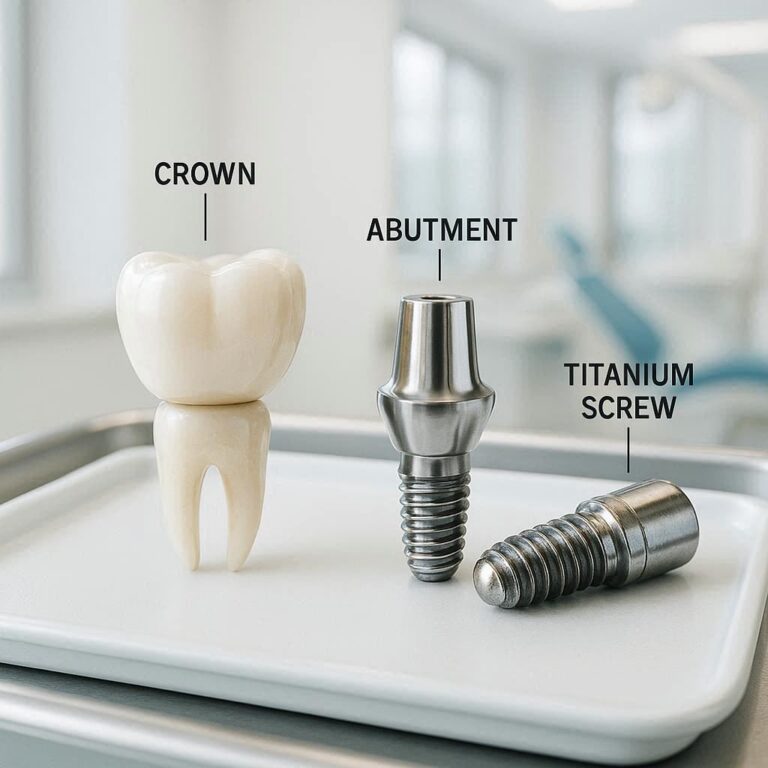
Surgical Placement of Implant Body: This is the titanium screw.
-
Coverage Status: Occasionally Covered (at 50%). However, this is where the Missing Tooth Clause kicks in. If you lost the tooth before you had this specific insurance policy, the implant may be denied as a “Pre-Existing Condition.”
Phase 3: Abutment and Crown (The Tooth Part)
-
Abutment & Crown: This is the visible tooth on top of the screw.
-
Coverage Status: Covered as a “Major Service.” Most plans pay 50% for crowns, but only up to the Annual Maximum. Since the crown is the last step, the annual maximum is often already depleted by the surgery or a filling you got six months ago.
The Waiting Period Gauntlet
Even if your specific policy document says “Implant Services: Covered,” you are not out of the woods. You must survive the Waiting Period.
Realistic Timeline Example:
-
Month 1: You buy a new dental PPO plan because you know you need an implant.
-
Months 1-6: You can get cleanings and fillings.
-
Months 7-12: You can get root canals or simple extractions.
-
Month 13+: Implant benefits unlock.
Why this matters: If you have a missing tooth right now and it hurts, buying insurance today will not help you get the implant paid for this year. You will pay premiums for 12 months before seeing a dime of implant coverage.
The 2026 Landscape: States Mandating Implant Coverage
The tide is turning, slowly. Recognizing the health consequences of missing teeth (malnutrition, diabetes complications, cognitive decline), some state legislatures have stepped in where the insurance lobby has failed.
State Spotlight: California
As of 2024, California law requires all state-regulated health plans (not self-funded ERISA plans) to cover biocompatible alternatives when a tooth is extracted. This means if your dentist says a bridge is not appropriate because it damages healthy teeth, the plan must cover the implant at the same percentage they cover a bridge.
State Spotlight: Medicaid Adult Dental
This is the area of fastest change. Historically, Medicaid paid for extractions but never for replacements.
| State | Medicaid Implant Coverage (Adults) |
|---|---|
| Colorado | Coverage for anterior (front) teeth implants. |
| Illinois | Coverage for implants when medically necessary. |
| New York | Limited coverage in select managed care plans. |
| Texas | No coverage. Extractions only. |
Note: If you are on a Self-Funded ERISA Plan (common at large corporations like Amazon, Walmart, Google), state laws do not apply. Your employer decides the coverage, not the state government.
Alternative Financial Avenues: If Insurance Says No
Since the answer to “does dental implant covered by insurance” is frequently a disappointing “not really,” you need a Plan B. Here are the realistic, non-scam options available in 2026.
1. The Dental Savings Plan (Discount Plan)
What it is: A membership club, not insurance.
Cost: $100 – $200 per year.
Implant Savings: 20% – 40% off the retail fee.
Comparison: Insurance vs. Savings Plan
| Feature | Dental Insurance (PPO) | Dental Savings Plan |
|---|---|---|
| Annual Maximum | Yes ($1,500 cap) | No Cap |
| Waiting Period | 6-18 Months | None (Starts in 3 days) |
| Pre-Authorization | Required (Slow) | Not Required |
| Best For | People who need cleanings and X-rays | People who need major work NOW |
2. In-House Membership Plans
Many private dental practices now offer their own “Wellness Plans.”
Typical Offer: $350/year includes 2 cleanings, 1 emergency exam, and 15% off all implant procedures.
Benefit: You bypass the insurance company entirely. The dentist likes it because they don’t pay an insurance coordinator to fight claims.
3. CareCredit and Healthcare Financing
This is a credit card for health expenses.
-
Promotional Periods: Often 12-18 months 0% Interest on charges over $1,500.
-
The Catch: If you miss a payment or do not pay the full balance in the promotional period, interest is charged retroactively from Day 1 at a very high rate (often 26.99% APR). This is a powerful tool for disciplined people and a debt trap for everyone else.
4. Dental Schools and Residency Programs
Savings Potential: 50% – 70% off private practice fees.
The Trade-Off: Time. A 45-minute implant surgery in private practice becomes a 3-hour appointment under faculty supervision.
Insider Tip: This is the absolute best value for a Single Tooth Implant if you live within driving distance of a university like UCLA, NYU, University of Michigan, or Tufts.
The Hidden Cost of NOT Getting the Implant (The Long View)
When you are looking at a $4,000 estimate and your insurance says they’ll pay $500, the natural instinct is to walk away. “I’ll just leave the space.”
We must address the long-term biology of a missing tooth.
Domino Effect of Tooth Loss
-
Bone Resorption: Without a root to stimulate the jawbone, the bone melts away (25% width loss in the first year).
-
Super-Eruption: The tooth above the gap drifts down because there is nothing to bite against.
-
Drifting: Neighboring teeth tilt into the empty space, creating food traps that lead to gum disease and cavities on the teeth you still have.
Cost Comparison: Fixing One Gap Now vs. Fixing Domino Damage Later
| Treatment | Cost in 2026 | Insurance Help? |
|---|---|---|
| Single Implant (Now) | $4,500 | Minimal |
| Wait 5 Years -> Need Bridge | $3,500 (Damages 2 healthy teeth) | Better, but sacrifices good teeth |
| Wait 10 Years -> Bone Graft + 2 Implants + Sinus Lift | $12,000+ | None |
Conclusion: Insurance companies are banking on you not getting the implant. They know that in 10 years, you will likely lose more teeth due to the shifting bite, and by then, you might be on Medicare (where they pay $0). Delaying the implant is almost always the more expensive choice in the long run.
How to Read Your Benefits Booklet Like a Pro
Stop calling the 1-800 number on your card and asking “Does dental implant covered by insurance?” The person on the phone is reading the same vague PDF you have. You need to search for specific codes.
Step 1: Look for D6010.
This is the ADA Code for Surgical Placement of Implant Body. If this code says “Not Covered” or “Limitations Apply,” you have your answer.
Step 2: Look for the “Replacement of Missing Teeth” Clause.
Find the section titled Prosthodontics or Major Restorative.
Text to look for: “Benefits for implant services are payable only when the tooth was extracted while the patient was covered under this plan.”
If that sentence is there, and you lost the tooth before you had the job/plan, the claim will be denied.
Step 3: The Pre-Treatment Estimate (The Only Truth That Matters)
This is a non-negotiable step. Your dentist sends the X-rays and treatment plan to the insurance company before any work is done. The insurance company sends back a letter stating exactly what they will pay.
-
It is not a guarantee of payment.
-
It is a written estimate.
If the estimate says “Patient Portion: $3,950,” believe it. Do not hope for a miracle on the back end.
Dental Tourism: Is It the Answer to “Does Dental Implant Covered by Insurance”?
When faced with a $5,000 bill and $0 from insurance, many Americans look south of the border. Places like Los Algodones (Mexico), Costa Rica, and Budapest have built entire economies on dental tourism.
Cost Comparison: US vs. Mexico (All-Inclusive)
| Item | US Average (No Ins) | Mexico (Los Algodones) |
|---|---|---|
| Implant + Crown | $4,500 | $1,400 |
| Flight/Hotel | $0 (Local) | $400 |
| Time Commitment | 4-6 months (healing) | 2 Trips (1 week each) |
| Follow-up Care | In your hometown | Non-existent or costly emergency flight |
The Realistic Risk:
If an implant fails in Mexico (and even the best implants have a 5% failure rate), you will pay a US dentist full price to remove it and fix the mess. No US dentist warranties work done in another country. You must factor this risk into the “savings.”
Summary
-
Standard dental insurance usually treats implants as a “cosmetic upgrade” and offers only limited, capped assistance, often subject to waiting periods and the “cheaper alternative” rule.
-
The most significant coverage potential lies within medical insurance (for trauma or congenital defects) and specific Medicare Advantage plans, not basic dental PPOs.
-
Patients should rely on Dental Savings Plans, in-office memberships, or dental schools for predictable discounts rather than expecting traditional insurance to cover the bulk of the cost.
Frequently Asked Questions (FAQ)
Q: Does dental implant covered by insurance if the tooth was missing before I got the job?
A: In most cases, no. This is the “Missing Tooth Clause.” The insurance company will not pay to replace a tooth that was missing before your coverage effective date. You must have been covered by that specific plan when the tooth was extracted or lost.
Q: Will Medicaid ever pay for dental implants in 2026?
A: Rarely, and only for front teeth in a few specific states. Medicaid’s primary focus is on extracting infected teeth to stop pain and systemic infection. Cosmetic or functional replacement (implants) is generally not considered a covered benefit for adults over 21, with very narrow exceptions for trauma or cancer reconstruction.
Q: My dentist says I need a “sinus lift.” Does insurance cover that part?
A: Almost never. Dental insurance classifies a sinus lift (bone grafting in the upper jaw) as a surgical procedure that is investigational or adjunctive to the implant. Medical insurance might cover it if you have a history of sinus disease, but that is a very difficult claim to win.
Q: Is it better to get a bridge if insurance pays more for it?
A: Insurance pushes you toward a bridge because it is cheaper for them in the short term. They do not care that the bridge requires grinding down two perfectly healthy teeth on either side of the gap. Those teeth are now more prone to decay and root canals in the future (which you will pay for). A bridge is an insurance company’s solution. An implant is a dental health solution.
Q: Can I use my FSA or HSA for the portion insurance doesn’t cover?
A: Absolutely yes. Dental implants are considered a Qualified Medical Expense by the IRS. You can use pre-tax dollars from your Flexible Spending Account (FSA) or Health Savings Account (HSA) to pay for the entire procedure, including the surgery, crown, and even the sedation. This saves you 20-30% in taxes.
Additional Resource: Finding a Fair Price
Navigating the cost of implants without insurance requires transparency. We recommend using FAIR Health Consumer (fairhealthconsumer.org). This is a non-profit organization that tracks actual out-of-network billing data by zip code.
How to use it for Implants:
-
Go to the website.
-
Click “Dental Costs.”
-
Enter your Zip Code.
-
Search for “D6010 – Implant Placement.”
-
It will show you the 80th percentile charge for your area. This is the “fair price.” If a dentist quotes you 50% more than this number, you are likely being overcharged.