Does Tooth Extraction Affect Jawline?
The shape and definition of our jawline are more than just aesthetic features; they are integral to our facial harmony, self-perception, and even our airway health. Given the profound importance of this structure, it’s no wonder that many people facing a tooth extraction worry about potential changes to their face. The question, “Does tooth extraction affect jawline?” is a serious and valid concern that bridges dentistry, orthodontics, and even cosmetic surgery.
This comprehensive guide will explore the science, the myths, and the realities of how removing a tooth can influence the underlying bone and soft tissues that define your jaw. We will move beyond simplistic answers to provide you with a nuanced understanding, empowering you to make informed decisions about your oral health. Whether you’re considering wisdom teeth removal, facing an extraction due to decay, or are simply curious about long-term facial changes, this article is your essential reference.
Understanding the Jawline: More Than Just Bone
Before we dive into the effects of extraction, it’s crucial to understand what creates your jawline’s appearance. It’s not a single structure but a complex interplay of several components:
-
The Jawbone (Mandible and Maxilla): This is the foundation. The mandible (lower jaw) is a U-shaped bone that determines the width and length of your lower face. The maxilla (upper jaw) supports your mid-face and cheekbones.
-
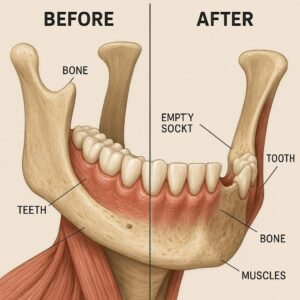
Teeth and Alveolar Bone: Your teeth are not simply planted in the main jawbone. They sit in sockets within a specialized, softer bone called the alveolar bone. This bone exists primarily to support the teeth; its health and volume are directly dependent on the presence of tooth roots.
-
Soft Tissues: Muscles (like the masseter, which is key for chewing), fat pads, and skin drape over the bony framework, adding contour and definition.
The critical takeaway is that the alveolar bone is a “use-it-or-lose-it” structure. It requires the mechanical stimulation from tooth roots to maintain its density and volume.
The Immediate vs. Long-Term Impact of an Extraction
The effect of a tooth extraction on your jawline isn’t a single event but a process that unfolds over time.
The Immediate Post-Extraction Period (0-6 Months):
Right after an extraction, the empty socket fills with a blood clot, which is then replaced by granulation tissue and eventually bone. During this healing phase, you will see no visible change to your external jawline. There may be some temporary swelling or mild tissue indentation at the site, but this resolves as you heal.
The Long-Term Biological Process: Alveolar Bone Resorption
This is the core of the issue. Once a tooth is lost:
-
The alveolar bone, now devoid of its primary stimulus (the tooth root), begins to resorb—it shrinks in both width and height.
-
This process is most rapid in the first year but continues gradually throughout life.
-
The overlying gum tissue also shrinks to follow the receding bone.
So, does a single extraction cause a dramatic, visible change in your jawline? For a single tooth, especially one not at the front of the arch, the change is often localized and may not be visibly noticeable from the outside. The overall architecture of your mandible remains intact. However, the loss of alveolar bone creates a “domino effect” that can lead to subtle and then more significant changes over decades.
How Different Types of Extractions Influence the Jaw
Not all extractions carry the same risk profile for facial change. Let’s break it down.
Wisdom Teeth Extraction
This is the most common question. The removal of third molars (wisdom teeth) from the very back of the jaw typically has no direct impact on your jawline contour. These teeth are situated behind the main supporting structure of the jaw angle. Their removal does not affect the anterior (front) bone that defines your chin and jawline. Any perceived “slimming” is usually due to reduced post-surgical swelling.
Single or Multiple Tooth Extractions in the Back (Molars & Premolars)
Extractions here can lead to:
-
Loss of chewing function on that side, potentially causing muscle asymmetry over time if you favor one side.
-
Shifting of adjacent and opposing teeth, which can alter your bite and, indirectly, the stress distribution on your jaw joints (TMJs).
-
While bone resorption occurs locally, its external visual impact on the jawline is usually minimal unless many teeth are lost, leading to a significant decrease in vertical facial height (making the face appear shorter and the jaw less defined).
Front Tooth Extractions
Loss of teeth in the aesthetic zone (incisors and canines) is more likely to affect lip support and the profile view of your mid-face. While it can contribute to a sunken appearance around the mouth (accelerating an aged look), it primarily affects the area around the lips and nose rather than the angular jawline itself.
The Critical Issue: Full Mouth Extractions and Dentures
This is where the most profound impact on the jawline occurs. With no teeth remaining:
-
The alveolar bone undergoes widespread and severe resorption.
-
Over years, this can lead to a dramatic loss of vertical facial height—the distance between the nose and chin collapses.
-
The chin rotates forward and upward, the lips thin and lose support, and the jawline loses its defined angle, often becoming more pointed or “witch’s chin” in appearance.
-
Dentures, which rest on the gums, cannot prevent this bone loss and can even accelerate it with improper fit.
Comparing Jawline Impact: A Quick Reference Table
| Extraction Type | Primary Area of Bone Loss | Visible Impact on Jawline | Key Considerations |
|---|---|---|---|
| Wisdom Teeth | Very back of jaw, minimal alveolar bone | Typically None. | No effect on jaw angle or definition. Swelling subsides. |
| Single Molar | Localized alveolar ridge | Minimal to None. | Risk of teeth shifting, affecting bite and long-term jaw health. |
| Multiple Back Teeth | Larger segment of posterior ridge | Potentially Moderate. | Can reduce facial height, leading to a “collapsed” look in lower face. |
| Front Teeth | Anterior alveolar bone | Significant on Profile/Lips. | Loss of lip support, aged appearance. Direct jawline impact is less. |
| Full Mouth | Complete alveolar ridge | Severe and Defining. | Profound loss of jaw structure, facial collapse, and loss of definition. |
Beyond Bone: The Role of Muscles and Bite
Your jawline isn’t just shaped by bone; the muscles that power your jaw play a huge role. The masseter muscles, which are used for chewing, are key contributors to a strong, square jawline.
-
The Bite Connection: Your teeth guide your jaw muscles. When you lose teeth, especially molars, your bite (occlusion) changes. You may subconsciously chew differently or clench to find a comfortable resting position.
-
Muscle Adaptation: Over time, this altered function can lead to muscle hypertrophy (enlargement) or atrophy (shrinking), subtly changing the contour of your lower face.
-
TMJ Disorders: A changed bite can also place strain on your temporomandibular joints, potentially leading to pain, clicking, and even further compensatory changes in jaw posture.
Expert Insight: Dr. Alan Goldstein, a maxillofacial surgeon, notes, “While we focus on bone, we must never forget the dynamic soft tissue envelope. The loss of dental support can initiate a cascade of adaptive changes in musculature and skin tension, contributing to facial aging that goes far beyond the socket itself.”
Preventive Measures and Modern Solutions
The good news is that modern dentistry offers powerful strategies to prevent bone loss and preserve your facial structure after an extraction.
1. Immediate Dental Implants: The Gold Standard
Placing a titanium implant into the extraction socket at the time of tooth removal is the single best way to prevent bone loss.
-
How it works: The implant acts as an artificial tooth root, providing the necessary mechanical stimulation to the bone (osseointegration).
-
Result: It preserves over 95% of the alveolar bone volume, maintaining the gum contour and supporting the surrounding facial tissues.
2. Bone Grafting at the Time of Extraction
If an implant isn’t placed immediately, a socket preservation graft can be performed.
-
How it works: The empty socket is filled with bone graft material (synthetic, donor, or from your own body), which acts as a scaffold to guide new bone growth.
-
Result: It significantly slows resorption, maintaining bone volume for a potential future implant and preventing the worst of the tissue collapse.
3. The Critical Role of Timely Replacement
Never leave a gap indefinitely (excluding some wisdom teeth). Options include:
-
Dental Implant & Crown: Best for bone and tissue preservation.
-
Fixed Dental Bridge: Restores function but doesn’t prevent bone loss under the false tooth (pontic).
-
Partial Denture: A removable appliance; prevents teeth shifting but does not preserve bone.
Important Note: If you are having a tooth extracted, discuss bone preservation options with your dentist or oral surgeon before the procedure. Planning ahead is the most effective way to protect your long-term oral and facial health.
Jawline Enhancement Beyond Dentistry
For some, the concern about jawline isn’t just prevention but enhancement. It’s important to distinguish between:
-
Reconstructive Procedures: These aim to restore lost form and function (e.g., bone grafting for implant placement, orthognathic surgery to correct jaw alignment).
-
Cosmetic Procedures: These aim to improve aesthetics on an otherwise healthy structure (e.g., fillers, implants, or Kybella for submental fat).
A strong, healthy jawbone from preserved dentition is the best foundation for any aesthetic enhancement.
Conclusion
So, does tooth extraction affect your jawline? The answer is nuanced: a single extraction may not immediately change your profile, but it initiates a process of bone loss that, if unaddressed—especially with multiple extractions—can fundamentally alter the foundation of your facial structure over time. The key is proactive management. By understanding the vital link between your teeth and your jawbone, and by utilizing modern preservation techniques like immediate implants or bone grafting, you can protect both your smile and the defining contours of your face for a lifetime.
Frequently Asked Questions (FAQ)
Q1: Will removing my wisdom teeth give me a slimmer, more defined jawline?
A: No. Any perceived slimming is almost always the result of reduced post-operative swelling. Wisdom teeth removal does not affect the bony angles of your jaw that create definition.
Q2: How long after an extraction does bone loss become noticeable in my face?
A: Significant external facial changes usually take years and are most associated with the loss of multiple teeth, particularly without replacement. The bone resorption itself begins within months but is internal and not visibly apparent at first.
Q3: Can braces or Invisalign after an extraction prevent jawline changes?
A: Orthodontics can perfect your bite and tooth alignment, which is beneficial for overall oral health. However, it cannot prevent the alveolar bone resorption in the gap left by an extracted tooth. Only an implant or bone graft can address that.
Q4: I already have dentures and notice my face has changed. Is it too late?
A: It is never too late to improve your oral health. While lost bone cannot fully regenerate, advanced procedures like implant-supported dentures (All-on-4®) can halt further bone loss, provide incredible stability, and often improve facial support and appearance compared to conventional dentures. Consult with a prosthodontist or implant surgeon.
Q5: Does getting a dental bridge prevent bone loss?
A: Unfortunately, no. A traditional bridge restores the crown of the tooth but not the root. The bone underneath the false tooth (pontic) in the bridge will still resorb over time, though the bridge itself hides the gap.
Additional Resources
For further reading and to find qualified professionals, consider these reputable sources:
-
The American Association of Oral and Maxillofacial Surgeons (AAOMS): Patient information on extractions, implants, and bone grafting. https://www.aaoms.org/
-
The American College of Prosthodontists (ACP): Expert resources on tooth replacement and restoring oral function. https://www.gotoapro.org/
-
International Congress of Oral Implantologists (ICOI): A global resource for patient education on dental implants. https://www.icoi.org/