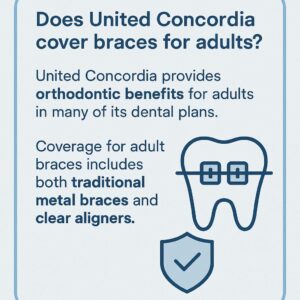
Does United Concordia Cover Braces for Adults?
If you are an adult considering braces, you are not alone. Whether it is for health reasons, to fix a bite issue, or simply to gain the confidence of a straighter smile, more adults than ever are seeking orthodontic treatment.
But there is usually one big question that stops people from booking that consultation: Does United Concordia cover braces for adults?
The short answer is: It depends entirely on your specific plan.
United Concordia is one of the largest dental insurance providers in the United States, offering a wide range of plans. Some plans offer excellent orthodontic coverage for adults, while others strictly limit benefits to children under the age of 19.
In this guide, we will walk you through exactly how to read your policy, what “lifetime maximums” mean, and how to avoid surprise bills. Whether you are looking at traditional metal braces or modern clear aligners, this article will help you understand your financial responsibilities before you start treatment.
Understanding How United Concordia Dental Insurance Works
Before we dive into the specifics of braces, it helps to understand the structure of a United Concordia policy. Dental insurance is not the same as medical insurance. It operates on a different model, usually focused on prevention and maintenance.
United Concordia organizes its plans into tiers. Depending on whether you get your insurance through your employer, the marketplace, or a federal program like Tricare or FEDVIP (Federal Employees Dental and Vision Insurance Program), your coverage levels will vary significantly.
The Three Main Categories of Coverage
Most United Concordia plans fall into one of these three structures:
-
DHMO (Dental Health Maintenance Organization): You choose a primary dentist from a network. You usually pay a low copay for services, and there are no deductibles or annual maximums. However, orthodontics for adults are rarely included in DHMO plans.
-
DPPO (Dental Preferred Provider Organization): This is the most common type for adults. You have the freedom to see any dentist, but you pay less if you stay in-network. There is usually a deductible and an annual maximum. Orthodontic coverage is often available, but with specific limitations.
-
Indemnity Plans: These are traditional fee-for-service plans. They allow you to see any dentist, and the plan reimburses you a percentage of the cost. Orthodontic coverage is typically an optional rider.
If you are covered under a FEDVIP plan (for federal employees and retirees), United Concordia offers specific high and standard options that often include adult orthodontics with a separate lifetime maximum.
Does United Concordia Cover Braces for Adults? The Eligibility Factor
This is the most critical section for anyone asking, “does united concordia cover braces for adults?” The determining factor is not whether the insurance company can cover it, but whether your specific employer group or purchased plan elected to include that benefit.
In the dental insurance industry, orthodontics is considered a “major” service. Many companies offer orthodontic coverage for dependents (children) as a standard feature to attract families. However, covering adults for braces is an additional cost to the employer.
Age Limitations
When looking at your policy documents, look for a section titled “Orthodontics.” Here, you will usually see one of three things:
-
Covered for Adults and Children: This is the ideal scenario. The plan provides a benefit regardless of age.
-
Covered for Dependents Only: This limits coverage to individuals under the age of 19 (or sometimes 26, depending on the plan). If you are the primary policyholder over that age, you will receive $0 in benefits.
-
Not Covered: Some basic plans exclude orthodontics entirely.
If you are enrolled in a United Concordia Tricare plan (for military families), adult orthodontics are generally not covered unless they are deemed medically necessary due to trauma or congenital defects. This is a strict guideline that rarely changes.
Important Note: If your plan says “orthodontics covered for dependents only,” it does not matter if you have a severe overbite or jaw pain. The insurance will reject the claim based on age alone.
Decoding the Orthodontic Benefit
If you have confirmed that your plan covers adult orthodontics, congratulations! However, understanding how much they pay is another puzzle.
Unlike fillings or crowns, which are billed per visit, orthodontic treatment is billed as a total case fee. Insurance companies handle this through a “lifetime maximum.”
What is a Lifetime Orthodontic Maximum?
A lifetime maximum is the total amount of money the insurance company will pay toward your braces ever. Once that limit is reached, they will not pay another penny for orthodontics for the rest of your time enrolled in that plan.
For adult orthodontics with United Concordia, this lifetime maximum typically ranges from $1,000 to $3,500.
Here is how it usually breaks down by plan tier:
| Plan Type | Typical Adult Orthodontic Lifetime Maximum | Waiting Period |
|---|---|---|
| FEDVIP High Option | $2,500 – $3,500 | Usually none |
| FEDVIP Standard Option | $1,500 – $2,000 | Usually none |
| Large Employer PPO | $1,500 – $2,500 | 12-24 months |
| Small Employer PPO | $1,000 – $1,500 | 12-24 months |
| DHMO / HMO | $0 (Usually not covered) | N/A |
How Payment Works
Unlike a crown where the insurance pays the dentist in one lump sum, orthodontic benefits are paid in installments. United Concordia typically pays a portion (often 50% of the total fee) upfront as a “down payment,” and then the remaining balance is paid monthly over the course of treatment.
For example, if your braces cost $5,000 and your plan has a $2,000 lifetime maximum covering 50% of the cost:
-
United Concordia calculates that they owe $2,000.
-
They pay $1,000 at the start of treatment.
-
They pay the remaining $1,000 in monthly installments over 12-24 months.
-
You are responsible for the remaining $3,000 (or whatever the contracted rate is if you are in-network).
In-Network vs. Out-of-Network: A Financial Trap
One of the biggest mistakes adults make when using United Concordia for braces is going out of network.
United Concordia has a massive network called “Concordia Plus.” If you choose an orthodontist who is a “Concordia Plus” provider, you are considered “in-network.”
Why In-Network Matters for Braces
When you stay in-network, the orthodontist agrees to a contracted fee. This fee is usually significantly lower than the orthodontist’s standard retail price.
-
In-Network: The orthodontist charges $4,500 (contracted rate). Insurance covers 50% ($2,250). You pay $2,250.
-
Out-of-Network: The orthodontist charges $6,000 (retail). Insurance covers 50% of their “allowed amount,” which might only be $3,500. They pay $1,750. You pay the difference: $4,250.
Going out of network can double your out-of-pocket costs. Always use the United Concordia provider search tool to confirm your orthodontist is in-network before signing a treatment contract.
Medical Necessity: The Exception to the Rule
Sometimes, braces are not just cosmetic. If you have a severe malocclusion (bad bite), temporomandibular joint disorder (TMJ/TMD), or sleep apnea related to jaw structure, your treatment might be considered “medically necessary.”
If your dental plan does not cover adult orthodontics, you may have the option to file a claim under your medical insurance (if you have it).
To do this, your orthodontist must document:
-
Difficulty chewing or speaking.
-
Chronic jaw pain.
-
Evidence of gum disease caused by crowding.
-
Airway issues.
If the medical claim is approved, your medical insurance (which often has a higher out-of-pocket maximum) may cover a portion of the surgery or orthodontics. However, this is a difficult route. It requires pre-authorization, and approval is not guaranteed. It is most common in cases involving orthognathic surgery (jaw surgery).
Clear Aligners (Invisalign) vs. Traditional Braces
A frequent question we hear is, “Does United Concordia cover Invisalign for adults?”
If your plan covers adult orthodontics, it usually covers any type of orthodontic treatment necessary to correct the condition. This includes:
-
Traditional metal braces
-
Ceramic (tooth-colored) braces
-
Lingual braces (behind the teeth)
-
Clear aligner therapy (Invisalign, ClearCorrect, etc.)
Insurance companies do not usually differentiate between the method. They base the payment on the severity of the case and the contracted fee.
However, there is a catch. Some orthodontists charge a premium for clear aligners. If the retail cost of Invisalign is $6,000 but traditional braces are $4,500, and your insurance has a $2,000 lifetime maximum, you will still pay the difference.
Tip: If you prefer Invisalign, ask your orthodontist if they offer “in-house” aligners (brands like 3M or Spark) which might have a lower lab fee than Invisalign, reducing your total cost while still utilizing your insurance benefit.
Waiting Periods: You Can’t Always Get Braces Immediately
If you are enrolling in a new United Concordia plan through a private market or a new employer, you need to check for the “orthodontic waiting period.”
A waiting period is a specific amount of time you must be enrolled in the plan before the insurance will pay for major services like braces.
-
No waiting period: Common in large employer groups and FEDVIP plans.
-
12-month waiting period: Common in individual plans or small business plans.
-
24-month waiting period: Rare, but exists for some low-cost plans.
If you sign up for a plan with a 12-month waiting period in January, you cannot start orthodontic treatment until the following January. If you start treatment earlier, the insurance will deny the claim entirely.
How to Maximize Your United Concordia Orthodontic Benefits
If you are planning to get braces as an adult, you want to squeeze every dollar out of your insurance plan. Here is how to do it strategically.
1. Use a Flexible Spending Account (FSA) or Health Savings Account (HSA)
Even with insurance, braces are expensive. If your employer offers an FSA or HSA, you can set aside pre-tax dollars to pay for your portion of the braces. This saves you roughly 20-30% on the total cost depending on your tax bracket.
2. Time Your Treatment
Most orthodontic treatment lasts 18 to 24 months. If you have a calendar year maximum (for other dental work) separate from your orthodontic lifetime max, try to start treatment late in the year. This allows you to use up your “annual maximum” for cleanings and fillings before the year resets, ensuring your orthodontic benefit remains untouched for the braces.
3. Double Coverage (Spousal Coordination of Benefits)
If you are married and both you and your spouse have dental insurance that covers orthodontics, you may be able to “coordinate benefits.”
For example:
-
Your United Concordia Plan: $2,000 lifetime max.
-
Spouse’s Plan: $2,000 lifetime max.
-
Total Available: Up to $4,000.
However, you cannot simply double the coverage to exceed 100% of the cost. Typically, the primary insurance pays its share (e.g., 50%), and the secondary insurance pays a portion of the remaining balance. This can drastically reduce your out-of-pocket costs.
Common Scenarios: Real-World Examples
To help you visualize how this works, let’s look at three common scenarios for adults seeking braces with United Concordia.
Scenario 1: The Federal Employee
Sarah is a federal employee with the FEDVIP High Option plan.
Sarah wants Invisalign. The contracted rate with her in-network orthodontist is $5,500. Her plan covers 50% of orthodontics up to a $3,000 lifetime maximum.
-
Insurance Pays: $2,750 (50% of the cost)
-
Sarah Pays: $2,750
-
Result: Sarah saves half the cost. She uses her FSA to cover the $2,750.
Scenario 2: The Dependent Adult
*Michael is 28 years old. He is covered under his father’s employer-based United Concordia PPO.*
Michael checks the policy. It says: “Orthodontics: Covered for dependents under 19.”
-
Insurance Pays: $0
-
Michael Pays: Full price ($4,500 – $6,000)
-
Result: Michael is an adult dependent. Despite being on a good plan, the age limit excludes him. He must pay out of pocket or ask the orthodontist for an in-house payment plan.
Scenario 3: The New Hire
Jessica starts a new job with a United Concordia DPPO. She needs braces for TMJ pain.
The plan covers adult orthodontics at 50% up to $1,500. However, the plan documents state a 12-month waiting period for major services. She started in March.
-
Action: Jessica must wait until March of next year to start treatment.
-
Result: If she starts now, the claim is denied. If she waits, she saves $1,500.
Frequently Asked Questions (FAQ)
Here are the most common questions we hear from adults navigating United Concordia orthodontic coverage.
1. Does United Concordia cover braces for adults over 50?
Yes, if your specific plan includes adult orthodontics. There is no age cap on the coverage itself beyond the “dependent” distinction. If you are the primary insured and your plan covers adults, you are eligible regardless of whether you are 30 or 65.
2. Does United Concordia cover braces for adults with Medicare?
United Concordia offers Medicare Advantage plans (through the “Jubilee” brand in some states) and Medicare Supplement plans. Typically, traditional Medicare does not cover dental braces. However, some United Concordia Medicare Advantage plans offer dental allowances that may apply toward orthodontics, though coverage is usually limited. You must check your specific Evidence of Coverage booklet.
3. Can I use my United Concordia dental insurance for braces if I have a missing tooth?
Yes. In fact, many adults get braces to open space for a dental implant. However, note that the orthodontic benefit and the implant (major restorative) benefit are separate. You will likely have an annual maximum for implants separate from your orthodontic lifetime maximum. Plan your treatment sequence carefully with your dentist and orthodontist.
4. What if my orthodontist says United Concordia denied my claim?
First, ask for the Explanation of Benefits (EOB). The denial code will tell you why. Common reasons include:
-
W8: Waiting period not satisfied.
-
AGE: Dependent age limit exceeded.
-
EXC: Orthodontic benefit lifetime maximum exhausted (used previously).
If you believe the denial is a mistake (e.g., you never had braces before), call United Concordia’s customer service directly. Do not rely solely on the provider’s office to fix it, as they manage hundreds of insurance plans.
5. Are retainers covered after braces?
This varies. Some United Concordia plans include a “retainer allowance” as part of the orthodontic lifetime maximum. For example, the insurance might pay for the braces and a set of retainers. However, if you lose your retainers a year later, replacement retainers are usually considered a “diagnostic and preventive” service or a “minor” service, often covered at a lower percentage (or not at all) depending on your plan.
Conclusion
Navigating dental insurance for orthodontic treatment can feel overwhelming, but it doesn’t have to be.
To answer the question does united concordia cover braces for adults, you must first look at your plan’s age limitations and whether orthodontics is an included benefit for adults. If it is, your next steps involve understanding your lifetime maximum, finding an in-network provider, and checking for waiting periods.
If your plan does not cover adult orthodontics, do not despair. Many orthodontists offer interest-free financing plans (like CareCredit) or in-house discounts that rival insurance benefits. Sometimes, paying the “cash price” without insurance ends up being similar to the cost after insurance deductions, especially if your plan has a low lifetime maximum.
The key to a stress-free experience is preparation. Verify your benefits directly with United Concordia (using the member services number on the back of your card) before your orthodontic consultation. This ensures that when you sit down in the orthodontist’s chair, you already know exactly how much your insurance will contribute and how much you will need to budget.
Summary:
United Concordia covers braces for adults only if the specific plan includes orthodontic benefits for adults (not just dependents). Coverage typically involves a lifetime maximum between $1,000 and $3,500, with higher benefits for in-network providers. Always verify waiting periods and age limits before starting treatment to avoid unexpected costs.
Additional Resource
For the most accurate and personalized information regarding your specific plan, we recommend accessing your member portal directly.
Link: United Concordia Member Login (Official Site)