Dual Dental Insurance Coverage Rules
Having one dental insurance plan can feel like a safety net. But what happens when you have two? Perhaps you are covered under your own employer’s plan and also as a dependent on your spouse’s plan. Welcome to the world of dual dental insurance coverage.
At first glance, having two plans sounds like a dream—double the coverage, right? In reality, it doesn’t quite work that way. You don’t get to “double dip” and collect a refund from your insurance companies. Instead, the two plans work together through a specific set of rules known as the Coordination of Benefits (COB).
Understanding these rules is the key to unlocking real value. When managed correctly, dual coverage can significantly reduce your out-of-pocket expenses, sometimes covering up to 100% of the costs that a single plan would leave behind.
In this guide, we will strip away the confusion. We will walk you through exactly how dual dental insurance works, who pays first, the different calculation methods insurers use, and the common pitfalls to avoid. By the end, you will know exactly how to use your two plans to get the most out of your dental care.
What Exactly is Dual Dental Insurance?
Dual dental insurance simply means you are a covered beneficiary under two different dental insurance plans simultaneously. This is a common situation in modern families.
The most frequent scenarios include:
-
Married Couples: Both you and your spouse work and have employer-sponsored dental plans. You each add the other as a dependent.
-
Children with Working Parents: A child is covered under both the mother’s plan and the father’s plan.
-
Student Coverage: A young adult is covered under a parent’s plan (often until age 26) and also obtains coverage through their own employer.
-
Retiree Coverage: A retiree has Medicare Advantage or a retiree dental plan, but also works part-time for an employer that offers benefits.
It is important to note that having two plans does not mean you have a $2,000 annual maximum from one plan and another separate $2,000 maximum from the other. Instead, the plans combine to pay for your treatment, but they will never pay more than the actual cost of the services rendered.
The Golden Rule: Coordination of Benefits (COB)
When two insurance companies are responsible for the same claim, they don’t just write checks blindly. They follow a legal and contractual process called Coordination of Benefits (COB). The purpose of COB is to prevent over-insurance (paying out more than the total cost of the treatment) and to establish a clear order of payment.
Without COB rules, patients might try to submit the same bill to two insurers to get paid twice, which is generally considered insurance fraud. COB ensures that the total payment from both plans does not exceed the total amount billed by the dentist.
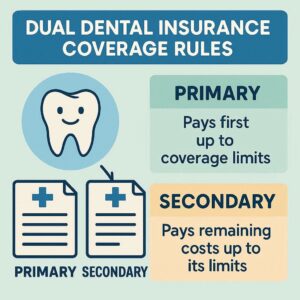
The core principle of COB is determining which plan is primary and which plan is secondary.
-
Primary Plan: This plan pays first, up to its limits. It processes the claim as if you had no other insurance.
-
Secondary Plan: This plan pays second. It reviews what the primary plan paid and may cover some or all of the remaining balance, up to its own limits, but never exceeding the total cost.
How the “Birthday Rule” and Other Determinants Work
You might be wondering: How do the insurance companies decide who pays first? They don’t flip a coin. There is a strict hierarchy established by the National Association of Insurance Commissioners (NAIC) that all reputable dental insurers follow.
For Adult Members (The Subscriber)
If you are the patient and you are covered under two plans because you have two jobs (or a job and a spouse’s plan), the rules are straightforward:
-
Your Own Employer Plan: If you are covered as an employee (subscriber) under your own workplace plan, that plan is always primary for you.
-
Your Spouse’s Plan: If you are also covered as a dependent on your spouse’s plan, that plan is secondary for you.
There is no “Birthday Rule” for the adult patient themselves. The rule is simple: the plan where you are the employee (the subscriber) pays first.
For Dependent Children (The Birthday Rule)
This is where things get interesting—and where the “Birthday Rule” comes into play. When a child is covered under both parents’ plans, the order of payment is determined by the parents’ birth dates.
-
The Rule: The parent whose birthday falls earlier in the calendar year (month and day only) carries the primary insurance for the child.
-
The Exception: If the parents are divorced or separated, the rules change. Typically, the parent with custody or the parent whose court order specifies responsibility for medical expenses will be primary. If there is no court order, the birthday rule usually applies, but many insurers require the parent who is the “custodial” parent to be primary.
Let’s look at an example:
-
Parent A: Birthday is March 10th.
-
Parent B: Birthday is July 22nd.
If both parents cover the child on their respective plans, Parent A’s plan is the primary insurer for the child because March comes before July.
Important Note: Some states have specific laws that override the standard birthday rule. For example, in some states, the parent with the earliest birthday is still primary, but if the parents are separated, the plan of the parent with physical custody pays first regardless of birthdays. It is always wise to check with your HR department or insurer if your family situation is complex.
Understanding the Two Methods of Coordination
Once the primary and secondary plans are identified, the secondary plan must decide how much to pay. They don’t just pay the leftover amount automatically. They use one of two main calculation methods. Knowing which method your secondary plan uses is crucial to estimating your out-of-pocket costs.
1. Non-Duplication of Benefits (The Most Common)
This is the most favorable method for the patient. Under the Non-Duplication of Benefits method, the secondary plan calculates what it would have paid if it were the primary plan. Then, it subtracts what the primary plan actually paid.
-
If the primary plan paid more than what the secondary would have paid: The secondary plan pays $0. You owe nothing more.
-
If the primary plan paid less than what the secondary would have paid: The secondary plan pays the difference, bringing the total to the secondary plan’s usual allowance.
Example:
-
Total Bill: $200
-
Primary Plan Allowance: $150 (Pays 80% = $120)
-
Secondary Plan Allowance: $150 (Pays 80% = $120)
Since the primary paid $120, and the secondary’s maximum payment would have been $120, the secondary says: “We would have paid $120, but the primary already paid $120. We pay $0.” The patient owes the $30 remaining from the primary’s deductible or coinsurance.
However, if the secondary plan has a higher allowance or coverage percentage:
-
Total Bill: $200
-
Primary Plan Allowance: $100 (Pays 80% = $80)
-
Secondary Plan Allowance: $150 (Pays 80% = $120)
The secondary calculates: $120 (our would-be payment) – $80 (primary payment) = $40. The secondary pays $40. Total paid by insurance: $120. Patient owes $80.
2. Maintenance of Benefits (Traditional Coordination)
This method is less common today but still exists in older plans or union plans. Under Maintenance of Benefits, the secondary plan pays the difference between what the primary paid and the total actual charge, up to the secondary plan’s usual allowance.
This method usually results in the secondary plan paying more, but it is also more likely to hit the annual maximum limits faster.
Example:
-
Total Bill: $200
-
Primary Plan Pays: $120
-
Secondary Plan Allowance: $150 (Typically pays 80% = $120)
Under Maintenance of Benefits, the secondary looks at the remaining balance: $200 – $120 = $80. Since $80 is less than their maximum allowance ($120), they pay the $80. The patient owes $0.
As you can see, the calculation method dramatically changes the patient’s final responsibility.
How to Identify Your Primary and Secondary Plan
Before you sit in the dentist’s chair, it is helpful to know which card to hand over first. Here is a quick reference guide to determine your coverage order.
| Scenario | Primary Plan | Secondary Plan |
|---|---|---|
| You are employed and married | Your employer’s plan (where you are the employee) | Your spouse’s plan (where you are a dependent) |
| Your spouse is employed and married | Your spouse’s employer plan (where they are the employee) | Your plan (where they are a dependent) |
| Child of married parents | Plan of parent with earliest birthday in the calendar year | Plan of parent with later birthday |
| Child of divorced/separated parents | Plan of the custodial parent (or parent with legal responsibility) | Plan of the non-custodial parent (if applicable) |
| Adult child under 26 | Parent’s plan (if the child is a dependent) OR the adult child’s employer plan if they have one. | Whichever is not primary. Note: If the adult child has their own job-based plan, that is usually primary. |
Important Note: You cannot choose which plan is primary. The insurers strictly enforce the COB rules. Attempting to “reverse” the order to get a better payout is a violation of your insurance contract and can result in denied claims or policy cancellation.
The Benefits of Dual Coverage
If the secondary plan often pays less than you expect, why bother maintaining two plans? While it is not a financial windfall, dual coverage offers distinct advantages that can save you a significant amount of money, especially if you need major dental work.
1. Reduced Deductibles
Most dental plans have an annual deductible (usually $50 to $100 per person). With dual coverage, once the primary plan’s deductible is met, the secondary plan may waive its deductible or apply the primary’s payment toward its own deductible requirements.
2. Lower Coinsurance Costs
If your primary plan covers a crown at 50% (you pay 50%), the secondary plan might cover 80% of the remaining balance. This can drop your out-of-pocket responsibility from 50% down to 10% or 20% of the cost.
3. Maximizing Annual Maximums
This is the biggest financial benefit. Most dental plans cap their annual payout at $1,000 to $2,000 per person. If you need a $4,000 procedure (like implants or full mouth reconstruction), a single plan leaves you with a $2,000+ bill. With dual coverage, the secondary plan effectively adds a second annual maximum on top of the primary.
For example:
-
Primary Max: $1,500
-
Secondary Max: $1,500
-
Total Potential Payout: Up to $3,000 (though they will never pay more than the procedure cost).
4. Coverage for Non-Duplicated Services
Sometimes, a primary plan might exclude a specific procedure (like sealants for adults or certain types of bone grafts). The secondary plan, if it covers that procedure, may step in to pay for it even if the primary denied it entirely.
Common Pitfalls and Misconceptions
Navigating dual insurance isn’t always smooth sailing. There are several misconceptions and administrative headaches that can trip you up if you aren’t prepared.
Myth 1: “I can submit claims myself to get paid back.”
In almost all cases, you cannot submit claims to both insurers yourself and expect a check. The process requires the dentist’s office to bill the primary plan, wait for the Explanation of Benefits (EOB), and then bill the secondary plan with the primary’s EOB attached. If you try to bypass this, you risk delays and denials.
Myth 2: “Dual coverage means no copays ever.”
While it is possible to have zero out-of-pocket costs for basic procedures (cleanings, fillings), it is not guaranteed. If both plans have high deductibles that haven’t been met, or if the secondary plan uses the Non-Duplication method aggressively, you may still owe a balance.
Myth 3: “My dentist will handle everything automatically.”
Dentists are experts in teeth, not necessarily in the complexities of your specific COB situation. You are responsible for informing the dental office that you have dual coverage. If you don’t provide both insurance cards and accurately tell them who is the primary subscriber (and the birthday details), claims will be processed incorrectly, leading to delays.
The “Timing Trap”
One of the biggest frustrations with dual coverage is timing. Insurance claims don’t process instantly. The dentist’s office must:
-
File to Primary (2-4 weeks)
-
Receive payment and EOB from Primary
-
File to Secondary with EOB (2-4 weeks)
-
Receive payment from Secondary
This means it can take 6 to 8 weeks for the full payment to settle. If you want the secondary insurance to cover a large portion, you must be prepared to either wait for the final bill or pay the estimated balance upfront and receive a refund later.
Step-by-Step: How to File a Claim with Dual Insurance
To ensure a smooth experience, follow this step-by-step protocol when visiting the dentist.
Step 1: Gather Your Information
Before your appointment, write down the following for both plans:
-
Insurance Company Name
-
Policy/Group Number
-
Subscriber Name (Employee name)
-
Subscriber Date of Birth
-
For children: Both parents’ birthdays
Step 2: Inform the Dental Office
When scheduling the appointment, explicitly state: “I have dual coverage. I am the primary subscriber under Plan A, and I am a dependent under Plan B (or, for my child, Plan A is primary because of the birthday rule).”
Step 3: Provide Both Cards
Give the front desk both insurance cards. Ask them to verify eligibility and COB rules with the carriers before your treatment, especially if it is a major procedure.
Step 4: Verify the Order
Ask the office manager to confirm which plan they have listed as primary in their system. A simple double-check here can save months of billing headaches.
Step 5: Review the Treatment Plan
Request a pre-treatment estimate (predetermination). The dentist will send the treatment plan to both insurers. In 4-6 weeks, you will receive an EOB from both companies showing exactly what they will pay and what you owe. This is the safest way to proceed with expensive work like crowns, bridges, or implants.
Special Situations and Exceptions
Dual coverage isn’t always a straightforward parent-child or spousal situation. Life is complicated, and insurance rules try to keep up.
Medicare and Dental Coverage
If you are over 65 and have Medicare Advantage (Part C) that includes dental benefits, and you also have a private dental plan through a spouse’s employer, the rules depend on the size of the employer.
-
If the employer has 20 or more employees, the employer group plan (the private insurance) is primary. Medicare is secondary.
-
If the employer has fewer than 20 employees, Medicare is primary.
COBRA and New Coverage
If you lose a job and elect COBRA, and then later obtain new coverage through a spouse’s plan, COBRA usually becomes secondary. However, if you have COBRA and also obtain your own new employer plan, your new employer plan becomes primary, and COBRA becomes secondary.
Tricare (Military)
Tricare has specific rules regarding dental coverage. If you have Tricare and a private employer plan, Tricare usually pays after the private insurance for dental services. It acts as a secondary payer in most non-active duty scenarios.
A Comparative Look: Plan Types and Dual Coverage
Not all dental plans play nicely together. The type of plan significantly impacts how dual coverage works.
| Plan Type | Characteristics | Effectiveness in Dual Coverage |
|---|---|---|
| PPO (Preferred Provider Organization) | Flexible network; highest coverage if you stay in-network. | Excellent. PPOs typically allow coordination well. Secondary PPOs often cover the difference left by the primary. |
| DHMO (Dental Health Maintenance Organization) | Low premiums; no deductibles; you must see a specific primary dentist; no balance billing. | Problematic. DHMOs usually waive the right to coordinate. If you have a DHMO as primary, the secondary plan may refuse to pay because the DHMO patient usually owes $0. If DHMO is secondary, they often pay $0 because they require you to use their network. |
| Indemnity (Fee-for-Service) | Freedom to see any dentist; usually pays a percentage of “usual and customary” fees. | Excellent. Indemnity plans often serve as excellent secondary plans because they pay a set percentage regardless of what the primary did. |
| Discount Plans | Not insurance. | Not applicable. These are not insurance and do not coordinate with insurance. |
Practical Tips for Maximizing Dual Coverage
To truly benefit from having two plans, you need to be strategic. Here are actionable tips from insurance coordinators and dental office managers.
1. Schedule Major Work Early in the Year
If you have a high-cost procedure, schedule it in January or February. This allows time for the pre-determination process and ensures you have the full annual maximum of both plans available. If you wait until November, you risk running out of time before the year resets.
2. Use In-Network Providers for Both Plans
If possible, find a dentist who is in-network for both your primary and secondary plans. This ensures you get the contracted rates from both insurers, maximizing the allowed amounts and minimizing your responsibility.
*“The biggest mistake I see is patients assuming the secondary plan will cover the leftover 50% of a crown. If the secondary plan uses non-duplication, they look at their own fee schedule. If the primary’s network discount is deep, the secondary might owe nothing. Always ask for a predetermination.”*
— Sarah J., Certified Dental Office Manager
3. Keep Your Information Updated
Marriage, divorce, birth of a child, and job changes all affect COB rules. If you get married, you have 30 to 60 days to update your coverage. Failing to report a change in employment or custody can result in the insurers retroactively denying claims, leaving you with a massive bill.
4. Understand “Usual and Customary” (U&C) Rates
If you have an indemnity plan as secondary, they pay based on U&C rates. If your primary plan allowed a lower network rate, the secondary might pay the difference up to their U&C. However, if the dentist charges more than the secondary’s U&C, you are responsible for the remainder.
The Role of the Dental Office in COB
A good dental office is your best ally in navigating dual coverage. However, it’s helpful to understand what they do behind the scenes.
When you present two insurance plans, the front desk team must:
-
Verify Eligibility: Confirm both plans are active.
-
Determine COB: Input the correct primary/subscriber data based on the rules you provide (or based on their software’s COB logic).
-
File Primary: Submit the claim with a COB indicator showing there is secondary insurance.
-
File Secondary: After receiving the primary EOB, they submit the secondary claim with the primary EOB attached.
If the dental office makes a mistake (e.g., they bill the secondary as primary by accident), the claim will be denied, and the payment cycle will restart, delaying the process by weeks.
Conclusion
Dual dental insurance coverage is a valuable benefit that, when understood and managed correctly, can significantly reduce your out-of-pocket costs for dental care. The system operates on strict Coordination of Benefits rules that determine which plan pays first and how the second plan contributes.
For adults, your own employer plan is always primary. For children, the “Birthday Rule” typically decides the order. The real financial benefit comes from stacking the annual maximums and using the secondary plan to reduce deductibles and coinsurance, particularly for major procedures.
By informing your dentist correctly, requesting predeterminations for costly work, and understanding whether your secondary plan uses Non-Duplication or Maintenance of Benefits, you can navigate this system with confidence. Remember, the goal isn’t to profit from insurance, but to ensure that your necessary dental care is as affordable as possible.
Frequently Asked Questions (FAQ)
1. Can I collect money from both insurance companies?
No. The total payment from both plans combined will never exceed the total amount the dentist charges. Coordination of Benefits prevents you from making a profit on a claim.
2. What happens if the secondary plan denies my claim?
If the secondary plan denies the claim, you are responsible for the balance left by the primary plan. This can happen if the secondary plan determines it is actually the primary (due to a COB error) or if the service is not covered under the secondary plan.
3. Does having dual insurance double my annual maximum?
Effectively, yes, but with a cap. If your primary has a $1,500 max and your secondary has a $1,500 max, you have access to up to $3,000 in combined benefits, provided the total cost of treatment exceeds $1,500.
4. Do I have to pay two premiums if I have dual coverage?
Yes. If you are paying for your own plan and your spouse is paying for their plan (and you are a dependent on theirs), you are paying two separate premiums. You must weigh the cost of the second premium against the potential out-of-pocket savings on dental work.
5. What if my spouse and I have the same insurance company?
This is common (e.g., both work for companies that use Cigna or Delta Dental). Even if the company is the same, they treat the plans as separate contracts. The COB rules still apply: the plan where you are the employee pays first.
6. Is dual coverage worth it for just cleanings and checkups?
Usually not. For preventive care, most plans cover 100% anyway. The cost of the second premium often outweighs the benefit of having a secondary plan pay for a $0 balance. Dual coverage is most beneficial when you anticipate major restorative work.