Magnetic Dental Implants: A Honest, In-Depth Guide for 2026
If you have been researching ways to replace a missing tooth, you have probably heard about traditional implants. They are the gold standard. But there is another option that sounds almost like science fiction: the magnetic dental implant.
The name alone sparks curiosity. Magnets? Inside your mouth? It sounds futuristic, but the concept has been around for decades in different forms.
Today, we are going to explore this technology together. I will tell you what is real, what is still experimental, and what you should know before talking to your dentist. No hype. No false promises. Just honest, useful information to help you make an informed choice.
Let us start from the very beginning.
What Exactly Is a Magnetic Dental Implant?
A magnetic dental implant is a type of tooth replacement system that uses magnetic forces to hold a denture or a crown in place.
Think of it like this. A traditional implant uses a screw. That screw goes into your jawbone. Then, a crown snaps or screws onto it. It is mechanical.
A magnetic implant replaces the screw or the abutment with a small magnet. You also have a matching magnet inside the denture or crown. When you put them together, the magnets click into place. They hold the false tooth securely, but you can still remove it with a little effort.
This is very different from a permanent crown. It is more like a removable hybrid.
The Basic Components
Let me break down the parts for you.
-
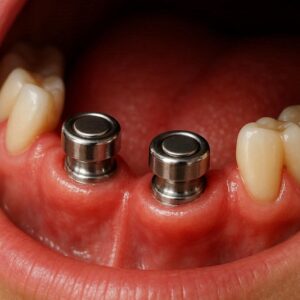
The root magnet (intraradicular magnet). This is a small, powerful magnet (often made of neodymium or samarium-cobalt) placed inside the root of a tooth or directly into the jawbone. It is coated with a safe material like titanium or gold alloy to prevent corrosion.
-
The denture magnet (keeper). This is the matching magnet or a metal cap embedded inside the denture, partial, or overdenture. It attracts the root magnet.
-
The protective coating. Because magnets can rust or degrade in a wet environment like your mouth, manufacturers cover them in a biocompatible shell.
When you place the denture over the implant, the magnets pull together. They create a stable connection. You can eat, talk, and smile normally. But you can also pull the denture out for cleaning.
A Brief History: Where Did This Idea Come From?
You might think magnetic implants are brand new. They are not.
The first experiments started in the 1970s. Dentists were looking for a way to hold loose dentures without using sticky pastes or metal clasps. Early magnets were weak. They corroded. Patients had bad tastes in their mouths. It was not a success.
In the 1990s, things improved. Stronger rare-earth magnets arrived. Manufacturers learned how to seal them in titanium. Corrosion stopped being a major problem.
By the early 2000s, some clinics in Europe and Asia started offering magnetic attachments for overdentures. In the United States, the technology remained rare. Most dentists preferred traditional screw-retained implants.
Today, magnetic implants exist. But they are not mainstream. You will find them most often in three situations:
-
To hold lower dentures in place (overdentures).
-
As a temporary solution while a traditional implant heals.
-
In experimental full-mouth reconstructions.
Important note for readers: Do not believe any website that calls magnetic implants “better than traditional implants in every way.” That is simply not true. Each system has strengths and weaknesses. We will look at both honestly.
How Does a Magnetic Dental Implant Work? (Step by Step)
Let me walk you through the process. Keep in mind that every case is different. Your dentist may adjust these steps.
Step 1: Initial Consultation
You sit down with an implant dentist. They take X-rays or a CT scan. They check your bone density. They ask about your health history. Not everyone is a candidate. More on that later.
Step 2: Preparing the Site (If Needed)
If you are getting a single magnetic implant, the dentist removes the damaged tooth (if present). They clean the socket. They may add bone graft material if your jawbone is too thin.
Step 3: Placing the Magnetic Implant
This is the main procedure. The dentist makes a small cut in your gum. They drill a precise hole into your jawbone. Then, they insert the magnetic implant body. This body contains the sealed magnet. They stitch the gum closed over it or around it.
In some systems, the dentist places a non-magnetic titanium screw first. Once the bone heals around that screw (osseointegration), they attach the magnet on top. This is called a two-stage system.
Step 4: Healing
You wait. Usually 3 to 6 months. During this time, your bone grows around the implant. This creates a solid foundation. You wear a temporary denture or leave a gap.
Step 5: Creating the Magnetic Denture or Crown
Your dentist takes impressions of your mouth. A dental lab builds your denture, partial, or crown. They embed the matching magnet or metal keeper into the acrylic or porcelain.
Step 6: Fitting and Adjustment
You return to the clinic. The dentist places your new magnetic restoration into your mouth. It clicks onto the implant. They check the fit. They adjust it if it feels too tight or too loose. They teach you how to remove and clean it.
Step 7: Follow-Up
You come back after one week, one month, and then once a year. The dentist checks the magnets. They look for wear, corrosion, or loosening.
Types of Magnetic Dental Implants
Not all magnetic implants are the same. Let me show you the main types you might encounter.
| Type | Description | Best For | Removable? |
|---|---|---|---|
| Single Magnetic Crown | One magnet in the jawbone, one magnet in a single crown. | Replacing one missing tooth when you want easy removal. | Yes (by patient) |
| Magnetic Overdenture | Two to four magnets in the jawbone. A full denture snaps onto them. | Lower jaw full arch replacement. | Yes (by patient) |
| Magnetic Partial Denture | Magnets in remaining natural teeth (roots) or implants. A partial denture attaches. | Replacing several missing teeth with a removable partial. | Yes (by patient) |
| Root Magnets (Magnetic Studs) | A magnet placed inside a hollowed-out natural tooth root. | Using existing teeth as anchors for a denture. | Yes (by patient) |
The “Root Magnet” Special Case
Here is a clever use of the technology. Imagine you have a natural tooth that is damaged but has a healthy root. A dentist can perform root canal therapy. Then, they hollow out the root canal space. They glue a small magnet inside. Now, that natural tooth acts like an implant. A denture can snap onto it.
This is less invasive than placing a full implant. But it only works if the natural tooth root is strong and healthy.
The Pros: Why Would Someone Choose a Magnetic Implant?
Let us start with the good news. Magnetic dental implants offer real advantages for the right patient.
1. Removable for Cleaning
This is the biggest selling point. You can take your crown or denture out at night. You can clean it thoroughly. You can also clean the implant site itself. This reduces your risk of infection (peri-implantitis).
2. No Screws to Loosen
Traditional implants have small screws that can loosen over time. Dentists need special tools to tighten them. With magnets, there are no screws. Nothing to torque. Nothing to break.
3. Gentler on the Jawbone
Traditional implants transfer chewing forces directly down into the bone. That is good for bone health. But it can also overload weak bone. Magnetic implants transfer forces more evenly because the magnets allow a tiny amount of micro-movement. This can be gentler for people with lower bone density.
4. Easier to Repair or Replace
If a magnet loses its strength (which happens over years), the dentist simply swaps it out. They do not need to remove the whole implant. If your denture breaks, the lab can embed a new keeper. Repairs are faster and cheaper.
5. No Cement or Paste Needed
If you have ever used denture adhesive, you know the mess. Magnetic implants eliminate that completely. No gooey pastes. No sticky powders. Just a clean, magnetic hold.
6. Useful for Small Spaces
Sometimes there is not enough room for a traditional screw-retained crown. Magnetic components can be smaller. This makes them useful in tight spots, like narrow gaps between teeth.
The Cons: Realistic Downsides You Must Know
Now for the honesty. Magnetic implants are not perfect. Here are the limitations.
1. Lower Retention Force
Magnets are strong, but they are not as strong as a screw. A traditional implant crown is locked in place. You cannot pull it off without tools. A magnetic crown can be pulled off with your fingers. For most daily activities (eating, talking), this is fine. But for biting into a hard apple or chewy steak? The magnet might let go.
2. Magnets Weaken Over Time
Every magnet loses strength. Heat, moisture, and repeated use speed this up. A new magnetic implant might hold strongly for 3 to 7 years. After that, you may notice the denture feels looser. You will need a replacement magnet. Traditional screws do not weaken like this.
3. Corrosion Risk (Even with Coatings)
Modern coatings are excellent. But no coating is perfect forever. Microscopic pinholes can develop. Saliva and fluids seep in. The magnet inside can rust or corrode. This can cause staining on your denture, a metallic taste, or even an allergic reaction in rare cases.
4. Not for Heavy Grinders (Bruxism)
Do you grind your teeth at night? Magnets and grinding do not mix well. The sideways forces can pop the magnets apart repeatedly. This wears them out fast. It can also damage the coating.
5. Expensive Compared to Traditional Dentures
A magnetic overdenture costs more than a standard denture with adhesive. Why? Because the magnets are precision-made. The implant surgery adds cost. In some countries, magnetic implants cost almost as much as traditional screw-retained implants.
6. Requires Healthy Bone (For Implant Magnets)
Just like traditional implants, magnetic implants need enough jawbone to hold them. If you have severe bone loss, you may need bone grafting first. That adds time and money.
7. Limited Availability
Most general dentists do not offer magnetic implants. You may need to find a specialist (prosthodontist or oral surgeon) who has experience with this system. In rural areas, this could mean traveling.
Who Is a Good Candidate for a Magnetic Dental Implant?
Let me give you a simple checklist. You are likely a good candidate if:
-
You wear a lower denture that moves around when you eat or talk.
-
You hate denture adhesives and want a cleaner solution.
-
You have enough jawbone to support small magnets (or healthy natural tooth roots).
-
You do not grind your teeth at night.
-
You are willing to remove and clean your restoration daily.
-
You understand that magnets weaken over time and may need replacement.
-
You have realistic expectations (it will not feel like natural teeth).
You may NOT be a good candidate if:
-
You have severe bruxism (teeth grinding).
-
You have very little jawbone and refuse bone grafting.
-
You have untreated gum disease.
-
You smoke heavily (smoking impairs healing and increases corrosion risk).
-
You expect a permanent, never-needs-maintenance solution.
Important note for readers: Always get a second opinion. Some clinics push magnetic implants because they are unique, not because they are right for you. Ask why they recommend this over traditional implants or a simple denture.
Magnetic vs. Traditional Implants: A Side-by-Side Comparison
Let us put these two head to head. I want you to see the differences clearly.
| Feature | Magnetic Dental Implant | Traditional Screw-Retained Implant |
|---|---|---|
| Retention method | Magnetic attraction | Mechanical screw |
| Removable by patient? | Yes (easily) | No (only by dentist with tools) |
| Typical lifespan of retention | 3–7 years (magnets weaken) | 15+ years (screw may need retightening) |
| Repair difficulty | Easy (swap magnet) | Moderate (replace screw or abutment) |
| Cost (single tooth) | $2,500 – $4,500 | $3,000 – $6,000 |
| Cost (full overdenture) | $8,000 – $15,000 | $20,000 – $40,000 (for 4–6 implants) |
| Biting force | Lower (magnets can separate) | Very high (comparable to natural teeth) |
| Risk of corrosion | Low but present | None (titanium is inert) |
| Surgery required | Yes (for bone-level magnets) | Yes |
| Best for | Removable denture users, small spaces, temporary restorations | Permanent single crowns, bridges, full arches |
As you can see, magnetic implants are not “better” overall. They are different. They serve a specific niche.
The Procedure in Detail: What Does It Feel Like?
I know you might be nervous about surgery. Let me describe what patients typically experience.
On the Day of Surgery
You receive local anesthesia. The same numbing you get for a filling. You feel pressure but not pain. The dentist drills a small pilot hole. They widen it carefully. They insert the magnetic implant body. The whole thing takes 30 to 60 minutes for one implant.
Most patients say the worst part is the sound of the drilling. It is like a high-pitched buzz. Bring headphones with music if you are sensitive to sounds.
After Surgery
For the first 24 to 48 hours, you will have some swelling and mild soreness. Ice packs help. Over-the-counter pain medication (ibuprofen or acetaminophen) is usually enough. Most people return to work the next day.
During the Healing Phase (3–6 months)
You wear a temporary denture or leave the space empty. You must be gentle with that side of your mouth. No chewing hard foods directly over the implant site. The bone needs quiet time to grow around the implant.
At the Final Fitting
The dentist uncovers the implant (if it was buried). They attach the magnet abutment. Then they place your magnetic denture or crown. You will feel a satisfying “click.” The dentist will ask you to bite down. They check the pressure. Then they send you home with care instructions.
The First Week of Use
Your mouth needs to adapt. The magnet might feel strange at first. Some patients describe a “tugging” sensation. Your tongue will notice the metal. This goes away after a few days. You will learn the exact angle to pull to remove the denture.
Caring for Your Magnetic Dental Implant
Good care makes your implant last longer. Follow these rules.
Daily Cleaning (Morning and Night)
-
Remove the denture or crown by pulling straight up or at the angle your dentist showed you.
-
Brush the denture with a soft brush and mild soap (not regular toothpaste, which can scratch the magnet coating).
-
Brush the implant site in your mouth. Use a soft toothbrush. Clean around the magnet base.
-
Rinse both parts with water.
-
Reinsert the denture. Listen for the click.
Weekly Deep Clean
-
Soak your magnetic denture in a denture cleaning solution (like Polident or Efferdent) for 15 minutes.
-
Use an interdental brush to clean around the magnet in your jawbone.
What to Avoid
-
Whitening toothpaste. It contains abrasives that damage the magnet coating.
-
Mouthwash with high alcohol content. It can dry out and degrade sealants over time.
-
Flossing aggressively near the magnet. Be gentle.
-
Biting on hard objects. Ice, hard candy, bones, and pens can pop the magnets apart.
Signs You Need a Dentist Visit
-
The denture feels looser than before.
-
You hear a clicking sound when you chew.
-
You see dark discoloration around the magnet (possible corrosion).
-
You taste metal.
-
The gum around the implant looks red or swollen.
Quote from a prosthodontist (paraphrased for clarity): “Magnetic implants are wonderful for the right patient. But they are not set-it-and-forget-it. I tell my patients to expect a magnet replacement every five years on average. If that sounds like too much maintenance, choose a traditional screw.” — Dr. A. Rivera, DDS, MS
Cost Breakdown: How Much Should You Expect to Pay?
Let me give you realistic numbers. Prices vary wildly by country, city, and dentist. These are averages in US dollars (2026).
Single Magnetic Crown
-
Implant placement: $1,500 – $2,500
-
Magnet abutment: $300 – $600
-
Magnetic crown (lab): $700 – $1,400
-
Total: $2,500 – $4,500
Magnetic Overdenture (Lower Jaw, 2 Implants)
-
Two implants with magnets: $3,000 – $5,000
-
New full denture with magnetic keepers: $1,500 – $3,000
-
Surgical guides and CT scan: $500 – $1,000
-
Total: $5,000 – $9,000
Magnetic Overdenture (Lower Jaw, 4 Implants)
-
Four implants: $6,000 – $10,000
-
Denture: $1,500 – $3,000
-
Imaging and extras: $500 – $1,000
-
Total: $8,000 – $14,000
Magnet Replacement (After 3–7 Years)
-
New magnet abutment: $200 – $400
-
Lab fee to embed new keeper in existing denture: $100 – $300
-
Total: $300 – $700
Insurance Coverage
Most dental insurance plans do not cover magnetic implants as a standard benefit. However, some plans cover a portion of the implant surgery (50% up to a yearly max). Call your provider and ask for “implant-supported overdenture” coverage. Do not say “magnetic” unless they ask. Use general terms.
Realistic Longevity: How Many Years Will It Last?
Let me be straight with you. There are three different lifespans to consider.
1. The Titanium Implant Body (In the Bone)
This part can last 20+ years. The bone fuses to it just like a traditional implant. It will not go bad unless you develop an infection.
2. The Magnet Strength
This is the weak link. Most manufacturers claim 5–10 years of full retention. Real-world patient reports suggest 3–7 years before you notice looseness. After that, you can still wear the denture, but it will not hold as tightly. You will need a magnet replacement.
3. The Denture or Crown
The acrylic or porcelain part lasts 5–10 years with good care. After that, it may stain, crack, or wear down. You can have a new denture made to fit the same magnets.
So the honest answer? A magnetic dental implant system is likely to need its first repair (magnet replacement) around year 5. The implant body itself can last decades.
Common Myths About Magnetic Dental Implants (Debunked)
Let me clear up some misinformation floating around online.
Myth #1: “Magnetic implants are completely non-invasive and require no surgery.”
False. Most magnetic implants require drilling into your jawbone. That is surgery. The only exception is root magnets placed inside existing natural teeth (which still requires a root canal).
Myth #2: “They feel exactly like natural teeth.”
False. They feel better than a loose denture, but not like natural teeth. The magnets create a slightly different sensation. Some patients describe a “magnetic drag” when moving their tongue.
Myth #3: “They are MRI-safe.”
This is complicated. Many modern magnetic implants use non-ferromagnetic materials (samarium-cobalt) that are MRI-compatible up to 1.5 Tesla. But you MUST tell the MRI technician. Some older neodymium implants are dangerous in an MRI. Always carry your implant card.
Myth #4: “You can never remove them.”
False. Removability is the whole point. You remove them daily for cleaning.
Myth #5: “They are cheaper than traditional implants.”
Not really. For a single tooth, magnetic implants are only slightly cheaper ($2,500–$4,500 vs. $3,000–$6,000). For a full arch, magnetic overdentures are actually cheaper ($8k–$15k vs. $20k–$40k for 4–6 traditional implants). So it depends on the case.
Alternatives to Magnetic Dental Implants
If you read this far and feel unsure, that is okay. Let me show you other options.
1. Traditional Screw-Retained Implant Crown
The gold standard. Permanent. Strong. Expensive. Requires good bone. Not removable by you.
2. Traditional Implant Overdenture (Locator Attachments)
Instead of magnets, these use plastic or metal caps that snap onto ball-shaped abutments. They are removable. They last longer than magnets (8–10 years before caps wear out). They are more common and easier to repair.
3. Mini Dental Implants (MDIs)
Smaller, thinner implants (1.8mm to 2.4mm diameter). They are often used to stabilize lower dentures. They cost less than standard implants. But they are less durable long-term.
4. Conventional Denture with Adhesive
The cheapest option. No surgery. But adhesive can be messy. Retention is poor. Many people struggle to eat comfortably.
5. Fixed Bridge (Traditional)
If you have healthy teeth on both sides of a gap, a bridge works well. No implants at all. But it requires grinding down those healthy teeth.
Here is a quick decision guide:
| If you want… | Then consider… |
|---|---|
| Permanent, never-remove solution | Traditional screw-retained implant |
| Removable but very strong hold | Locator attachment overdenture |
| Removable, gentle on bone, and don’t mind magnet replacement every 5 years | Magnetic dental implant |
| Cheapest possible denture stabilization | Mini implants or adhesive |
| No surgery at all | Conventional denture or bridge |
Finding a Qualified Dentist for Magnetic Implants
This is critical. Not every dentist who offers implants offers magnetic implants.
Where to Look
-
Prosthodontists. These are specialists in replacing teeth. They have the most experience with magnetic attachments.
-
Oral surgeons. They place the implant body. But they may not do the denture part. You may need two different providers.
-
Large dental schools. Universities often have the latest technology. They may offer magnetic implants at lower cost.
-
Online directories. Search for “magnetic implant dentist near me.” But verify their credentials. Call and ask: “How many magnetic overdentures have you placed in the last year?”
Questions to Ask Before Booking
-
How long have you used magnetic implants?
-
What brand of magnets do you use? (Good answers: Magfit, Dyna, Hicorene, or Steco)
-
What is your magnet replacement rate? (If they say never, they are lying.)
-
Can I speak to a previous patient who has had magnetic implants for 3+ years?
-
What is your warranty on the magnets?
Red Flags to Avoid
-
The dentist claims magnets last forever.
-
They say there is no risk of corrosion.
-
They refuse to show you before-and-after photos.
-
They push you to decide today with a “limited time discount.”
The Future of Magnetic Dental Implants
Research continues. Here is what is coming in the next 5 to 10 years.
Corrosion-Proof Coatings
Scientists are testing diamond-like carbon (DLC) coatings and gold-palladium alloys. These could extend magnet life to 15+ years.
Stronger, Smaller Magnets
New formulations of neodymium-iron-boron (N52 grade) are incredibly strong. A magnet the size of a grain of rice could hold a full denture. This means smaller, less invasive implants.
MRI-Safe Magnets
Manufacturers are phasing out neodymium for dental use. Samarium-cobalt is becoming the standard. It is less strong but completely non-reactive in MRI machines up to 3 Tesla.
Smart Magnets with Sensors
Experimental implants include micro-sensors that detect bite force, temperature, and pH. The data transmits to your smartphone. Your dentist can monitor your implant health remotely.
None of these are widely available yet. But they show that magnetic implant technology is not dead. It is evolving.
Frequently Asked Questions (FAQ)
Q1: Can I use a magnetic dental implant if I am allergic to metal?
A: True metal allergies (like to nickel or cobalt) are rare but possible. The magnets are sealed in titanium, which is hypoallergenic. However, if you have a known allergy to rare-earth metals, ask for a samarium-cobalt magnet instead of neodymium. Also request a patch test before surgery.
Q2: Will the magnets affect my pacemaker or other medical devices?
A: Possibly. Strong magnets can interfere with pacemakers, defibrillators, and insulin pumps. If you have any electronic medical implant, tell your dentist immediately. You may not be a candidate for magnetic dental implants. Traditional implants would be safer.
Q3: Can I sleep with my magnetic denture in place?
A: Dentists recommend removing it at night. Why? Your gums need rest. Also, sleeping with any denture increases your risk of pneumonia and bone loss. Remove it. Clean it. Store it in water or a dry container (follow your dentist’s advice).
Q4: How do I know when the magnet is weakening?
A: You will notice the denture feels looser. It may rock when you chew. It might come off when you eat sticky foods like caramel or bread. Some patients hear a faint “click” as the magnets reseat themselves. That is a sign.
Q5: Can I upgrade my existing traditional implants to magnetic ones?
A: Sometimes yes. If you already have traditional implant screws in your jaw, a dentist can remove the top abutment and replace it with a magnetic abutment. Then a new magnetic denture can snap on. This is a common conversion for patients who want a removable option later in life.
Q6: Are magnetic dental implants safe for children or teenagers?
A: No. Jawbones in children and teens are still growing. Placing any implant (magnetic or traditional) can cause the implant to become misaligned as the jaw grows. Wait until at least age 18–21 for females and 21–25 for males.
Q7: Do magnetic implants set off airport metal detectors?
A: Yes, they can. The metal content (titanium, magnet alloy) is small, but sensitive airport scanners may detect it. Carry your dental implant ID card. It explains your device. Most security personnel are familiar with dental implants.
Q8: Can I have an MRI with a magnetic implant?
A: It depends on the magnet type. Neodymium magnets are generally unsafe for MRI. Samarium-cobalt magnets are safe for 1.5T and some 3T machines. Always provide your implant card to the radiologist. Do not guess.
Q9: How painful is the surgery compared to a tooth extraction?
A: Most patients say it is similar to or slightly less painful than a difficult extraction. The soreness peaks at day 2 and improves by day 5. Ibuprofen usually controls it.
Q10: Will my insurance cover magnet replacement after 5 years?
A: Most basic dental plans do not. However, some dental discount plans or implant warranty programs may cover it. Read your policy’s “implant maintenance” section. When in doubt, call and ask specifically about “replacement of implant attachments.”
Important Notes for Readers (Please Read)
Before you go, let me leave you with five critical reminders.
-
No dental solution is perfect. Every option has trade-offs. Magnetic implants solve the problem of loose dentures. They create the new problem of magnet weakening. Choose based on what you can tolerate.
-
Your bone health matters more than the technology. If your jawbone is weak or infected, no implant will work long-term. Fix your bone first (grafting, periodontal treatment). Then choose your implant type.
-
Second opinions are not optional. If one dentist recommends magnetic implants and another recommends traditional ones, do not assume one is lying. They may have different experiences. A third opinion often clarifies things.
-
Costs change fast. The prices I listed are averages for 2026. By the time you read this, materials and labor may have shifted. Always get a written quote before scheduling surgery.
-
You are in charge. Do not let any dentist pressure you into a same-day decision. Take the quote home. Sleep on it. Research the brand of magnets they use. Then call back.
Additional Resources
For more trustworthy, evidence-based information on dental implants and tooth replacement options, I recommend visiting the American College of Prosthodontists patient education page.
👉 Link: www.gotoapro.org (This is the official patient-facing website of the American College of Prosthodontists. They offer a “Find a Prosthodontist” tool and free educational guides.)
You can also check the National Library of Medicine (PubMed) for peer-reviewed studies. Search for “magnetic attachment dental implant review” to read the actual research.
Conclusion
Let me wrap this up in three clear lines.
Magnetic dental implants offer a removable, gentler alternative to traditional implants, ideal for denture wearers who hate adhesives and want easy cleaning.
However, magnets weaken every 3 to 7 years and require replacement, they cost more than standard dentures, and they are not for heavy grinders or people with pacemakers.
If you have realistic expectations and find an experienced prosthodontist, magnetic implants can be a life-changing solution—but they are not a permanent, set-it-and-forget-it fix.