The Complete Guide to the 4 Bitewings Dental Code (D0274)
If you have ever sat in a dentist’s chair and been told, “We need to take some X-rays,” you have likely had bitewings taken. If your dentist recommended four of them, you were probably looking at a specific billing code on your treatment plan: D0274.
Understanding dental codes can sometimes feel like trying to read a foreign language. Whether you are a patient trying to decipher your insurance Explanation of Benefits (EOB), a new dental assistant learning the ropes, or simply someone curious about what happens during your checkup, knowing what the “4 bitewings dental code” means is essential.
In this guide, we will explore everything about this specific procedure. We will break down what the code is, why four images are the standard of care, how it differs from other X-ray codes, and what you can expect to pay.
Let’s demystify the world of dental radiography together.
What is the Dental Code D0274?
In the world of dentistry, standardization is key—not just for procedures, but for billing and record-keeping. This is where the Current Dental Terminology (CDT) codes come in. These codes, published by the American Dental Association (ADA), are used consistently across the United States to ensure that dentists, insurance companies, and patients are all on the same page.
The specific code we are focusing on today is D0274.
The Official Definition
According to the ADA’s CDT manual, D0274 is defined as: “Bitewings – four films.”
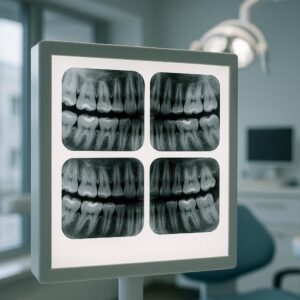
In simple terms, this code is used when a dentist takes four separate images of your back teeth, showing the crowns (the part you see) and a small portion of the supporting bone. These images allow the dentist to see the upper and lower teeth in the same picture.
Why “Four”?
You might wonder why there is a specific code for four films. It’s because the number of images taken dictates the diagnostic value. Four bitewings are typically the “standard of care” for an adult with a full set of permanent teeth. This number allows the dentist to capture the entire posterior region of the mouth—both the left and right sides, broken down into premolar and molar sections.
Important Note: The code D0274 is distinct from a full-mouth series (which is 14-20+ images) or a single bitewing (D0272). It sits right in the middle as the most common diagnostic tool for detecting decay between teeth.
The Importance of Bitewing X-Rays
Before we dive deeper into the code itself, it helps to understand why dentists rely on these images so heavily. You cannot bill for a code unless the procedure is necessary, and bitewings are arguably one of the most important preventive tools in dentistry.
Detecting the “Hidden” Cavities
Your teeth touch each other. When they are tight and healthy, a dentist cannot see the surfaces between them with the naked eye or even with a metal explorer. Bitewing X-rays pass through these tight contacts, revealing cavities that are just starting to form. By catching decay early—when it is small—dentists can often place a smaller filling rather than waiting for a large cavity that might require a crown or root canal.
Monitoring Bone Health
The “wing” part of the bitewing image shows the bone level surrounding your teeth. Periodontal disease (gum disease) causes bone loss. By comparing bitewings year over year, a dentist can track if a patient is losing bone, which is a critical indicator of gum health.
Checking Existing Restorations
Have you ever had a filling? Bitewings allow the dentist to check the margins of that filling. They can see if decay is forming underneath an old filling or if the filling is broken.
4 Bitewings Dental Code vs. Other X-Ray Codes
One of the most common points of confusion for patients is why they sometimes see different X-ray codes on their bills. To help you navigate this, let’s compare D0274 with other common radiographic codes.
The Bitewing Family
The ADA has specific codes based on the number of images taken:
-
D0272: Bitewings – Two films. (Often used for recall exams on children or adults with very few back teeth).
-
D0273: Bitewings – Three films.
-
D0274: Bitewings – Four films. (The gold standard for most adults).
-
D0277: Vertical Bitewings – Seven to eight films. (Used specifically for patients with advanced gum disease to see deeper bone levels).
The “Full Mouth” Codes
-
D0210: Intraoral – Complete series (including bitewings). This is a comprehensive set of images (usually 14-20) taken for a new patient or to establish a new baseline of health.
-
D0330: Panoramic image. This is the machine that rotates around your head. It gives a broad view of the jaws, sinuses, and all teeth, but it is not detailed enough to catch small cavities between teeth. It is often used in conjunction with bitewings, not as a replacement.
Comparison Table: Common X-Ray Codes
| CDT Code | Description | Typical Use Case | Diagnostic Focus |
|---|---|---|---|
| D0274 | Bitewings – Four films | Adult recall exam (6-12 months) | Interproximal (between teeth) decay, bone levels |
| D0272 | Bitewings – Two films | Child exam or adult with few back teeth | Interproximal decay in limited areas |
| D0210 | Intraoral – Complete series | New patient comprehensive exam | Full-mouth assessment, all teeth and roots |
| D0330 | Panoramic image | Initial evaluation, wisdom teeth assessment | General overview, impacted teeth, jaw pathology |
| D0220 | Intraoral – Periapical first film | Single tooth pain or injury | Detailed view of the entire tooth (crown to root tip) |
When is D0274 Used? (The Frequency Rule)
Dentists cannot simply take X-rays every time you come in for a cleaning. There are guidelines, often referred to as the “standard of care” and insurance frequency limitations.
The Recall Patient
For an established patient with good oral health, D0274 is typically used once every 12 to 24 months. If you go to the dentist every six months for a cleaning, you will likely have bitewings taken once a year during one of those visits. This allows the dentist to compare the new images to the old ones and check for any changes in the previous 365 days.
The New Patient
If you are new to a dental office, the dentist may need a baseline of your dental health. While they might opt for a full mouth series (D0210), they will sometimes take a set of four bitewings (D0274) supplemented by other specific images if the rest of your mouth appears healthy.
High-Risk Patients
For patients who are prone to cavities (high caries risk) or those with active periodontal disease, the dentist may recommend D0274 more frequently—sometimes every 6 months—to monitor rapidly progressing conditions. Insurance, however, may not always cover this increased frequency.
Important Note: Always check with your dental insurance provider to understand your specific plan’s frequency limits. Most plans cover D0274 at 100% for diagnostic and preventive purposes, but only once every 12 or 24 months.
What to Expect During a 4 Bitewing Procedure
If your dentist has recommended D0274 and you are a bit anxious about the process, don’t worry. It is one of the simplest and fastest parts of a dental checkup.
Step 1: The Preparation
You will be asked to remove any metallic objects that might interfere with the image (like glasses or earrings). You will then be covered with a lead apron with a thyroid collar to protect your body from any stray radiation. Modern dental X-rays are already extremely low dose, but safety is always the priority.
Step 2: Placing the Sensor/Film
The dental assistant will place a small sensor or film inside your mouth. For bitewings, you will be asked to gently bite down on a holder or a tab. This ensures the film stays perfectly still and captures the upper and lower teeth in the correct position.
Step 3: The Four Positions
To get four films, the assistant will take images of four specific areas:
-
Right Posterior (Back): Capturing the upper and lower molars on the right side.
-
Right Premolar: Capturing the upper and lower bicuspids on the right side.
-
Left Posterior (Back): Capturing the upper and lower molars on the left side.
-
Left Premolar: Capturing the upper and lower bicuspids on the left side.
Step 4: The Result
The assistant will step out of the room or behind a shield, press a button, and it’s done. The entire process for four images usually takes less than five minutes. You will likely see the images pop up on a computer screen immediately.
The Cost of D0274: What Patients Pay
The cost of dental care varies widely depending on where you live and the specific dental practice. However, we can look at general ranges to give you a realistic idea of what to expect for the 4 bitewings dental code.
The “Procedure” Price
If you are paying without insurance (self-pay or cash price), the cost for D0274 typically ranges from $50 to $150. This price covers the clinical time, the equipment, the interpretation of the images by the dentist, and the infection control protocols.
With Dental Insurance
D0274 falls under the “Diagnostic and Preventive” category. Most dental PPO and HMO plans cover these procedures at 80% to 100%, often with no deductible required.
-
Scenario: If the fee is $100 and your insurance covers preventive care at 100%, you pay $0.
-
Scenario: If the fee is $120 and your insurance covers diagnostic services at 80%, you would be responsible for the remaining 20% (approx. $24).
Discount Plans
If you have a dental discount plan (not insurance), you will receive a reduced fee based on the plan’s contracted rate. This is often 15% to 30% off the regular price.
4 Bitewings Dental Code: Common Patient Questions
It is completely normal to have questions about dental procedures. Here are some of the most frequently asked questions regarding the D0274 code.
Why do I need four? Can’t you just take two?
While two bitewings (D0272) can be sufficient for someone with a smaller mouth or fewer teeth, they simply do not cover the entire arch of an adult. Two films would require the beam to cover too much area, leading to distortion and overlap. Four films ensure that the geometry is correct, the contacts are open (viewable), and the diagnosis is accurate.
Are digital X-rays (D0274) safe?
Yes, extremely safe. Digital radiography, which most offices use today, reduces radiation exposure by up to 80% compared to old film-based X-rays. The amount of radiation you receive from a set of four bitewings is roughly equivalent to the background radiation you experience in a single day from the sun and environment.
Does insurance always cover D0274?
Most insurance plans cover D0274, but only up to a specific frequency. If you had bitewings taken 10 months ago, and your plan only covers them once every 12 months, the insurance company will deny the claim as a “frequency limitation.” You would then be responsible for the full cost.
What is the difference between D0274 and D0277?
The main difference is the orientation. D0274 uses horizontal bitewings, which are best for detecting cavities. D0277 uses vertical bitewings. These images are placed vertically to show more of the tooth root and bone, making them essential for patients with gum disease.
Can I refuse X-rays?
Yes, you have the right to refuse any medical or dental treatment, including X-rays. However, it is important to understand the risks of refusal. By declining D0274, you are essentially asking the dentist to diagnose cavities and gum disease without the necessary tools. This can lead to missed decay that grows silently until it becomes a painful, expensive emergency.
Additional Resources for Understanding Dental Codes
Navigating dental terminology can be challenging, but you don’t have to do it alone. Here are some reliable resources if you want to dive deeper:
-
The American Dental Association (ADA): The ADA maintains the CDT code set. You can visit their website for official definitions and dental health information.
-
Your Dental Office’s Treatment Coordinator: Never hesitate to ask the front office staff to explain a code. They deal with insurance every day and are usually happy to help patients understand their benefits.
-
Cigna Dental Dictionary: Many insurance providers, like Cigna, have online glossaries that explain common dental terms in plain English. Check out Cigna’s Dental Glossary for more help.
The Future of Bitewing Radiography
The dental field is constantly evolving, and so is the technology behind the 4 bitewings dental code. While the code D0274 remains the same, the technology used is changing rapidly.
AI-Assisted Detection
You may soon see “AI” mentioned on your treatment plan notes. Artificial intelligence software is now being integrated into dental imaging. These programs scan your D0274 images and highlight potential areas of decay or bone loss, acting as a second set of eyes for the doctor. This leads to even more accurate diagnosis and early intervention.
Lower Radiation Sensors
Manufacturers are constantly improving digital sensors to be more sensitive, requiring even less radiation to produce a high-quality image. The procedure is already incredibly safe, and it is getting safer.
3D Imaging (CBCT)
While not a replacement for bitewings, Cone Beam Computed Tomography (CBCT) is becoming more common for implant planning and complex cases. However, for routine cavity detection, the humble 4-bitewing series remains the undisputed champion due to its low cost, low radiation, and high detail.
Conclusion
The 4 bitewings dental code (D0274) is far more than just a billing number. It represents the gold standard for preventive dental care. By allowing dentists to see the hidden spaces between teeth, these four small images play a massive role in keeping your smile healthy and avoiding costly, painful procedures down the road.
Whether you are reviewing your EOB, scheduling your next checkup, or simply satisfying your curiosity, understanding this code empowers you to be an active participant in your dental health. So the next time your dentist recommends D0274, you can rest assured knowing that you are investing in a crucial diagnostic tool designed to keep your smile bright for years to come.
Frequently Asked Questions (FAQ)
Q1: What exactly is the 4 bitewings dental code?
A: The code is D0274. It is the official CDT code used by dentists and insurance companies to bill for a set of four bitewing X-rays, which are used to detect cavities between the back teeth.
Q2: How often can I get D0274 done?
A: For most patients with good oral health, the standard frequency is once every 12 to 24 months. However, if you are at high risk for cavities or gum disease, your dentist may recommend them more frequently.
Q3: Does D0274 hurt?
A: Not at all. The procedure involves biting gently on a small sensor or film holder for a few seconds per image. It is non-invasive and painless.
Q4: Will my insurance pay for the 4 bitewings code?
A: Yes, most dental insurance plans cover D0274 as a preventive service, often at 100%. However, coverage is subject to your plan’s specific frequency limits, so check with your provider.
Q5: What happens if I refuse the bitewings?
A: While it is your right to refuse, you risk the dentist missing early signs of decay. What could have been a small filling might progress into a larger cavity requiring a root canal or crown without early detection.
Q6: Can children get the D0274 code?
A: Yes, but it depends on the child’s age and how many back teeth they have. For children with a full set of permanent molars and premolars, D0274 is appropriate. For younger children, D0272 (two films) is more common.