what are dental implants made out of?
You sit down in the dental chair, and the word “implant” hangs in the air. It sounds industrial. It sounds like a car part or a piece of hardware from the garage. Yet somehow, this tiny piece of engineering is going to become a permanent part of your smile.
The first question almost everyone asks isn’t about the procedure itself. It’s about the thing they’re putting inside the jaw. You want to know what it is. You want to know: what are dental implants made out of.
This is a fair question. It is the most important question, actually. You wouldn’t let a surgeon put a mystery metal hip socket in your body without knowing the alloy, and you shouldn’t let a dentist do the same with your jawbone.
The answer is not just one word. It’s a story of material science, human biology, and a quest for a substance that bone will actually like. Let’s walk through the anatomy of a dental implant. We will look at every screw, every abutment, and every crown. By the time you finish reading, you will understand exactly what sits beneath that new tooth and why these specific materials were chosen over everything else on Earth.
The Three-Layer Cake: Anatomy of a Modern Dental Implant
Before we dive into the periodic table of elements, we need to agree on language. People say “dental implant” and they picture the whole tooth. That’s not quite right.
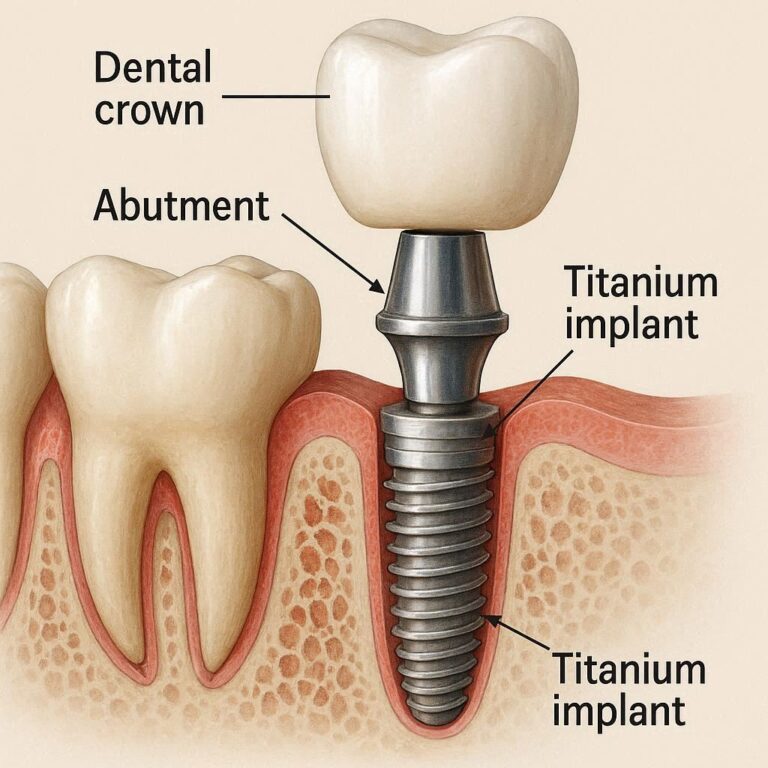
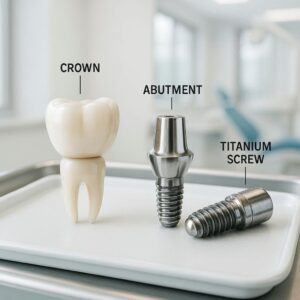
A single replaced tooth is actually a sandwich of three distinct parts, and each part answers the question what are dental implants made out of in a slightly different way.
-
The Implant Fixture (The Root): This is the part buried under the gum line, drilled directly into the jawbone.
-
The Abutment (The Connector): This is a small stump that screws into the fixture. It sticks out just above the gum.
-
The Prosthesis (The Crown): This is the visible tooth part you chew with and smile about.
Each layer has its own material requirements. The root needs to fuse with bone. The connector needs to seal out bacteria. The crown needs to survive the crushing force of a jaw that can clamp down with over 200 pounds of pressure.
If you ever hear a dentist say, “You need an implant,” but you only think about the shiny white tooth on top, you’re missing 90% of the engineering marvel. Let’s start where it all begins: deep in the bone.
The Core Answer: Titanium and the Magic of Osseointegration
Let’s cut straight to the core of what are dental implants made out of. If you stripped away the fancy marketing brochures and the brand names, you would find a simple, metallic gray, incredibly strong metal: Titanium.
Specifically, it is usually Grade 4 Commercially Pure Titanium (CP Ti) or the slightly tougher Grade 5 Titanium Alloy (Ti-6Al-4V) .
Why Titanium? Why not steel? Why not platinum or gold?
The answer lies in a word that sounds like a Harry Potter spell but is actually a biological miracle: Osseointegration.
The Accidental Discovery of a Lifetime
In the 1950s, a Swedish orthopedic surgeon named Per-Ingvar Brånemark was studying blood flow in rabbit bone using a titanium optical chamber. When he went to remove the chamber at the end of the experiment, he couldn’t. The bone had grown so tightly against the titanium surface that it was physically impossible to separate the two without breaking the bone.
He called it osseointegration (from Latin os for bone, and integrare to make whole).
That moment changed dentistry forever. Before Brånemark, dentists tried all sorts of things to replace teeth. They used stainless steel screws, vitallium (a cobalt-chromium alloy), and even carved seashells in ancient times. The body always rejected them. The jawbone would either resorb (shrink away) or form a soft, fibrous capsule around the object, like a splinter under your skin that never heals right.
Titanium is different. Bone cells (osteoblasts) are not smart. They don’t see titanium as a foreign invader. They see it as a scaffold. They crawl onto the surface of the titanium implant, lock into the microscopic grooves, and lay down new bone matrix as if the metal were just a slightly weird, extra-hard piece of skeleton.
Important Note for the Skeptical Reader:
Titanium is not “organic.” It is a metal. But the body’s reaction to it is so passive, so inert, that it behaves like a part of the body. This is the single most critical factor in answering what are dental implants made out of.
The Difference Between Grade 4 and Grade 5 Titanium
While both are titanium, they behave slightly differently in the mouth. Here is a quick comparison to help you understand why your surgeon might prefer one over the other for the implant screw itself.
| Property | Grade 4 (Commercially Pure) | Grade 5 (Ti-6Al-4V Alloy) |
|---|---|---|
| Composition | 99%+ Pure Titanium with traces of Oxygen and Iron | 90% Titanium, 6% Aluminum, 4% Vanadium |
| Strength | High, but softer than Grade 5 | Extremely High (Superior tensile strength) |
| Biocompatibility | Gold Standard. The purest option. Lowest risk of any reaction. | Excellent, but contains traces of Aluminum/Vanadium (which are controversial but widely accepted as safe). |
| Common Use | Implant Fixtures. This is the most common material for the part that touches bone. | Narrow Diameter Implants or Mini Implants. Used where space is tight and extra strength is needed to prevent breaking. |
| Osseointegration Speed | Slightly faster due to purity. | Slightly slower but mechanically more robust long-term. |
Most of the time, when you ask what are dental implants made out of, the answer for the screw in your jaw is Grade 4 Titanium.
The Surface Story: Why It’s Not Just a Smooth Screw
If you look at a dental implant straight out of the sterile packaging, it doesn’t look like a shiny bolt from the hardware store. It looks dull gray and feels slightly rough, almost like sandpaper. This is not a manufacturing defect. This is a feature that costs millions of dollars in research to perfect.
The surface of the implant is where the magic happens. A smooth implant takes forever to heal and never gets as strong. A rough implant invites bone cells to the party.
Here are the two main ways manufacturers treat the surface of the titanium:
1. Sandblasting and Acid-Etching (SLA)
This is the industry workhorse. They literally blast the titanium with tiny particles of aluminum oxide or calcium phosphate to create microscopic craters. Then they dip it in a mild acid bath to smooth out the sharp edges of those craters. The result? A surface with the texture of a lunar landscape under an electron microscope. Bone cells love this texture.
2. Anodization
You might know this from colored aluminum water bottles. For dental implants, anodization thickens the natural oxide layer on the titanium. This creates a specific crystalline structure that is incredibly attractive to proteins in your blood that start the healing cascade.
A Realistic Note on “Coated” Implants:
Some brands market implants with a coating of Hydroxyapatite (HA) . HA is basically synthetic bone mineral. The idea is that the body sees a layer of “bone” and integrates faster.
-
Pros: Faster initial healing in soft bone.
-
Cons: There is a long-term concern that the HA coating can separate (delaminate) from the titanium underneath over decades. For this reason, the vast majority of high-end implant surgeons now prefer the uncoated, roughened titanium surface. It’s more predictable in the very long run.
The Alternative: What Are Zirconia Dental Implants Made Out Of?
For the last forty years, titanium has been the undisputed king. But there is a challenger in the ring, and it’s white.
When people worry about metal allergies or when they want a completely “metal-free” mouth, they turn to Zirconia.
Now, let’s be precise. When we ask what are dental implants made out of in this context, we are talking about Zirconium Dioxide (ZrO₂) . This is a ceramic crystal.
Specifically, it is Yttria-stabilized Tetragonal Zirconia Polycrystal (Y-TZP) . That’s a mouthful. But here’s what it means in plain English:
Zirconia on its own is brittle and can crack under pressure (just like a ceramic coffee mug). By adding a tiny amount of Yttrium oxide (a rare earth metal), the crystal structure changes. It becomes transformation toughened. If a crack starts to form, the crystal actually expands to seal the crack shut.
This is the same material used for hip replacements in patients who are allergic to metal.
Zirconia vs. Titanium: The Honest Comparison
Many patients come in asking for zirconia because they’ve read “titanium is a heavy metal.” This is where we need to be realistic and not fall for marketing hype.
| Feature | Titanium Implants | Zirconia Implants |
|---|---|---|
| Color | Metallic Gray (can show through thin gums) | White/Tooth-Colored. Ideal for front teeth with thin gums. |
| Long-Term Data | 50+ Years of clinical success. The gold standard. | ~15-20 Years of reliable data. Newer technology. |
| Strength | Flexes slightly under stress. Almost impossible to break inside the mouth. | Extremely hard but brittle. Can fracture if overloaded (rare, but possible). |
| Healing | Osseointegration well understood. | Osseointegration is slightly different (biomimetic). Bone grows around and adheres to the ceramic. Success rates are now nearly equal to titanium. |
| Abutment Connection | Two-piece system (Implant + Abutment). | Often One-Piece. This means the abutment is molded with the implant. This limits the angle at which you can place the crown. |
| Biofilm (Plaque) Attraction | Plaque sticks, but easy to clean. | Plaque sticks less. Zirconia is highly polished and resists bacterial adhesion better than titanium. |
A Word of Caution Regarding “Metal-Free” Claims:
If you are allergic to Nickel or Cobalt, titanium is safe. True Titanium allergy is exceptionally rare (less than 0.6% of the population). Zirconia is a fantastic alternative for those specific cases or for the front of the mouth. However, if a dentist tells you titanium is “toxic” or “dangerous,” you should view that statement with extreme skepticism. Titanium is literally the same material that makes up the turbines in jet engines and the rods holding broken legs together.
Part Two: The Abutment – The Bridge Between Worlds
We’ve covered the root. Now let’s move up a few millimeters. The next piece in the puzzle of what are dental implants made out of is the Abutment.
Think of the abutment as the manhole cover on the implant. It screws down into the titanium fixture and seals it off from the outside world. The crown is then cemented or screwed onto this abutment.
Historically, abutments were made of metal. But that created a problem: the gray metal would peek through the gum tissue, especially around the neck of the tooth, giving the crown a dull, lifeless look. “Blue gums” is the technical term, and it’s a cosmetic disaster.
Here is what modern abutments are made out of and why the choice matters.
1. Titanium Abutments (Stock Abutments)
These are pre-fabricated. They are strong, cheap, and reliable.
-
Material: Grade 5 Titanium Alloy (stronger than the implant itself).
-
Best For: Molars in the back of the mouth. Nobody sees them, and they need the brute strength to chew steak.
-
The Downside: If your gums are thin, you might see a gray shadow at the gumline.
2. Zirconia Abutments (Custom Abutments)
This is the modern standard for front teeth.
-
Material: Y-TZP Zirconia (Same as the white implant, but just the top part).
-
Best For: Incisors, Canines, and Premolars.
-
The Benefit: Light Transmission. Zirconia is translucent. Light passes through it just like it passes through a natural tooth root. This eliminates the gray shadow and creates a truly lifelike restoration.
3. The Hybrid Abutment (Titanium Base + Zirconia Top)
This is the best of both worlds and is used by top-tier restorative dentists.
-
How it Works: A tiny titanium insert screws into the implant. This provides the precision metal-to-metal seal that prevents bacteria from leaking out and causing “peri-implantitis” (implant gum disease). Then, a custom-milled Zirconia sleeve is bonded over the top of that titanium base.
-
Result: Metal strength where it counts (the connection) and white esthetics where it shows (the gums).
A Quote from the Lab Bench:
“When a patient asks me what are dental implants made out of, I tell them the root is titanium but the ‘neck’ is often zirconia. They don’t realize there’s a whole other piece in there designed just to make it look pretty under the gum.” — A Master Dental Ceramist
Part Three: The Crown – What You Actually See
Finally, the part everyone thinks about first. When you look in the mirror at your new tooth, what are dental implants made out of on the surface?
There are three main players here, and they are not created equal.
Option 1: Porcelain-Fused-to-Metal (PFM)
This is the old-school crown.
-
Inside: A metal shell (usually high-noble gold alloy or base metal alloy).
-
Outside: A layer of porcelain baked on top like enamel paint.
-
The Problem: The porcelain chips off the metal edge. And as your gums recede over the years (which they naturally do), that dark metal margin at the gumline becomes visible. It looks like a black line on your tooth.
-
Verdict: Avoid for implants if possible. It defeats the purpose of a high-end restoration. However, it is cheaper.
Option 2: Full Zirconia (Monolithic Zirconia)
This is the toughest crown on the planet.
-
Material: Solid block of Zirconia (Y-TZP) milled by a robot. No porcelain layer to chip off.
-
Strength: You can open a beer bottle with these (don’t, but you could).
-
Esthetics: Modern “Multi-Layered” zirconia blocks look incredibly natural. They have gradients of color built into the block, just like a real tooth has a whiter tip and a yellower neck.
-
Use: Back teeth, grinders, clenchers.
Option 3: Lithium Disilicate (e.max)
This is the gold standard for the front of the mouth.
-
Material: A glass-ceramic (lithium disilicate reinforced).
-
Properties: It has the exact same light-reflecting index as natural enamel. It is translucent, opalescent, and beautiful.
-
Strength: Stronger than natural teeth (around 400 MPa flexural strength), but not as strong as Zirconia (1200 MPa). It is perfect for front teeth where biting forces are shear forces, not crushing forces.
Comparative Table: Crown Materials for Implants
| Material | Hardness | Esthetics | Best Location | Relative Cost |
|---|---|---|---|---|
| PFM | Medium (Porcelain chips) | Low (Gray line risk) | Budget Molars | $ |
| Full Zirconia | Extreme (Virtually unbreakable) | High (Modern blocks) | Back Molars / Bruxers | $$ |
| e.max | High | Highest (Identical to enamel) | Front Teeth / Bicuspids | $$$ |
Deep Dive: The Purity and Safety of Implant Materials
Let’s address the elephant in the room. You’re reading this article because you want to know what are dental implants made out of, but the subtext of that question is often: “Is this stuff safe?” or “Is it going to poison me?”
This is a valid concern. The internet is full of misinformation about “heavy metal toxicity” and “galvanic currents” in the mouth.
Let’s separate the science from the science fiction.
The Vanadium and Aluminum Question (Grade 5 Alloy)
Remember the Grade 5 Titanium alloy (Ti-6Al-4V)? It contains 6% Aluminum and 4% Vanadium.
-
The Concern: Aluminum has been linked (controversially) to neurological issues. Vanadium in high doses is toxic.
-
The Reality: The metals are alloyed. This means they are chemically bonded in a crystal lattice. They do not leach out into your body in any measurable amount. The oxide layer on titanium is incredibly stable. It passivates the surface, meaning it forms a barrier that prevents ion release.
-
The Data: Studies measuring titanium, aluminum, and vanadium in the blood of patients with implants show no statistical increase above baseline levels. You absorb more aluminum from using antiperspirant deodorant or drinking tea than you ever will from a dental implant.
The Titanium Allergy Myth
As mentioned earlier, true allergy to titanium is one of the rarest allergies in medicine. It’s rarer than an allergy to gold.
-
Symptoms of Suspected Reaction: Redness, rash, bone loss around the implant.
-
The Catch: 99% of “titanium allergy” symptoms are actually peri-implantitis (a bacterial infection from poor flossing) or a reaction to Nickel in the abutment screw (not the implant body). Some manufacturers use a screw with trace nickel for the internal connection. If you have a known severe nickel allergy, a Zirconia implant with a pure gold or titanium nitride-coated screw is the solution.
The Zirconia Radioactivity Myth (Don’t Laugh)
Zirconia comes from the mineral Zircon. Zircon contains trace amounts of radioactive elements (Uranium and Thorium).
-
The Truth: Medical-grade Y-TZP Zirconia is purified. The refinement process removes these radio-nuclides to a level that is lower than the background radiation of the human body itself.
-
The Comparison: A granite countertop in your kitchen emits more radiation than a Zirconia crown. A Brazil nut emits more. Flying in an airplane emits infinitely more. This is a non-issue.
Galvanism and the “Battery Mouth” Theory
If you have a mouth full of old silver amalgam fillings and a new titanium implant, you have two different metals sitting in salty saliva (an electrolyte). That is the definition of a battery.
-
Does it happen? Yes. A tiny, microamp current can be measured.
-
Does it matter? Almost never. The current is so infinitesimally small that it cannot be felt. The only time it might be an issue is if you have an old amalgam filling directly touching the metal abutment of the implant. This is rare and easily fixed by replacing the filling with a white composite.
The Hidden Hero: The Screw That Holds It All Together
When discussing what are dental implants made out of, we cannot forget the tiny, unglamorous, yet critical piece: The Prosthetic Screw.
This is the screw that goes through the crown and tightens into the abutment (or tightens the abutment into the implant).
This screw is usually NOT made of the same thing as the implant.
-
Material: Usually a Gold Alloy or Titanium Alloy coated with Teflon (PTFE) .
-
Why Gold? Gold is soft. This is intentional. If you bite down too hard on a rock or an olive pit, the screw is designed to break before the implant breaks. It is a mechanical fuse. Replacing a broken screw is a 20-minute appointment. Replacing a broken implant screw inside the jawbone is a surgical nightmare.
-
Why Teflon? To prevent bacteria from wicking down the screw threads.
The Future: What Are Dental Implants Going to Be Made Out Of?
Material science doesn’t stand still. The answer to what are dental implants made out of is slowly evolving. Here are two frontiers that might become standard in the next 20 years.
1. PEEK (Polyetheretherketone)
This is a high-performance polymer plastic.
-
Properties: It is flexible. Bone loves to be loaded and flexed. Titanium is so stiff it “stress shields” the bone, causing some loss of density over time. PEEK bends like natural tooth roots do.
-
Color: It’s white/translucent.
-
Current Status: Used successfully in spine surgery. In dentistry, it’s still experimental for permanent implants but gaining traction for healing abutments (the temporary cap used while the implant heals).
2. 3D Printed Trabecular Metal (Tantalum)
Tantalum is another “bio-inert” metal. But it’s special because they can now 3D print it with a structure that looks exactly like cancellous bone (the spongy inside of your jaw).
-
Porosity: Up to 80% of the implant volume is empty space. Bone cells can grow through the implant, not just on it.
-
The Benefit: Unbelievable stability in soft, poor-quality bone.
The Biological Reality: How Your Body Accepts These Materials
We’ve talked a lot about metals and ceramics. Let’s talk about you. The human body.
Understanding the answer to what are dental implants made out of is useless without understanding the protein layer.
Within milliseconds of the implant touching your blood during surgery, a layer of plasma proteins (fibronectin, vitronectin, albumin) coats the surface. It is this protein pellicle that your bone cells actually interact with. They never see the naked titanium. They see the proteins stuck to the titanium.
This is why surface texture matters so much. A rough surface traps more of the right kind of proteins. It signals to the osteoblast: “This is a good place to build a house.”
A Note on “Value” Implants and Material Quality
You might see ads for “$99 Implants” or “Dental Implants Mexico – $500.” This is where the question what are dental implants made out of becomes a financial and health consideration.
There is a difference between medical-grade titanium and commercial-grade titanium.
-
Medical Grade (ASTM F67 / F136): Manufactured under strict ISO cleanroom standards. Trace elements are strictly limited. The oxide layer is perfectly uniform.
-
Commercial Grade: Used for bicycle frames and eyeglasses. May contain higher levels of interstitial elements (Oxygen, Nitrogen) that make the metal brittle and more prone to microscopic corrosion.
When you go to a reputable implant center (Straumann, Nobel Biocare, Zimmer Biomet, BioHorizons), you are paying for the lot traceability. Every implant has a serial number. If there is ever a recall or a problem, they can trace that implant back to the exact batch of titanium ore from the specific mine in Russia or Japan.
When you get a bargain implant, you are often getting a “clone” or a “look-alike” made in a factory without that traceability. The thread design looks the same, but the metallurgy is not the same.
A Hard Truth:
Implant failure is rarely because the surgeon drilled the hole wrong. It is almost always a biological or material problem. Using substandard materials to save $500 on a restoration that you hope will last 30 years is a gamble with poor odds.
Care and Maintenance Based on Material Composition
How you clean your implant depends entirely on what the abutment and crown are made out of.
-
If you have a Zirconia abutment and a Zirconia crown: You are in luck. This is the slickest, most plaque-resistant surface in dentistry. Regular flossing and a soft toothbrush are all you need. Avoid harsh, gritty “smokers toothpaste” which can scratch the polished zirconia.
-
If you have a Titanium abutment with an e.max crown: Be gentle around the gumline. You want to remove plaque without scratching the cement seal. Use a Waterpik on a low setting. This is a game-changer for implant hygiene because it flushes out the micro-gap where the crown meets the abutment.
-
If you have a PFM crown: You must be diligent. The rough edge of the porcelain near the gumline is a magnet for bacteria. Use a rubber tip stimulator to massage the gum margin daily.
The Surgeon’s Perspective: Why We Prefer One Material Over Another
If you were to sit down with a surgical specialist and ask them directly, “What are dental implants made out of that YOU would put in your own mother’s mouth?“, the answer is almost universally the same:
“A Grade 4 Titanium fixture, with a SLA surface texture, an internal conical connection, and a platform-switched design. The abutment will be a custom Zirconia hybrid with a titanium base. The crown will be a screw-retained full Zirconia monolith in the back, or a screw-retained e.max in the front.”
That sentence contains a universe of knowledge about materials. Let’s break down the last two terms, because they relate directly to what the implant is made of and how it handles stress.
1. Conical Connection (Morse Taper)
This is how the abutment and implant fit together. It’s a cone inside a cone. The friction is so tight that it is hermetically sealed. Bacteria cannot get into the inside of the implant. This is a material design feature that is only possible because of the elastic modulus of titanium. Titanium flexes just enough to “cold weld” together.
2. Platform Switching
This is a design where the abutment is slightly narrower than the implant platform. This moves the inflammatory cell zone away from the edge of the bone. This preserves bone levels long-term. Again, this is only possible because we can precisely machine titanium to tolerances of 5 microns.
Environmental and Ethical Considerations
A final, often overlooked aspect of what are dental implants made out of is the supply chain.
-
Titanium Mining: Titanium ore (Ilmenite, Rutile) is mined primarily in Australia, South Africa, and Canada. The extraction process is energy-intensive but significantly less toxic than gold mining (no cyanide leaching required).
-
Zirconia Mining: Zircon is a byproduct of titanium mining. Using zirconia in dentistry is actually a form of recycling an industrial waste stream from mineral sands.
-
Recyclability: A dental implant is not recyclable once used. It is medical waste. This is a sobering thought. That 4mm piece of metal, with its complex engineering and global journey, ends its life in a sharps container and an incinerator. This is why it is so critical to get the implant right the first time. A failed implant is a piece of space-age metal turned into atmospheric pollution.
Conclusion
We began with a simple question: what are dental implants made out of? We end with a complex, layered understanding. The root is commercially pure titanium, chosen for its unique ability to trick the human body into thinking it belongs. The connector is often a hybrid of titanium strength and zirconia beauty. The tooth is a ceramic engineered to mimic nature or outlast it. This is not just hardware. This is the intersection of geology, metallurgy, and biology, all shrunk down to fit inside a space smaller than a pencil eraser.
Frequently Asked Questions (FAQ)
Q: Can I have an MRI if I have dental implants made of titanium?
A: Absolutely. Titanium is paramagnetic. It does not respond to the strong magnetic fields of an MRI machine. It will not heat up, pull out of your jaw, or distort the image significantly. (There may be a tiny “flare” artifact right next to the implant, but it will not obscure the scan of your brain or neck).
Q: Do dental implants set off airport metal detectors?
A: Rarely. Dental implants are made of non-ferrous metal and are very small in mass. The metal detectors at airports are calibrated to look for weapons—large masses of ferrous metal (steel, iron). A tiny titanium screw in your jaw is beneath the threshold of detection. If you have a full mouth of metal PFM crowns, you might get a beep, but the implant root itself is invisible.
Q: Are there any plants or vegan-friendly alternatives to titanium?
A: Titanium is a metal; it is not animal-derived. However, the manufacturing process uses some animal-based lubricants in some factories. The only true “vegan” alternative is Zirconia (Ceramic) . Zirconia is a mineral crystal. If you have strict ethical objections to metals, Zirconia is your answer.
Q: Can my body reject a titanium implant because it’s metal?
A: No, not in the way the body rejects a transplanted kidney or a heart. That is an immune rejection. The body does not produce antibodies against titanium. The failure of an implant is almost always due to Bacterial Infection (peri-implantitis) or Mechanical Overload (biting too hard on a loose crown). It is not an allergy rejection.
Q: What is the white stuff on the implant when they remove it from the package?
A: That is not part of the implant material itself. It is usually a calcium phosphate coating or a sterile oxide layer. It dissolves or integrates within hours of placement.
Additional Resource
For a deeper understanding of the clinical standards for these materials, you can review the specifications set by the American Society for Testing and Materials (ASTM) .
-
Link to ASTM International Standards for Medical Devices: https://www.astm.org/products-services/standards-and-publications/standards/medical-device-standards.html
(Here you can search for “F67” for titanium or “F1873” for Zirconia to see the exact chemical requirements for your implant).