A Complete Guide to the ADA Codes for Dental Bridges
- On
- InDENTAL CODE
If you’ve recently been told you need a dental bridge, you might have glanced at your treatment plan and seen a jumble of letters and numbers next to a significant fee. That string of characters—like D6240, D6251, or D6710—is an ADA dental code. It’s the universal language that your dentist uses to communicate with your insurance company about exactly what procedure you need.
Understanding these codes can feel like trying to decipher a secret language. But having a basic grasp of what these numbers mean can empower you. It helps you understand your treatment options, anticipate costs, and have more informed conversations with your dental office and your insurance provider.
This guide is designed to be your friendly roadmap through the world of ADA dental codes for bridges. We’ll walk through the most common codes, explain what they cover, and help you make sense of your dental plan.
Table of Contents
ToggleWhat Exactly is an ADA Dental Code?
Before we dive into the specifics of bridges, let’s cover the basics. ADA stands for the American Dental Association. They are the governing body that maintains and publishes the Code on Dental Procedures and Nomenclature. Think of it as the industry standard dictionary for dental procedures.
Every routine and complex dental treatment, from a simple cleaning to a full-mouth reconstruction, has a corresponding code. These codes are essential for a few key reasons:
-
Standardization: They ensure that a dentist in California and a dentist in Maine are using the same term for the same procedure.
-
Insurance Claims: They are the foundation of dental insurance claims. Without the correct code, an insurance company won’t know what they’re being asked to pay for.
-
Record Keeping: They provide a clear, concise way to keep accurate patient records.
-
Treatment Planning: They help both the dental team and the patient understand the specific nature of the proposed treatment.
For a patient, seeing these codes on an explanation of benefits (EOB) or treatment plan is your first clue into the “what” and “why” of your financial responsibility.
The Main Keyword: ADA Dental Code for Bridge
There isn’t just one single code for a bridge. The specific code your dentist uses depends on several factors: the type of bridge, the material it’s made from, and the number of units (teeth) involved.
A bridge is designed to fill the space left by one or more missing teeth. It uses the teeth on either side of the gap (called abutment teeth) as anchors to support the false tooth or teeth in between (called pontics).
The ADA codes are incredibly specific to describe this setup. Let’s break down the most common ones you’re likely to encounter.
D6240: The Workhorse Code
Code: D6240
Description: Pontic – cast high noble metal
This is one of the most frequently used codes in restorative dentistry. A “pontic” is the artificial tooth that fills the gap. It doesn’t just float there; it’s attached to the crowns placed on your abutment teeth.
-
What it means: This code specifies that the false tooth (the pontic) is made from a cast high noble metal covered with a layer of porcelain that is fused to the metal substructure. This is commonly known as Porcelain Fused to Metal (PFM).
-
Material specifics: “High noble metal” means the alloy used for the strong internal framework contains a high percentage of gold, platinum, or palladium. These metals are prized for their strength, biocompatibility, and ability to create a precise fit.
-
Why it’s used: This is a classic, time-tested option. It offers an excellent balance of strength (from the metal) and aesthetics (from the porcelain). It’s a durable and reliable choice for restoring chewing function, especially for bridges in the back of the mouth where bite forces are strongest.
A Friendly Note: When you see D6240 on your treatment plan, you’re looking at a code for a strong, durable, and traditionally reliable false tooth.
D6245: For a Different Look
Code: D6245
Description: Pontic – porcelain/ceramic
While D6240 is for a metal-based pontic, D6245 is for a pontic that is made entirely of porcelain or ceramic, with no metal substructure.
-
What it means: This code is used for all-ceramic or all-porcelain pontics. Modern materials like lithium disilicate (brand names like e.max) or zirconia fall under this category.
-
Aesthetic Advantages: Because there is no metal underneath, these pontics can achieve a level of translucency and color depth that is remarkably similar to a natural tooth. They are the top choice for the most lifelike results, as they allow light to pass through them just like natural enamel.
-
When it’s chosen: Dentists often recommend this option for bridges in the front of the mouth, where aesthetics are the primary concern. They are incredibly strong, though for bridges in the very back of the mouth, your dentist will ensure the specific material chosen is strong enough to withstand heavy chewing.
D6250 & D6251: The Supporting Roles (Retainers)
A bridge isn’t just about the false tooth. It’s a system. The parts that cover your natural abutment teeth to hold the pontic in place are called retainers. In most cases, these retainers are dental crowns.
For a three-unit bridge (replacing one missing tooth), you will have two crowns and one pontic. The codes for these crowns are billed separately from the pontic.
D6250: The Metal-Based Retainer
Code: D6250
Description: Retainer – cast metal – for resin bonded fixed prosthesis
(Wait, let’s clarify this. While the official description is for resin-bonded, in common practice for traditional bridges, a more analogous code is for a crown that serves as a retainer. To avoid confusion, let’s look at the common PFM crown code that acts as a retainer.)
In the context of a traditional bridge, the abutment teeth are prepared for crowns. The most common crown code used alongside the D6240 pontic is:
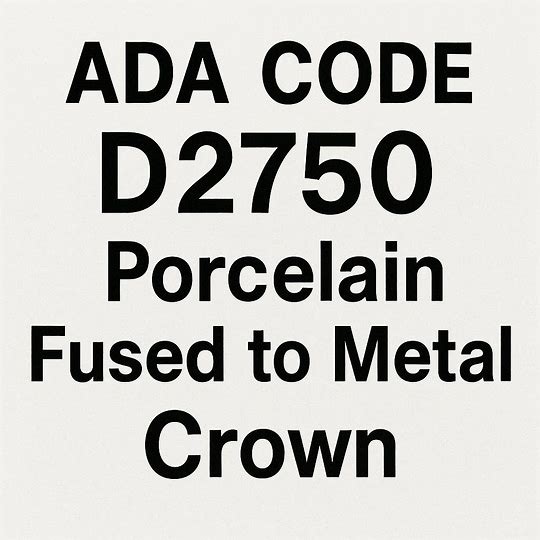
Code: D2750
Description: Crown – porcelain fused to high noble metal
This code is for the crown that will be placed on your prepared abutment tooth. It matches the materials of the D6240 pontic, creating a uniform, strong, and aesthetically consistent bridge. So, for a three-unit bridge with PFM materials, your treatment plan might show:
-
Tooth #X (Abutment): D2750 (PFM Crown)
-
Tooth #Y (Missing Space): D6240 (PFM Pontic)
-
Tooth #Z (Abutment): D2750 (PFM Crown)
D6251: The All-Ceramic Retainer
Code: D6251
Description: Retainer – ceramic/porcelain
Just as with the pontic, there is a code for an all-ceramic retainer. This would be used in conjunction with the D6245 all-ceramic pontic for a completely metal-free bridge.
Code: D2751 (or D2740 depending on the specific material)
Description: Crown – porcelain/ceramic substrate
-
D2751 is often used for crowns made from materials like lithium disilicate.
-
D2740 is a broader code for a porcelain/ceramic crown.
For a completely aesthetic, metal-free anterior bridge, your treatment plan might show:
-
Tooth #A (Abutment): D2751 (All-Ceramic Crown)
-
Tooth #B (Missing Space): D6245 (All-Ceramic Pontic)
-
Tooth #C (Abutment): D2751 (All-Ceramic Crown)
D6710: The Temporary Solution
Code: D6710
Description: Provisional crown – further treatment
Before your final, permanent bridge is placed, you will wear a temporary or “provisional” bridge. This is an essential step in the process.
-
Purpose: The temporary bridge serves several critical functions. It protects the newly prepared abutment teeth, prevents your other teeth from shifting into the empty space, maintains your ability to chew and speak, and helps your gum tissue heal around the area where the new bridge will sit.
-
Material: These are typically made from a tooth-colored acrylic material right there in the dental office.
-
Code Application: Code D6710 is used for each provisional crown that makes up the temporary bridge. So, for a three-unit bridge, you would likely see this code three times on the treatment plan for the temporary phase.
Other Bridge-Related Codes You Might See
Beyond the core codes for the bridge itself, there are other procedures that are often part of the overall treatment.
Core Buildup (D2950)
Code: D2950
Description: Core buildup, including any pins
If an abutment tooth is broken down or has a large existing filling, it may not have enough solid tooth structure to properly support a crown. In this case, the dentist needs to build up the core of the tooth before placing the crown.
-
What it is: Think of it as preparing a strong foundation. The dentist uses a special filling material to replace the missing tooth structure, creating a solid base for the new crown to be cemented onto.
-
Why it’s billed separately: The buildup is an additional procedure that goes above and beyond a simple filling or crown preparation. Because it requires extra time, skill, and material, it is billed with its own code.
Post and Core (D2952 or D2953)
Code: D2952 (for cast post and core) or D2953 (for each prefabricated post)
Description: Post and core in addition to crown
Sometimes, a tooth is so severely damaged that a simple core buildup isn’t enough. If the tooth has had a root canal, a post may be placed inside the hollowed-out root canal space to help anchor the core buildup.
-
The Difference:
-
D2952: This is for a post and core that are cast together as one piece in a dental lab. It’s a very strong but less common option today.
-
D2953: This is for a prefabricated post (often made of metal or fiber) that is cemented into the canal. The core is then built up around it using filling material. This is a much more common procedure.
-
-
What it means for you: This is a significant procedure to save a tooth that might otherwise need to be extracted. It adds a layer of complexity and cost to the bridge treatment.
Common Bridge Configurations and Their Coding
A “bridge” isn’t always a simple three-unit replacement. The ADA codes also account for different designs.
The Traditional Three-Unit Bridge
This is the classic scenario: one missing tooth, two abutment teeth. As we discussed, the coding will be:
| Tooth/Location | Procedure | ADA Code | Description |
|---|---|---|---|
| Abutment Tooth 1 | Crown | D2750 | Crown – porcelain fused to high noble metal |
| Missing Space | Pontic | D6240 | Pontic – cast high noble metal |
| Abutment Tooth 2 | Crown | D2750 | Crown – porcelain fused to high noble metal |
The Maryland Bridge (Resin-Bonded Bridge)
For replacing a missing front tooth, especially in younger patients or when the abutment teeth are perfectly healthy, a less invasive option is a Maryland bridge.
-
How it works: Instead of full crowns, this bridge uses “wings” of metal or porcelain that are bonded to the back surfaces of the adjacent teeth.
-
The Code: The primary code for this is D6545. This code covers the entire prosthesis, including the pontic and the retainer wings. Because it requires minimal to no preparation of the abutment teeth, it is a much more conservative (and often less expensive) option.
The Cantilever Bridge
In some situations, there may only be one healthy tooth adjacent to the gap. A cantilever bridge is designed to attach to that single abutment tooth, with the pontic “floating” next to it. This is more common in areas of the mouth that experience less force. The codes would still be a crown code for the single abutment and a pontic code for the false tooth.
Understanding Your Dental Insurance and These Codes
This is where knowing the codes can be most helpful. Insurance companies don’t just look at the procedure; they look at the code’s classification.
The “Missing Tooth Clause”
This is a crucial part of many dental insurance plans. Most plans have a clause stating they will not cover a bridge to replace a tooth that was missing before you became insured. They consider it a pre-existing condition. Your dentist’s office will verify this with your insurance company before treatment begins, but it’s helpful for you to be aware of this potential hurdle.
Frequency Limitations
Dental bridges are major, durable restorations. Insurance companies know this. They will typically only pay for a bridge to replace the same tooth once every 5, 7, or even 10 years. If a bridge fails before that time limit (barring an accident), the insurance company may deny the claim, stating it’s too soon for a replacement. This is often called a “frequency limitation.”
Annual Maximums and Deductibles
Bridges are among the more expensive dental procedures. It’s very common for the total cost of a bridge to exceed your plan’s annual maximum (the total dollar amount your insurance will pay in a year, typically $1,000 to $2,000).
For example, if a three-unit bridge costs $4,500, and your annual maximum is $1,500, you will be responsible for the remaining $3,000 after your deductible is met. Understanding this helps set realistic financial expectations.
How to Read Your Treatment Plan Like a Pro
Your treatment plan is your map. Here are a few tips to make sure you understand it:
-
Check for Code Consistency: Look at the codes for your bridge. Do the codes for the abutment crowns and the pontic seem to match in material type? (e.g., D2750 with D6240 for PFM, or D2751 with D6245 for all-ceramic).
-
Look for Modifiers: Sometimes, you’ll see a code with a modifier, like -TD (for a “facial porcelain” or “facing” on a metal crown). This indicates a specific aesthetic feature.
-
Ask About “Alternative Benefits”: If your insurance doesn’t cover the specific type of bridge your dentist recommended, the office may run the claim with a different, less expensive code to see what your “alternative benefit” would be. For example, if they don’t cover an all-ceramic bridge (D6245), they might tell you what they would pay toward a PFM bridge (D6240). You can then decide if you want to pay the difference for the better aesthetic option.
-
Don’t Be Shy: If you see a code you don’t recognize, ask! A good dental office is happy to explain. You can say, “I see code D2950 on my plan. Can you help me understand why that’s necessary for my treatment?” This shows you’re engaged and helps you feel more in control.
The Bottom Line: Knowledge is Power
The world of ADA dental codes might seem complex, but it doesn’t have to be a barrier. By understanding the basic codes for bridges—like the difference between a PFM pontic (D6240) and an all-ceramic one (D6245), or why a core buildup (D2950) might be needed—you transform from a passive patient into an active participant in your dental care.
This knowledge helps you understand the value of the treatment being proposed, have more productive conversations with your dental team, and navigate the financial aspects of your care with greater confidence. The codes are just a tool—a tool designed to clearly define your treatment and ensure everyone involved is speaking the same language.
Frequently Asked Questions (FAQ)
1. Is there a single ADA code for a full dental bridge?
No, there is not one single code. A bridge is a combination of procedures. The full treatment plan will include separate codes for each retainer (crown) and each pontic (false tooth) that makes up the bridge.
2. What is the most common ADA code for a bridge tooth?
The most common code for a single false tooth (pontic) in a traditional bridge is D6240, which is for a pontic made from porcelain fused to high noble metal. It’s a popular choice for its balance of strength and aesthetics.
3. Will my insurance cover 100% of a bridge?
It is highly unlikely. Most dental insurance plans cover major restorative procedures like bridges at 50%. Your specific coverage percentage will be detailed in your plan’s benefits summary. Remember to also factor in your deductible and annual maximum.
4. What does code D2950 mean on my bridge treatment plan?
Code D2950 is for a “core buildup.” This means your dentist needs to add filling material to one of your abutment teeth to build up enough healthy tooth structure to properly support the new crown that will hold the bridge in place.
5. Why is there a code for a temporary bridge (D6710)?
The temporary bridge is a vital part of the process. Code D6710 covers the cost and labor of creating and placing this temporary restoration, which protects your prepared teeth, maintains spacing, and allows your gums to heal properly while your permanent bridge is being made in a dental lab.
Additional Resource
For the most authoritative and up-to-date information, you can visit the American Dental Association’s official page on dental procedures. They offer resources for both dental professionals and patients seeking to understand the standards of care.
Link to: https://www.ada.org/en/publications/cdt
Conclusion
Understanding the ADA dental codes for your bridge—such as D6240 for a metal-based pontic or D2750 for a supporting crown—demystifies your treatment plan. These codes are the key to clear communication between your dentist and insurance company. By learning their meaning, you can confidently discuss your options and financial responsibilities for a healthier, more complete smile.

dentalecostsmile
Newsletter Updates
Enter your email address below and subscribe to our newsletter