Diagnosis Code for Dental Bone Loss
If you have just received a dental report that mentions “bone loss,” you might feel a little overwhelmed. Medical codes can look like a secret language. You see letters, numbers, and decimal points. But here is the good news: understanding the diagnosis code for dental bone loss is easier than you think.
This guide walks you through everything step by step. We focus on real-world use, honest information, and practical clarity. No complex medical jargon. No fake data. Just the answers you need.
What Is a Diagnosis Code?
A diagnosis code is a alphanumeric label. Dentists and doctors use it to describe a patient’s condition. Insurance companies also rely on these codes. They decide what treatments get covered.
Think of it like a product barcode. Each health issue has its own unique string of characters. When your dentist enters that code into their system, everyone understands exactly what problem you have.
For dental bone loss, there is not just one single code. Several different codes apply. The right one depends on why the bone loss happened in the first place.
Why Does the Correct Code Matter?
Using the wrong code can cause problems.
- Your insurance might deny the claim.
- You could pay more out of pocket.
- Your medical record becomes inaccurate.
- Future treatments may face delays.
Dentists take coding seriously. They undergo regular training. But you, as a patient, also benefit from knowing what codes mean. You can review your dental claim forms. You can ask better questions. And you can catch mistakes before they become headaches.
The Main Diagnosis Code for Dental Bone Loss (K08.1)
Let us get straight to the point. The most common diagnosis code for dental bone loss is K08.1.
In the ICD-10 system (that stands for International Classification of Diseases, 10th Revision), K08.1 specifically means: Loss of teeth due to accident, extraction, or local periodontal disease.
But wait—does that code actually mention bone? Not directly. However, in dental practice, when teeth are lost, the jawbone that once supported those teeth begins to resorb. That resorption is bone loss. So K08.1 covers the bone loss that follows tooth loss.
When Do Dentists Use K08.1?
Your dentist will likely use K08.1 in these situations:
- A tooth was extracted, and the socket has lost bone volume.
- You have missing teeth, and the ridge (the bony arch) has shrunk.
- Periodontal disease caused teeth to fall out, leaving deficient bone.
- An accident knocked out teeth, and now the bone has deteriorated.
Important note: K08.1 does not cover bone loss from a tumor, cyst, or systemic disease. For those causes, a different code applies.
Other Diagnosis Codes for Dental Bone Loss
Because bone loss has multiple causes, several codes exist. Below is a table of the most relevant ones.
| ICD-10 Code | Full Name | When It Applies |
|---|---|---|
| K08.1 | Loss of teeth due to accident, extraction, or local periodontal disease | Most common code for post-extraction bone loss and ridge defects |
| M27.2 | Inflammatory conditions of the jaws | Bone loss caused by osteomyelitis or chronic jaw inflammation |
| K05.30 | Chronic periodontitis, unspecified | Bone loss around still-existing teeth due to gum disease |
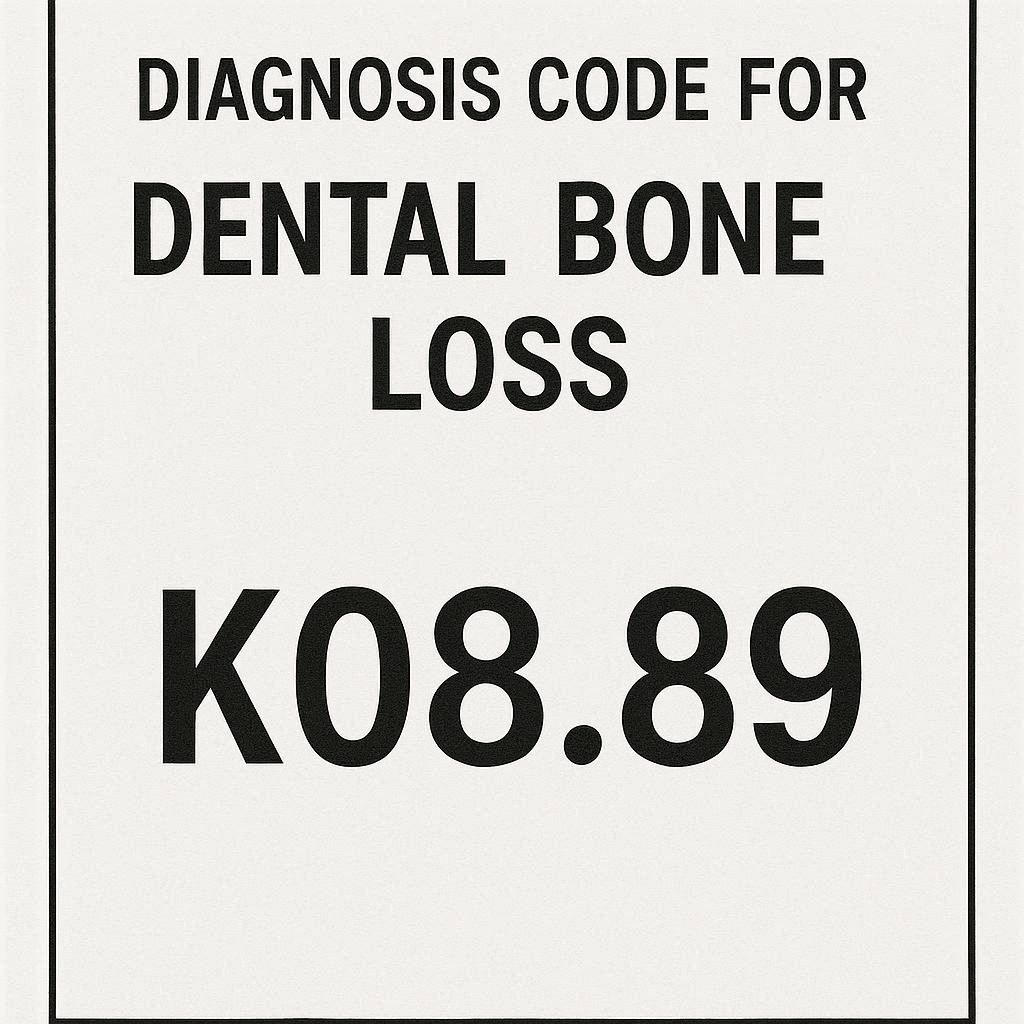
| K08.89 | Other specified disorders of teeth and supporting structures | Bone loss from rare causes like radiation injury |
| K08.9 | Disorder of teeth and supporting structures, unspecified | Used only when the exact cause is unknown |
Quote from a coding specialist: “K08.1 is the workhorse code for dental bone loss. But never assume it is always the right one. Read the patient’s history carefully. Bone loss around existing teeth is not the same as bone loss after extractions.”
Bone Loss Around Existing Teeth: K05.30
What if you still have your natural teeth, but X-rays show bone loss? Then K08.1 is not correct. In that case, the problem is likely periodontitis.
K05.30 stands for Chronic periodontitis, unspecified. This code covers bone loss that happens around teeth that are still present.
Periodontitis is a bacterial infection. It destroys the ligament and bone holding your teeth. Over time, pockets form between the tooth and gum. Those pockets deepen. The bone recedes. Teeth become loose.
Dentists also use more specific codes under K05.3, such as:
- K05.31 – Chronic periodontitis, localized (less than 30% of sites involved)
- K05.32 – Chronic periodontitis, generalized (30% or more sites involved)
So if your dentist says, “You have bone loss around your lower molars,” the code will likely be K05.31. If most of your mouth is affected, it becomes K05.32.
Bone Loss After Tooth Extraction: The K08.1 Detail
Extraction is a common dental procedure. But many patients do not realize what happens afterward. When a tooth is removed, the body no longer needs to maintain that section of jawbone. So it begins to break down.
This process is called ridge resorption. In the first six months after extraction, you can lose 30% to 60% of the bone width. Over a few years, the height also decreases.
K08.1 is the proper diagnosis code for dental bone loss in these cases. It does not matter if the extraction happened last month or ten years ago. The code remains the same.
Example Scenarios Using K08.1
- A 55-year-old patient had a lower first molar extracted in 2015. Now they want a dental implant. The CBCT scan shows a narrow ridge. Code: K08.1.
- A young adult had all four wisdom teeth removed. The area behind the second molars shows bone deficiency. Code: K08.1.
- A patient lost a front tooth in a bicycle accident. Five years later, the bone is flat and thin. Code: K08.1.
Inflammatory Bone Loss: M27.2
Some bone loss comes from deep infections inside the jawbone itself. This is rarer but more serious. The code M27.2 covers Inflammatory conditions of the jaws.
What falls under M27.2?
- Osteomyelitis – An infection of the bone marrow.
- Radiation osteonecrosis – Bone death caused by radiation therapy for cancer.
- Chronic jaw inflammation from an infected root or cyst.
In these cases, the bone loss is not primarily from missing teeth or gum disease. Instead, the bone tissue is actively being destroyed by inflammation. Treatment often requires surgery and long-term antibiotics.
Important: Do not confuse M27.2 with routine bone loss from periodontitis. M27.2 is for conditions inside the bone itself.
Bone Loss from Systemic Diseases
Certain whole-body diseases can cause dental bone loss. The code then depends on the underlying disease.
For example:
| Underlying Disease | ICD-10 Code | Link to Bone Loss |
|---|---|---|
| Osteoporosis | M80-M82 series | Weakens jawbone, increasing fracture and resorption risk |
| Hyperparathyroidism | E21.3 | Excess hormone causes bone calcium loss |
| Diabetes (poorly controlled) | E11.8 | Worsens periodontitis, leading to bone loss |
In these situations, the dentist will often use two codes. One for the bone loss itself (like K08.1 or K05.30). And another for the systemic disease. This gives a complete picture to the insurance company.
How Dentists Confirm Bone Loss
No one guesses when it comes to bone loss. Dentists rely on hard evidence. Here is what they use.
1. Periapical X-Rays
These small X-rays show a few teeth at a time. They reveal the bone level around each root. A healthy tooth has bone covering the top third of the root. If the bone has receded to the middle or lower third, that is bone loss.
2. Panoramic X-Rays (OPG)
An OPG shows the entire upper and lower jaw in one image. It is excellent for spotting general bone loss patterns. However, it can distort measurements. So dentists often use it as a screening tool.
3. CBCT Scans
Cone Beam CT scans are the gold standard. They provide 3D images of the jawbone. Dentists can measure bone height, width, and density with incredible accuracy. CBCT is essential for implant planning.
4. Periodontal Probing
A small probe measures pocket depths between the tooth and gum. Normal depth is 1 to 3 millimeters. Depths of 4 millimeters or more suggest bone loss. Depths over 6 millimeters indicate severe bone loss.
What Patients Should Know About Their Own Records
You have the right to see your dental records. This includes diagnosis codes. Ask your front desk for a printout of your “encounter form” or “claim submission.” Look for the ICD-10 codes.
If you see a code you do not understand, ask the dentist or office manager. A good practice will explain everything in plain language.
Practical tip: Keep a personal health record. Write down any diagnosis code you receive. Also note the date and the tooth number. This helps you track your bone health over time.
Insurance Coverage for Bone Loss Treatments
Diagnosis codes directly affect your wallet. Different codes lead to different coverage levels.
- K08.1 (bone loss after extractions): Most dental insurances cover bone grafting for implant placement under this code. However, they may have waiting periods.
- K05.30 (bone loss from periodontitis): Covered under periodontal benefits. Scaling and root planing is typically covered at 80% after a deductible.
- M27.2 (inflammatory jaw conditions): Often shifts to medical insurance. Dental insurance may deny it. Your dentist may need to file with your health plan instead.
Real-world advice: Always ask your dentist to submit a pre-authorization before major bone grafting or implant surgery. This gives you a written estimate of what insurance will pay. No surprises.
Common Coding Mistakes to Avoid
Even experienced offices make errors. Here are frequent mistakes with diagnosis codes for dental bone loss.
Mistake #1: Using K08.1 for Active Periodontitis
If the patient still has the tooth, do not use K08.1. Use K05.30 series instead. K08.1 assumes the tooth is already gone.
Mistake #2: Forgetting a Secondary Code
A patient with diabetes and bone loss needs two codes: one for the bone loss, one for diabetes. Omitting the systemic code can lead to a denial.
Mistake #3: Using Unspecified Codes Too Often
K08.9 (unspecified disorder) should be rare. If the dentist does not know why bone loss happened, they need more investigation. Unspecified codes can trigger audits.
Step-by-Step: How to Read a Dental Claim with Bone Loss Codes
Let us walk through a real example.
Patient situation: Mary, age 62, lost her upper right first molar ten years ago. She now wants an implant. X-rays show a narrow ridge. She also has well-controlled osteoporosis.
On her claim form, you might see:
| Field | Entry |
|---|---|
| Diagnosis code 1 | K08.1 |
| Diagnosis code 2 | M80.0 (Age-related osteoporosis without current fracture) |
| Procedure code | D7953 (Bone graft, ridge preservation) |
Translation: Mary’s bone loss came from the old extraction (K08.1). Her osteoporosis is a secondary factor (M80.0). The dentist plans to graft bone before placing the implant (D7953).
Does Medical Insurance Ever Cover Dental Bone Loss?
Yes, sometimes. If the bone loss stems from a medical condition (tumor, infection, trauma), medical insurance may take over.
For example:
- A patient with osteonecrosis of the jaw (M27.2) needs surgical debridement. Medical insurance usually covers this.
- A patient with a jaw fracture that leads to bone loss. Medical insurance covers the fracture repair and any grafting.
However, routine bone loss from missing teeth or gum disease remains a dental insurance matter. Always check your specific policy.
Preparing for an Appointment: Questions to Ask
You can walk into your next dental visit prepared. Here are useful questions.
- “What is the exact diagnosis code for my bone loss?”
- “Is this code K08.1 or does it fall under periodontitis codes?”
- “Do I need a secondary code for any medical condition?”
- “Will my insurance cover bone grafting under this code?”
- “Can you give me a pre-authorization before treatment?”
Asking these questions saves time, money, and confusion.
How to Prevent Further Dental Bone Loss
Codes are important, but prevention is better. Here is what actually helps slow or stop bone loss.
For existing teeth (to avoid K05.30 codes)
- Brush twice daily with a soft-bristled brush.
- Floss or use interdental brushes every day.
- See your dentist for cleanings every six months.
- Do not smoke. Smoking accelerates bone loss by 200% to 300%.
- Control your blood sugar if you have diabetes.
After extractions (to avoid severe K08.1 outcomes)
- Consider ridge preservation at the time of extraction. The dentist places bone graft material into the socket.
- If you plan an implant, do not wait years. Bone resorption is fastest in the first 12 months.
- Ask about a provisional restoration to maintain space and bone stimulation.
The Role of Bone Grafting Codes
Treatment codes go hand-in-hand with diagnosis codes. When a diagnosis code for dental bone loss is present, you may see these procedure codes:
| ADA Code | Procedure | Typical Use |
|---|---|---|
| D7953 | Bone graft, ridge preservation | Same visit as extraction |
| D7956 | Bone graft, ridge augmentation | Adding bone width or height for implant |
| D7960 | Sinus graft (sinus lift) | Bone loss in upper back jaw |
| D4266 | Guided tissue regeneration | Growing bone back in periodontal defects |
Each of these procedures must link to a valid diagnosis code. Otherwise, insurance will not pay.
What About “Peri-Implantitis” Bone Loss?
Peri-implantitis is bone loss around a dental implant. It is similar to periodontitis but around an implant instead of a natural tooth.
The ICD-10 coding system does not yet have a specific code for peri-implantitis. Most dentists use:
- K08.1 – If the bone loss is severe and the implant fails.
- K05.30 – As an analogy for inflammatory bone loss around an implant.
This is an area where coding guidelines continue to evolve. Always check with your specific payer.
A Closer Look at K08.1 Subcategories
The K08.1 code actually has more detail in the full ICD-10 manual. Here are subcategories you might see:
- K08.10 – Loss of teeth due to unspecified cause
- K08.11 – Loss of teeth due to trauma (accident)
- K08.12 – Loss of teeth due to extraction (including surgical removal)
- K08.13 – Loss of teeth due to periodontal disease
These subcategories are not always used in dental offices. Many still use K08.1 alone. But larger health systems may require the extra digit.
How Long Does It Take for Bone Loss to Show on X-Rays?
This is a common patient question. Bone loss does not appear overnight.
- After extraction: X-rays begin to show resorption at 3 to 6 months.
- From periodontitis: Bone loss of 1 to 2 millimeters per year is possible without treatment.
- From systemic disease: Variable. Some conditions cause rapid loss over months.
Regular X-rays (every 12 to 24 months) help catch bone loss early. Early detection means simpler treatment.
Summary Table: Diagnosis Code for Dental Bone Loss by Clinical Scenario
| Clinical Scenario | Correct ICD-10 Code |
|---|---|
| Missing tooth, ridge is narrow or short | K08.1 |
| Active gum disease with bone loss around existing teeth | K05.31 or K05.32 |
| Infection inside the jawbone causing bone destruction | M27.2 |
| Bone loss after radiation therapy for cancer | M27.2 (plus Z92.3 for radiation history) |
| Osteoporosis-related jawbone thinning | M80.0 + K08.1 (if teeth missing) |
| Bone loss around a failing dental implant | K08.1 or K05.30 (payer-dependent) |
| Cause of bone loss completely unknown | K08.9 (use sparingly) |
Frequently Asked Questions (FAQ)
1. Is K08.1 always the correct diagnosis code for dental bone loss?
No. K08.1 applies when the bone loss followed tooth loss (extraction, accident, or periodontal disease leading to missing teeth). If the teeth are still present, periodontitis codes like K05.30 are correct.
2. Does Medicare cover dental bone loss treatments?
Original Medicare generally does not cover dental services. However, if bone loss results from a medical condition (like osteomyelitis), Medicare Part A may cover inpatient hospital procedures. Always check with Medicare or your supplemental plan.
3. Can a general dentist assign these codes, or only a specialist?
Any licensed dentist can assign ICD-10 codes. Periodontists and oral surgeons do it frequently. But general dentists also use these codes every day for fillings, extractions, and crowns.
4. How do I know if my dentist used the right code?
Request a copy of your claim form. Look at box 21 (Diagnosis codes). Compare the code to the table above. If it does not match your situation, politely ask the office to review it.
5. What if my insurance denies a claim because of the bone loss code?
First, ask your dentist to submit an appeal with additional documentation (X-rays, chart notes). Sometimes a more specific code or a secondary code is needed. If that fails, ask for a peer-to-peer review between your dentist and the insurance dentist.
6. Can bone loss be reversed?
True bone loss cannot be reversed naturally. However, bone grafting can rebuild lost bone. Guided tissue regeneration can also grow new bone around teeth with moderate defects. Prevention is far easier than cure.
7. Why do some X-ray reports mention “alveolar bone loss”?
Alveolar bone is the part of the jawbone that holds tooth sockets. Alveolar bone loss is the clinical term for dental bone loss. The diagnosis code is still K08.1 or K05.30 depending on the tooth status.
Additional Resource
For a complete, searchable list of all ICD-10 dental codes, visit the American Dental Association’s CDT Code Search Tool:
https://www.ada.org/en/publications/ada-catalog/2025-cdt-code-on-dental-procedures-and-nomenclature
*Note: Always verify codes annually, as ICD-10 updates occur every October 1st.*
Important Notes for Readers
📌 Note 1: Diagnosis codes are not interchangeable. Using the wrong code can be considered insurance fraud. Trust your dentist, but also educate yourself.
📌 Note 2: This guide is for informational purposes only. It does not replace professional medical or dental advice. Always consult a licensed dentist for your specific situation.
📌 Note 3: Insurance coverage varies widely. A diagnosis code alone does not guarantee payment. Your specific plan’s exclusions and limitations always apply.
📌 Note 4: If you see a code for “unspecified bone loss” (K08.9) on multiple visits, ask for further testing. An unspecified code should be a temporary measure.
Conclusion
Understanding the diagnosis code for dental bone loss empowers you as a patient. The most common code, K08.1, covers bone loss after teeth are missing. For bone loss around existing teeth, periodontitis codes like K05.30 apply. Always verify codes on your claims, ask questions before major treatments, and remember that early detection prevents severe bone loss. With this guide, you can now navigate dental insurance forms and dentist discussions with confidence.