Dental Code D5211: Your Complete Guide to a Mandibular Partial Denture
Navigating the world of dental insurance codes can sometimes feel like learning a new language. You sit in the dentist’s chair, treatment plan in hand, and see a jumble of letters and numbers. If you’re missing some teeth on your bottom arch, you might have come across the term Dental Code D5211.
Don’t worry—you are not alone, and we are here to help.
This guide is designed to be your friendly, trustworthy companion. We are going to unpack everything you need to know about D5211. Forget the confusing jargon and the intimidating insurance manuals. By the time you finish reading this, you’ll understand exactly what this procedure entails, why you might need it, how much it might cost, and how to make the best decision for your smile.
Think of this as a relaxed conversation over coffee, where we turn a complex dental topic into something simple, clear, and actionable.
What Exactly is Dental Code D5211?
Let’s start with the basics. In the world of dentistry, the Current Dental Terminology (CDT) code set is used to standardize procedures for insurance billing and patient records. It ensures that when your dentist in New York says “partial denture,” a dentist in California knows exactly what they mean.
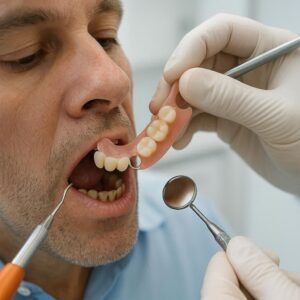
Dental Code D5211 specifically refers to a Partial Denture – Mandibular, Resin Base (Including Retentive Clips, Rest, and Teeth), and Conventional.
Okay, that’s a mouthful. Let’s break that down into plain English:
-
Partial Denture: This means it replaces some teeth, not all of them. It’s a removable appliance designed to fill in the gaps where you have missing teeth.
-
Mandibular: This is a fancy word for the lower jaw. So, we are specifically talking about a denture for your bottom teeth.
-
Resin Base: The part of the denture that looks like your gums (the pink part) is made from a hard, durable resin (a type of plastic).
-
Including Retentive Clips, Rest, and Teeth: This tells us the denture is complete. It comes with the artificial teeth already set in the base, and it includes metal or plastic clips (clasps) that hook around your existing natural teeth to hold it securely in place. The “rest” is a small part of the framework that helps stabilize the denture and prevents it from moving too much when you chew.
-
Conventional: This is the most important word for the process. “Conventional” means that this denture is made after your mouth has fully healed from any extractions. It is not an immediate “same-day” denture.
Important Note: D5211 is specifically for the lower jaw. If you are getting a partial denture for your upper jaw, your dentist would use a different code, usually D5212 (Partial Denture – Maxillary).
D5211 vs. Other Partial Denture Codes: What’s the Difference?
One of the most common points of confusion is how D5211 differs from other partial denture codes. To make it crystal clear, let’s look at a simple comparison.
| Dental Code | Description | Key Takeaway |
|---|---|---|
| D5211 | Partial Denture – Mandibular, Resin Base | A lower partial made from acrylic. It usually has metal clasps. It is the standard, workhorse partial for the bottom jaw. |
| D5212 | Partial Denture – Maxillary, Resin Base | The exact same concept as D5211, but for the upper jaw (maxillary) . It covers the roof of the mouth (palate) for support. |
| D5213 | Partial Denture – Mandibular, Cast Metal Framework with Resin Denture Bases | A lower partial with a strong, thin, and more comfortable metal base (usually chrome cobalt) that the pink acrylic is attached to. It is generally more durable and less bulky than D5211. |
| D5214 | Partial Denture – Maxillary, Cast Metal Framework with Resin Denture Bases | The upper version of D5213. Often preferred because the metal framework can be much thinner than a full acrylic palate. |
| D5221 | Immediate Partial Denture – Mandibular | A lower partial that is placed immediately after teeth are extracted. It acts as a bandage and allows you to have teeth during the healing process. It often requires a reline later as the gums shrink. |
As you can see, D5211 is your “entry-level” or standard lower partial. It’s a reliable, time-tested solution for replacing missing teeth.
The Step-by-Step Journey: Getting Your D5211 Partial Denture
Getting a partial denture is a process, not a single appointment. It requires patience and teamwork between you and your dentist. Knowing what to expect can ease any anxiety. Here is a friendly walkthrough of the journey.
Step 1: The Initial Consultation and Examination
Your journey begins with a conversation. Your dentist will:
-
Examine your mouth: They will look at your remaining teeth, your gums, and the areas where teeth are missing.
-
Take X-rays: This is to check the health of the roots of your remaining teeth and the bone beneath the gums.
-
Discuss your goals: What do you hope to achieve? Better chewing? A more confident smile? Preventing your other teeth from shifting?
-
Present the treatment plan: If a partial denture is right for you, they will explain why and present you with the appropriate code, likely D5211 for a lower partial.
Step 2: The Preliminary Impressions
Once you’ve decided to move forward, the dentist will take a preliminary impression of your bottom teeth and gums. They use a soft, putty-like material in a tray that fits over your teeth. This creates a model of your mouth, which the dental lab will use to create a custom tray for the next step. Think of this as the first draft.
Step 3: The Final Impressions and Bite Registration
This is a crucial appointment. Using the custom tray made from your first model, the dentist will take a very detailed and accurate final impression. This captures every contour of your gums and remaining teeth with precision.
They will also take a bite registration. This involves having you bite into a soft wax or silicone material to record exactly how your upper and lower jaws fit together. This ensures your new denture will align perfectly with your bite.
Step 4: The “Try-In” Appointment (The Wax Model)
The dental lab will use your final models and bite registration to create a wax model of your new partial denture. This model has the artificial teeth set in pink wax.
During this appointment, you get to see the denture before it’s made permanent!
-
You check the fit: The dentist will place the wax model in your mouth to check for comfort and stability.
-
You check the look: This is your chance to approve the size, shape, and color of the teeth. Do they look natural? Are you happy with your future smile?
-
You check the bite: The dentist will ensure your bite feels normal and comfortable.
This is a critical step. Don’t be shy! If something doesn’t look or feel right, speak up. It’s much easier to adjust the wax now than the final acrylic later.
Step 5: The Final Delivery
After you’ve approved the try-in, the lab will process the denture, replacing the wax with the hard, pink resin base. A few weeks later, your new D5211 partial denture is ready!
At this appointment, your dentist will:
-
Place the denture: They will carefully insert it and check the fit, making any minor adjustments needed for comfort.
-
Show you how to insert and remove it: There is a specific path of insertion to avoid putting stress on the clasps or your natural teeth.
-
Give you home-care instructions: This is essential for the longevity of your denture and the health of your mouth.
Step 6: The Follow-Up (The “Tissue” Side)
It is very common to need a follow-up appointment a week or two later. As you wear your new denture, your gums and the bone beneath will compress slightly. This can create small pressure points or make the denture feel a little loose. Your dentist will make minor adjustments to ensure a perfect, comfortable fit.
The Pros and Cons of a D5211 Resin Base Partial
Every dental solution has its advantages and disadvantages. Being informed helps you feel confident in your choice. Here’s an honest look at the D5211.
The Upsides (Pros)
-
Affordability: Compared to a cast metal partial (D5213) or dental implants, the D5211 resin base partial is a very cost-effective way to replace multiple missing teeth.
-
Aesthetics: The resin base can be tinted and shaped to closely mimic the look of your natural gums. The acrylic teeth are also available in a wide range of natural shades.
-
Ease of Modification: If you ever need to add another tooth to the denture (if you lose another natural tooth later), it is generally easier and less expensive to do with a resin base than a metal framework.
-
Non-Invasive: The process does not require any surgery or permanent alteration to your remaining teeth (unlike a dental bridge, which requires shaving down adjacent teeth).
The Downsides (Cons)
-
Fragility: Acrylic resin is not as strong as a cast metal framework. It is more prone to cracking or breaking if dropped.
-
Bulkiness: To be strong enough, the resin base needs to be a certain thickness. This can feel a bit bulky in your mouth compared to a thin metal partial, especially on the tongue side.
-
Long-Term Fit: The acrylic base can wear down and distort very slowly over many years. It also doesn’t transfer heat and cold the same way a metal base does, which some people find less comfortable.
-
Clasp Visibility: While functional, the metal clasps (clips) that wrap around your natural teeth can sometimes be visible when you smile or talk.
How Much Does Dental Code D5211 Cost? (A Realistic Look)
Talking about money can be awkward, but being prepared is key. The cost of a D5211 partial denture is not a fixed number. It’s like buying a car—the base model has a price, but factors like your location and the specific dentist can change it.
Generally speaking, the national average for a D5211 mandibular partial denture can range from $700 to $1,800.
Here’s a breakdown of what influences the final price:
-
Geographic Location: Dental costs in major cities like New York, Los Angeles, or Chicago are typically higher than in rural areas.
-
Dentist’s Experience: A highly experienced prosthodontist (a specialist in restorations) may charge more than a general dentist.
-
Laboratory Fees: The quality of the dental lab used by your dentist plays a role. A high-quality lab with skilled technicians will produce a better-looking, better-fitting denture, but it comes at a higher cost to the dentist, which is passed on to you.
-
Complexity of the Case: If your mouth has unusual anatomy, or if the partial needs a complicated design to fit around tilted teeth, the laboratory work is more complex and expensive.
-
Additional Procedures: The D5211 code is just for the fabrication of the denture itself. It does not include other necessary procedures like:
-
Extractions
-
Comprehensive oral exams
-
X-rays
-
Any periodontal (gum) treatment for your remaining teeth
-
Navigating Dental Insurance for D5211
Here is where things can get a little tricky, but we’ll navigate it together.
Most dental insurance plans categorize D5211 as a major restorative procedure. This is important because it affects how much they will pay.
-
Coverage Percentage: Major services are typically covered at a lower percentage than basic fillings or preventative cleanings. It is common for insurance to cover 50% of the cost, after you have met your deductible. For example, if your deductible is $100 and the dentist’s fee is $1,500, you would pay the first $100, and then the insurance would likely cover 50% of the remaining $1,400 ($700), leaving you responsible for the other $700.
-
Annual Maximum: This is the total dollar amount your insurance plan will pay in a single calendar year. It is often between $1,000 and $2,000. If a D5211 partial uses up most or all of your annual maximum, other work you need done that same year might have to be paid for out-of-pocket.
-
Waiting Periods: Many plans have a waiting period (often 6-12 months) for major services. This means you can’t get a partial denture right after you sign up for the plan.
Tip: Before you commit, ask your dentist’s office to do a “predetermination of benefits.” They will send your treatment plan to your insurance company, who will send you a written statement of exactly what they will pay. This avoids any surprises later.
Caring for Your D5211 Partial Denture
Your new partial denture is an investment in your health and happiness. Treating it well will ensure it lasts for many years (typically 5-10 years). Here is your simple care guide:
Daily Cleaning Routine
-
Rinse After Eating: Remove your partial and rinse it under lukewarm water to remove food particles. Never use hot water, as it can warp the acrylic.
-
Brush, Don’t Scrub: Use a soft-bristled toothbrush (specifically designed for dentures is best) and a non-abrasive denture cleaner or mild liquid soap. Avoid regular toothpaste, as it is too abrasive and can create microscopic scratches where bacteria can grow. Gently brush all surfaces of the denture.
-
Soak Overnight: Most dentures need to stay moist to maintain their shape. Place your D5211 in a denture-soaking solution or plain water overnight. This also gives your gum tissues a chance to rest.
-
Clean Your Mouth: Before re-inserting your denture in the morning, brush your natural teeth, your tongue, and your palate (roof of your mouth) with a soft brush. This stimulates tissues and removes plaque.
Handling with Care
-
Fill the Sink: When you are cleaning your denture, fill the sink with water or place a soft towel in the basin. If you drop it, the water or towel will cushion the fall and prevent it from breaking.
-
Be Gentle: The acrylic and clasps are durable but not indestructible. Don’t bend the clasps when you are cleaning them.
What to Avoid
-
Abrasive Cleaners: Avoid bleach, powdered cleansers, and stiff-bristled brushes.
-
Adhesives (at first): A well-fitting denture should not need adhesive. If yours feels loose, see your dentist for an adjustment. Don’t rely on adhesives to fix a poor fit.
Frequently Asked Questions (FAQ)
We’ve compiled some of the most common questions we hear about D5211.
Q: Is a D5211 partial denture my only option for replacing lower teeth?
A: Not at all! Other options include a dental bridge (which crowns the teeth on either side of the gap) or dental implants. A bridge is fixed (non-removable), and implants are the most durable option but also the most expensive and invasive. Your dentist can help you weigh the pros and cons of each based on your specific situation and budget.
Q: How long does it take to get used to wearing a D5211?
A: Everyone adapts at their own pace. It may feel bulky or strange for the first few days to a couple of weeks. Your speech might sound a little different, and eating will take some practice. Start with soft foods cut into small pieces, and practice reading out loud. Be patient with yourself—your mouth is a highly sensitive place, and it needs time to learn to accept this new appliance.
Q: Will my D5211 affect how I taste food?
A: It might, especially at first. A conventional upper partial (D5212) covers the palate, which has many taste buds. Since D5211 is for the lower jaw, it covers less of the tongue’s taste areas, so taste is usually less affected. However, any appliance in the mouth can temporarily alter your perception of food.
Q: Can I sleep with my partial denture in?
A: It is generally not recommended. Removing your denture at night gives your gum tissues a chance to breathe and be stimulated by your tongue and saliva. It also helps prevent plaque buildup and fungal infections under the denture.
Q: What happens if the metal clasp breaks?
A: Don’t try to fix it yourself with superglue! This can ruin the denture and may even be harmful if ingested. Place the partial in a safe container and call your dentist immediately. In many cases, a dental lab can repair it by replacing the clasp.
Additional Resource
For a visual guide on how to insert and remove your new lower partial denture, the American College of Prosthodontists offers excellent patient education resources. You can visit their website at www.gotoapro.org and search for “partial dentures” to find helpful videos and articles.
Final Thoughts
Choosing to replace missing teeth with a Dental Code D5211 mandibular partial denture is a positive and proactive step for your oral health. It’s about more than just filling gaps in your smile; it’s about maintaining the proper alignment of your remaining teeth, improving your ability to chew and enjoy food, and restoring the confidence to laugh and speak freely.
We hope this guide has demystified the process and left you feeling informed and empowered. Remember, your dentist is your partner on this journey. Ask questions, share your concerns, and work together to create a smile that makes you feel fantastic.
Summary: Dental Code D5211 refers to a conventional lower partial denture made with a resin base. It is an affordable and effective solution for replacing multiple missing teeth on the bottom arch. Proper care and communication with your dentist are key to a successful and long-lasting result.