Understanding ADA Dental Codes and Fees
If you have ever sat in a dentist’s chair, nodded along to a treatment plan, and then later stared at a statement from your insurance company wondering what it all means, you are not alone. The world of dental billing is built on a specific language: the ADA dental codes. These codes, combined with the fees attached to them, form the backbone of how dental care is documented, billed, and paid for.
Understanding this system is not about becoming a billing expert. It is about becoming an empowered patient. When you know what the codes mean and how fees are structured, you can make informed decisions about your oral health, ask the right questions, and feel confident that you understand the value of the care you are receiving.
This guide is designed to walk you through everything you need to know. We will explore what ADA codes are, how they are structured, how dentists determine their fees, and how to read a dental insurance explanation of benefits. By the end, you will have a reliable roadmap to navigate the financial side of dental care with clarity and confidence.
What Are ADA Dental Codes?
The American Dental Association (ADA) maintains a standardized system called the Code on Dental Procedures and Nomenclature. This system, more commonly known as the CDT (Current Dental Terminology) code set, is the universal language of dentistry in the United States.
Every dental procedure, from a simple exam to a complex surgical extraction, has a unique five-character alphanumeric code. The code starts with the letter “D” followed by four numbers (e.g., D0120, D1110, D2740). This system ensures that when a dentist submits a claim to an insurance company, there is no ambiguity about what procedure was performed. A D0120 is a periodic oral evaluation everywhere, whether you are in a small private practice in Maine or a large dental clinic in California.
The Structure of a CDT Code
The numbering system is logical and grouped by category. The first digit of the four-digit number tells you the broad category of the service.
-
D0000-D0999: Diagnostic (e.g., exams, x-rays)
-
D1000-D1999: Preventive (e.g., cleanings, fluoride treatments)
-
D2000-D2999: Restorative (e.g., fillings, inlays, onlays)
-
D3000-D3999: Endodontics (e.g., root canals)
-
D4000-D4999: Periodontics (e.g., gum disease treatments)
-
D5000-D5999: Prosthodontics – Removable (e.g., dentures)
-
D6000-D6999: Prosthodontics – Fixed (e.g., crowns, bridges, implants)
-
D7000-D7999: Oral and Maxillofacial Surgery (e.g., extractions, biopsies)
-
D8000-D8999: Orthodontics (e.g., braces, aligners)
-
D9000-D9999: Adjunctive General Services (e.g., sedation, emergency care)
This logical grouping makes it easier for both dental professionals and patients to understand the general nature of the treatment being proposed.
Why ADA Codes Matter to You
As a patient, you might wonder why you should care about a coding system designed for dentists and insurance companies. The reason is simple: accuracy and transparency.
Every dental insurance claim begins with a code. If the wrong code is used, your claim could be denied, or you could end up paying more than you should. For example, a “prophylaxis” (standard cleaning) has the code D1110. However, if a patient has active gum disease, the appropriate code might be D4341 or D4342 (periodontal scaling and root planing). Using the wrong code could lead to a claim being rejected because the insurance company expects a different procedure for a patient of a certain age or with a specific diagnosis.
Understanding the codes on your treatment plan allows you to:
-
Verify that the procedure listed matches the treatment your dentist explained.
-
Compare treatment plans from different dental offices accurately.
-
Understand your insurance explanation of benefits (EOB) and spot any potential errors.
-
Ask informed questions about why a specific code is being used.
The Nuances of Dental Fees
While ADA codes provide a standardized language for procedures, fees are a different story. There is no national standard for what a dentist can charge for a specific code. Instead, fees are determined at the local practice level and are influenced by a variety of factors.
How Dentists Determine Their Fees
Setting a fee schedule is a complex process for a dental practice. It is not as simple as looking up a suggested price. Several key factors come into play:
Geographic Location: The cost of living and operating a business varies dramatically. A dental practice in a major metropolitan area like New York or San Francisco will have higher overhead costs—rent, utilities, staff salaries—than a practice in a rural town. These costs are reflected in the fees.
Overhead Costs: Dentistry is a high-overhead profession. Beyond rent and salaries, a modern dental practice must invest in advanced technology like digital x-ray sensors, 3D imaging (CBCT) machines, CAD/CAM systems for same-day crowns, and sterilization equipment. The cost of materials, such as ceramics for crowns or implants, also plays a role.
Practice Philosophy and Expertise: Some practices focus on high-volume, insurance-driven care, while others focus on high-quality, fee-for-service care. Dentists with advanced training in specialties like implantology or cosmetic dentistry often charge higher fees that reflect their expertise and the premium materials they use.
Insurance Fee Schedules: This is a critical point. Many dentists participate in insurance networks. When a dentist is “in-network” with an insurance company, they agree to accept that insurer’s negotiated fee for each ADA code. This is often a discounted rate. The dentist’s standard “full fee” is what they would charge a patient without insurance or a patient who is out-of-network.
A Look at Common Fee Ranges
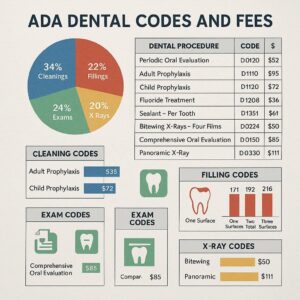
It is important to remember that fees vary widely. The following table provides a realistic range for common procedures based on typical full fees (before insurance adjustments) in the United States. These are estimates to provide context, not guarantees.
| ADA Code | Procedure Description | Typical Fee Range (Full Fee) |
|---|---|---|
| D0120 | Periodic Oral Evaluation (Exam) | $40 – $100 |
| D1110 | Prophylaxis (Adult Cleaning) | $75 – $200 |
| D0210 | Full Mouth X-Ray Series | $100 – $250 |
| D2740 | Crown – Porcelain/Ceramic | $1,000 – $1,800 |
| D3310 | Root Canal – Anterior (Front Tooth) | $700 – $1,300 |
| D3330 | Root Canal – Molar (Back Tooth) | $1,100 – $1,800 |
| D7140 | Extraction – Erupted Tooth | $150 – $350 |
| D6010 | Surgical Placement of Implant | $1,500 – $3,000 (per implant) |
| D5110 | Complete Denture – Maxillary (Upper) | $1,300 – $2,500 |
Important Note: These figures represent the dentist’s full, undiscounted fee. If you have dental insurance, your actual out-of-pocket cost will likely be lower, based on your plan’s co-pays, deductibles, and the in-network negotiated rate.
Decoding Your Dental Insurance and Fees
Insurance is where the worlds of ADA codes and fees collide. Understanding the relationship between the two is the key to predicting your costs and avoiding surprises.
The Three Key Terms
When looking at a treatment plan or an insurance statement (EOB), you will see three main numbers associated with each ADA code:
-
The Dentist’s Fee: This is the full amount the dentist charges for the procedure.
-
The UCR (Usual, Customary, and Reasonable) Fee: This is a term used by insurance companies. It is the maximum amount the insurer deems acceptable for a procedure in a specific geographic area. This is often, but not always, lower than the dentist’s fee. It is essentially the insurance company’s internal fee schedule.
-
The Allowed Amount: This is the actual amount the insurance company has agreed to pay for the service. If the dentist is in-network, the allowed amount is the pre-negotiated fee. If the dentist is out-of-network, the allowed amount is usually based on the insurer’s UCR fee.
A Simple Example
Let’s say you need a crown (D2740).
-
Scenario A: In-Network Dentist
-
Dentist’s Full Fee: $1,400
-
In-Network Negotiated Fee (Allowed Amount): $1,100
-
Your Insurance Plan Covers: 50% of the allowed amount ($550)
-
Your Co-Pay (Out-of-Pocket): $550
-
-
Scenario B: Out-of-Network Dentist
-
Dentist’s Full Fee: $1,400
-
Insurer’s UCR (Allowed Amount): $950
-
Your Insurance Plan Covers: 50% of the allowed amount ($475)
-
Your Co-Pay (Out-of-Pocket): $1,400 – $475 = $925
-
In this example, choosing an out-of-network provider results in a significantly higher out-of-pocket cost, even though the insurance plan’s coverage percentage (50%) appears the same.
Frequency Limitations
Insurance companies also use ADA codes to enforce frequency limitations. Most plans will only cover a specific code a certain number of times per year. Common frequency limits include:
-
D0120 (Exam): Often limited to two per calendar year.
-
D1110 (Cleaning): Typically two per calendar year.
-
D0210 (Full Mouth X-Rays): Often once every three to five years.
-
D2740 (Crown): Usually once every five to seven years per tooth.
If a dentist performs a procedure more frequently than the insurance allows, the claim will likely be denied, and the patient may be responsible for the full fee.
A Guide to Common ADA Codes
To help you become more familiar with the language, here is a more detailed look at some of the most frequently used ADA codes you might encounter on a treatment plan.
Diagnostic Codes (D0000-D0999)
-
D0120 – Periodic Oral Evaluation: This is the standard “check-up” exam performed on a patient of record at regular intervals. It is the bread-and-butter code for routine visits.
-
D0140 – Limited Oral Evaluation: This is used for a problem-focused exam, such as when you call with a toothache. It is not a comprehensive exam but a targeted assessment of a specific issue.
-
D0150 – Comprehensive Oral Evaluation: This is a detailed and thorough evaluation of a new patient. It includes a full medical and dental history, a head and neck exam, a soft tissue exam, a periodontal evaluation, and a detailed charting of existing restorations.
-
D0210 – Intraoral – Complete Series of Radiographic Images: A full set of x-rays showing all the teeth, roots, and supporting bone.
-
D0274 – Bitewings – Four Radiographic Images: The four small x-rays taken typically once a year to check for cavities between the teeth.
Preventive Codes (D1000-D1999)
-
D1110 – Prophylaxis – Adult: The standard cleaning for a patient with a healthy periodontium (gums).
-
D1120 – Prophylaxis – Child: The cleaning for a patient under the age of 14 or 15, depending on the insurance plan.
-
D1206 – Topical Fluoride Varnish: A high-concentration fluoride application used to prevent cavities, especially common for children.
Restorative Codes (D2000-D2999)
-
D2140 – Amalgam – One Surface, Primary or Permanent: A silver filling for a cavity on a single surface of a tooth.
-
D2150 – Amalgam – Two Surfaces: A silver filling for a cavity involving two surfaces (e.g., the top and side of a tooth).
-
D2330 – Resin-Based Composite – One Surface, Anterior: A tooth-colored filling for a front tooth.
-
D2391 – Resin-Based Composite – One Surface, Posterior: A tooth-colored filling for a back tooth (molar or premolar).
-
D2740 – Crown – Porcelain/Ceramic: A full-coverage crown made of porcelain or ceramic.
-
D2750 – Crown – Porcelain Fused to High Noble Metal: A crown with a metal substructure fused to a porcelain exterior. “High noble” means the metal contains a high percentage of gold or platinum.
Endodontic Codes (D3000-D3999)
-
D3310 – Endodontic Therapy, Anterior Tooth: A root canal on an incisor or canine (front teeth).
-
D3320 – Endodontic Therapy, Bicuspid Tooth: A root canal on a premolar (the teeth between the front and back).
-
D3330 – Endodontic Therapy, Molar Tooth: A root canal on a molar (large back teeth). This is the most complex and time-consuming root canal, hence the higher fee.
-
D3410 – Apicoectomy – Anterior: A surgical procedure to remove the tip of a tooth’s root and seal the end, often performed after a previous root canal has failed.
Periodontal Codes (D4000-D4999)
-
D4341 – Periodontal Scaling and Root Planing – Four or More Teeth Per Quadrant: This is a deep cleaning for patients with active gum disease. It is performed one quadrant (quarter of the mouth) at a time.
-
D4342 – Periodontal Scaling and Root Planing – One to Three Teeth Per Quadrant: A deep cleaning for a localized area of gum disease.
-
D4355 – Full Mouth Debridement: A preliminary cleaning to remove gross plaque and calculus that is interfering with the dentist’s ability to perform a comprehensive exam. This is not a substitute for a regular cleaning (D1110).
Oral Surgery Codes (D7000-D7999)
-
D7140 – Extraction, Erupted Tooth or Exposed Root: A simple extraction of a tooth that is fully visible in the mouth.
-
D7210 – Extraction, Erupted Tooth Requiring Removal of Bone and/or Sectioning: A surgical extraction of a tooth that is broken off at the gum line or has curved roots, requiring the dentist to cut bone or section the tooth to remove it.
-
D7240 – Removal of Impacted Tooth – Completely Bony: The surgical extraction of a wisdom tooth that is fully encased in the jawbone.
Prosthodontic Codes (D5000-D6999)
-
D5110 – Complete Denture – Maxillary: A full set of upper dentures.
-
D5120 – Complete Denture – Mandibular: A full set of lower dentures.
-
D5211 – Maxillary Partial Denture – Resin Base: A removable partial denture for the upper arch.
-
D6010 – Surgical Placement of Implant Body: The surgical procedure to place the titanium implant fixture into the jawbone. The crown placed on top of the implant is coded separately.
How to Read a Dental Treatment Plan
When a dentist presents a treatment plan, it should be a clear document that outlines the recommended procedures, their associated ADA codes, the fees, and what portion is estimated to be covered by insurance.
A well-structured treatment plan is your roadmap. Here is how to interpret one.
-
Patient Information: Verify your name and date of birth are correct.
-
List of Procedures: Each recommended procedure should be listed with its ADA code and a plain-English description.
-
Fees: The full fee for each procedure should be clearly stated.
-
Insurance Estimates: This is where you see the breakdown.
-
Dentist’s Fee: The full charge.
-
Insurance Allowance: The amount the insurance company will pay (if in-network, this is the negotiated rate).
-
Estimated Patient Portion: What you are expected to pay, including deductibles and co-pays.
-
Pro Tip: Ask for a copy of the treatment plan before you undergo any major procedure. Take it home. Compare it to your insurance booklet. If something is unclear, call your insurance company to verify coverage for the specific codes listed.
Questions to Ask Your Dentist’s Office
To avoid surprises, you can have a simple conversation with the office manager or treatment coordinator. Here are a few questions to guide that conversation:
-
“Can you explain the ADA codes on my treatment plan in simple terms?”
-
“Are these procedures covered by my insurance, and are there any frequency limits I should know about?”
-
“Is the estimated patient portion based on my in-network benefits or the office’s full fee?”
-
“If my insurance denies part of the claim, what is my responsibility?”
A trustworthy dental office will welcome these questions. Transparency is a hallmark of quality care.
The Future of ADA Codes and Dental Fees
The world of dental coding is not static. The ADA updates the CDT code set every year, with new codes added, old ones revised, and some deleted. These updates often reflect advances in dental technology and changes in standard care.
For example, in recent years, we have seen the introduction of specific codes for:
-
Teledentistry: Codes like D9995 and D9996 were created to accommodate the growing use of virtual consultations.
-
Silver Diamine Fluoride (SDF): A non-invasive treatment for arresting cavities now has its own specific codes.
-
Clear Aligner Therapy: Codes have been refined to better distinguish between comprehensive orthodontic treatment and minor tooth movement.
Staying informed about these changes can be useful, especially if you are undergoing newer treatments. Your dentist will always be able to explain if a new code is being used for your care.
Comparing Treatment Plans
One of the most valuable skills you can develop is the ability to compare treatment plans from different dental offices. ADA codes make this possible.
If you receive a second opinion, ask for a treatment plan that uses ADA codes. You can then compare the codes line by line.
-
Are the same codes used? One office might code a deep cleaning as D4341 (four or more teeth per quadrant), while another uses D1110 (a standard cleaning). This tells you the offices have different diagnoses regarding your gum health.
-
Are the fees significantly different for the same code? Comparing the full fee for D2740 (crown) between two offices gives you an apples-to-apples comparison of their pricing structure.
-
Is the treatment plan the same? One dentist might recommend a crown (D2740) for a cracked tooth, while another recommends an onlay (D2650). The codes will reflect these different treatment philosophies, allowing you to weigh the pros and cons of each approach.
A Sample Comparison Table
Let’s say you need a crown on a back tooth.
| Item | Office A (In-Network) | Office B (Out-of-Network) | Office C (Fee-for-Service) |
|---|---|---|---|
| ADA Code | D2740 (Crown) | D2740 (Crown) | D2740 (Crown) |
| Dentist’s Fee | $1,400 | $1,600 | $1,800 |
| Insurance Status | In-Network | Out-of-Network | No Insurance Participation |
| Allowed Amount | $1,100 | $1,000 (UCR) | N/A |
| Insurance Pays (50%) | $550 | $500 | $0 |
| Your Estimated Cost | $550 | $1,100 | $1,800 |
This table illustrates the dramatic difference in out-of-pocket cost based on network status and fee structure. However, the lowest cost option may not always be the best fit for your specific clinical needs or personal preferences regarding materials and experience.
Important Notes for Every Patient
-
Your insurance is a contract between you and your employer (or the insurer). Your dentist is not a party to that contract. Their role is to provide care and submit claims accurately.
-
A pre-treatment estimate is not a guarantee of payment. It is an estimate based on the information available at the time. The final payment is determined when the claim is processed after the procedure is completed.
-
Understand your “maximum” and “deductible.” Most plans have an annual maximum (the most they will pay in a year) and a deductible (what you must pay out-of-pocket before they start paying). These are applied to the allowed amounts.
-
Never feel pressured to proceed. A good treatment plan is a recommendation, not a demand. You have the right to take time, seek a second opinion, and decide on a timeline that works for your health and your budget.
The Value of Transparency in Dental Care
Ultimately, the relationship between ADA codes and fees is about more than just numbers on a page. It is about the trust between you and your dental care provider. When a dental practice is transparent about their fees, uses codes correctly, and takes the time to explain your treatment plan, it empowers you to be an active participant in your own oral health.
You are not just paying for a procedure; you are paying for a dentist’s years of education and training, the skill of the dental team, the quality of the materials, the safety of the sterilization protocols, and the technology used to diagnose and treat you. Understanding the codes and fees helps you see the value in what you are receiving.
Conclusion
ADA dental codes provide the universal language that connects dental care, insurance, and patient responsibility. By familiarizing yourself with the structure of these codes and the factors that influence dental fees, you transform from a passive recipient of care into an informed and empowered decision-maker. This knowledge allows you to accurately compare treatment plans, understand your insurance benefits, and have meaningful conversations with your dental team, ensuring that your investment in your oral health is both clear and confident.
Frequently Asked Questions (FAQ)
1. What does ADA stand for in dental codes?
ADA stands for the American Dental Association. The ADA is responsible for maintaining and updating the Current Dental Terminology (CDT) code set, which is the standard for dental procedures in the United States.
2. Why is there a difference between the fee my dentist charges and what my insurance pays?
Your dentist sets their own full fee based on their practice costs, location, and expertise. If your dentist is in-network with your insurance, they have agreed to accept a lower, pre-negotiated fee for that service. If they are out-of-network, your insurance will only pay up to what they deem “usual, customary, and reasonable” (UCR), which may be less than the dentist’s full fee.
3. How can I find out what a specific ADA code will cost me before treatment?
The best approach is to ask your dental office for a pre-treatment estimate. They will submit the proposed codes to your insurance company, and the insurer will return an estimate showing what they will pay and what your estimated out-of-pocket cost will be.
4. Can a dentist use a different ADA code than the one on my treatment plan?
A dentist should only use the code that accurately reflects the procedure performed. If the treatment changes during the appointment (for example, a simple extraction becomes a surgical one), the code on the final claim should reflect that change. Using an incorrect code to get insurance to pay is considered fraud.
5. What should I do if my insurance denies a claim for a procedure my dentist said would be covered?
First, check your explanation of benefits (EOB). If the denial is due to a frequency limit or a non-covered service, you may be responsible for the fee. If you believe it was a coding error, contact your dentist’s office. They can review the claim and, if necessary, submit a corrected claim or an appeal to the insurance company.
Additional Resource
For the most current and official information on the CDT code set, you can visit the American Dental Association’s official CDT page. This resource provides detailed information on coding guidelines, updates, and the annual revision process.
-
Link: American Dental Association – CDT (This is a trusted resource for the official code set.)