Dental Code for Maxillary Denture: Costs, Codes, and Coverage
If you have been told you need a maxillary denture—commonly known as an upper denture—you might be feeling a mix of relief and confusion. Relief that a solution is finally in sight, but confusion when you start looking at the treatment plan and see a string of numbers and letters that look like a secret code.
You are not alone.
One of the most common questions we hear from patients is simply, “What is the dental code for a maxillary denture?”
Understanding this code is the first step to understanding your insurance benefits. It helps you know what you are paying for, why there might be multiple fees listed, and how to avoid surprise bills.
In this guide, we will break down everything you need to know. We will look at the standard codes, the differences between immediate and permanent dentures, how insurance companies view these procedures, and what you should expect to pay. By the end, you will feel confident walking into your dentist’s office and reading your treatment plan like a pro.
What Is a Maxillary Denture?
Before we dive into the numbers, let us clarify what a maxillary denture actually is.
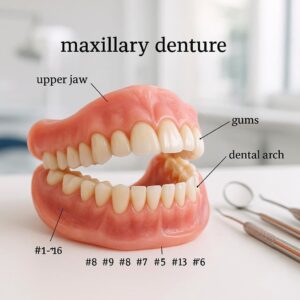
The term “maxillary” refers to the upper jaw. So, a maxillary denture is a removable dental appliance designed to replace missing teeth on the upper arch. Unlike a bridge, which is cemented onto existing teeth, or implants, which are surgically placed, a traditional denture rests on the gums.
For many people, a maxillary denture offers a life-changing improvement. It restores the ability to chew properly, supports the facial muscles to prevent that “sunken” look, and significantly improves speech and confidence.
However, getting a denture is rarely a one-step process. It usually involves several appointments, from initial impressions to the final insertion. This is why you might see more than one code on your paperwork.
The Official Dental Code for a Maxillary Denture
In the world of dental billing, the standard reference is the Current Dental Terminology (CDT) code set, published by the American Dental Association (ADA). These codes are used universally by dentists and insurance companies to standardize procedures.
For a standard, conventional maxillary denture, the code is:
D5110: Complete Denture – Maxillary
This code represents a complete, full-arch denture for the upper jaw. It covers the fabrication and placement of the denture after the teeth have been extracted and the gums have healed.
What D5110 includes:
-
Diagnostic impressions
-
Bite registrations
-
Try-in appointments (where you see the wax model)
-
The final processing of the acrylic
-
The final insertion and adjustments
It is important to note that D5110 assumes the mouth is already healed. If you are having teeth extracted and getting a denture on the same day, this is not the code you will see.
The Other Important Code: Immediate Dentures
If you currently have upper teeth that need to be removed, your dentist will likely recommend a different code. When teeth are extracted and a denture is placed immediately (on the same day), it is called an immediate denture.
The code for this is:
D5111: Complete Denture – Maxillary – Immediate
This code is distinct from D5110 because it involves a significantly different workflow. The dentist must take impressions before the teeth are removed, anticipate how the gums will heal, and create a denture that fits over the extraction sites immediately.
Why this matters for your wallet:
Immediate dentures usually cost more than conventional dentures. The process is more complex. Furthermore, you will almost always require a reline or a new permanent denture in the future. As the gums heal and shrink (which they inevitably do), the immediate denture will become loose.
Insurance companies treat these codes differently. Some will only cover D5110 (the permanent one) and consider the D5111 a temporary measure.
A Quick Reference Table: Denture Codes
To make things clearer, here is a simple breakdown of the most common codes related to upper dentures. Keep this handy when you review your treatment plan.
| CDT Code | Procedure Description | When It Is Used |
|---|---|---|
| D5110 | Complete Denture – Maxillary | Permanent denture for a healed upper arch (no teeth present or teeth removed weeks/months ago). |
| D5111 | Complete Denture – Maxillary – Immediate | Denture placed immediately following extractions on the same day. |
| D5120 | Complete Denture – Mandibular | The lower arch counterpart (not the focus of this article, but often billed together). |
| D5730 | Reline – Complete Maxillary Denture (Chairside) | Adjusting the fit of the existing denture in the office. |
| D5731 | Reline – Complete Maxillary Denture (Laboratory) | Sending the denture to a lab to refit it for better accuracy. |
| D5850 | Tissue Conditioning | A soft material placed inside a denture to heal irritated gums before a reline. |
| D6010 | Surgical Placement of Implant Body | If you are getting implant-supported dentures (overdentures), this code appears. |
What Is Not Included in the Code?
This is where many patients get caught off guard. The dental code for the denture itself (D5110 or D5111) covers the fabrication. However, it does not cover the foundation work that is often required before a denture can be made.
Here are common procedures that are billed separately:
Extractions (D7140, D7210, etc.)
If you still have teeth in your upper jaw, they must be removed. Extractions are billed per tooth or per surgical complexity. You will see a list of codes for each tooth extracted, which are separate from the denture code.
Bone Recontouring (Alveoloplasty – D7310)
After teeth are extracted, the bone ridge can be sharp or uneven. Sometimes, the dentist needs to smooth the bone to ensure the denture fits comfortably without pressure points. This is a separate procedure.
Preliminary Exams and X-Rays (D0150, D0210)
Before any work begins, you will have a comprehensive oral exam and X-rays. These diagnostic codes are usually billed separately from the denture fabrication.
Laboratory Fees
Most denture codes include the lab fee, but some practices bill it separately. Always ask if the quoted price includes the lab or if there will be an additional “lab bill.”
Important Note for Readers:
When you receive a treatment plan, do not just look at the total number. Ask your dental office to explain each code line by line. A good dental office will happily walk you through it. If they seem rushed or dismissive, that is a red flag.
How Insurance Views the Maxillary Denture Code
Understanding insurance can feel like learning a new language. Most dental insurance plans classify procedures into three categories:
-
Preventive (Cleanings, X-rays) – Covered at 80-100%
-
Basic (Fillings, Extractions) – Covered at 70-80%
-
Major (Crowns, Dentures, Bridges) – Covered at 50%
D5110 falls into the Major category.
This means your insurance will likely pay 50% of the allowable fee, not necessarily 50% of the total bill. You are responsible for the remaining 50%, plus any difference if your dentist charges more than the insurance’s allowable amount.
The “Missing Tooth Clause”
Many insurance plans have a rule called the “Missing Tooth Clause.” If a tooth was extracted before you enrolled in the current insurance plan, the insurance may refuse to pay for a denture to replace it. They argue that the condition existed before coverage began.
If you have missing teeth from years ago, check your plan’s fine print regarding this clause.
Frequency Limitations
Insurance companies usually limit how often you can get a new denture. Most plans allow one denture (per arch) every five to eight years. If you need a replacement sooner due to normal wear and tear, you will likely have to pay out of pocket unless the dentist can prove it is medically necessary.
Why Two Dentures? The Immediate vs. Conventional Process
One of the biggest sources of frustration for patients is the realization that they might need to pay for two dentures within the span of a year.
Let us look at a common scenario:
Scenario: You have upper teeth that are failing. You need them all removed.
Step 1: The Immediate Denture (D5111)
Your dentist takes impressions now. A denture is fabricated. On the day of surgery, the teeth are extracted, and the immediate denture is inserted. You walk out with teeth.
Cost: You pay for D5111.
Step 2: Healing
For the next 6 to 12 months, your gums and bone heal and shrink. The immediate denture will start to feel loose. You may need soft liners (tissue conditioning—D5850) during this period.
Step 3: The Permanent Denture (D5110)
Once healing is complete (usually after a year), the immediate denture often no longer fits properly. At this point, you need a new permanent denture (D5110) fabricated to fit your healed ridge.
Some insurance plans will cover both, but many will only cover one denture in a five-year period. If your plan only covers one, you might have to pay for the immediate denture out of pocket and have insurance cover the permanent one, or vice versa.
Quote from a dental billing specialist: “The biggest misunderstanding we see is patients thinking the immediate denture is the final product. It is a transitional appliance. We always recommend discussing the long-term timeline with your dentist so there are no financial surprises six months later.”
The Cost Range for Maxillary Dentures
Pricing varies wildly depending on where you live, the type of materials used, the dentist’s expertise, and whether a prosthodontist (a specialist in dentures and reconstruction) is involved.
Here is a realistic breakdown of what you can expect:
| Type of Denture | Average Cost (Without Insurance) |
|---|---|
| Economy/Standard Denture | $600 – $1,500 |
| Mid-Range Denture | $1,500 – $3,000 |
| Premium Denture (High-end materials, natural look) | $3,000 – $5,000+ |
| Implant-Supported Overdenture | $5,000 – $15,000+ (per arch) |
*Note: These prices are estimates for the denture code itself. Add extractions, X-rays, and relines, and the total treatment cost can easily be $3,000 to $10,000 for a full mouth rehabilitation.*
Upgrading Your Denture: Understanding Material Codes
Sometimes, the basic D5110 code covers a standard acrylic denture. However, you might want to upgrade for comfort or aesthetics. These upgrades often have their own codes or are listed as “laboratory upgrades.”
-
Premium Teeth: The standard code usually includes basic acrylic teeth. Upgrading to porcelain teeth or high-impact acrylic teeth costs extra.
-
Metal Reinforcement: Some dentures have a metal mesh inside the acrylic to prevent fracturing. This is often an add-on.
-
Flexible Partials: If you are not getting a complete denture but a partial denture (replacing only some upper teeth), the codes change (D5211, D5212), and flexible materials like Valplast have different fee structures.
Implant-Supported Maxillary Dentures
A growing trend is the use of implants to secure the upper denture. A traditional denture sits on the gums and relies on suction. An upper denture can be very stable, but some patients prefer the security of implants.
If you are getting an implant-supported denture, the codes become more complex. You will see:
-
D6010: Implant placement (times the number of implants)
-
D6110 – D6117: Codes for the implant-supported prosthesis (overdenture)
These codes are significantly more expensive but offer superior retention and help preserve the jawbone, preventing the bone loss that typically occurs under traditional dentures.
Common Coding Mistakes and How to Avoid Billing Errors
Errors in dental coding happen more often than you might think. As a patient, you are your own best advocate. Here are a few red flags to watch for:
-
Using D5110 when D5111 is appropriate: If you are getting teeth pulled and the denture placed on the same day, but the office bills D5110 (conventional), insurance may deny it because the mouth wasn’t healed. The dentist might try to bill you for the difference.
-
Unbundling: Sometimes, offices try to bill separately for steps that are included in the denture code (like “try-in” appointments or basic adjustments). Check your explanation of benefits (EOB) to see if these are being billed separately.
-
Wrong Arch: Ensure the code specifies maxillary. If you are having work on the upper jaw but the code says mandibular, it is a typo that will cause a denial.
Tips for Maximizing Your Insurance Benefits
You have paid for dental insurance. Here is how to get the most out of it for your maxillary denture.
1. Time Your Treatment
Most dental plans have an annual maximum (usually between $1,000 and $2,500). A denture often eats up that entire maximum. If you need extractions and a denture, consider starting the extractions late in the year (using this year’s benefits) and finishing the denture early the next year (using next year’s benefits).
2. Pre-Determination
Always ask your dentist to send a pre-determination (or pre-authorization) to your insurance before starting treatment. This is not a guarantee of payment, but it gives you a realistic estimate of what the insurance will pay and what you will owe. It is a free service.
3. Consider a Dental Savings Plan
If you do not have insurance, or if your insurance has a low maximum, look into dental savings plans (also called discount plans). For a yearly membership fee, you get discounted rates on major procedures like dentures (often 20-30% off the office fee). This is often better than traditional insurance for dentures, because insurance caps out so quickly.
4. Dental Schools
If budget is a major concern, accredited dental schools offer high-quality care at significantly reduced rates. The treatment takes longer because it is performed by students under the supervision of experienced professors, but the codes and procedures are the same. The cost for a D5110 at a dental school can be 50-60% less than a private practice.
What to Expect During the Process
Understanding the timeline helps you understand why the billing is structured the way it is. Here is a typical journey for a conventional maxillary denture (D5110):
-
Appointment 1: Consultation, X-rays, impressions (alginate).
-
Appointment 2: Wax rim try-in. The dentist checks jaw relation, bite, and tooth size.
-
Appointment 3: Tooth try-in. You see the teeth set in wax. You can approve the shape, color, and arrangement. This is your last chance to make changes before the final product is made.
-
Appointment 4: Insertion. The final denture is delivered. Adjustments are made.
-
Appointment 5 (and beyond): Follow-up adjustments. It is normal to need 2-4 adjustment visits after insertion to address sore spots.
Each of these steps is included in the single code (D5110). You should not be charged extra for the “try-in” steps.
Frequently Asked Questions (FAQ)
Q1: Is there a difference between the code for a maxillary denture and a complete upper denture?
No. “Maxillary” means upper jaw. “Complete” means full arch. D5110 is the standard code for a full upper denture. If you are only replacing a few teeth, you are looking at partial denture codes (D5211 or D5212).
Q2: Can I get my maxillary denture covered by medical insurance?
Rarely. Dental insurance is the primary payer for dentures. However, if the denture is required due to an accident, trauma, or as part of treatment for oral cancer, medical insurance may cover it. You would need to ask your dentist to file a medical claim, which is a different process.
Q3: What is the “adjustment” code after a denture is placed?
Most dentists include basic adjustments for the first 30 to 90 days for free as part of the insertion fee. However, if you come back a year later needing a reline, you will see codes like D5730 (Chairside Reline) or D5850 (Tissue Conditioning). These are separate from the original fabrication code.
Q4: Why does my treatment plan have two different codes for the same upper denture?
It is possible you are seeing the code for an immediate denture (D5111) and a conventional denture (D5110) listed. This is common practice to show the long-term plan: one immediate to get you through healing, and one permanent later. Ask your dentist to clarify the timeline.
Q5: If I lose my denture, will insurance pay for a replacement?
Usually, no. Dental insurance typically covers replacement due to normal wear and tear after a waiting period (5+ years). If you lose the denture or your dog chews it up, that is usually considered a patient responsibility. Some offices offer a “lost or stolen” warranty, but this is rare.
Additional Resources
For further reading and to verify the most current CDT codes directly from the source, visit the American Dental Association’s official CDT Code page. They provide the most authoritative updates on dental coding standards.
Conclusion
Understanding the dental code for a maxillary denture—specifically D5110 for conventional dentures and D5111 for immediate dentures—is crucial for navigating your dental treatment with confidence. These codes dictate not only what procedure you receive but also how your insurance applies benefits and how your final bill is calculated. By familiarizing yourself with these codes, associated costs, and the insurance nuances, you can avoid unexpected fees and collaborate more effectively with your dental team to achieve a healthy, functional smile.