Decoding D4381: The Complete Guide to the ADA Dental Code for Arestin
If you have recently visited a periodontist or a general dentist for a deep cleaning, you might have glanced at your treatment plan and felt a bit lost. Among the familiar terms like “scaling and root planing,” you likely saw a code that looked more like a secret agent than a dental procedure: D4381.
This code is the official American Dental Association (ADA) code for the localized delivery of antimicrobial agents—specifically, a product many patients know as Arestin.
Understanding what this code means, why it appears on your bill, and whether it is truly necessary can feel overwhelming. You are not alone. Most patients only become familiar with dental coding when they are staring at an estimate from their insurance company.
This article is designed to be your complete guide. We will break down everything you need to know about the ADA dental code for Arestin, from the science behind the treatment to the practical realities of insurance coverage. By the end, you will feel confident and informed about your periodontal health decisions.
What is Arestin? A Quick Overview
Before we dive into the code itself, it is helpful to understand what Arestin actually is. Arestin is a brand-name, FDA-approved antibiotic treatment used to fight periodontal (gum) disease.
Unlike a pill you swallow, Arestin is a powder form of the antibiotic minocycline hydrochloride. It is placed directly into the infected gum pockets—the small spaces between your teeth and gums that have become diseased.
Think of it like this. Scaling and root planing (the deep cleaning) is the process of removing the heavy tartar and bacteria from the tooth root. However, after that cleaning, there are often deep pockets where bacteria can quickly return. Arestin acts as a targeted “insurance policy” against that recurrence. The powder solidifies upon contact with moisture, releasing antibiotics slowly over time to kill the bacteria that cause inflammation and bone loss.
Why a Code Matters
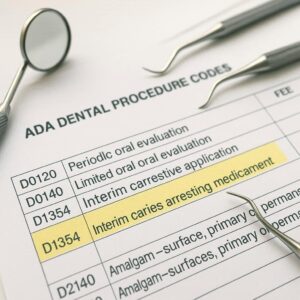
In the world of dentistry, codes are everything. They are the language used to communicate with insurance companies. The ADA dental code for Arestin is officially listed as D4381. This code stands for: “Localized delivery of antimicrobial agents via a controlled release vehicle into diseased crevicular tissue, per tooth.”
In simpler terms, it means: “We are placing a specific, time-released antibiotic into the infected area around one tooth.”
The Anatomy of Code D4381
To truly understand this procedure, we need to dissect the code itself. The ADA does not simply create codes for fun. Each code is meticulously defined to ensure that dentists, insurance adjusters, and patients are all on the same page.
What D4381 Includes
When a dentist bills using D4381, they are certifying that they have performed a very specific set of actions:
-
Localized Delivery: The treatment is focused on a specific area. It is not a full-mouth treatment.
-
Antimicrobial Agent: A substance designed to kill bacteria is being used.
-
Controlled Release Vehicle: The medication is designed to stay in place and release medicine over a period of time (usually 14 to 21 days).
-
Per Tooth: The code is applied on a per-tooth, per-site basis. If you have treatment on three teeth, the code will appear three times on your claim form.
D4381 vs. Scaling and Root Planing (D4341/D4342)
One of the biggest points of confusion for patients is the relationship between the deep cleaning code and the Arestin code.
-
Scaling and Root Planing (SRP): This is the foundational treatment. Coded as D4341 (four or more teeth per quadrant) or D4342 (one to three teeth per quadrant), this procedure physically removes the calculus and biofilm from the root surfaces.
-
D4381 (Arestin): This is an adjunctive procedure. This means it is an addition to the SRP. It is not a replacement.
Think of it like landscaping. SRP is pulling out the weeds and tilling the soil. D4381 is laying down a specialized weed killer to ensure the weeds do not grow back immediately. Both serve important but different roles.
When is Arestin (D4381) Actually Necessary?
No one wants to undergo a procedure they do not need. A responsible dentist will only recommend D4381 when there is clear clinical evidence that the benefit outweighs the cost.
Here are the specific scenarios where this code is most commonly and appropriately used.
1. Persistent Deep Periodontal Pockets
After a dentist performs a comprehensive periodontal evaluation (using a probe to measure the depth of the gum pockets), they look for depths of 5 millimeters or more. These pockets are generally too deep for a patient to clean effectively with a toothbrush and floss. They are also prone to harboring anaerobic bacteria (bacteria that thrive without oxygen). When these pockets remain inflamed even after the initial scaling, Arestin is often recommended to target the bacteria hiding deep within.
2. Sites with Bleeding on Probing (BOP)
A pocket that bleeds when gently probed is a sign of active infection. Bleeding indicates that the body’s immune system is fighting bacteria. Even if a pocket is only 4 millimeters, if it bleeds persistently, it may be a candidate for localized antimicrobial therapy. The goal is to resolve the infection before it leads to further bone loss.
3. Recurrent Periodontitis
Some patients respond well to traditional scaling and root planing. Others, due to genetics, smoking, or systemic health issues like diabetes, may see a recurrence of bacteria in the same spots. In these cases, a dentist may use D4381 to “spot treat” these recurring problem areas without having to repeat the full deep cleaning immediately.
4. Strategic Teeth
If a tooth is a critical part of a future bridge or an implant, saving that tooth is a top priority. Dentists are often more aggressive in treating pockets around “strategic” teeth to ensure long-term stability.
The Patient Experience: What to Expect
Knowing what happens during the procedure can alleviate a lot of anxiety. The process is straightforward and usually takes only a few minutes after your deep cleaning.
Step 1: The Deep Cleaning
Your dentist or dental hygienist performs the scaling and root planing. They numb the area to ensure comfort while they remove the tartar.
Step 2: Evaluation
After the root surfaces are smooth, the clinician checks the pocket again to ensure it is accessible for the Arestin.
Step 3: Placement
The Arestin powder is loaded into a small, blunt-tipped applicator. The clinician gently inserts the tip into the gum pocket and delivers the powder. It looks a bit like a small orange or yellow powder.
Step 4: Hydration
The powder immediately mixes with the gingival crevicular fluid (the fluid in the gum pocket) and solidifies. It forms a solid, waxy mass that adheres to the pocket wall.
Step 5: Post-Operative Instructions
This is crucial. You will be given specific instructions:
-
Do not floss or use a Waterpik in that area for 10 days. You do not want to dislodge the medication.
-
Avoid sticky or hard foods on that side of the mouth.
-
Wait 12 hours before brushing the area, and then brush very gently.
Insurance Coverage: The Reality of D4381
This is where the conversation often gets complicated. Insurance coverage for D4381 is notoriously inconsistent.
Because D4381 is classified as an adjunctive procedure, many dental insurance plans view it as “above and beyond” the standard of care, even though periodontists consider it a standard part of therapy for moderate to severe cases.
Coverage Scenarios
| Insurance Type | Typical Coverage for D4381 | Notes |
|---|---|---|
| Traditional PPO | Often covered at 50% – 80% | Usually requires that SRP (D4341) is performed on the same tooth on the same day. Often subject to a separate “periodontal” deductible. |
| DHMO (Capitation) | Rarely covered | These plans often pay a set fee per patient. D4381 is frequently a “non-covered service,” meaning the patient pays the full fee. |
| Medicaid (State Dependent) | Variable | Some states cover D4381 for specific high-risk populations (e.g., diabetics, pregnant women). Others do not cover it at all. |
| Medicare Advantage | Often denied | Original Medicare does not cover dental procedures. Some Medicare Advantage plans have dental riders, but coverage for D4381 is limited. |
Important Note on Frequency
Insurance companies are also strict about how often this code can be used. Most plans have a frequency limitation, such as:
-
Once per tooth per 24 months.
-
Once per site per 36 months.
If your dentist recommends Arestin on the same tooth within that timeframe, your insurance will likely deny the claim, arguing that it is too soon for re-treatment.
Comparative Analysis: Arestin vs. Other Periodontal Treatments
D4381 is not the only code used to manage gum disease. It is important to see how it fits into the larger picture of periodontal therapy. This table outlines the differences between common treatment codes.
| ADA Code | Procedure Name | What It Does | Average Time | Best Used For |
|---|---|---|---|---|
| D4341 | Scaling and Root Planing (4+ teeth/quad) | Mechanical debridement of root surfaces. | 45-60 min per quad | Moderate to severe generalized periodontitis. |
| D4381 | Localized Antimicrobial Delivery | Places antibiotic powder in pocket. | 5-10 min per site | Persistent deep pockets (5mm+) with bleeding. |
| D4266 | Guided Tissue Regeneration (GTR) | Surgical procedure to regenerate lost bone and tissue. | 60-90 min | Severe bone loss; requires flap surgery. |
| D4910 | Periodontal Maintenance | Post-treatment cleaning to prevent recurrence. | 30-45 min | Patients with history of periodontitis. |
As you can see, D4381 sits in the middle. It is more aggressive than a regular cleaning but far less invasive than surgery. For many patients, it is the “goldilocks” solution—just the right amount of intervention to avoid going under the knife.
Common Questions Patients Ask About D4381
When patients see this code on their treatment plan, they usually have a flood of questions. Let’s address the most frequent concerns.
“Is this just a way for the dentist to make more money?”
This is a fair question. Dental care is expensive. However, it is important to understand the cost-benefit analysis from a clinical perspective. A single application of Arestin costs significantly less than a surgical procedure. If the antibiotic can reduce pocket depths to a maintainable level (4mm or less), it saves you the cost and recovery time of surgery down the road. While it does represent an added expense to the deep cleaning, it is often viewed as a cost-effective alternative to more invasive surgery.
“Does it hurt?”
Generally, no. The procedure is performed after scaling and root planing, so the area is usually still numb from the local anesthetic used for the deep cleaning. You might feel pressure as the applicator is inserted, but it is not typically painful. After the anesthetic wears off, you might have mild tenderness in the gum, similar to the soreness you feel after a deep cleaning.
“What if it falls out?”
The material is designed to stay in place, but it can sometimes dislodge. If you notice a small, solid piece of yellow or orange material in your mouth within the first 24 hours, it is likely the Arestin. If this happens, call your dentist. They will usually not reapply it for free, but they will want to know so they can monitor the pocket. The risk of dislodgement is why you are instructed to avoid flossing and sticky foods.
“Is there a generic version?”
Currently, Arestin is the only FDA-approved minocycline hydrochloride powder for this specific use in the United States. There are other antimicrobial agents (like PerioChip, which contains chlorhexidine), but they have a different ADA code (D4382). If your dentist uses Arestin, they will use D4381. If they use a different product, the code may differ.
Maximizing Insurance Benefits for D4381
Navigating the insurance maze requires strategy. If your dentist has recommended treatment involving D4381, here are some steps to ensure you maximize your benefits.
1. Verify Coverage Before Treatment
Do not rely on a front-desk estimate alone. Ask your dentist’s office to submit a pre-determination of benefits (also called a pre-authorization) to your insurance company. This is not a guarantee of payment, but it gives you a written estimate of what the insurance company says they will pay. It takes 2-4 weeks, but it prevents surprise bills.
2. Understand Your Plan’s “Missing Tooth Clause”
Some insurance plans have a “missing tooth clause.” If a tooth is missing, they may refuse to pay for periodontal treatment on adjacent teeth, arguing that the tooth is not necessary. If you are treating teeth next to a missing tooth, be aware of this potential pitfall.
3. Check for Coordination of Benefits
If you have dental insurance through two different plans (e.g., yours and a spouse’s), ensure the dentist’s office bills the primary insurance first. The secondary insurance may pick up the remaining portion of the D4381 fee, significantly reducing your out-of-pocket cost.
4. Medical Insurance Cross-Coding
In rare cases, if the periodontitis is linked to a systemic medical condition (like uncontrolled diabetes or a pre-surgical clearance for heart valve replacement), it may be possible to bill D4381 to medical insurance. This is complex and not accepted by all medical insurers, but it is worth asking your dentist if you have a qualifying medical history.
The Science: Why Localized Delivery Works
To appreciate the value of D4381, it helps to understand a bit of the microbiology behind gum disease. Periodontitis is not caused by a single germ but by a complex biofilm of bacteria.
When a dentist performs scaling and root planing, they are physically disrupting this biofilm. However, research shows that in pockets deeper than 5mm, mechanical debridement alone often fails to eliminate specific aggressive bacteria, such as Aggregatibacter actinomycetemcomitans and Porphyromonas gingivalis.
Arestin (Minocycline)
Minocycline is a tetracycline-class antibiotic. It works by inhibiting protein synthesis in bacteria, effectively starving them. Because it is delivered locally:
-
High Concentration: The concentration of the antibiotic at the site of infection is thousands of times higher than what could be safely achieved with an oral pill.
-
Low Systemic Absorption: Because it stays in the pocket, very little enters your bloodstream. This avoids the side effects often associated with oral antibiotics, such as digestive upset or yeast infections.
-
Biofilm Penetration: The controlled release allows the antibiotic to penetrate the biofilm matrix, killing bacteria that were protected from the mechanical cleaning.
Long-Term Outcomes
Studies cited by the American Academy of Periodontology indicate that scaling and root planing combined with localized antimicrobial therapy (D4381) results in significantly greater pocket depth reduction and clinical attachment gain compared to scaling and root planing alone.
In practical terms, this means that using D4381 increases the odds that your gums will heal to a healthy, maintainable state without requiring surgical intervention.
Red Flags and Realistic Expectations
While D4381 is a powerful tool, it is not magic. Setting realistic expectations is key to being satisfied with your treatment.
When it works best:
-
In shallow to moderately deep pockets (5mm to 7mm).
-
In patients who do not smoke (smoking significantly reduces healing potential).
-
In patients who commit to excellent home care afterward.
When it may fail:
-
Smoking: Tobacco use severely impairs blood flow to the gums. Arestin relies on the body’s healing response. If you smoke, the success rate drops dramatically.
-
Anatomy: If a tooth has a deep furcation involvement (a hole where the roots split), the Arestin powder may not be able to reach all the way into the crevice.
-
Systemic Disease: Uncontrolled diabetes or immune disorders can hinder the body’s ability to respond to the antibiotic.
If your dentist recommends D4381, ask them: “Based on my specific pocket depths and health history, what is the likelihood of success?” A transparent answer will help you decide whether to proceed.
Documentation: Why Your Dentist Needs to Be Precise
For D4381 to be paid by insurance or justified in your records, the dentist must have excellent documentation. If you ever feel like your claim was denied unfairly, understanding what the dentist should have recorded can help you appeal.
The required documentation for D4381 includes:
-
Pre-treatment probing depths: Showing pockets of at least 5mm.
-
Bleeding index: Indicating active infection (BOP).
-
Tooth numbers: Specific teeth treated.
-
SRP correlation: Proof that scaling and root planing was performed on the same teeth on the same date of service (or within a very short window).
-
Radiographs: X-rays showing bone loss consistent with periodontitis.
If any of these elements are missing, an insurance adjuster may deny the claim, labeling the treatment as “not medically necessary.”
The Future of Periodontal Coding
The ADA updates its Code on Dental Procedures and Nomenclature (the CDT Code) annually. While D4381 has been a stable code for years, the conversation around it is evolving.
There is increasing discussion in the dental community about “value-based care.” Instead of paying per procedure (like D4381), future models may pay based on outcomes (healthy gums). However, for the foreseeable future, D4381 remains the standard code for this specific treatment.
Additionally, with the rise of laser therapy (LANAP) and other technologies, dentists are combining modalities. You might see a treatment plan that includes D4341 (SRP), D4381 (Arestin), and D4999 (unspecified periodontal procedure) for laser decontamination. If you see a code like D4999, ask for a detailed explanation, as it is a catch-all code that insurance companies often scrutinize heavily.
Practical Tips for Discussing D4381 with Your Dentist
Effective communication with your dental team can save you money and confusion. Here is how to approach the conversation.
-
Ask for a printed estimate: Request a breakdown that lists the tooth numbers for the D4381. Verify that the number of units matches the number of teeth being treated.
-
Inquire about a cash discount: If your insurance does not cover D4381, ask if the office offers a discount for paying in full on the day of service. Many offices offer 5-10% off for cash/credit payments, as it saves them the administrative cost of billing insurance.
-
Discuss the payment plan: If the cost is prohibitive, ask about third-party financing like CareCredit or in-house payment plans. Do not skip necessary treatment due to cost without exploring financing options. Untreated periodontitis leads to tooth loss, which is far more expensive to replace (implants cost thousands per tooth) than it is to treat.
A Note on Ethics and Over-Treatment
Unfortunately, in any medical field, there is a risk of over-treatment. Because D4381 is a revenue-generating procedure, it is theoretically possible for an unethical provider to recommend it when it is not clinically indicated.
How can you protect yourself?
-
Seek a second opinion: If you are diagnosed with periodontitis and a treatment plan includes Arestin on 10+ teeth, it is wise to see a periodontist (a gum specialist) for a second opinion. Periodontists are often more conservative with antibiotics because they deal with severe cases daily.
-
Look for red flags: Be cautious if a dentist recommends Arestin on teeth that have not had recent (within 6 months) full-mouth probing depths recorded, or if they recommend it on teeth that are only 3-4mm deep with no bleeding.
-
Trust, but verify: A good dentist will show you your probing depths on a chart, point to the bleeding sites, and explain why those specific teeth need the antibiotic. If they cannot explain it clearly, ask more questions.
Conclusion: Making an Informed Decision
Understanding the ADA dental code for Arestin—D4381 empowers you to take control of your periodontal health. This code represents a targeted, scientifically backed approach to managing the stubborn bacteria that cause gum disease. While it adds a cost to the standard deep cleaning, it offers a significant opportunity to avoid more invasive and expensive surgical procedures in the future.
By knowing when it is necessary, how insurance views it, and what questions to ask, you transform from a passive patient into an active partner in your dental care. Periodontal disease is a chronic condition, much like high blood pressure or diabetes. Managing it requires a partnership between you and your dental team, and D4381 is one of the most effective tools in that management arsenal.
Frequently Asked Questions (FAQ)
1. Is the ADA dental code D4381 the same as Arestin?
Yes, in the United States, D4381 is the specific Current Dental Terminology (CDT) code used to bill for the placement of Arestin (minocycline hydrochloride) and similar localized antimicrobials. If you see D4381 on your bill, it is for this type of antibiotic treatment.
2. Will my insurance pay for D4381 if I already paid for my deep cleaning?
Generally, yes, but it depends on your specific plan. Most insurers require that the scaling and root planing (D4341 or D4342) be performed on the same tooth on the same day to consider D4381 a covered adjunctive service. It is always best to verify your coverage before the procedure.
3. How long does the Arestin last after it is placed?
The controlled-release mechanism of Arestin typically lasts for 14 to 21 days. During this time, it continuously releases the antibiotic to fight bacteria. This is why you are advised to avoid flossing that area for at least 10 days to prevent dislodging the material.
4. Can I get Arestin without having a deep cleaning?
No. D4381 is classified as an adjunctive treatment. It is intended to be used in addition to scaling and root planing (mechanical debridement). Using the antibiotic without mechanically removing the tartar (calculus) is considered ineffective and not the standard of care.
5. What happens if the Arestin falls out?
If the material falls out within the first 24-48 hours, the effectiveness of the treatment is compromised. Contact your dental office. While policies vary, some dentists may reapply the material at a reduced fee, but it is not typically guaranteed due to the risk of patient dislodgement (e.g., eating hard food). Following post-op instructions is crucial to prevent this.
Additional Resource
For further reading on periodontal disease and treatment standards, the American Academy of Periodontology (AAP) offers a wealth of patient education materials. Their “Gum Disease” section provides insights into the latest research, risk factors, and guidelines for care.
Link to American Academy of Periodontology Patient Resources